Voice of Customer Programs: A Social-First Guide
"Learn how voice of customer programs transform social and community signals into actionable insights for faster support and stronger retention."
At 2 PM on a Tuesday, your product goes down. Within minutes, replies on X turn into billing complaints, Discord fills with screenshots, and a community moderator flags a wave of scam links using your brand name. Your official support queue is busy, but it isn't where the incident is moving fastest. The customer story is scattered across public posts, private messages, voice threads, and forum comments.
That's the operating reality for social care and customer support teams. A voice of customer program that only surveys customers after an interaction will miss the urgency, context, and language customers use when something breaks. Modern VoC programs need to capture what people say voluntarily, understand what it means, route it to an owner, and show whether anyone acted.
Table of Contents
- The Real-Time Feedback Crisis
- Core Components of Modern VoC Programs
- Closed-Loop Systems and Operational Metrics
- From Surveys to Social Signals
- Driving Business Outcomes with VoC
- Implementation Roadmap and Next Steps
The Real-Time Feedback Crisis
The first problem during an outage isn't a lack of feedback. It's too much feedback arriving through disconnected channels.
On X, customers may post short, angry updates that mention a symptom but not an account number. In Discord, they may explain the exact sequence that caused the failure, using product shorthand your survey taxonomy doesn't recognize. On Instagram, a billing complaint might sit beneath an unrelated post. In a forum, a long thread may contain the clearest reproduction steps, while a TikTok comment reveals that the issue is spreading to a new customer segment.
A traditional VoC workflow often catches none of this quickly. It sends a post-interaction survey, waits for a response, aggregates scores, and reviews trends after the immediate problem has passed. Surveys still have a role, especially for structured loyalty, satisfaction, and effort measurement. They're useful when you need a consistent question across a defined audience. They're weak as the sole listening mechanism during a fast-moving incident.

Why surveys leave operational blind spots
One analysis estimates that 80% to 90% of customer feedback is unstructured, while 96% of VoC and CX measurement professionals still regularly collect and analyze surveys. The contrast points to a practical gap, not a reason to abandon surveys. Teams are often measuring the channel that is easiest to report on rather than the channel where customers express themselves most freely. The Canvs analysis of VoC trends also describes surveys as holding a 24.83% share in 2025, while in-app behavior and feedback are projected to grow at a 21.34% CAGR through 2031.
Social and community signals add the missing context. They show what happened, where it happened, how customers describe it to one another, and whether the issue is becoming a reputational risk. They also expose silent friction, such as repeated failed attempts to complete a task, before a customer ever agrees to answer a survey.
Operational rule: During a live incident, the fastest useful signal is often the customer's own language, not the score they might provide later.
The answer isn't to replace every survey with a social listening dashboard. A dashboard that produces another stream of alerts just moves the overload somewhere else. The useful design is an always-on feedback system that filters spam and duplicate posts, detects intent, identifies urgency, and creates a clear path to resolution.
That path matters because social feedback is only valuable when someone can act on it. A billing complaint needs finance or support. A reproducible product defect belongs with engineering. A coordinated scam wave may require trust and safety. A credible allegation spreading through mentions may need communications involved before a frontline agent drafts a response.
Core Components of Modern VoC Programs
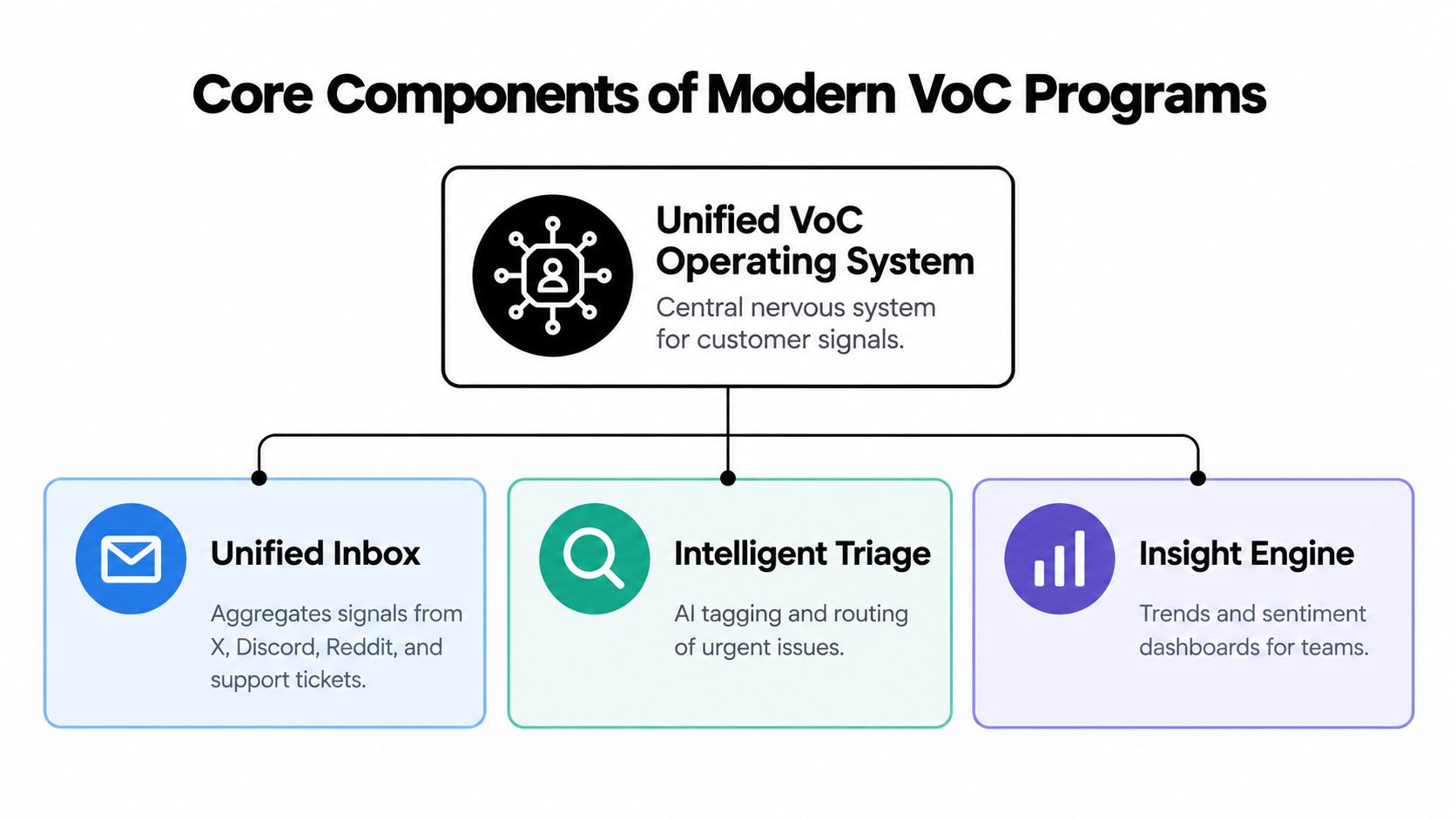
A mature voice of customer program behaves less like a survey repository and more like an operating system for customer signals. It combines collection, interpretation, routing, and measurement in one workflow so the team doesn't have to reconstruct the customer journey across separate tabs.
One inbox for many forms of customer speech
Start with a unified inbox that brings together X, Instagram, TikTok, Discord, Telegram, WhatsApp, forums, and support records. The point isn't merely convenience. A shared workspace lets reviewers see whether a single complaint is isolated, repeated across channels, or connected to an incident already owned by another team.
The inbox should preserve useful context, including the original post, replies, attachments, language, account history where permitted, and related conversations. Without that context, agents spend their time searching instead of helping. They may also send contradictory answers because support, community, and communications teams are working from different versions of the story.
Triage that understands intent
Keyword matching can find “charged,” “refund,” or “down.” It can't reliably distinguish a genuine billing complaint from a joke, a scam, a feature request, or a news article mentioning your company. AI-assisted triage should classify intent, urgency, sentiment, language, and likely ownership, then give a human reviewer enough evidence to accept or change the label.
Useful tags reflect real work:
- Billing and account issues: Route payment failures, duplicate charges, and cancellation requests to support or finance.
- Product defects and feature requests: Send reproduction details and recurring requests to product or engineering.
- Reputation and crisis risk: Escalate allegations, outage narratives, and high-reach complaints to communications.
- Spam, scams, and abuse: Separate malicious campaigns from ordinary negative sentiment and route them to trust and safety.
Noise filtering is just as important as issue detection. Duplicate outage posts, bot replies, promotional spam, and scam links can bury the one message that contains the evidence your engineers need. Filtering reduces reviewer fatigue, but it shouldn't hide uncertainty. High-risk or ambiguous items need a visible human review queue.
Analytics that explains movement
A score tells you that something changed. Conversation analysis helps explain why. Effective VoC analytics combines surveys, support transcripts, reviews, social posts, and behavioral signals with topic modeling, sentiment analysis, intent detection, and driver analysis. Qualtrics' guide to VoC analytics describes this approach as a way to connect themes with changes in loyalty or satisfaction and validate whether a fix produced the expected result.
The insight layer should answer operational questions, not just display sentiment. Which issue is generating repeat contacts? Which feature request appears across languages? Which outage theme is accelerating? Which owners are closing issues quickly, and which queues are aging?
Closed-Loop Systems and Operational Metrics
Listening without follow-through creates a more refined form of neglect. Customers see that a brand noticed their complaint, tagged it, and placed it in a dashboard, but nobody fixed the underlying issue or explained what would happen next.
A closed-loop VoC system connects four actions: capture the signal, assign an owner, resolve or respond, and record the outcome. The loop can end with a direct customer reply, an internal product fix, a policy change, a communications update, or a documented reason no action was taken. What matters is that the decision is visible and auditable.
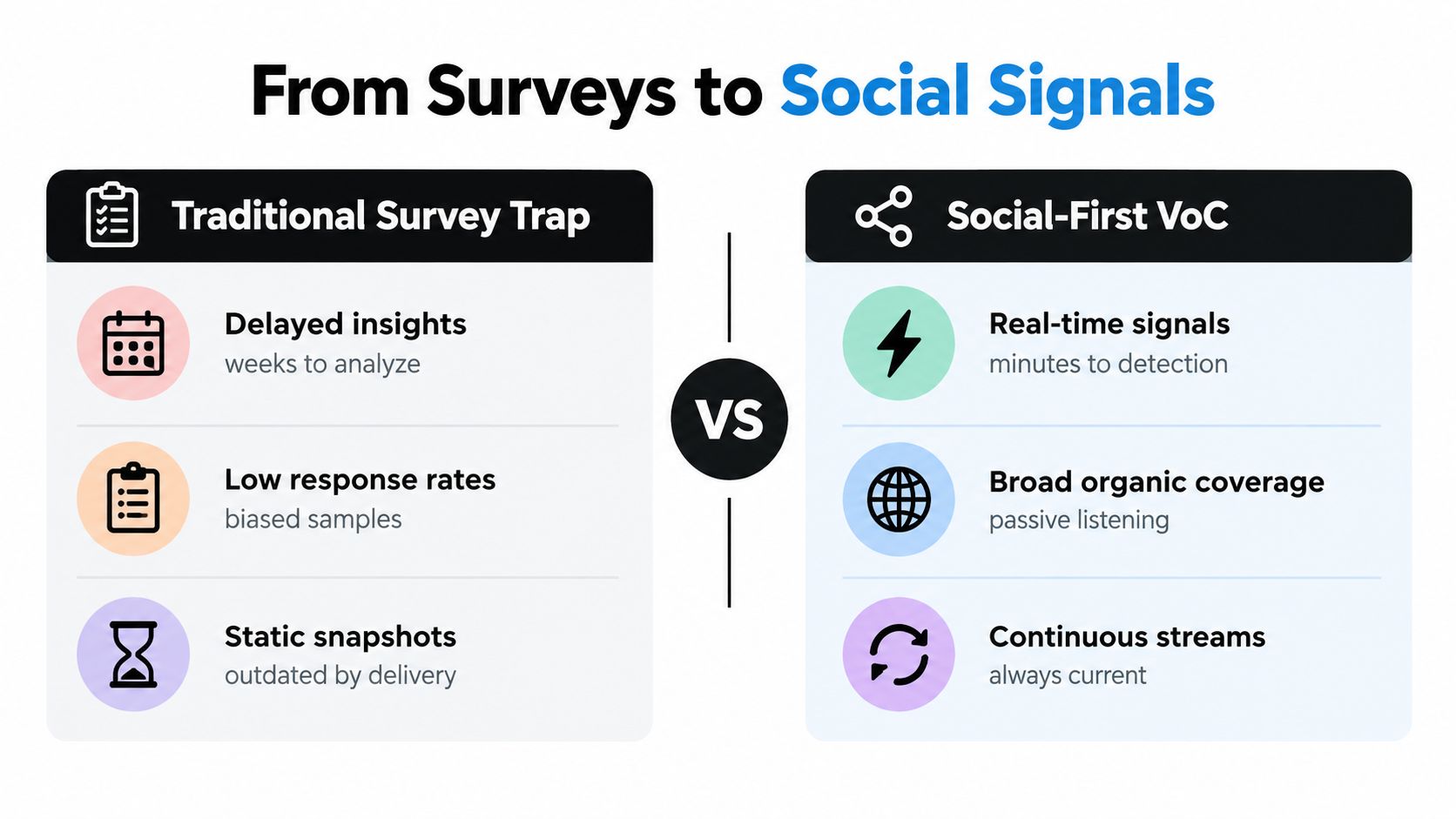
Traditional survey-led VoC and social-first VoC differ in the operating clock:
| Survey-led approach | Social-first approach |
|---|---|
| Measures loyalty, satisfaction, or effort at planned touchpoints | Detects unsolicited issues as customers discuss them |
| Produces structured scores that are easy to benchmark | Produces unstructured context that requires classification |
| Often routes results to a CX or research team | Routes signals directly to support, finance, engineering, comms, or trust and safety |
| Favors periodic review | Requires continuous triage and incident ownership |
| Can show how customers feel | Can show what is happening right now and why |
Neither side is sufficient alone. NPS measures loyalty, CSAT measures satisfaction with a specific interaction, and CES measures how easy it was to complete a task. Those metrics shouldn't be treated as interchangeable. The six useful VoC benchmarks include NPS, CSAT, CES, response rate, coverage, and closing-the-loop rate. Contentsquare's VoC guide explains the distinction between these measures and why program health depends on more than sentiment.
Metrics that expose routing failure
Track the operational measures that tell you whether feedback is moving:
- First response time: How long a customer waits for an initial acknowledgment.
- Resolution time: How long it takes to provide a solution or a clear next step.
- Repeat contact rate: Whether customers must return because the first answer failed.
- Closed-loop completion: The share of flagged issues that receive a documented response or action.
- Coverage: Whether the program captures enough of the relevant customer journey and channels.
- Response rate: Whether solicited feedback is reaching and engaging the intended audience.
Practical guidance commonly sets email survey response targets around 20% to 30%, interaction coverage at 80% or more, and acknowledgment plus action on high-priority signals within 24 to 48 hours. Monday.com's VoC guidance connects these benchmarks to signal quality and downstream outcomes such as churn and retention.
For social care, the outer limit is often even clearer. One VoC benchmark recommends closing the loop with all customers within 48 hours at maximum. CustomerGauge's closed-loop guidance makes the operational implication plain: tagging is not closure. A high-priority complaint needs an owner, a response, and a recorded next step.
From Surveys to Social Signals
The survey trap starts with good intentions. A team wants clean data, so it asks customers a controlled question at a controlled moment. Over time, the program becomes optimized for completion rates and tidy charts, while the most revealing customer language remains outside the system.
A social-first VoC program doesn't throw away structured research. It gives unsolicited feedback a primary place in the operating model and uses surveys to validate patterns, measure specific interactions, and track loyalty over time.
Build the listening layer first
Begin by listing every place customers can speak, including public mentions, replies, DMs, community threads, reviews, support tickets, and product feedback. Mark which sources are solicited, which are organic, and which contain attachments or conversation history. This map usually reveals duplicate monitoring, unowned channels, and important spaces nobody is measuring.
Next, define a small intent taxonomy based on actual workflows. Use labels such as billing, outage, cancellation, feature request, bug, scam, praise, and PR risk only if each label has an owner and a next action. A taxonomy with no routing rule is decorative metadata.
Teach the system customer language
Social feedback contains slang, sarcasm, abbreviations, code-switching, screenshots, memes, and incomplete sentences. A message saying “love paying twice for one order” may be sarcastic, while “it's cooked again” may be an outage report in a community where that phrase is normal. Review examples from each major language and community before trusting automated classification.
Set confidence thresholds and escalation rules. Let AI group duplicates, identify routine intent, and draft low-risk responses. Require human approval for refunds, safety issues, legal allegations, crisis messaging, account-specific decisions, and anything that could expose private information.
A practical workflow looks like this:
- Capture: Ingest conversations from every relevant social and community channel.
- Enrich: Add language, sentiment, intent, urgency, conversation history, and duplicate relationships.
- Route: Assign the item to the team that can resolve it, not just the team that first sees it.
- Respond: Use a draft that follows brand voice, then let a reviewer approve or edit it.
- Learn: Record the outcome and feed confirmed labels back into reporting and triage.
The goal isn't to automate customer judgment. It's to reserve human judgment for the conversations where it matters most.
Use content operations as part of the same loop. Clear, useful posts can prevent repeat questions during incidents, while better community explanations can reduce confusion before customers contact support. Teams building that discipline may also find mastering content creation for engagement useful when turning recurring customer questions into content people can actually use.
Driving Business Outcomes with VoC
The business case for VoC isn't that executives should admire a sentiment dashboard. It's that customer signals should change decisions before avoidable friction becomes churn, operational cost, or public risk.
Suppose a feature request appears in DMs, a forum, and replies to a product announcement. A social-first workflow can consolidate those conversations, identify the common need, and give product managers evidence beyond a handful of survey answers. Engineering can receive the original language and reproduction details, while support gets an approved explanation for customers waiting on the fix.
The same routing logic applies outside product:
- Finance: Duplicate charges, payment failures, refund disputes, and subscription cancellation patterns.
- Engineering: Error reports, broken flows, device-specific issues, and repeated workarounds.
- Communications: Outage narratives, allegations, executive mentions, and emerging PR risks.
- Trust and safety: Impersonation, phishing, scam waves, harassment, and coordinated abuse.
- Marketing and community: Repeated questions, education gaps, advocacy opportunities, and useful customer language.
Why speed affects more than support
A slow answer creates repeat contacts. Repeated contacts inflate queues, increase agent workload, and make customers repeat the same story across channels. A fast but inaccurate answer creates a different cost, especially when an agent promises a refund they can't authorize or gives an outage estimate that communications hasn't approved.
Orchestration handles that trade-off. AI can filter noise, cluster similar conversations, identify likely intent, and draft a response in the configured brand voice. A human still decides whether the response is accurate, appropriate, and safe to publish. That division reduces manual triage without pretending that every decision can be automated.
VoC programs also expose process defects that teams often misclassify as agent performance problems. If customers repeatedly ask finance for information that only support can access, the routing model is broken. If agents answer a known outage question individually for hours, the organization needs a coordinated status message. If feature requests disappear after tagging, product lacks a feedback intake that connects themes to prioritization.
Connect themes to outcomes
A mature program tracks three measurement layers: customer metrics such as NPS, CSAT, and CES; behavioral signals such as repeat purchase, churn, and support contact frequency; and qualitative evidence that explains the reasons behind the movement. It should also track input quality, including response rate, representativeness, and the share of feedback that is coded and usable. Conveo's VoC metrics framework defines closed-loop rate as the share of flagged issues receiving a documented response or action, which makes it a useful bridge between listening and execution.
The strategic payoff comes from connecting a theme to a decision and then checking what changed. A billing workflow fix should affect repeat contacts. A product fix should reduce the related complaint theme. A communications intervention should clarify the customer narrative. If the dashboard only shows sentiment, it can't prove whether the operation improved.
Implementation Roadmap and Next Steps
A reliable VoC program starts with ownership, not software. Decide which customer problems you need to detect, which teams can act on them, and how quickly each class of issue needs a response. Then choose technology that supports those decisions rather than forcing every signal into the same queue.
Four practical moves
Audit current channels. Catalog X, Instagram, TikTok, Discord, Telegram, WhatsApp, forums, reviews, DMs, and support records. Note who monitors each source and where conversations are lost.
Build the pipeline. Connect the relevant APIs and define intent tags, routing rules, escalation paths, and permissions. Start with the workflows that create the most repeat contacts or incident risk.
Add human oversight. Assign reviewers for high-severity issues, multilingual edge cases, sensitive account requests, crisis communications, and uncertain classifications. Full automation is a liability when nobody owns the exceptions.
Measure and iterate. Track first response time, resolution time, repeat contact rate, coverage, and closed-loop completion. Review false positives and missed escalations with the teams receiving the work.
The common failure is launching a large listening program before the organization can respond. More channels won't help if finance, engineering, support, and communications disagree about ownership. Start with a focused pilot around one incident type, such as billing complaints or outage escalation, and expand after the routing and review process works under pressure.
Sift AI offers a unified inbox for social and community conversations, AI-assisted filtering and intent tagging, routing to teams such as support, finance, engineering, and communications, drafted responses, and analytics for themes, sentiment, and operational outcomes. Those capabilities fit a VoC model in which AI handles volume while people approve responses, make judgment calls, and own resolution.
Bring social and community feedback into one operating workflow with Sift AI, so urgent customer issues can reach the right owners without getting buried in noise. Visit Sift AI to see how unified triage, human review, and VoC analytics can help your team respond at social speed.