Voice of Customer Examples: 8 Channel Playbooks for 2026
"Voice of Customer Examples from X, Instagram, TikTok, Discord, Telegram, Reddit, and outage surges, with intent tags, routing rules, and team actions."
Most social care teams already have a rich voice of the customer program. It's sitting in X replies, Instagram DMs, TikTok comments, Discord threads, WhatsApp chats, Reddit posts, and outage chatter. The problem is that useful feedback arrives beside memes, spam, scams, sarcasm, and off-topic conversation. A double charge can sit unanswered while an agent works through noise, a valuable feature request can disappear inside a comment thread, and a genuine outage signal can look like ordinary frustration.
These voice of customer examples show how to turn each stream into an operating workflow. Every example pairs a realistic customer message with an intent and urgency read, a tag and routing rule, and the action a team should take. The focus is practical triage: separate account-specific problems from general sentiment, route billing issues to finance, technical problems to engineering, reputation risks to comms, and scams to trust and safety.
Sift AI's unified inbox supports the tagging and routing described here across social channels and communities. Humans still approve replies, decide escalation, and own decisions involving money, security, safety, or sensitive claims.
Table of Contents
- 1. Billing Complaints in X Replies and Quote Posts
- 2. Instagram DMs and Comment Threads Containing Feature Requests
- 3. TikTok Comments and Duets Reacting to Brand Videos
- 4. Discord Feedback and Bug-Report Channels
- 5. Telegram and WhatsApp Business Chats for Multilingual Support
- 6. Reddit Threads and Subreddit Megathreads
- 7. Outage Surge Mentions Across Public Platforms
- 8. Impersonation and Scam Replies in Comments and DMs
- 8-Channel Voice of Customer Comparison
- Turning Each Example Into a Routed Action
1. Billing Complaints in X Replies and Quote Posts
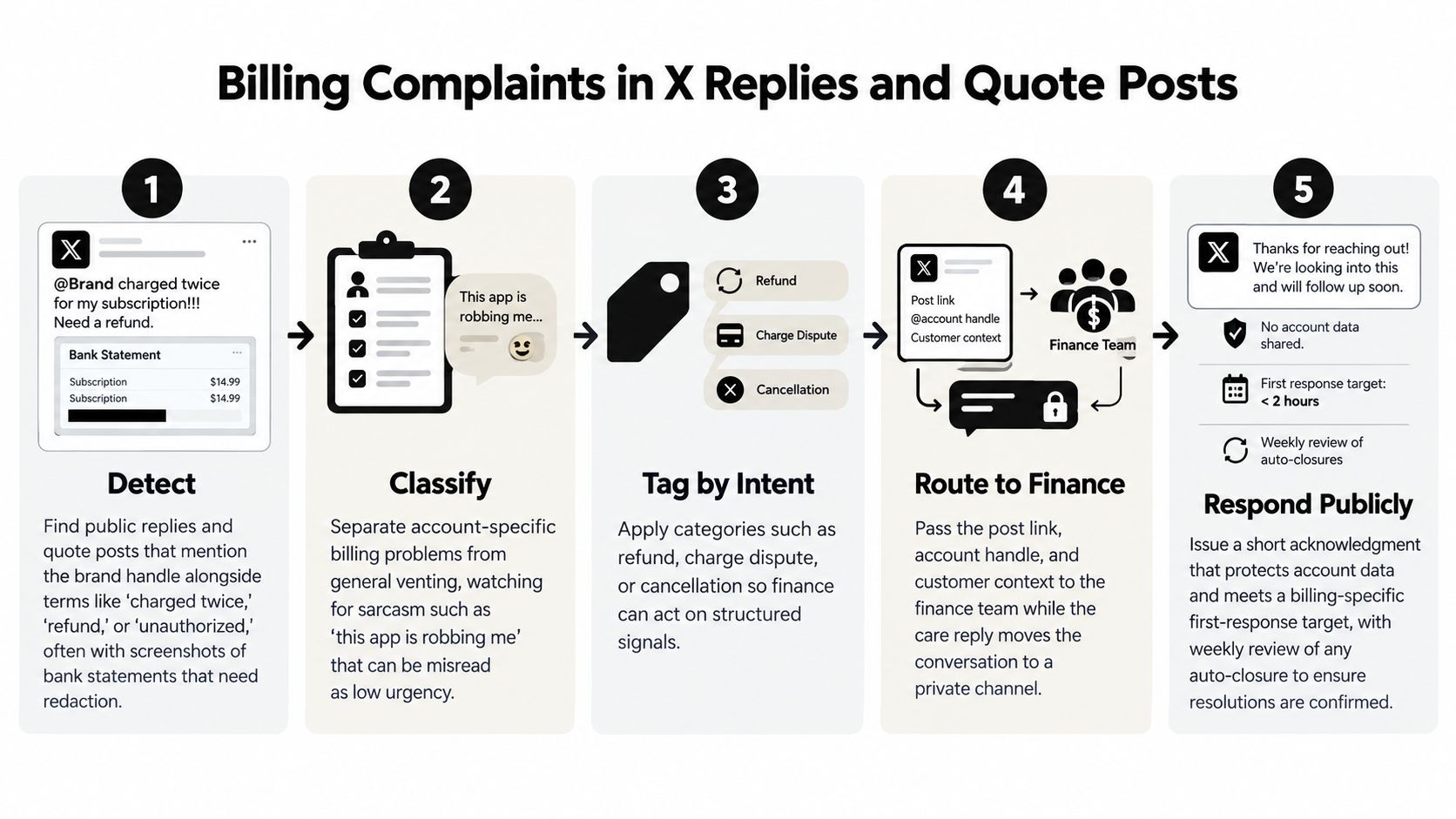
A public X reply can be the first warning that a customer was charged twice, didn't receive a refund, or was renewed unexpectedly. The same stream may contain jokes, memes, and general complaints, so the operational risk is simple: a money-related issue gets buried while the SLA clock keeps running.
“I cancelled last month and you charged me again today. I want the renewal fee refunded.”
Intent: Renewal dispute and refund request.
Urgency: High, because the message involves money and is public.
Tag: billing > unexpected charge > refund.
Route: Finance or billing support, with the post link and customer handle attached.
Comcast's @ComcastCares account, launched in 2008 and led by Frank Eliason, became an early benchmark for responding to customer complaints directly on social platforms, including public billing disputes. The lesson isn't to copy the channel presence. It's to give public complaints a controlled path into account-level resolution.
The public reply should acknowledge the issue without requesting sensitive information:
“We're sorry you've been charged after cancelling. Please send us a DM with the account email or case number, and we'll check this securely.”
Never ask for a full card number in a reply or DM. A telecom or streaming team commonly moves a billing thread from public reply to private messaging within one or two messages, protecting account data while showing observers that the issue has been recognized.
The routing rule that prevents repeat exposure
Create a billing intent tag that detects phrases such as “charged,” “refund,” “renewal,” and currency symbols, then sends the post to finance with the original context. Set a billing-specific first-response target, separate from general mentions. A social-care team may choose an under-60-minute business-hours target, but it should define that internally and measure it consistently.
Review auto-closure on billing tags every week. A post mentioning a charge shouldn't close because an agent sent a DM. Close it only after the account issue is resolved or the case has a documented handoff. That discipline also helps teams manage chargeback risk before a frustrated public thread turns into a formal dispute.
2. Instagram DMs and Comment Threads Containing Feature Requests
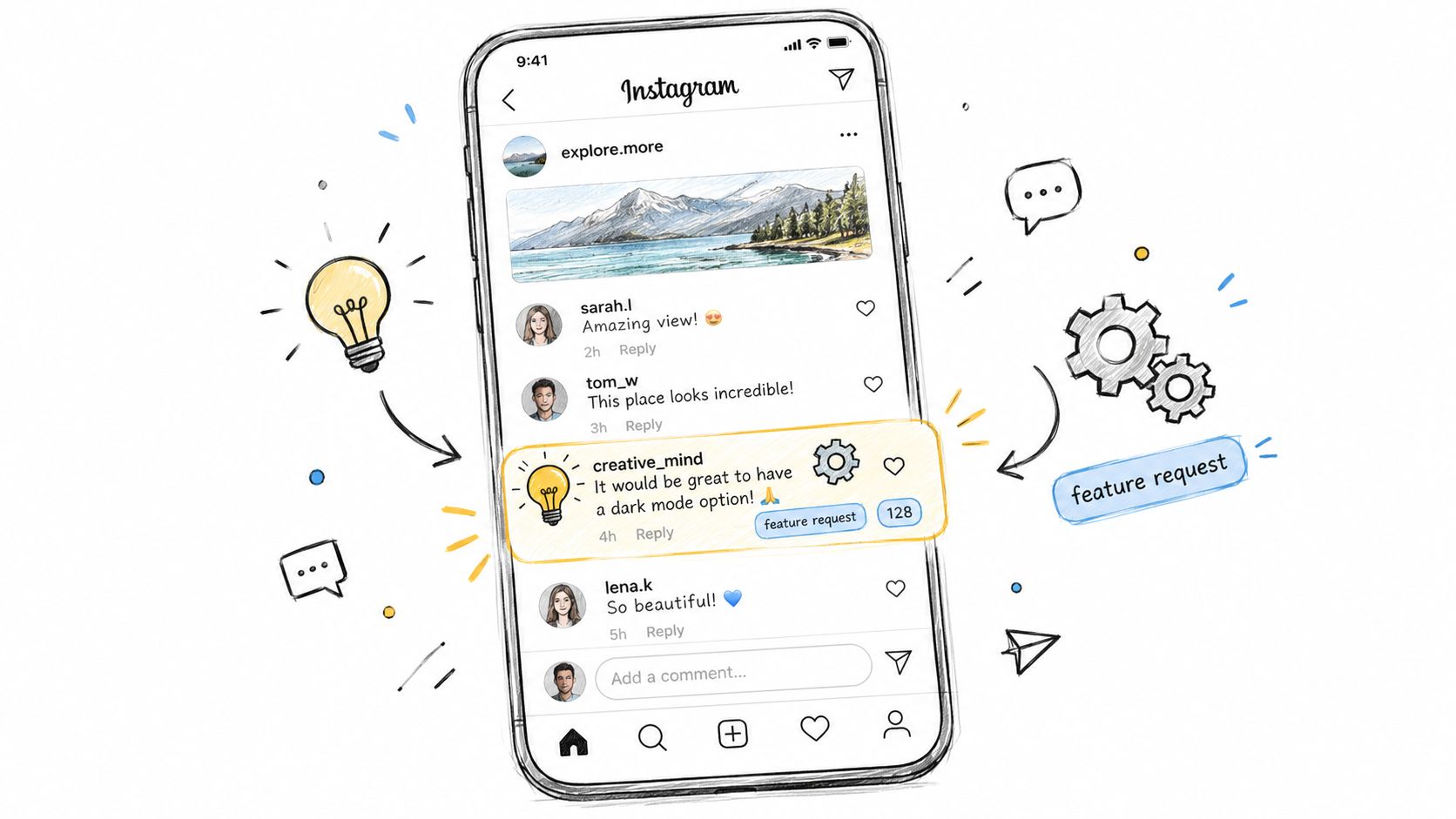
Feature requests often arrive where product teams aren't looking. A customer comments under a product reel, replies to a story, or sends a DM explaining a missing capability. None of those messages is necessarily urgent, but together they can reveal a recurring product or merchandising gap.
“Can you add dark mode to the iOS app? I use it every night and the white screen is painful.”
Intent: Feature request.
Urgency: Normal, unless the request exposes an accessibility or critical usability issue.
Tag: product feedback > mobile app > dark mode.
Route: Product management, with the conversation link and related requests attached.
A consumer electronics brand might find the same accessory request repeated across comments under a product reveal. A fashion retailer may see repeated questions about sizing or restocks in DMs. Those messages shouldn't remain isolated customer-service replies. They should become grouped themes that product marketing, merchandising, or product management can review.
Turn scattered requests into a product signal
Use a feature request parent tag with sub-tags by product area. Then group near-duplicate messages into one theme while preserving each source link. The product team needs to know that a request is recurring, but it also needs examples that show the language customers use and the context behind the demand.
- Acknowledge without promising: Reply that the feedback has been shared with the product team, but don't commit to a release date.
- Separate gaps from requests: A missing size guide may be a content or merchandising fix, not a product feature.
- Report themes, not anecdotes: Review recurring requests monthly and show each theme's share of inbound volume alongside representative messages.
Sift AI can tag intent across comments and DMs in a unified inbox, helping teams distinguish a real product pattern from one enthusiastic commenter. Humans should still decide whether the theme belongs on the roadmap, in product education, or in a content update.
3. TikTok Comments and Duets Reacting to Brand Videos
TikTok feedback moves quickly and rarely arrives in a tidy sentence. A product demo can attract compatibility questions, jokes about a feature, a duet correcting the brand, or a sudden wave of comments challenging a claim. The useful signal is often a change in conversation, not a single negative word.
“Your video says this works with every device, but mine doesn't. Which models actually support it?”
Intent: Product-claim clarification, with possible PR risk.
Urgency: High if the claim is inaccurate or the thread is spreading quickly.
Tag: reputation risk > product claim > clarification.
Route: Comms for the public response, product or legal for claim verification.
A beverage brand might notice comments questioning a packaging claim shortly after a launch video goes live. The comms team can capture the trend early, verify the wording with the relevant owner, and prepare a clarification. In another case, users stitching a software onboarding video may reveal that a setup step is confusing. That evidence belongs with product, even if the tone is humorous.
Read velocity and context together
Set velocity alerts on individual videos when comment activity rises above the account's normal baseline. The threshold should be calibrated to the channel rather than copied from another brand. Route potential claim-related risk to comms, while keeping ordinary engagement in the community queue.
TikTok slang and emoji use need reviewer testing. Sarcasm can look positive to a classifier, and a laughing emoji can signal ridicule rather than approval. Keep duets and stitches in a separate queue so creator responses don't disappear among ordinary comments.
Human approval matters most when the thread is viral and the claim is sensitive. A fast, inaccurate reply can turn a small product question into a larger reputation problem.
Review false positives and false negatives monthly. The goal isn't to label every comment perfectly. It's to identify emerging issues early without sending every joke to comms.
4. Discord Feedback and Bug-Report Channels
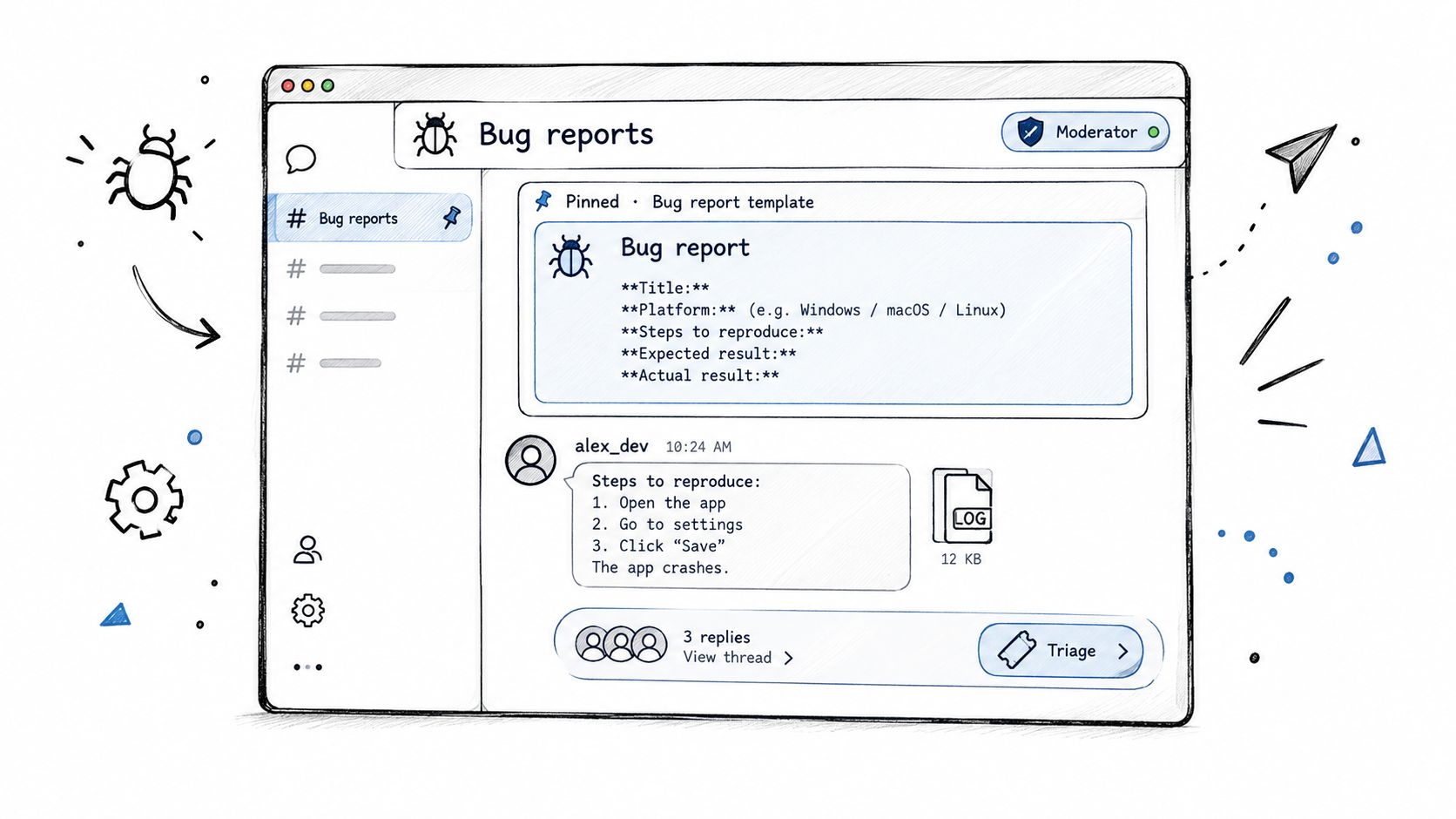
Discord produces some of the most technically useful customer feedback because members often include reproduction steps, build numbers, screenshots, and logs. It also creates operational complexity. A community manager may need to merge duplicate bugs, answer status questions, remove harassment, and preserve the original evidence for engineering.
“After the latest build, the settings screen freezes on Windows. It happens every time after I change the audio output.”
Intent: Reproducible bug report.
Urgency: High if the issue blocks a core workflow or affects many members.
Tag: bug > desktop > settings freeze.
Route: Engineering, with the build number, platform, reproduction steps, and reporter linked.
A game studio can pin a bug template asking for platform, build number, expected behavior, actual behavior, and reproduction steps. A developer-tools community may use thread labels such as confirmed, needs repro, and workaround available. Those labels make the community's status visible without requiring every member to read the full engineering tracker.
Preserve signal while reducing repetition
A bot can ask for missing fields before accepting a report, but it shouldn't block unusual reports that don't fit the template. Merge duplicates into one tracked issue and link every reporter so they receive status updates. That prevents engineering from counting the same bug as separate incidents while keeping affected users informed.
- Set an acknowledgment owner: Track the time from the first report to engineering acknowledgment.
- Control commitments: Define which staff can promise a fix, workaround, or release timing.
- Separate safety from support: Route spam and harassment through moderation workflows without deleting technical evidence attached to the report.
Community managers should also publish status changes in the original thread. A silent handoff may satisfy an internal queue but still feels like abandonment to the reporter.
5. Telegram and WhatsApp Business Chats for Multilingual Support
Telegram and WhatsApp often carry support conversations in regions where messaging is a primary customer-service channel. The difficult cases aren't limited to translation. Customers send voice notes, screenshots, mixed-language messages, local slang, and indirect descriptions of what went wrong.
“I sent the transfer yesterday, but it still hasn't arrived. Please check, the app says completed.”
Intent: Transfer failure or delayed settlement.
Urgency: High if money is missing, or if fraud is suspected.
Tag: payments > transfer delayed, with a language and region tag.
Route: Regional support first, finance for settlement issues, trust and safety for suspected fraud.
A fintech app serving Latin America might receive Portuguese and Spanish voice notes about failed transfers. Agents can review transcriptions, identify fraud indicators, and route those cases to trust and safety. A ride-sharing service in South Asia might receive Hinglish messages about a refund, then route the case to finance with the trip ID attached.
Evaluate meaning, not keyword matches
Enable language detection at ingestion and route by both language and intent. A message containing “refund” may be routine billing, while the same conversation may reveal account takeover or a fraudulent transaction. The classifier should surface the distinction, and a trained reviewer should make the final call when the situation demands close oversight.
Native speakers should review translated replies for tone, brand voice, and compliance. A grammatically correct response can still sound dismissive or use a term that has a different meaning locally. Maintain a glossary of slang, common error descriptions, and regional product terms.
Regional SLAs should account for local coverage, with fallback routing when a team is offline. Reporting one global response-time average can hide slower service for a smaller language group. Review intent accuracy, escalation quality, and unresolved conversations by language and region.
6. Reddit Threads and Subreddit Megathreads
Reddit gives teams depth that short social posts rarely provide. A single thread can contain a cancellation timeline, screenshots of an error, workarounds shared by other customers, competitor comparisons, and a detailed account of how support handled the issue. The challenge is that threads are long, vote-sorted, and shaped by community rules rather than a brand's workflow.
“I cancelled three weeks ago, but I'm still being billed. Support keeps sending me the same article, and several people here have the exact issue.”
Intent: Repeated billing failure and support-process complaint.
Urgency: High if the thread indicates a widespread account or cancellation problem.
Tag: billing > cancellation failure > recurring theme.
Route: Support and finance, with comms added if the thread raises legal, privacy, or reputational risk.
A streaming service might use a billing-change megathread to identify a recurring error message and send it to engineering. An airline could monitor an outage thread to understand the disruption's scope before the official status page is updated. In both cases, the team should treat the thread as a source of evidence, not as a queue where every comment gets the same response.
Participate without breaking trust
Check each subreddit's rules before engaging. Identify which employees can post from an official account, and avoid dropping a promotional reply into a thread where customers are asking for accountability.
Track a megathread as one source with timestamped snapshots. Pull repeated themes into a weekly report for product and support leaders, but preserve the original comments so teams can inspect context. Route mentions of legal action, data exposure, or safety to comms and trust and safety immediately.
A Reddit score or comment count isn't a substitute for customer coverage. A highly visible thread may represent a vocal segment, while a quieter issue may affect more customers elsewhere. Compare Reddit themes with support contacts, account outcomes, and other public channels before changing policy or prioritizing a major fix.
7. Outage Surge Mentions Across Public Platforms
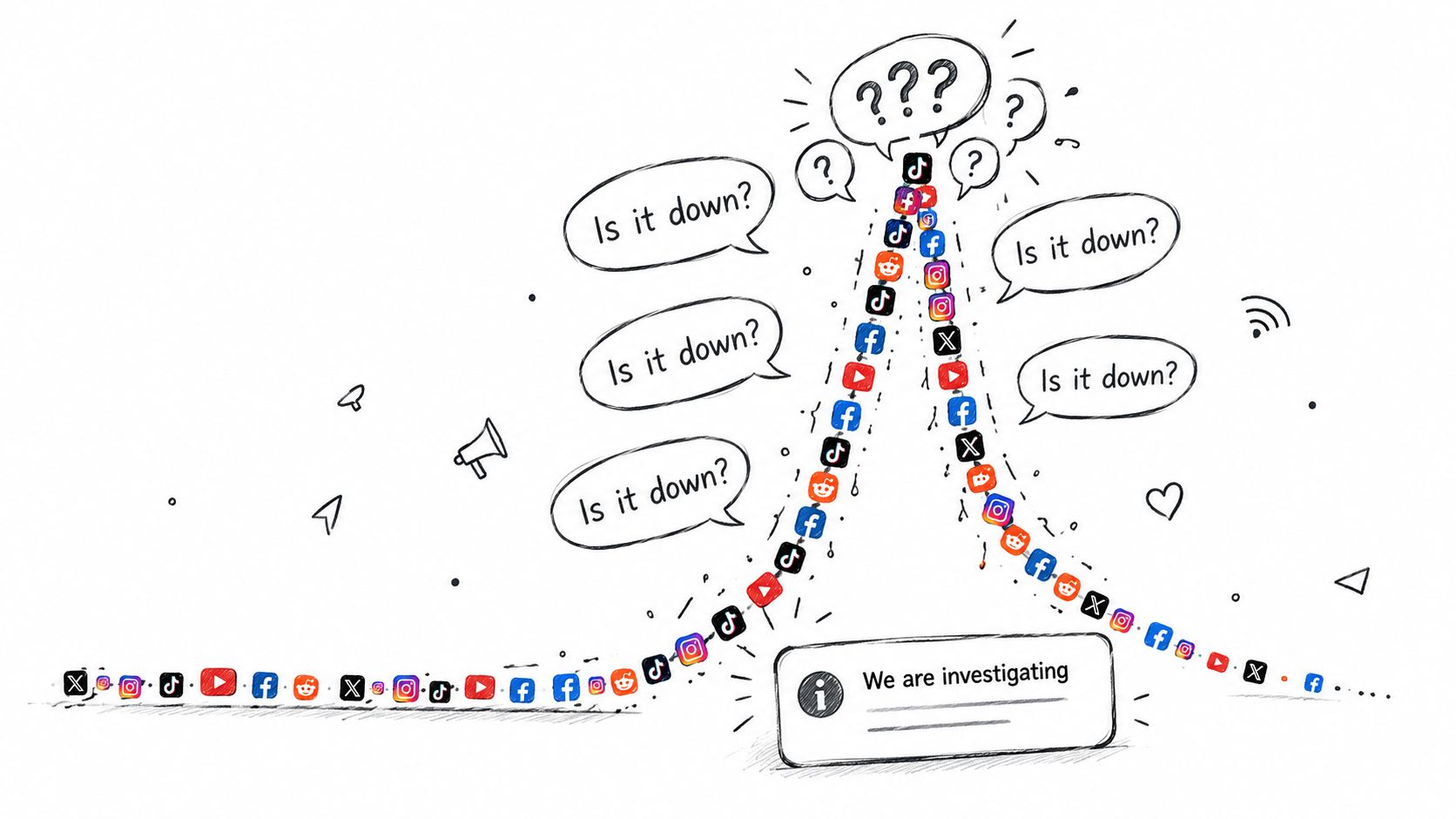
An outage changes the operating model. X, Instagram, Reddit, and third-party outage trackers can fill with error screenshots, “is it down?” questions, and repeated complaints. The repetition is useful because it confirms an incident, but individual messages may contain early clues about the affected region, feature, or error code.
“Login has failed three times in the last ten minutes. I'm in Manchester, and the mobile app shows error 504.”
Intent: Active service incident.
Urgency: Critical.
Tag: incident > login failure > error 504 > region.
Route: Incident management and engineering, with comms receiving the approved public update.
A payments company might detect a cluster of mentions containing the same error code, link those posts to an incident record, and publish a status update. A telecom provider might use regional clusters to confirm that an outage is limited to two cities while engineering investigates.
Switch to incident mode early
Set a surge threshold that moves the queue into incident mode and activates a pre-approved holding reply. Group reports by error code, region, and feature, then send the structured view to engineering. Don't make customers repeat the same details across multiple channels if the team can connect the records.
Use one status-update template across channels, with human approval before publication. The message should state what's known, what's being investigated, and where customers can follow updates. Avoid promising a restoration time until the incident owner has approved it.
After resolution, compare auto-closed conversations with those that required human handling. A status reply may resolve a simple “is the service down?” question, but it won't resolve a billing consequence, data concern, or account-specific failure. Those cases need a continuing route to support.
8. Impersonation and Scam Replies in Comments and DMs
Scam traffic looks like customer service until you inspect the destination link or the request for credentials. Fake support accounts can reply under legitimate brand posts, offer false refunds, and send users to phishing pages. If agents treat those messages as ordinary complaints, they waste time and may accidentally amplify the scam.
“We can process your refund. Please send your account password and verification code to this support account.”
Intent: Impersonation and credential theft.
Urgency: Critical.
Tag: security > impersonation > credential request.
Route: Trust and safety or security, not general support.
Crypto exchanges regularly warn customers about impersonation accounts on X and Instagram, particularly when fake accounts offer recovery or refund services. A consumer brand may detect a wave of fake refund replies under a launch post, capture the links, and send them to security for takedown requests.
Keep suspected scammers out of the care queue
Maintain an official-handle list and publish a clear statement that the brand will never ask for a password, full payment credentials, or one-time verification codes in replies or DMs. Auto-tag suspicious links and credential requests, then route them to trust and safety.
- Use report and block: Agents shouldn't debate or negotiate with suspected scammers.
- Protect real customers: Reply with a safe warning when appropriate, using an approved public template.
- Separate reporting: Track scam volume apart from genuine customer volume so response-time and SLA dashboards remain meaningful.
The same workflow supports community protection with AI Image Detector when scam posts include copied logos, fake screenshots, or manipulated visual assets. Humans should approve action when an account could be legitimate, a customer may already be compromised, or a takedown could affect an important conversation.
8-Channel Voice of Customer Comparison
| Source | 🔄 Implementation Complexity | ⚡ Resource & Response Speed | ⭐ Expected Outcomes | 📊 Ideal Use Cases | 💡 Key Advantages / Tips |
|---|---|---|---|---|---|
| Billing Complaints in X Replies and Quote Posts | High, requires intent tagging, redaction, and finance routing workflows | High resources + fast SLA (urgent first-response) | High impact on retention, refunds, regulatory risk | Billing disputes, chargebacks, finance escalation | Early detection and public reassurance; tag amounts, move to DM, use standard acknowledgment |
| Instagram DMs & Comment Threads (Feature Requests) | Medium, deduplication and cross-thread tagging needed | Moderate resources; lower immediacy, best handled in aggregate | Strong product signals when aggregated; moderate direct actionability | Feature discovery, prioritization, product-launch feedback | Unfiltered customer language; group near-duplicates, avoid promising timelines |
| TikTok Comments & Duets (Brand Reactions) | High, slang, memes, and visual context require specialized review/classifiers | High-speed monitoring required for viral spikes; human review essential | Early PR risk detection; noisy but can surface advocacy | Rapid reputation management, creator amplification, PR monitoring | Fast viral signals; set velocity alerts, train on slang, require human approval for replies |
| Discord Feedback & Bug-Report Channels | Medium, structured channels and bots simplify triage but need ops rules | Moderate–high staff for triage; technical depth speeds engineering handoff | High-quality technical reports and faster fixes when triaged correctly | Games, developer tools, technical products needing logs/repro | Rich technical detail and community self-help; enforce templates, dedupe before handoff |
| Telegram & WhatsApp Business Chats (Multilingual) | High, language detection, transcription, and regional routing are required | High localization effort; transcription adds latency | Strong regional coverage and private resolutions; risk of delayed responses | Multilingual markets, voice-note support, regional operations | Direct rich-media support; enable language detection, regional SLAs, review auto-translations |
| Reddit Threads & Subreddit Megathreads | Medium, long-form, vote-sorted content and subreddit rules complicate triage | Lower immediacy but deeper analysis over time; moderate resourcing | Deep qualitative insights and timelines; good for trend analysis | Long-form feedback, outage timelines, competitor comparisons | Detailed first-person accounts; respect subreddit rules, snapshot megathreads for tracking |
| Outage Surge Mentions Across Public Platforms | Medium, surge detection and incident grouping required | Very high speed requirement; incident-mode staffing needed | Early outage detection and structured signals for engineering/comms | Incident detection, cross-platform outage confirmation, status updates | Fast, cross-platform signals; set surge thresholds, group by error/region, use a single status template |
| Impersonation & Scam Replies in Comments and DMs | High, pattern/link analysis, escalation to security, and blocking workflows | High trust & safety resources; requires rapid action to mitigate fraud | Reduces fraud and customer harm when detected early; protects brand trust | Fraud prevention, trust & safety operations, phishing campaigns | Protects users and brand; auto-tag suspicious links, never engage scammers, maintain official-handle list |
Turning Each Example Into a Routed Action
The common failure across these voice of customer examples is not a lack of feedback. It's a lack of ownership. A billing complaint reaches social care but never finance, a feature request receives a polite acknowledgment but never reaches product, and an outage surge generates thousands of replies without creating one incident record. Collection without routing creates the appearance of listening while the customer experiences delay.
Start with the two channels that generate the most billing, outage, or scam traffic. Don't begin by building a perfect taxonomy for every possible intent. Choose the streams that create the most operational risk, review real conversations, and define tags that agents can apply consistently.
A workable taxonomy usually has at least three layers:
- Intent: Billing, outage, feature request, bug, fraud, safety, product question, or general sentiment.
- Urgency: Routine, heightened, high, or critical.
- Owner: Finance, engineering, product, support, comms, or trust and safety.
Add context only when it helps a team act. Language, region, product, account tier, error code, and public-risk flags can make routing more useful. Too many tags create reviewer fatigue and inconsistent reporting. The test is practical: can a team lead explain why a message received its tag and route?
Set a separate SLA for each intent class. A public billing complaint, active outage, and routine feature request shouldn't share one average response target. Social-care teams need to distinguish first acknowledgment from actual resolution, because a quick “please DM us” reply may satisfy visibility while leaving the customer's problem untouched.
The SLA should follow the customer risk, not the channel name. A low-volume WhatsApp fraud report can deserve faster escalation than a high-volume stream of ordinary comments.
Keep human approval on replies that touch money, security, or sensitive claims. AI can filter noise, identify likely intent, group duplicate conversations, route work, and draft a response in the approved brand voice. Humans should decide whether a refund is warranted, whether an incident is public, whether a claim is accurate, and whether a customer may be at risk.
Measure the system beyond response volume. Track first-response time, resolution time, escalation accuracy, reviewer overrides, unresolved conversations, and auto-closure rate. Report scam volume separately, or a sudden fraud wave may make the whole support operation look slower than it is. For product feedback, track recurring themes and whether an accountable team accepted, investigated, or rejected the signal.
Sampling bias also needs a deliberate counterweight. Survey respondents are self-selected, review writers often have strong experiences, support data overrepresents customers with problems, and social data reflects the demographics of each platform. A highly vocal minority can dominate a dashboard unless teams compare mention volume with customer coverage, repeat contacts, severity, exposure, retention signals, and the number of affected accounts. The right question isn't “Which issue has the most mentions?” It's “Which issue affects enough customers, carries enough risk, and has a clear owner?”
The Rwanda field experiment offers a useful reminder that feedback has value when teams act on it. Over two years, firms that actively sought customer feedback experienced a 62.0% increase in revenue and a 54.5% increase in profit relative to control firms, while nonsolicited customers showed a 38.2% increase in recall and a 77.4% increase in purchases. The study's experimental design matters because it connects feedback collection to operational changes and business outcomes, not just positive testimonials.
The operating loop is straightforward: capture the conversation, classify intent and urgency, route it to an accountable owner, respond safely, record the outcome, and review whether the theme changed. Sift AI can support that loop by unifying conversations across social and community channels, filtering noise, tagging intent, routing issues, drafting replies, and surfacing recurring customer themes. The platform doesn't replace the people responsible for judgment. It gives those people a clearer queue and the context needed to make the call.
Sift AI brings social and community conversations into one command center, with AI-assisted tagging, routing, escalation, response drafting, and Voice of the Customer analysis. If your team needs to turn billing complaints, outage signals, feature requests, and scam reports into owned actions, visit Sift AI to see how the platform can support your workflow.