Unified Social Media Inbox: The 2026 Operating Guide
"Learn what a unified social media inbox is, how it routes work across channels, and how to measure real ROI in 2026 with response time and auto-closure metrics."
A payments outage starts with one public complaint. Within minutes, the same issue appears in an Instagram DM, a Discord thread, and a stream of replies on X. The frontline agent moves between X, Instagram, Discord, email, the help center, and the CRM, copying account details into notes while trying to decide whether the next reply belongs to support, finance, engineering, or communications.
The problem isn't too many tabs. Each tab has its own queue, identity record, notification logic, and response expectation. A conversation can sit unanswered in one channel while the status dashboard reports healthy performance because every channel is measured in isolation. A useful overview of the difference between publishing dashboards and conversation-focused systems is available in this social media dashboard explained guide from Trendy.
Table of Contents
- The Day Six Tabs Could Not Save You
- What a Unified Social Media Inbox Does
- How Channels Quietly Set Different SLA Rules
- Inside the Triage and Routing Engine
- When AI Should Hand the Reply to a Human
- Integrations an Enterprise Inbox Must Get Right
- Measuring ROI Beyond Response Time
- A 30 Day Rollout Plan You Can Defend
The Day Six Tabs Could Not Save You
At 9:14, the agent sees a customer post on X claiming that a payment was taken twice. The post has public visibility, so the agent drafts a short acknowledgment and asks the customer to move account details into a private channel. Before that reply goes out, an Instagram DM arrives from another customer with the same issue, followed by a Discord message from a community moderator reporting a wider payment failure.
The agent opens the CRM to search for the first customer, then the help center to confirm the approved billing language, then email to check whether finance has already opened an incident. By the time the agent returns to X, the original post has attracted replies from other customers. What began as a billing complaint now looks like a public service incident and a potential PR thread.
Operational reality: A channel can look healthy on its own while the customer journey is already failing across channels.
This is why a social-ops team needs to think in terms of conversation volume, urgency, and ownership, not merely the number of publishing accounts. DataReportal reported 5.24 billion active social media user identities worldwide in January 2025, representing 63.9% of the global population. The same analysis found that the total rose by 206 million identities, or 4.1%, over the preceding 12 months, while GWI research cited there found that 97.3% of connected adults use at least one social or messaging platform each month and the average internet user uses 6.83 platforms per month. Those figures are documented in DataReportal's global social media analysis.
The six-tab setup creates a queue behind every queue. Agents duplicate replies, miss DMs, lose customer history, and escalate incidents late. The first-response dashboard may stay green because X, Instagram, and Discord each meet a separate target, even though no one has connected the billing complaint to the outage report.
A unified social media inbox exists to solve that operating failure. The important question isn't whether every message appears on one screen. It's whether the right person receives the right conversation quickly, with enough context to make a safe decision.
What a Unified Social Media Inbox Does
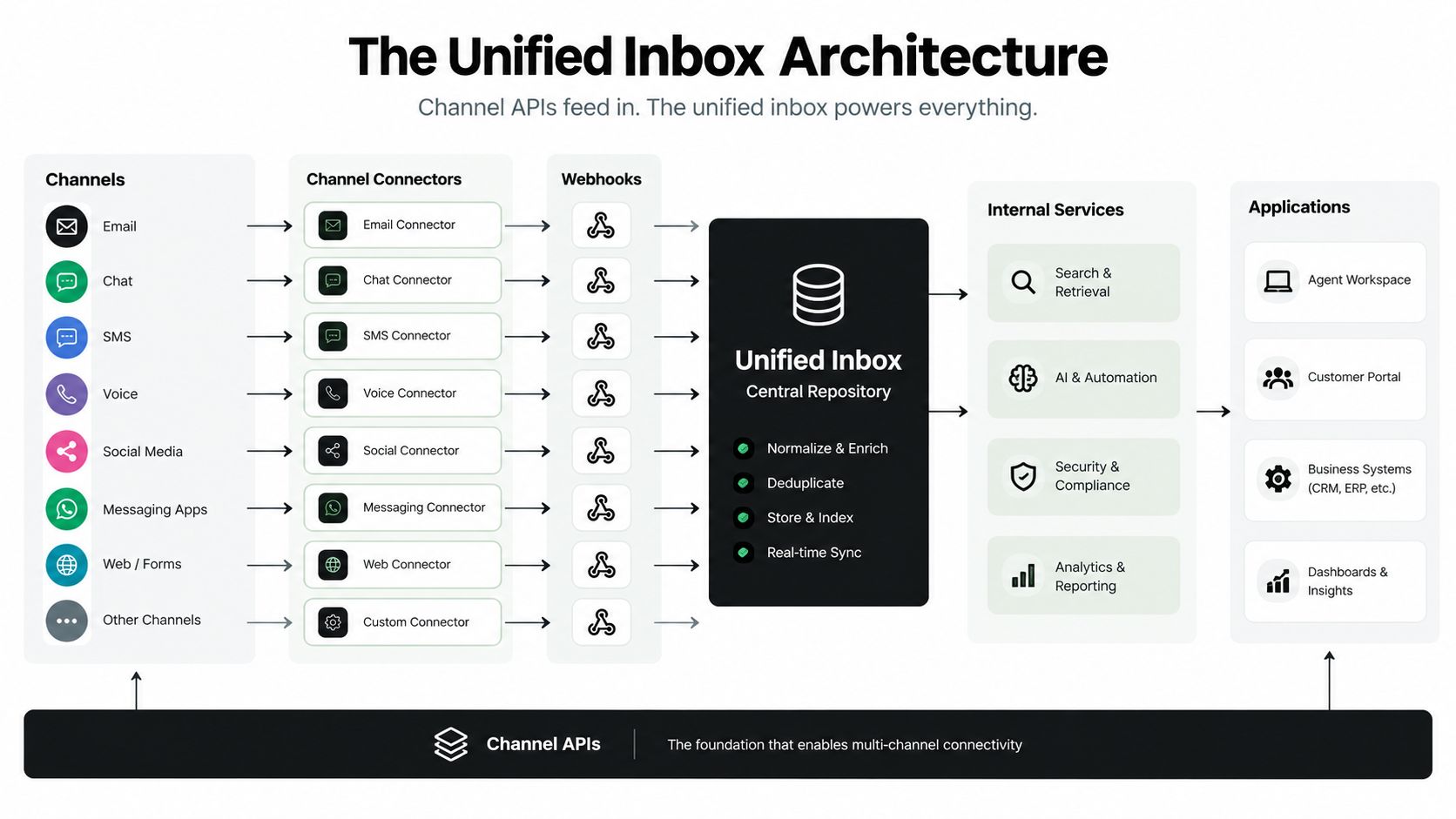
A unified social media inbox is an operating layer above channel APIs. It receives events from each service, converts them into a common structure, adds customer and operational context, and sends conversations into queues with clear owners. Its value appears in triage and hand-off, not in placing every message on one screen.
The architecture usually has four parts:
Ingestion receives posts, comments, mentions, direct messages, replies, and community events through channel-specific connectors and webhooks. Each connector handles platform rules for media, threading, rate limits, and delivery retries.
Normalization converts those events into a canonical message schema. The system preserves the channel, handle, timestamp, thread relationship, media, language, and visibility, giving agents a consistent way to search, prioritize, and act.
Context enrichment adds customer records, prior conversations, order references, account status, and internal notes. Identity resolution can connect a social handle, verified email, order ID, and CRM contact when the available evidence supports that match.
Routing assigns conversations to queues using intent, language, skill, severity, channel, service hours, and SLA tier. A billing complaint should reach the right owner without waiting behind a routine feature request from the same platform.
The customer may start with an X mention, continue in an Instagram DM, and provide an order ID through WhatsApp. Agents should not rebuild that history manually. The inbox should preserve the relationship while respecting channel permissions and sensitive-data rules.
A good triage layer also controls automation. AI can filter, tag intent, suggest a route, or draft a response, while staying quiet when confidence or context is insufficient. A human should own replies involving billing, account access, safety, escalation, or unclear identity. That hand-off needs an audit trail, not a hidden reassignment.
This model can span X, Instagram, Discord, Facebook, WhatsApp, TikTok, Telegram, forums, and other communities, but channel count is not the success criterion. Poor normalization creates one crowded queue. A useful inbox gives each event a stable identity, clear ownership, auditable status, and a recorded reason for its priority.
Sift AI is one example of this operating model. Its stated capabilities include a unified inbox for social and community conversations, AI filtering, intent tagging, routing, escalation, and drafted responses, with humans retaining responsibility for important decisions.
How Channels Quietly Set Different SLA Rules
A single response-time target creates false comfort. Customers experience the channel they used, not the blended average across every queue.
On X, a public mention can gather attention while an agent is still deciding whether it belongs to support or communications. Instagram DMs are private, but they often contain account or order context that requires a careful handoff. Discord can behave like a real-time support room when a server is staffed. WhatsApp conversations are usually treated as near-synchronous, while TikTok comments may be reviewed in a broader community queue.
The practical policy should distinguish business-as-usual handling, incident mode, and visibility risk.
| Channel | BAU first response | Incident-mode target | Visibility |
|---|---|---|---|
| X public mentions | Sub-hour queue for urgent or public issues | Immediate escalation for outage, safety, or viral complaints | High |
| Instagram DMs and comments | Priority based on intent and account context | Accelerated review when complaints cluster | Medium to high |
| Facebook Pages | Same-day handling for ordinary service conversations | Tighter queue during active incidents | High |
| Discord | Real-time handling in staffed servers | Moderator and incident escalation | High inside the community |
| Near-synchronous handling for active customer conversations | On-call routing for billing or account risk | Private | |
| TikTok comments | Intent-based review within the team's service window | Fast lane for fast-spreading complaints | Public |
The Buffer customer-service guide cites survey evidence that 42% of consumers expect a social-media response within 60 minutes and 32% expect one within 30 minutes. It also reports that 83% of Twitter users and 71% of Facebook users want a response on the same day. Those expectations support a sub-hour fast lane for urgent public conversations, but they don't justify applying one identical policy to every channel.
Independent research covering 3,111 people across 15 countries found that 52% of Twitter users expected a company response within two hours, while more than half of Facebook users expected a same-day response. The research also found that 81% of Twitter users expected a same-day reply, including 30% who expected one within 30 minutes, as documented in this Oracle social customer-service research.
A dashboard should expose SLA attainment by channel, intent, severity, language, and queue. A green blended average is not useful if an X escalation aged out while routine Facebook comments kept the overall number compliant.
Inside the Triage and Routing Engine
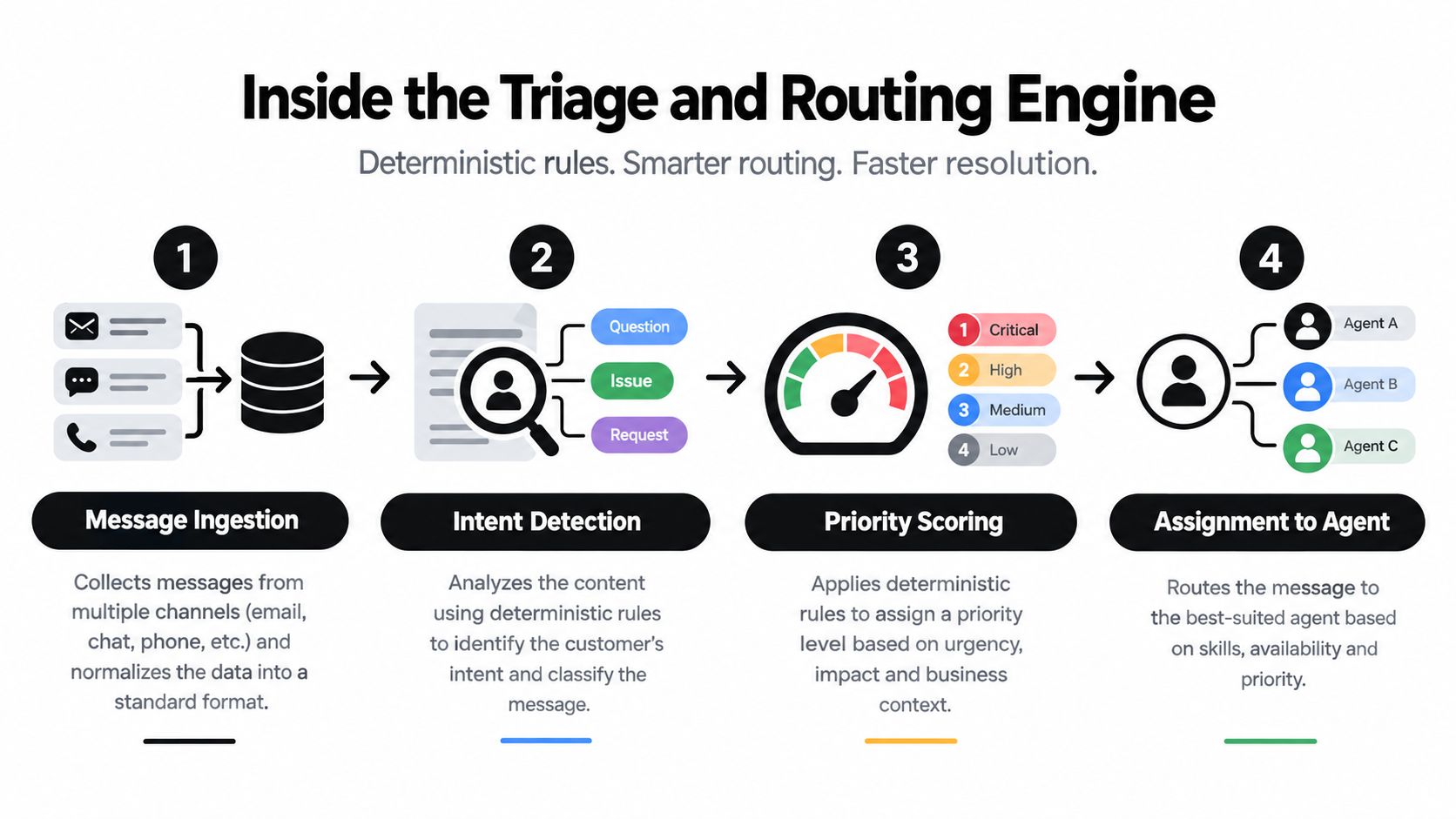
A reliable triage engine works as a visible rules pipeline. Agents should see the reason for every assignment and have a way to challenge it. The first pass identifies language, intent, sentiment, spam or bot signals, and entities such as products, account references, order IDs, and incident names.
The system combines those signals with operational rules and clear hand-off points. A high-confidence billing complaint with verified CRM context can go to finance or support with a drafted acknowledgment. A message containing an outage phrase should enter the incident queue even when the sentiment classifier is uncertain. A PR-sensitive mention should route to a named communications approver, with ownership visible to the team.
The decision path
Routing should answer four questions in sequence:
- What is this? Classify intent, language, channel visibility, sentiment, and likely entities.
- How urgent is it? Score public exposure, customer impact, safety or legal risk, repeat contact, and incident signals.
- Who owns the next action? Assign by skill, region, product, account tier, or on-call rotation.
- What can happen automatically? Permit a draft, tag, duplicate merge, or low-risk closure only when policy allows it.
A billing complaint containing profanity exposes a common production failure. The classifier may detect payment intent and high emotional intensity, then apply only one routing tag because the matrix does not support dual intent. Preserve both signals and define the winning rule, while keeping the secondary signal available to the assignee.
Outage surges need the same discipline. If every message enters the normal intent queue, agents spend time classifying complaints that belong to one incident. A surge detector should raise incident priority, link related conversations, and notify engineering and communications while preserving each customer's history.
The pipeline also needs a fallback queue. No taxonomy catches every slang term, meme, image, language variant, or new product name. Unmatched conversations should remain visible, with a reviewer responsible for feeding new patterns back into the routing matrix.
Auditability depends on context. Agents need the assignment reason, the signals that triggered it, and the rule that determined ownership. The following video gives additional context on the routing concept:
When AI Should Hand the Reply to a Human
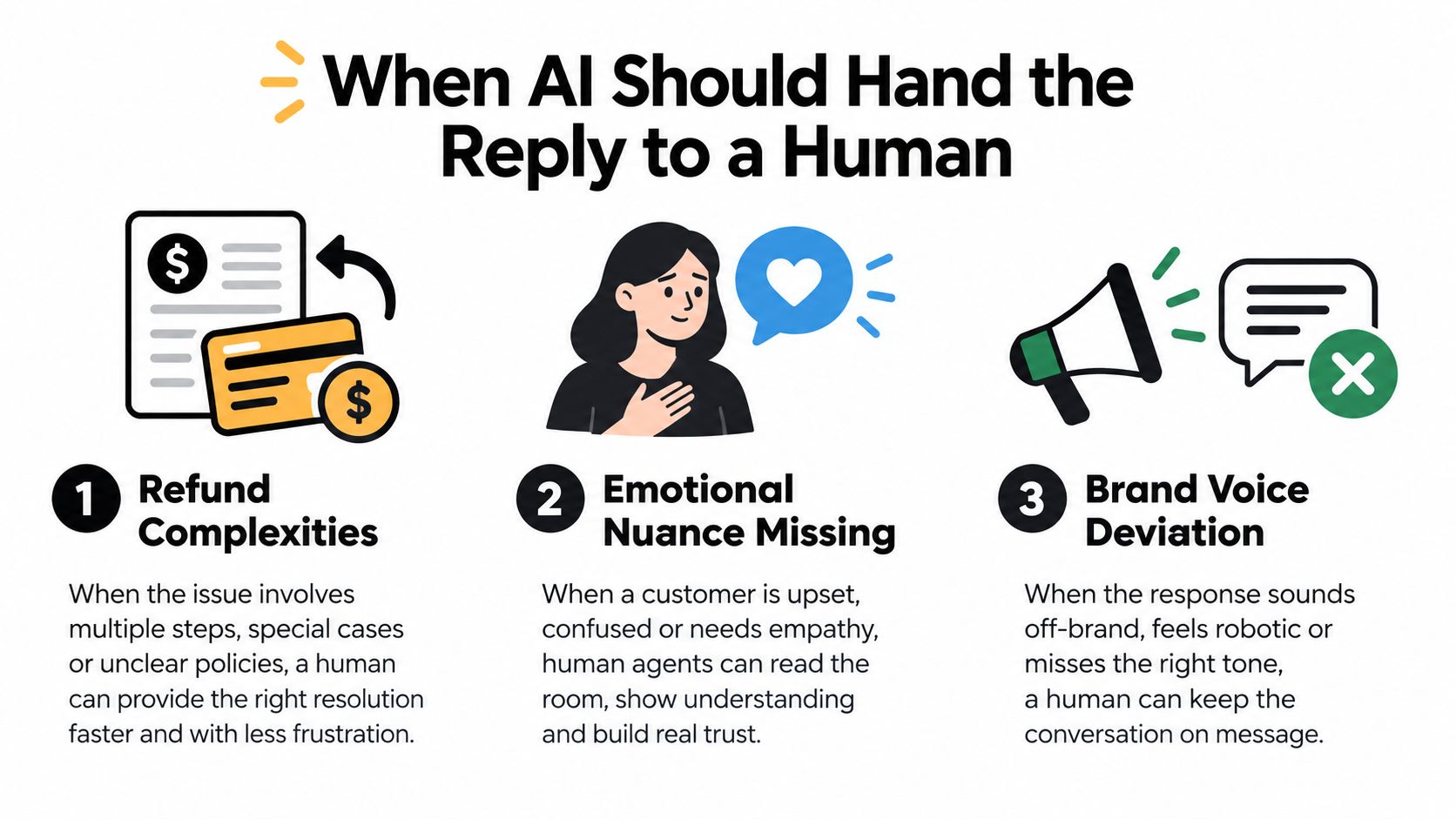
Automation should remove repetitive work, not remove ownership from sensitive conversations. AI can classify a message, find the relevant policy, summarize history, and draft a response. It shouldn't independently authorize a complex refund, make a legal or medical claim, or improvise during a crisis when tone and accountability matter more than speed.
Consumer preference makes this boundary operational. Emplifi reports that 67% of consumers prefer human support on social media, more than half describe AI responses as inauthentic, and 70% may stop buying after one or two poor service experiences. The same source reports that 83% want to know when AI is being used and 60% worry about accuracy, as detailed in Emplifi's social customer-service research.
Triggers that should pause autonomous replies
A defensible handoff policy includes:
- Refund complexity: The draft can explain the next step, but an authorized person owns exceptions, partial refunds, chargebacks, and disputed transactions.
- Regulated or high-risk language: Legal, medical, safety, financial, and privacy terms should route to the designated specialist.
- Emotional or crisis context: Threats, grief, self-harm references, harassment, and fast-moving public incidents require human judgment.
- Repeated contact: A customer who returns after an unanswered or unsatisfactory interaction should bypass the ordinary automation path.
- Brand and reputation risk: A high-reach mention, journalist inquiry, executive complaint, or coordinated criticism should reach a named approver.
Disclosure needs to work across public comments, DMs, and handoffs. Customers should be able to understand when an AI-generated response is involved, request a human, and see when the case has moved to human ownership. A visible internal takeover state is just as important because it prevents another automation rule from replying after an agent has started a sensitive conversation.
A practical guide such as this Claude social media automation guide can help teams think through drafting workflows, but drafting is only one layer. The inbox still needs confidence thresholds, escalation reason codes, reviewer sampling, and an audit trail.
Don't optimize for zero human overrides. A nonzero override rate can show that agents are catching ambiguity before it reaches the customer. The useful question is whether overrides cluster around particular intents, languages, products, or tone patterns, and whether those clusters lead to better rules.
Integrations an Enterprise Inbox Must Get Right
Most rollout failures happen at the seams between systems. The inbox may classify a message correctly, yet route it to the wrong team because the CRM record is stale or the social handle isn't linked to the verified customer identity.
Start with CRM identity mapping. A handle, verified email, loyalty ID, order ID, and account record shouldn't be treated as interchangeable evidence. The system needs clear matching rules, confidence states, and a safe path for anonymous conversations. If identity resolution is uncertain, the agent should see that uncertainty instead of receiving a false customer history.
The integration audit
Ticketing sync must work in both directions. Status, priority, assignee, tags, notes, and resolution reason should move between the social inbox and the case system without overwriting a newer decision. A customer who moves from an Instagram comment to a formal support case should retain the original public context and the private handoff.
Analytics exports should preserve event timestamps, channel, intent, queue, assignment, first response, resolution, closure reason, and escalation history. Without those fields, the data warehouse can report volume but can't explain why a queue missed its SLA.
Identity and access require SSO, role-based permissions, and separation between agent, reviewer, manager, and administrator actions. Finance, engineering, communications, and trust-and-safety teams shouldn't all have identical access to customer data.
Reliability controls matter at the connector level. Webhooks need retries, dead-letter handling, replay capability, and monitoring for rate-limit responses. A silent connector failure is worse than a visible outage because agents continue to believe the queue is complete.
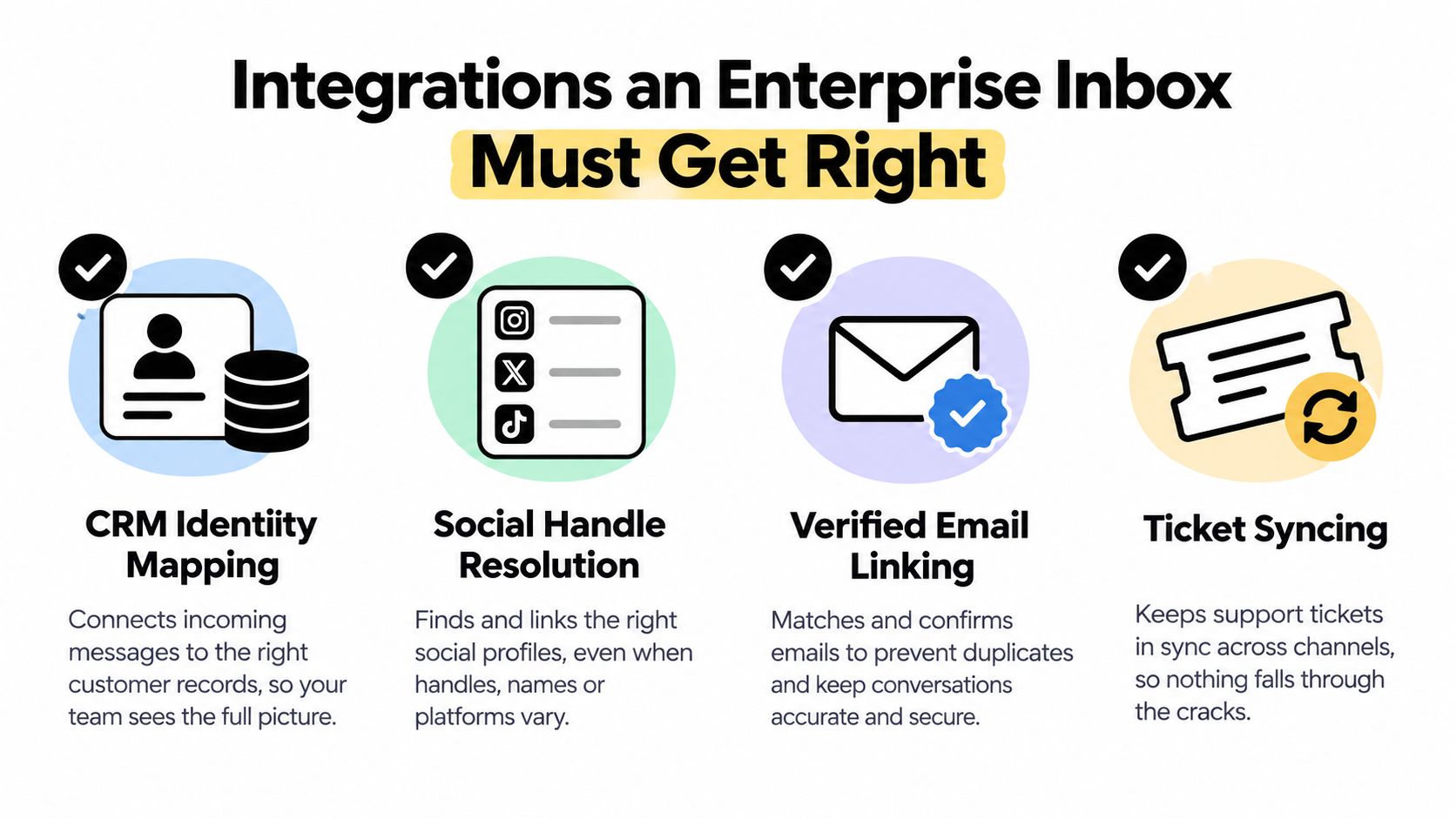
Before launch, test anonymous accounts, deleted messages, attachments, duplicate events, stale CRM records, API throttling, and a customer who uses several channels in one incident. Also confirm archival, retention, and legal-hold behavior for regulated teams.
Publishing automation belongs in a separate control plane. Resources such as this auto post to social media setup are useful for scheduled distribution, but a social care inbox needs stricter controls around identity, reply permissions, auditability, and escalation. Sending a post and responding to a billing complaint are different operational actions.
Measuring ROI Beyond Response Time
Response time is visible, but it isn't sufficient for a CFO. A fast, inaccurate reply can create a reopened case, a second contact, reviewer work, and a public complaint that costs more than the original interaction.
The core measurement set should combine median first-response time, auto-closure rate, and false-closure rate. Add override rate to show where agents rewrite or replace AI drafts. Together, these metrics show whether the system is fast, whether automation is absorbing routine work, whether it is closing the wrong conversations, and where human judgment remains essential.
| Metric | What It Measures | Target Band | Why Finance Cares |
|---|---|---|---|
| Median first-response time | Typical speed before a customer receives an acknowledgment | Channel-specific and intent-specific | Shows queue efficiency and service risk |
| Auto-closure rate | Share of eligible conversations resolved without manual handling | Controlled by intent and review policy | Indicates potential labor deflection |
| False-closure rate | Share of automated closures that should have stayed open | As low as the risk category requires | Connects automation to rework and customer harm |
| Override rate | Share of drafts or decisions changed by a human | Stable, explainable, and reviewed by intent | Signals trust, quality, and brand-risk exposure |
| Cost per resolved case | Operational cost after routing and resolution | Compared with the prior workflow | Gives finance a unit-economics view |
| Repeat contact | Customers returning about the same issue within the chosen window | Falling for resolved intents | Shows whether savings reflect actual resolution |
A useful working example doesn't compare response time alone. Suppose the X queue moves from a slow median to a materially faster median while false closures remain below the team's approved risk threshold. The CFO can then see two linked effects: fewer agent hours spent on preventable follow-up and less exposure from unanswered public complaints. That relationship is stronger than claiming that faster replies automatically create better outcomes.
The 2025 Sprout Social Index summary reports that 73% of consumers would buy from a competitor if a brand failed to respond on social media. That makes public response a commercial-control metric, not merely a service vanity metric.
Track the same measures by platform, language, intent, severity, and escalation reason. A blended average can conceal a failing X queue or a multilingual classification problem. Reviewers should also sample auto-closed conversations and compare them with reopened cases, repeat contact, customer feedback, and downstream support tickets.
A 30 Day Rollout Plan You Can Defend
A defensible rollout starts with two channels, not every available channel. Pick the channels where customer risk and operational volume are clearest, then prove that identity, routing, escalation, and reporting work before expanding the surface area.
Week 1
Inventory the channels, event types, message permissions, data residency requirements, retention rules, and SSO groups. Map the CRM fields that agents trust. Name the owners for support, finance, engineering, communications, and trust and safety.
The first week should end with a written routing matrix. It needs an owner for every high-risk intent, a fallback queue for unmatched messages, working-hours rules, on-call behavior, and a clear definition of human takeover.
Week 2
Ingest messages from the two selected channels into staging. Use labeled samples to test language, intent, sentiment, spam detection, entity extraction, and duplicate handling. A small agent pod should review the classifications and identify where slang, sarcasm, images, memes, or code-switching confuse the system.
Don't tune the model against clean examples only. Include billing complaints in public replies, outage surges, feature requests buried in DMs, scam waves, and mentions that need communications review.
Week 3
Enable AI drafting only for low-risk intents. Keep legal, billing exceptions, outage language, safety concerns, and crisis terms on a hard escalation path. Agents should be able to edit, reject, or replace every draft, while reviewers inspect the reason codes behind escalations.
Week 4
Turn on auto-closure for narrowly defined FAQ messages only after the team has validated the false-closure budget. Sign off on the dashboard with channel-level SLA attainment, median first response, auto-closure, false closure, override rate, reopened cases, and fallback-queue volume.
The first weekly review should feel calm for the right reason. Agents should see fewer duplicates, clearer ownership, and less reviewer fatigue, while managers can explain every exception. If the queue feels calm only because the system is hiding ambiguous messages, the rollout isn't ready.
Make three decisions this week:
- Pick the two channels: Choose the channels with the clearest customer risk and the strongest operational ownership.
- Lock the routing rules: Define who receives billing, outage, PR, product, spam, and multilingual cases.
- Name the override reviewers: Give specific people responsibility for examining human changes and feeding patterns back into the system.
Sift AI provides a unified inbox for social and community operations, with AI filtering, intent tagging, routing, escalation, analytics, and drafted replies while humans retain control of important decisions. Visit Sift AI to evaluate how its operating model could support channel-specific triage and safer handoffs.