Social Media Response Time: A 2026 Playbook
"Cut social media response time with channel-aware SLAs, AI triage, and routing. Benchmarks, business impact, and a playbook teams use in 2026."
At 10:14 on a Tuesday, a payment processor hiccup turns a normal social queue into an incident. X complaints, Instagram DMs, Facebook comments, and private replies arrive together, while a creator's viral post pushes the issue into a much larger audience. The unified inbox shows one flood, but customers aren't presenting one problem. Some need an outage acknowledgement, some need billing help, some are asking whether service is back, and many are duplicates or noise.
The instinct is familiar: set one global social media response time target and make the team type faster. That approach fails under pressure. A blended SLA treats a public outage complaint, a billing escalation, and a sarcastic one-word reply as equivalent work, so the queue rewards volume instead of consequence.
Response time is a routing and triage problem, not a typing problem. The operating system has to identify intent, assess urgency, assign ownership, and measure the result by channel. Humans should still approve sensitive replies and own difficult decisions, but they shouldn't spend the incident manually sorting every incoming message.
Table of Contents
- When the Inbox Floods and the Clock Starts
- What Social Media Response Time Actually Measures
- Channel-by-Channel Benchmarks and the Expectation Gap
- Why Slow Replies Hurt CSAT and Brand Risk
- The Triage Stack That Moves Time-to-First-Reply
- Three Scenarios Through the Same Pipeline
- Where AI Should Lead and Where Humans Must Hold the Pen
- Turning Response Time Into a Number You Can Actually Move
When the Inbox Floods and the Clock Starts
The social ops lead watching that outage queue needs answers before anyone reaches for a keyboard. Which mentions describe a real payment failure? Which DMs belong with billing? Which public posts could become a communications issue? Which messages are duplicates of the same incident, and which contain new information for engineering?
A single 60-minute target obscures those distinctions. The team may clear easy replies first because they're visible and fast to handle, while a customer with an account-specific billing problem waits in a private queue. A public complaint can sit untouched because it requires context, even though every minute of silence gives the post more room to attract replies and screenshots.
Operational rule: The first question isn't “Who can answer this fastest?” It's “What is this, how urgent is it, and who owns the next decision?”
A unified inbox helps only when it adds structure. Bringing X, Instagram, TikTok, Discord, Telegram, WhatsApp, forums, and other communities into one view removes tool switching, but consolidation alone can create a larger undifferentiated queue. The useful layer is context-aware triage that separates a payment outage from a feature request, a scam wave from a legitimate account question, and a creator mention from routine commentary.
One incident, several clocks
The outage should generate different service targets:
- Public outage complaints: acknowledge quickly, protect the visible conversation, and route technical details to the on-call support owner.
- Billing and account DMs: preserve privacy, identify the customer, and send the case to finance or support rather than answering with a public template.
- Creator and PR-sensitive mentions: alert comms and assign a human reviewer who can judge reach, tone, and reputational risk.
- Duplicates, spam, and thank-you replies: filter or close them so reviewers can concentrate on unresolved intent.
Those paths produce different metrics. The public queue needs time-to-first-reply and escalation latency. The private queue needs response and resolution tracking. The noise queue needs a noise-filtered percentage and an audited auto-closure rate.
A faster team can still produce a worse customer experience if it routes badly. The right design makes the queue smaller, puts consequential messages in front of reviewers, and lets AI draft routine acknowledgements while humans retain responsibility for the cases where accuracy, empathy, or policy judgment matters.
What Social Media Response Time Actually Measures
Teams often report one response-time number because platforms make it easy to do so. That number can hide three different operational realities.
First response time measures the interval between an inbound message and the first reply visible to the customer. The formula is:
first response time = first reply timestamp - inbound message timestamp
The reply may be human-authored or AI-authored, depending on the team's reporting policy. If an automated acknowledgement is counted, leaders should label it clearly. Otherwise, a queue can appear fast while customers still wait for a meaningful answer.
Reply wait time measures the gap after the first reply, while the customer waits for the next action or response. It exposes stalled handoffs, unanswered follow-up questions, and conversations where the brand acknowledged the issue but failed to move it forward.
Resolution time ends when the underlying issue is closed. That event may live in a CRM, billing system, incident platform, or case-management tool rather than on the social channel. A quick acknowledgement can improve perceived responsiveness, but it doesn't prove that finance issued a refund or engineering fixed an account problem.
| Metric | What It Counts | Data Source | What Optimising It Changes |
|---|---|---|---|
| First response time | Time from inbound message to first visible reply | Social inbox and platform timestamps | Encourages fast acknowledgement and effective triage |
| Reply wait time | Time between a brand reply and the customer's next required action | Conversation events and queue activity | Exposes handoff delays and stalled follow-up |
| Resolution time | Time from inbound issue to confirmed closure | CRM, case system, billing, incident, and social records | Rewards complete fixes and reveals cross-team friction |
Measure the number the workflow can influence
First response time is useful for queue design, but it shouldn't become a race to send empty language such as “We're looking into it.” A relevant acknowledgement can reassure a customer while a specialist investigates. A generic acknowledgement can create another turn in the conversation and increase reply wait time.
Resolution data also needs a reliable closure definition. A social platform may show that a thread stopped receiving replies, while the customer's account remains unresolved. Teams that connect social events to CRM outcomes can distinguish a quiet thread from a completed case.
For teams connecting social interactions to commerce or customer records, a resource such as Yotpo + for Shopify can provide useful context around customer and order workflows. The important principle is consistent across tools: report the timestamp that matches the customer experience, and keep the event definition explicit.
Channel-by-Channel Benchmarks and the Expectation Gap
Customers don't assign the same urgency to every social interaction. A public complaint on X can attract attention quickly, while a LinkedIn request may behave more like an email case. A channel-aware SLA reflects that difference instead of averaging it away.
Broadly, roughly three-quarters of consumers expect a response within 24 hours or sooner, according to Sprout Social's social media customer service statistics. On X, about 50% of customers expect a reply within an hour, and complaint scenarios can create even tighter pressure. Yet industry summaries place average social response time around four to five hours, as reported by Nextiva's customer service statistics.
Brandwatch's glossary defines response time as the interval from a customer inquiry to the brand's first reply. Its cited platform benchmarks include Facebook within 30 minutes, X within 15 minutes, Instagram within 1 hour, and LinkedIn within 24 hours, while average brand performance is slower: 1 hour 56 minutes on Facebook, 33 minutes on X, 3 to 5 hours on Instagram, and 24 to 48 hours on LinkedIn. Those figures appear in the Brandwatch response-time glossary.
| Channel | Customer Expectation | Typical Brand Delivery | Recommended Tiered SLA |
|---|---|---|---|
| X public complaint | Within an hour, often faster for urgent complaints | Slower than the expectation curve | Critical public queue, immediate acknowledgement and rapid human escalation |
| Within 30 minutes in the cited benchmark | Around 1 hour 56 minutes in the cited benchmark | High-priority care queue during staffed hours | |
| Within 1 hour | Around 3 to 5 hours in the cited benchmark | High-priority DMs and comments, with separate account-case routing | |
| Within 24 hours in the cited benchmark | Around 24 to 48 hours in the cited benchmark | Business-hours service queue with clear ownership | |
| TikTok, Threads, and forums | Set by intent, visibility, and community norms | Varies by audience and monitoring coverage | Escalate complaints, creator mentions, and safety issues ahead of routine commentary |
The exact target should follow your operating capacity and risk profile. Skycom's coverage of social response expectations highlights why channel, intent, and time of day matter, especially outside business hours. A low-priority informational post doesn't need the same path as an outage mention, even when both arrive on the same platform.
A single blended SLA creates a tidy report by hiding the urgency tail. Tiered SLAs make the trade-off visible.
Why Slow Replies Hurt CSAT and Brand Risk
A slow reply has different consequences depending on where the conversation happens. On a public channel, the customer's waiting period is visible to everyone who reads the thread. In a DM, the delay is less visible, but the customer may still be deciding whether to stay, cancel, dispute a charge, or continue using the product.
Consider a billing complaint posted in a reply to a brand tweet. If it sits unanswered through the workday, other users can quote it, add similar experiences, or interpret the silence as avoidance. The reply becomes part of the brand's public service record. A fast acknowledgement won't solve the billing issue by itself, but it can show that a named owner has taken responsibility.
A private billing message creates a different risk. The customer may have provided account context, order details, or a refund request that cannot be handled publicly. If the first response arrives after the customer has already abandoned the support path, the team may face a chargeback, a repeat contact, or a more difficult recovery conversation.
| Channel Type | What “Slow” Looks Like | Primary Cost | Secondary Cost |
|---|---|---|---|
| Public mentions and replies | A visible complaint waits while the conversation grows | Brand and communications risk | More escalations for support and comms |
| Private DMs | An account or billing case waits without a clear owner | Retention and revenue risk | Repeat contacts, chargebacks, and longer resolution |
| Owned communities and forums | A useful question remains unanswered or inaccurate advice spreads | Loss of trust in the community | Moderation and support workload increases |
| High-urgency incident channels | Customers receive no acknowledgement during an outage or safety event | Escalation and operational confusion | Duplicated reports and inconsistent messaging |
The team shouldn't claim that every minute produces a predictable change in CSAT or churn. The relationship is contextual. Urgency, customer value, issue severity, public visibility, and reply quality all influence the outcome.
The practical distinction is sharper: public channels are paid for in impressions, private channels are paid for in dollars. Public response time protects the conversation that other customers can see. Private response time protects the customer journey that can end in renewal, cancellation, refund, or dispute.
For a practical operating perspective on social support workflows, PostSyncer's customer service guide is a useful companion. The central discipline remains measurement by channel and intent, not a single average that treats reputational exposure and account recovery as the same job.
The Triage Stack That Moves Time-to-First-Reply
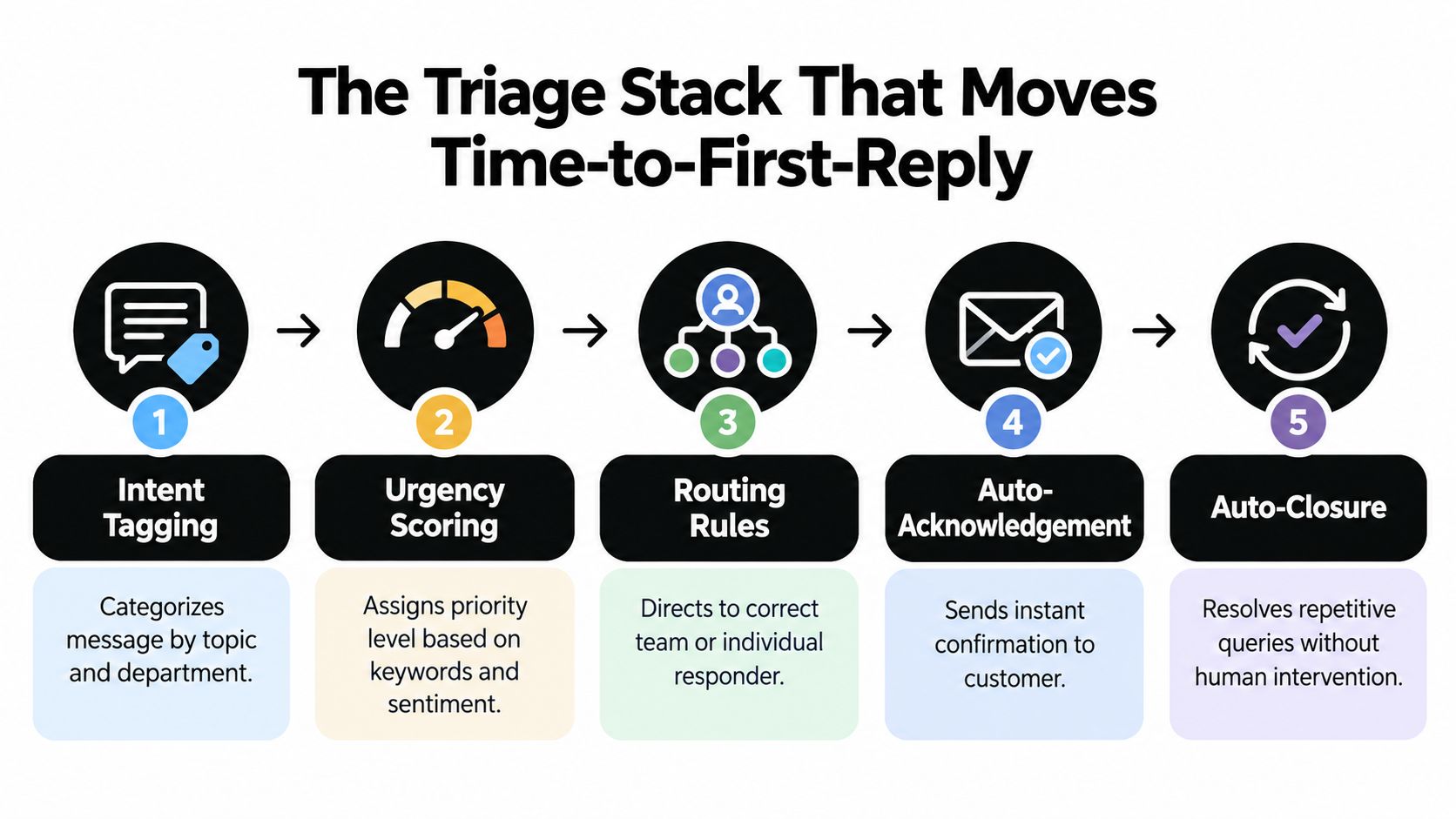
A response pipeline should reduce uncertainty in a fixed order. Start with what the message means, then decide how urgent it is, identify the owner, acknowledge predictable cases, and remove work that doesn't need a reviewer.
Five layers with five operational effects
Intent tagging turns a firehose into categories such as outage, billing, account access, feature request, spam, scam, and praise. AI can apply tags across text, images, slang, and conversation context, while operations leaders audit drift and add new intents when incidents create unfamiliar language.
Urgency scoring puts an outage, safety allegation, or regulatory threat ahead of a routine feature request. The score should use channel, sentiment, keywords, audience visibility, customer context, and conversation history. AI can rank the queue, but humans should define escalation thresholds and review false negatives.
Routing rules send the tagged item to support, finance, engineering, comms, legal, trust and safety, or community operations. Routing should preserve the original channel and conversation context, so the owner doesn't waste time reconstructing what happened.
Auto-acknowledgement handles predictable first replies when the message fits a safe template. A useful acknowledgement confirms ownership, sets an expectation, and avoids making a promise the team can't keep. It can reduce time-to-first-reply without pretending that the underlying issue is resolved.
Auto-closure removes duplicate outage reports, bot mentions, and simple thank-you replies from the active reviewer queue. It should never automatically close a plausible billing dispute, safety concern, regulatory threat, or unresolved account case.
Teams evaluating automated social workflows can use this explanation of how social media bots work to separate automation mechanics from the judgment that still belongs with people. The dashboard should show what each layer changed, including filtered volume, routing accuracy, acknowledgement rate, and the cases escalated for review.
A process video can help teams align on the sequence before they configure rules:
Humans own policy, escalation, exceptions, and final accountability. AI owns repetitive classification and drafting when the confidence is high and the consequences are bounded.
Three Scenarios Through the Same Pipeline
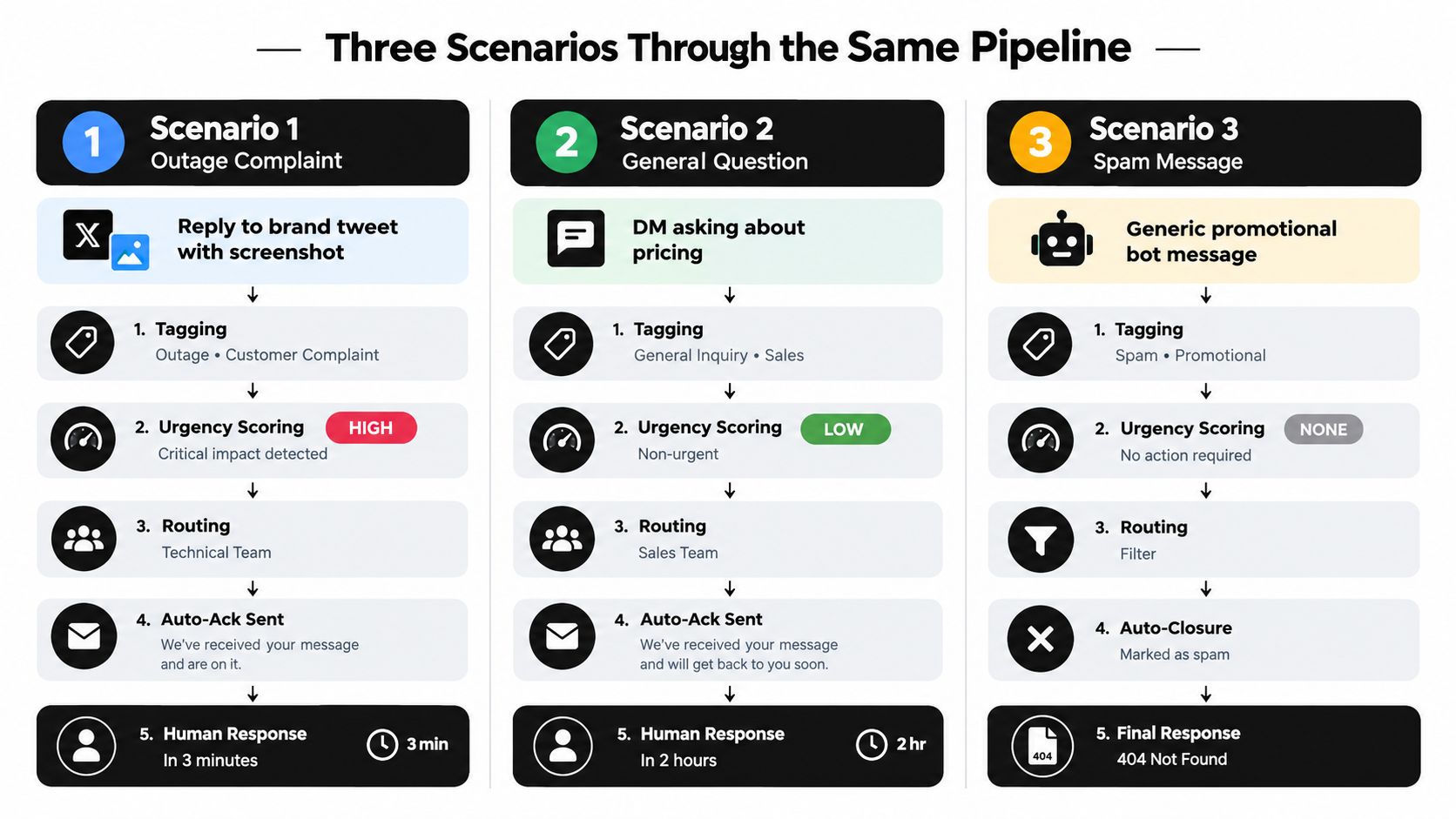
The same five-layer pipeline should produce different outcomes for different messages. That variance isn't a flaw. It shows that the system is routing work according to consequence rather than forcing every conversation through one response pattern.
An outage reply with a screenshot
A customer replies to the brand's X post with a screenshot showing a failed payment. Intent tagging marks the message as a payment issue and outage candidate. Urgency scoring raises it because the message is public, contains evidence, and may match other reports.
Routing sends the case to the on-call technical support owner and links it to the active incident. An auto-acknowledgement confirms that the team has received the report without asking the customer to repeat the screenshot. A human then decides whether the reply should include a known workaround, a status-page reference, or a private handoff.
The primary metric is time-to-first-reply, but the operational outcome also depends on escalation latency and duplicate suppression. A fast acknowledgement that reaches the wrong owner isn't a successful path.
A billing refund request in DMs
A customer sends an Instagram DM asking for a refund and includes account-level details. The system tags it as billing and refund, scores it as private account work, and routes it to finance or the designated support queue.
AI drafts a reply using approved language and the relevant policy. A human checks eligibility, verifies the account context, adjusts the tone, and sends the response. The case remains open until the refund decision and customer communication are complete.
Here, reply wait time and resolution time matter more than a superficial acknowledgement. The first response should reassure the customer, but the team must also measure how quickly the case reaches the correct decision owner.
A sarcastic macro mention
A high-follower account posts a sarcastic one-line mention that contains no request, product signal, or credible complaint. Intent classification marks it as low-intent commentary, while urgency scoring keeps it below service and risk queues.
Auto-closure can remove it from the active inbox, but only if the rule is conservative and the system records the reason. If the account has a history of influencing a crisis conversation, comms may still need an alert even when support doesn't.
The relevant KPI is noise-filtered percentage, paired with a false-positive audit. A high filtering rate isn't useful if the system hides a real PR risk. One pipeline can therefore optimize first reply for an outage, resolution for a billing case, and reviewer capacity for low-intent mentions.
Where AI Should Lead and Where Humans Must Hold the Pen
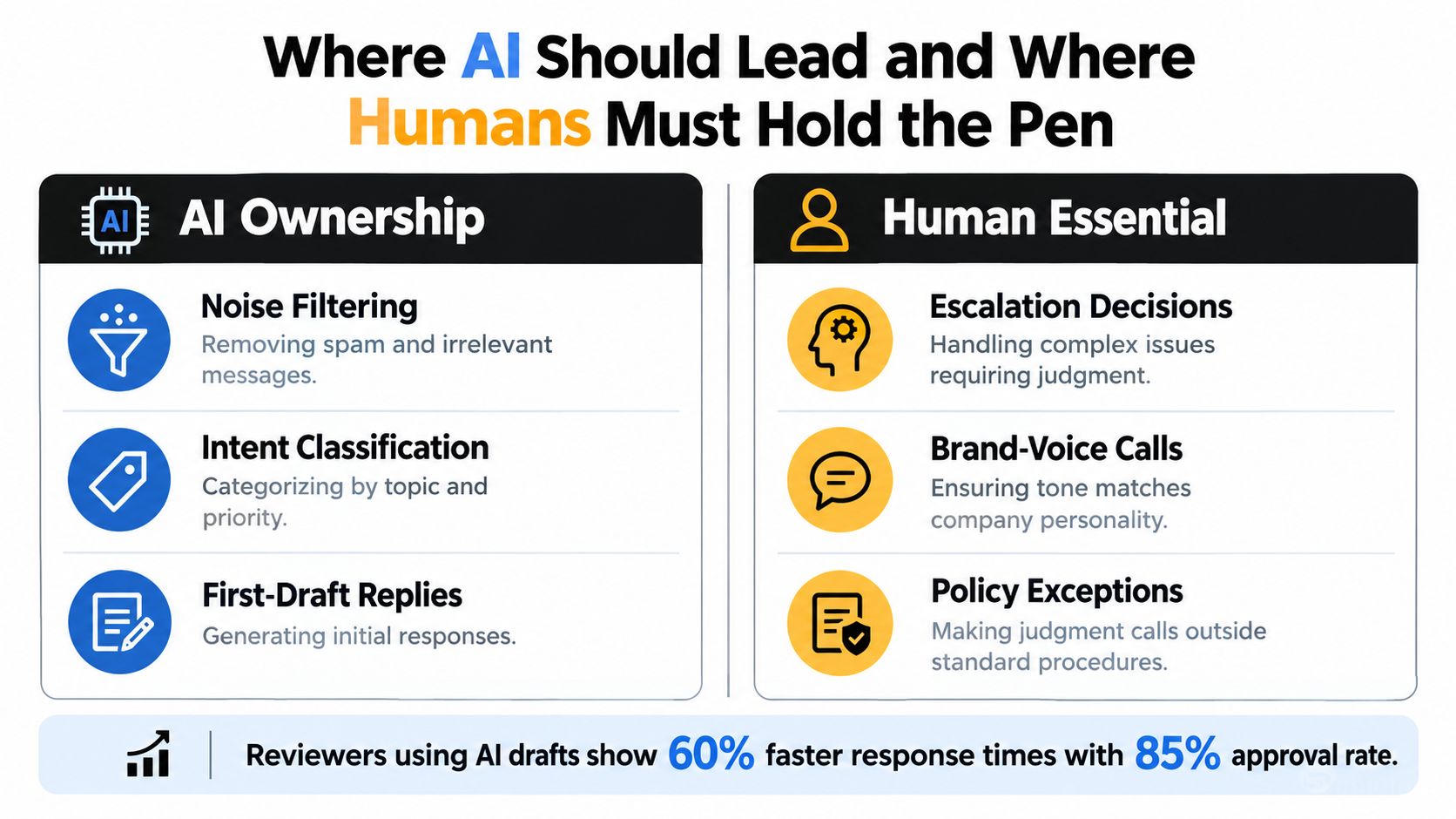
AI should remove repetitive work before it tries to make sensitive decisions. Noise filtering, intent classification, urgency ranking, translation support, and first-draft replies are strong candidates because they help reviewers reach the meaningful cases sooner. Escalation decisions, brand-voice choices, policy exceptions, and regulatory responses require accountable human judgment.
Give AI the repetitive edge
AI can auto-acknowledge a predictable delivery question with a verified tracking link, provided the customer isn't reporting a lost package or a safety issue. It can classify multilingual slang and sarcasm, identify likely scam waves, and draft a response to a common product question. It can also summarize the thread and show why it assigned a confidence score.
The agent should see the original message, the proposed intent, the urgency rationale, relevant account or incident context, and the suggested reply. A confidence score without an explanation creates false certainty. A short rationale lets the reviewer accept, edit, reroute, or reject the recommendation.
Auto-resolution should stay narrow. Shipping FAQs, duplicate outage reports, and simple thank-you replies may qualify. Refund disputes, account access, threats of regulatory action, crisis language, and unclear multilingual messages should remain reviewable.
Keep the pen with a person
Humans should own:
- Escalation decisions: whether a complaint belongs with legal, comms, trust and safety, engineering, or executive response.
- Brand-voice calls: whether a reply needs empathy, brevity, apology, explanation, or a public correction.
- Policy exceptions: whether a customer qualifies for treatment outside the standard refund, safety, or account procedure.
A human-first queue wastes reviewer attention on sorting before anyone can solve. That produces fatigue, slower handling on escalated cases, and inconsistent edits when the queue becomes repetitive. An AI-assisted model should instead track noise-filtered percentage, auto-resolution rate, and reviewer handling time for escalated cases.
The visual distinction is straightforward:
Use AI to narrow the queue and prepare the work. Use people to approve the consequences.
Turning Response Time Into a Number You Can Actually Move
A useful dashboard doesn't celebrate a low average while urgent messages wait. It shows whether the operating system is putting the right work in front of the right owner.
Review four tiles each week:
| Metric | What It Measures | Target Direction | Owner |
|---|---|---|---|
| Time-to-first-reply by channel and tier | How quickly customers receive the first visible response | Down for urgent queues, stable with quality controls | Social ops and channel leads |
| Noise-filtered percentage | Share of inbound volume removed from active review through filtering | Up, while false positives stay controlled | AI operations and trust reviewers |
| Auto-resolution rate | Share of cases safely closed without human handling | Up only for approved intents | Support operations and policy owners |
| Escalation latency | Time from detection to handoff with the correct context | Down for critical and high-risk cases | Incident, comms, legal, and support owners |
Run a weekly operating review
Start with outliers, not the overall average. Look for an X complaint that waited behind routine replies, an Instagram billing DM routed to community management, a creator mention that never reached comms, or a false auto-closure involving a real account problem.
Then audit the rule that produced the result. Was the intent taxonomy too broad? Did the urgency score ignore an image? Did the routing rule fail after business hours? Did the acknowledgement copy create a second customer reply because it didn't answer the immediate question?
Finally, sample auto-closures and re-score drifting intents. If multilingual slang, sarcasm, memes, and new scam patterns are changing the queue, update the model inputs and reviewer guidance. A small rule change can move the median first response time without anyone typing faster.
Use this Monday checklist:
- Audit channel SLAs: Separate public complaints, DMs, communities, and lower-priority information requests.
- Place AI before the human queue: Filter noise, tag intent, score urgency, and route with context.
- Instrument the four tiles: Keep time-to-first-reply, noise-filtered percentage, auto-resolution rate, and escalation latency visible.
- Review on a fixed cadence: Inspect outliers, false positives, routing failures, and policy exceptions every week.
- Protect human review: Keep high-risk, ambiguous, and brand-sensitive cases out of unattended automation.
Response time becomes controllable when the team can identify which rule, owner, or handoff moved it. The objective isn't a faster average. It's a queue where urgent customers receive timely ownership, routine work doesn't exhaust reviewers, and resolution data proves whether the first reply led anywhere.
Sift AI brings social and community channels into one command center, filters noise, tags intent and urgency, routes cases to teams such as support, finance, engineering, and comms, and drafts replies for human approval. If your team needs to turn social media response time into a measurable triage system, visit Sift AI and evaluate the workflow against your channel SLAs.