Enterprise Social Media Moderation: A Practical Guide
"Master enterprise social media moderation with AI, human workflows, and scalable ops. Learn routing, compliance, and escalation strategies for modern brands."
At 9:07 on a Monday morning, an outage turns a routine support queue into a public incident. Customers post billing complaints in X replies, frustrated users send screenshots through Instagram DMs, and a spam wave floods your Discord with fake recovery links. While agents fight through duplicate messages, an important escalation sits unanswered, and the communications team learns about the issue from a viral post rather than from social care.
That isn't a filtering problem alone. It's an orchestration problem involving triage, tagging, routing, escalation, response time, brand voice, and human judgment. Enterprise social media moderation works when support, trust and safety, community, product, engineering, finance, and comms can act from the same operational picture.
Table of Contents
- Why Social Media Moderation Needs an Orchestrated Approach
- Understanding Human, Automated, and Hybrid Moderation Models
- Designing Effective Moderation Policies and Workflows
- Handling Diverse Content Modalities and Language Challenges
- Navigating Legal and Compliance Requirements in Moderation
- Measuring Moderation Performance with Key Metrics and Reporting
- Scaling Moderation Operations Across Multiple Channels
- Best Practices for Sustainable Social Media Moderation
Why Social Media Moderation Needs an Orchestrated Approach
During an outage, volume isn't the only problem. The same event creates several different work types at once. A billing complaint needs support or finance. A technical failure needs engineering. A coordinated scam wave needs trust and safety. A post from a high-reach account may need communications or PR review before anyone replies.
A traditional moderation queue treats these interactions as similar because they arrive through the same channel. A unified operation treats them according to intent, urgency, risk, and ownership. X, Instagram, TikTok, Discord, Telegram, WhatsApp, and forums can feed one command center, where teams see the original message, conversation history, attachments, account signals, and previous actions together.

The inbox must separate noise from consequence
AI is useful for identifying duplicates, tagging likely intent, detecting urgency, and grouping related conversations. It can move repetitive delivery questions toward a standard response while elevating a potential account takeover, a legal threat, or a surge of fraudulent replies.
It shouldn't decide every difficult case. Sarcasm, political criticism, slang, screenshots, memes, and emotionally charged complaints often require context that a classifier can't safely infer. A human reviewer should approve risky removals, sensitive replies, crisis escalations, and exceptions to standard policy.
Operational rule: Automate sorting and preparation first. Automate enforcement only where the policy is clear, the harm is limited, and a reviewer can correct the decision.
This approach also changes what leaders see. Instead of reporting only deleted posts or inbox volume, social ops can report unresolved billing issues, finance escalations, engineering-impacting complaints, scam clusters, response-time breaches, and conversations that need executive attention. Moderation becomes part of customer operations and reputation management, not a siloed cleanup task.
Understanding Human, Automated, and Hybrid Moderation Models
The three moderation models differ less by ideology than by where they place judgment.
| Model | What it handles well | Where it fails |
|---|---|---|
| Human moderation | Context, sarcasm, local language, exceptions, appeals | High volume, repetitive work, reviewer fatigue |
| Automated moderation | Fast filtering, duplicate detection, obvious spam, first-pass tagging | Ambiguity, new threats, cultural context, nuanced policy decisions |
| Hybrid moderation | Scale with human review for uncertainty and risk | Requires clear policies, good routing, calibration, and oversight |
A fully human model can understand why a customer writes “great, another payment failure” and distinguish sarcasm from praise. It can inspect an image, review the conversation, and notice that a repeated complaint is legitimate rather than spam. The trade-off is speed and consistency. During a surge, reviewers may spend their time on duplicates while high-risk cases wait.
A fully automated model offers the opposite advantage. It processes volume quickly and applies consistent rules to obvious content. But commercially available text-based content filters reviewed by the Center for Democracy and Technology achieved approximately 70 to 80 percent accuracy, according to the empirical research on internet platforms and content moderation. That makes automation useful for first-pass triage, not a safe autonomous enforcement layer.
Why hybrid systems fit enterprise operations
A hybrid workflow assigns different jobs to different components:
- AI filters volume: It detects likely spam, groups duplicate outage complaints, extracts claims, and identifies intent.
- Rules enforce certainty: Clear scam patterns, repeated unsolicited replies, and known policy violations can follow predefined actions.
- Humans resolve ambiguity: Reviewers assess sarcasm, satire, local slang, disputed claims, and high-impact enforcement.
- Leads own exceptions: Trust and safety, comms, finance, or engineering decide cases that affect customers or reputation.
Teams that monitor audience quality can also use a fake follower checker when investigating suspicious account activity, coordinated engagement, or unusual reply patterns. That signal shouldn't determine whether a complaint is genuine, but it can help reviewers understand whether a sudden interaction wave looks organic or manipulated.
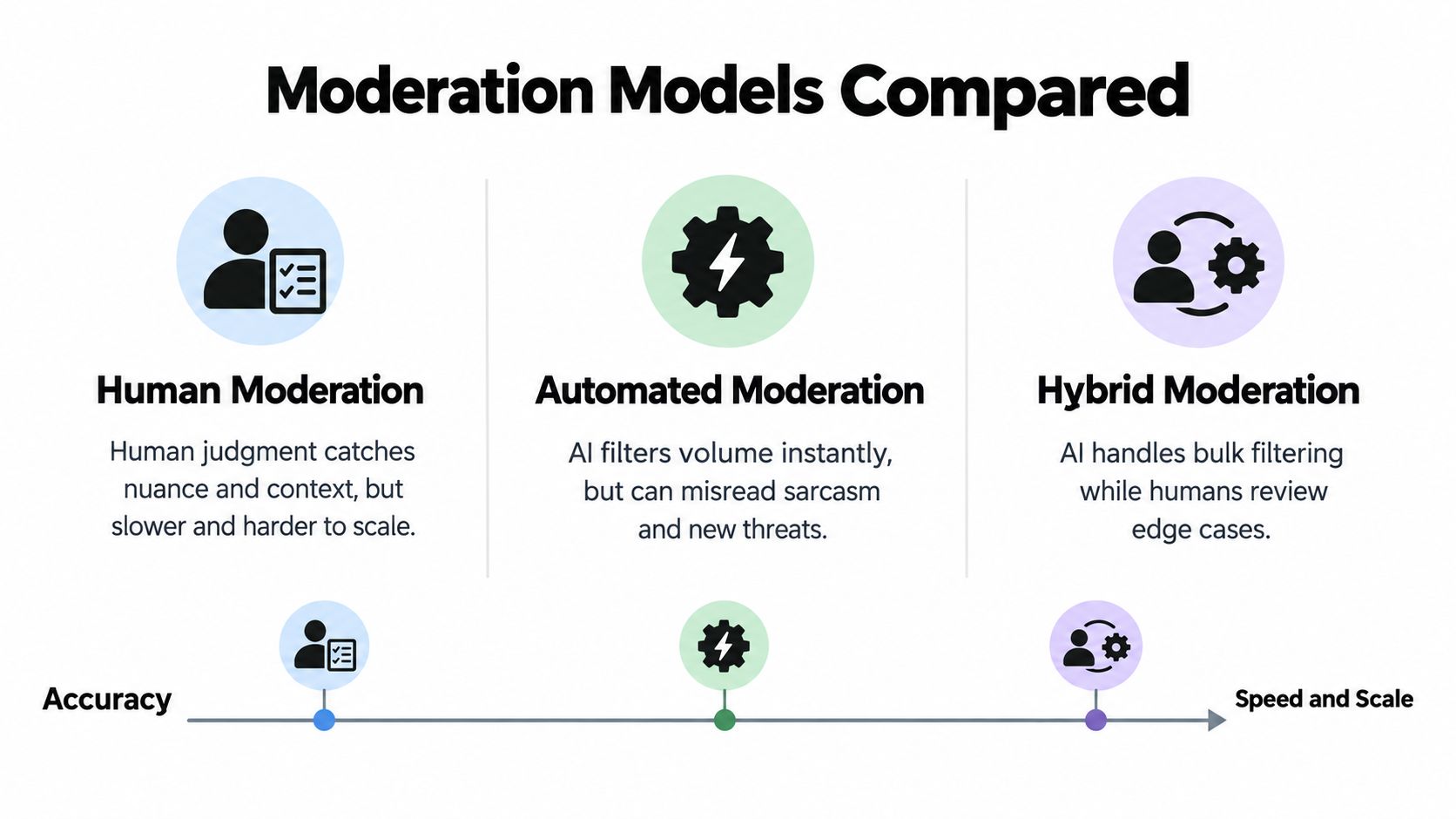
The strongest design separates detection from adjudication. An AI agent can flag a likely misinformation claim and draft an evidence request. A trained reviewer decides whether the post violates policy and what remedy, if any, is appropriate.
Designing Effective Moderation Policies and Workflows
A moderation policy becomes operational only when a reviewer can apply it under pressure. “Be respectful” is a value. It isn't enough to route a threatening reply, a billing dispute, or a coordinated spam campaign.
Start with behavior categories that map to an action and an owner:
- Customer issue: Preserve the conversation, tag the intent, and route billing matters to support or finance.
- Product signal: Capture the feature request or defect and route it to product or engineering without closing the social thread prematurely.
- Abuse or safety risk: Restrict exposure where policy allows, preserve evidence, and escalate to trust and safety.
- Reputation or crisis signal: Notify communications, apply the approved response protocol, and avoid improvised claims.
- Spam or manipulation: Suppress repetitive unsolicited activity while protecting genuine complaints from automated closure.
Write policies reviewers can actually use
For each category, define the trigger, allowed response, prohibited response, escalation owner, evidence requirement, and appeal path. Include examples of borderline cases. A repeated copy-paste reply may be spam, but a customer repeating the same unresolved billing complaint may be signaling that the first response failed.
X's platform rules and policies explicitly classify repeatedly posting duplicated or unsolicited replies to many accounts as spam behavior. That distinction matters in a unified inbox. Tag repetition and coordination as risk signals, but don't treat repetition alone as proof that a customer interaction is illegitimate.
Configure routing around consequences
Routing should answer “who can resolve this?” rather than “which channel did this arrive from?” A feature request in a TikTok comment may belong with product. A leaked personal detail in a forum post may need trust and safety. A high-reach complaint about a failed payment may require support, finance, and comms at the same time.
Document the workflow in a policy library, then test it against real historical conversations. Review false positives and false negatives with the teams that receive the escalations. Teams comparing tools can consult this overview of top social media management platforms, but the deciding factor should be workflow depth, auditability, integrations, and routing control, not the number of publishing features.
Handling Diverse Content Modalities and Language Challenges
Text, images, memes, and multilingual conversations require different review methods. A keyword filter may catch “refund,” but it won't reliably understand a screenshot of a failed transaction, a meme that implies a threat, or slang that changes meaning within a community.
For text, combine intent classification with conversation history. A single phrase might look abusive in isolation but be a quote from a support agent, a lyric, or a sarcastic response. For images, preserve the attachment and inspect visible text, logos, faces, product screens, and context. OCR and image classification can assist, but reviewers need the original media because extracted text rarely captures the whole meaning.

Translation isn't the same as understanding
English-first moderation often creates a dangerous illusion of coverage. Recent research on Amharic and Afan Oromo found that a widely used generic hate-speech classifier detected only about one-tenth of hate speech after English translation, showing that under-detection can dominate multilingual moderation failures. The finding is documented in research on Amharic and Afan Oromo hate-speech detection.
Translation can remove precisely the context a reviewer needs. Code-switching, dialect, reclaimed language, sarcasm, and political references may disappear or become misleading after translation. A translated message should support review, not replace language-specific evaluation.
Build a language-aware escalation path
Track whether a case is low confidence, unsupported, or ambiguous. Those labels mean different things operationally. Route uncertain content to reviewers with relevant language and cultural knowledge, and maintain evaluation sets for the languages and dialects your customers use.
The same principle applies to memes and visual jokes. Don't auto-close a post because it resembles a known spam template. Preserve the surrounding thread, account history, media, and user intent, then let a reviewer decide when the consequence is meaningful.
Navigating Legal and Compliance Requirements in Moderation
Compliance starts with an evidence trail. For every meaningful decision, retain the original content, timestamp, channel, policy category, detection method, action taken, reviewer or system identity, explanation, appeal status, and final outcome. A deleted post without a reason is difficult to audit, defend, or correct.
The European Union's Digital Services Act provides a useful example of this direction. Since the DSA began applying to designated very large online platforms in 2023, providers have reported moderation decisions to a public database. A research dataset covering a two-month period collected 156 million statements of reasons, records explaining why platforms acted against content, as documented in research on the DSA moderation database.
Treat explanations as operational records
A reason code should be specific enough for a reviewer, customer, auditor, or appeals team to understand. “Policy violation” is weak. “Repeated unsolicited replies matching the spam policy” is more useful because it identifies the behavior and the rule applied.
Keep policy versions attached to decisions. If the policy changes, teams should still be able to see which version governed an earlier action. Access controls matter too. Social care agents may need customer context, while trust and safety reviewers may need moderation evidence that shouldn't be visible to every role.
Design the appeal before the takedown
Appeals aren't just a legal formality. They are a quality-control mechanism. Give users a meaningful reason, a way to submit context, and a route to human review for consequential decisions. Track the original action, appeal reason, reviewer decision, remedy, and time to resolution.
A mature workflow also protects against abuse of reporting tools. Coordinated reports can target legitimate criticism, while automatic enforcement can amplify a mistaken classification. Preserve the content and decision history so reviewers can identify manipulation without treating every report as proof of wrongdoing.
Measuring Moderation Performance with Key Metrics and Reporting
A moderation dashboard should explain whether the operation is getting safer and more useful, not merely busier. Start with the journey from intake to outcome:
- Response time: Measure first acknowledgment separately from full resolution, then segment by channel, intent, and urgency.
- SLA adherence: Show which queues miss targets and whether the cause is volume, routing, staffing, or approval delay.
- Auto-closure rate: Review what gets closed automatically and sample outcomes instead of treating a higher rate as automatically better.
- Escalation rate: Identify whether escalation reflects healthy risk control or poor first-pass classification.
- Appeal reversal rate: Use reversals to find unclear policies, weak evidence, or over-aggressive automation.
- False positives and false negatives: Separate legitimate content removed from harmful content left visible.
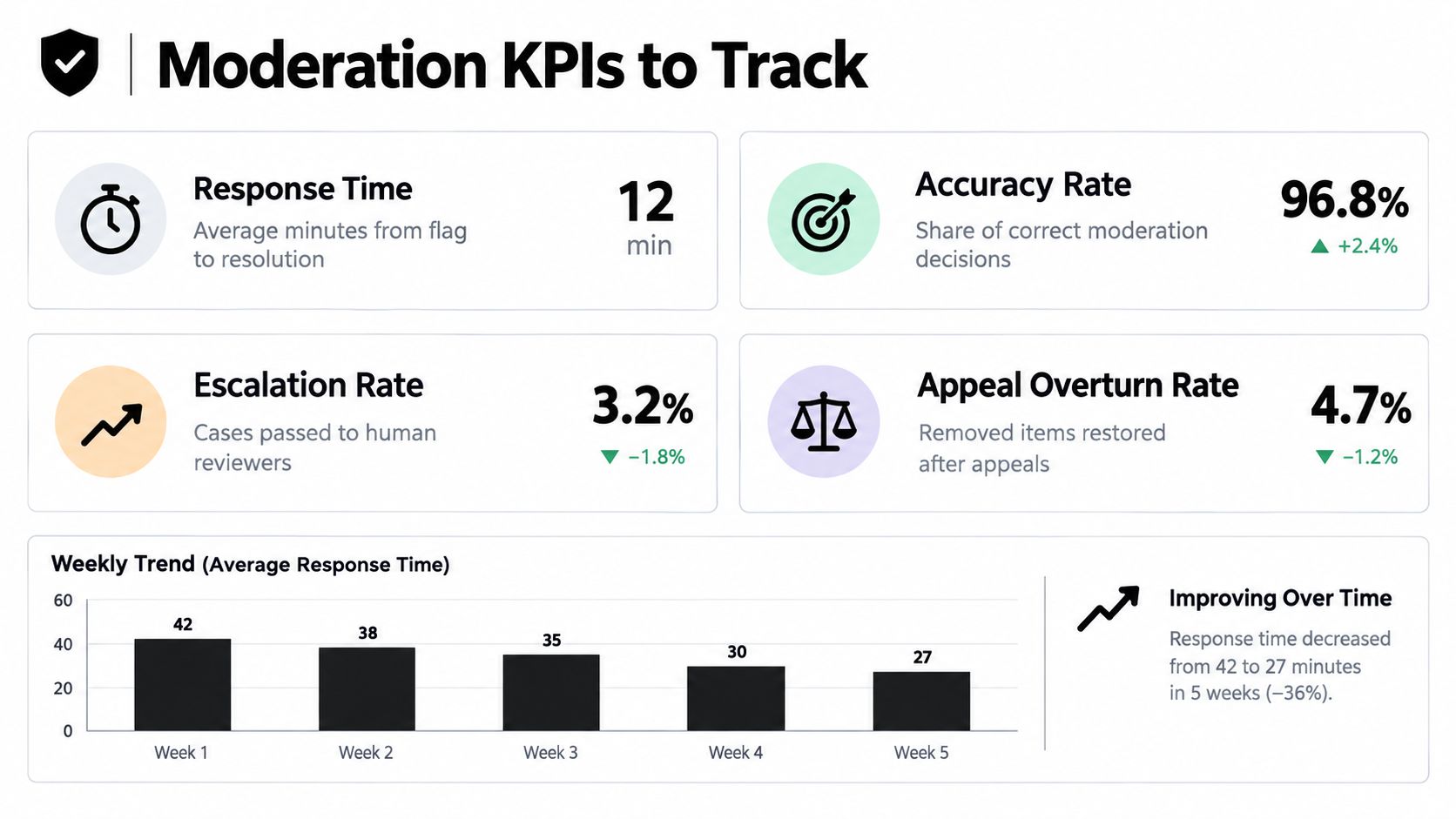
Accuracy alone hides the operational trade-off. False positives create unnecessary appeals and frustrate customers. False negatives leave scams, abuse, or reputational threats in public view. Review precision, recall, class-specific error rates, reviewer overrides, and outcomes by language and content type.
A useful executive view: Show volume, risk, ownership, SLA performance, and remedy together. A queue that closes quickly while missing finance escalations isn't efficient.
Use dashboards to trigger action. If X response time rises during an outage, add surge routing. If auto-closure performs poorly for billing complaints, narrow the rule. If one language produces repeated reviewer reversals, adjust thresholds and add qualified review capacity.
Watch this practical overview of moderation KPI reporting to see how a performance view can connect response time, accuracy, escalation, and appeal outcomes.
Scaling Moderation Operations Across Multiple Channels
Scaling doesn't mean sending more content through the same queue. It means giving every channel a consistent policy layer while preserving the context each channel requires. X may produce rapid public replies during an outage. Discord may contain coordinated scam activity. WhatsApp or Telegram may carry private support conversations that need different access controls.
A unified inbox helps teams normalize intake without flattening the work. AI can group duplicates, identify intent, draft a reply, and route the conversation. Humans should still approve high-risk enforcement, sensitive customer responses, crisis statements, and uncertain multilingual or visual cases.
Model calibration must be continuous. Sample auto-closed conversations, compare predictions with reviewer actions, inspect appeals, and update thresholds by harm category. A model that works for obvious spam may be too aggressive for sarcasm or too weak for a new scam pattern.
Scale with control: Expand automation only after you can explain its errors, reverse its decisions, and identify who owns the exceptions.
Global operations need local review capacity, not just translated policies. Give regional teams a way to flag cultural mismatches, new slang, and emerging abuse patterns. Feed those reviewed examples back into policy and evaluation processes rather than treating them as isolated tickets.
Best Practices for Sustainable Social Media Moderation
Sustainable moderation protects both customers and the people doing the work. It reduces repetitive effort without hiding difficult decisions, gives reviewers enough context to act confidently, and makes mistakes visible before they become recurring incidents.
Build the operation around these practices:
- Keep humans accountable: Let AI prepare, classify, and prioritize. Assign people to approve consequential actions and own escalations.
- Route by intent: Send billing complaints to support or finance, product feedback to engineering, reputation risks to comms, and abuse signals to trust and safety.
- Review the edges: Sample auto-closed cases, appealed decisions, low-confidence classifications, and content from under-supported languages.
- Maintain policy discipline: Version policies, document examples, and update workflows when products, threats, or community norms change.
- Protect reviewer quality: Use clear queues, escalation criteria, role-based access, and manageable review workloads.
- Engage before crisis: Publish useful status updates, answer recurring questions, and turn repeated feature requests into structured product signals.
The strongest teams measure remedy, not removal volume. European Commission reporting on the DSA states that, since 2024, users have appealed more than 165 million platform decisions through internal complaint mechanisms, and almost 30 percent of those decisions were reversed, according to the European Commission's DSA impact reporting. That is a reminder that speed without review can move mistakes downstream.
Social media moderation should leave your organization with fewer blind spots, clearer ownership, and better customer outcomes. The practical architecture is straightforward: centralize conversations, filter noise, tag intent, route by consequence, preserve evidence, and keep humans responsible for the calls that require context.
Sift AI brings social and community conversations from channels such as X, Instagram, TikTok, Discord, Telegram, WhatsApp, and forums into a unified inbox, where AI can filter noise, tag intent, draft replies, and route issues to support, finance, engineering, comms, or trust and safety. Visit Sift AI to see how your team can build a human-in-the-loop moderation operation with clearer escalations and more actionable reporting.