10 Moderation Examples for Social Teams
"Explore 10 moderation examples for triage, tagging, routing, escalation, and resolution across social channels with human-in-the-loop AI tactics."
Your unified inbox is filling faster than your team can reason through it. A billing complaint arrives in an X reply while an outage creates a surge across Instagram, a scam wave spreads through Discord, and a routine product question sits unnoticed in a WhatsApp thread. None of these messages should follow the same path.
Useful moderation examples show the full operating chain, not just whether content gets removed. The team detects context, separates noise from intent, applies a precise tag, routes the item to the right owner, escalates when the risk justifies it, and measures what happened afterward. That means protecting support SLAs, reducing reviewer fatigue, and keeping consequential decisions with people.
Sift AI provides the operating layer for that work. It can unify conversations across social and community channels, interpret text and context, draft replies, cluster related signals, and surface the cases that need support, finance, engineering, communications, or trust and safety. The practical model is orchestration, not replacement. AI handles repetitive classification and triage, while humans approve exceptions and own judgment-heavy outcomes.
Table of Contents
- 1. Billing Complaint Triage in Social Replies
- 2. Outage Response and Surge Detection
- 3. Spam and Scam Wave Detection
- 4. Feature Request Extraction and Routing to Product
- 5. Multilingual Sentiment and Slang Interpretation
- 6. PR Risk Detection and Escalation
- 7. Auto-Closure and Response Time Optimization
- 8. Community Forum Moderation and Spam Prevention
- 9. Brand Safety and Advertiser-Unsafe Content Prevention
- 10. Crisis Escalation and Executive Notification
- 10 Moderation Use Cases Compared
- Turn Moderation Signals Into Operating Rules
1. Billing Complaint Triage in Social Replies
A post about a failed payment can look like an ordinary mention until the system understands frustration plus financial impact. “My card was charged twice” should not sit behind compliments, campaign replies, or generic spam. It needs a financial tag, a clear owner, and a tighter SLA than a routine product question.
A unified inbox can detect the billing intent in an X reply, attach account context where permitted, and route the case to finance or a billing specialist. The AI can draft a response that acknowledges the issue without promising a refund before a human checks the transaction. That keeps the public reply helpful while moving sensitive account work into a private channel.
Follow the issue to resolution
Consider a customer reporting a duplicate charge on a public post. The workflow should be:
- Detect intent: Identify payment failure, duplicate charge, renewal, refund, or cancellation language, including indirect descriptions of financial harm.
- Tag priority: Apply financial, urgent, and account-value tags where that information is available under your access controls.
- Route ownership: Send the item to billing, not a general social queue.
- Escalate carefully: Alert a supervisor when the complaint is public, repeated, or linked to a wider payment incident.
- Draft safely: Offer verification steps and a private handoff rather than exposing account details in the reply.
- Measure quality: Review routing accuracy, false positives, response time, and whether the customer needed to follow up publicly.
An Instagram DM about a failed subscription renewal can receive a drafted account-recovery response first. If the customer confirms a billing problem, the system routes it with the conversation history attached.
Practical rule: Billing automation should accelerate ownership, not make financial decisions without review.
2. Outage Response and Surge Detection
A ride-sharing brand sees failed ride requests spike on X in one region. Instead of answering each “your app is down” post separately, the moderation queue should detect the surge, group related complaints, and create one incident signal for product and communications.
Sift AI can cluster messages such as “I can't request a ride,” “the app won't book,” and “is the service down?” It can separate those posts from unrelated complaints and trolls, then tag the cluster with its channel, geography, affected feature, volume direction, and representative messages. Product receives evidence for incident assessment, while communications receives a draft status update for approval.
The alert should enter an on-call Slack channel with the evidence attached. Product and communications leads can confirm whether the pattern reflects an outage, approve one public response, and route individual threads to that update. Human review remains necessary for cases that look similar but involve a single account or a separate safety issue.
After confirmation, the queue can:
- Cluster duplicates: Group semantically similar complaints so reviewers see the incident rather than repetitive posts.
- Tag the failure: Distinguish login, API, payment, installation, and location issues.
- Route by role: Send technical evidence to product and the public-response draft to communications.
- Preserve exceptions: Keep refund requests, safety reports, and account-specific failures in dedicated queues.
- Measure impact: Track detection time, acknowledgement time, duplicate handling, false alerts, and SLA attainment.
Set thresholds against normal traffic. A busy Tuesday should not create an incident alert by itself. Review false positives after each incident and adjust detection with product and communications.
3. Spam and Scam Wave Detection
A phishing link can spread through comments before a reviewer sees the first report. An impersonator may copy a brand profile, while a Discord raid redirects customers into fake support conversations. Treat the event as a coordinated case, not a series of unrelated posts. Moderation must remove or restrict the content, protect legitimate customers, and give communications a clear warning to review.
Start with signals that connect the reports: shared URLs, repeated wording, copied visual identity, account age, and coordinated timing. AI can cluster the activity, tag likely phishing, impersonation, promotional spam, or harassment, then route the case to trust and safety. It can also draft a customer notice that identifies the fraudulent account or link and points users to official support. The system should not label every unfamiliar domain as malicious. Reputation data, confidence thresholds, and human review determine whether enforcement is justified.
One campaign may cross Instagram, X, Telegram, Discord, and email. Keep one case record with platform-specific evidence, proposed actions, and owners. Trust and safety can review removals and account reports, while communications approves any public claim. Customer support needs the approved guidance so agents do not issue conflicting instructions.
A customer-report flow adds coverage between automated detections. A channel button or Discord command can collect suspected scams, and AI can group similar submissions before a reviewer confirms the pattern. Related monitoring, including spam trap detection in email lists, can expose campaigns that move from social channels into email operations.
Track the operating result, not just removed posts:
- Detection: Time from the first signal to a confirmed case.
- Routing: Handoff time to trust and safety, communications, and support.
- Containment: Time to restrict content, report accounts, and publish approved guidance.
- Quality: False positives, missed variants, repeat tactics, and unnecessary customer friction.
- Resolution: Closure time and recurrence after enforcement.
Humans own mass suppression, account action, and customer-facing claims. Teams should review false positives and recurring tactics after each wave, then adjust rules and escalation thresholds.
4. Feature Request Extraction and Routing to Product
A request may surface in a reply to an old post, a support DM, a forum thread, or a Discord conversation. A manual forwarding process sends product the loudest messages, while quieter signals remain scattered across channels. AI can detect requests expressed as direct suggestions, recurring problems, or workarounds, then connect statements such as “Can we export this to accounting?” and “I waste hours moving this data manually” when they describe the same need.
The useful output is a case record, not a keyword count. Preserve the original wording, channel, customer context, and problem statement so product can inspect the evidence before choosing a solution.
For example, a developer-tool company may receive requests for API versioning support from customers on X, in support tickets, and in a community forum. The system can tag the feature area, affected workflow, customer segment, and urgency, cluster related submissions, and route a concise evidence packet to the product owner. A reviewer should separate genuinely similar needs before merging them, because one request may concern migration support while another concerns version control.
Product owns prioritization. A strategic customer may warrant discovery despite limited volume, while repeated requests may point to unclear documentation rather than a roadmap commitment. The handoff should also assign an owner and a follow-up path, so unresolved cases do not disappear after routing.
Use these status changes to keep the queue actionable:
- Detect: Identify explicit asks, workarounds, and problem statements.
- Tag: Record feature area, workflow, segment, urgency, and source channel.
- Cluster: Merge related requests while retaining distinct requirements.
- Route: Send evidence to product with an accountable owner.
- Resolve: Mark the request shipped, declined, planned, or requiring research.
- Measure: Review duplicate accuracy, product acceptance, missed requests, and manual forwarding volume.
A shared dashboard can expose recurring themes without turning popularity into an automatic roadmap. Product managers should be able to open the original conversation and explain the decision. Teams collecting storefront and social signals can pair the process with a Shopify bot filtering strategy, provided automation flags candidates and humans approve consequential product decisions.
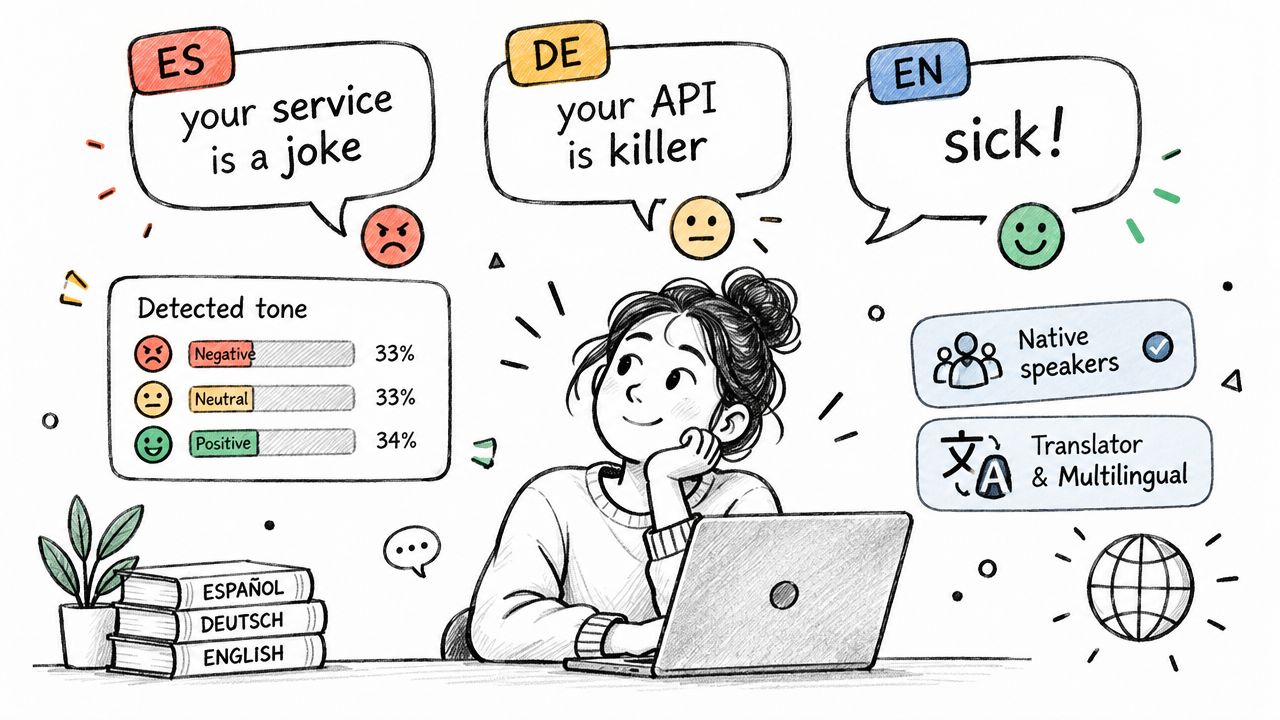
5. Multilingual Sentiment and Slang Interpretation
A Spanish customer may praise a brand while reporting a delayed order. A German phrase translated as “killer API” may express enthusiasm, while sarcasm in another language can signal frustration. Routing from translated keywords alone sends false positives to regional teams and hides potential churn signals.
Start with the original language, confidence, and conversation context. AI can detect language, interpret local phrasing, tag likely intent, and route uncertain cases to a native-speaking reviewer. Sentiment remains a supporting signal. A positive message that includes a delivery problem belongs in a time-sensitive support queue, not a marketing report.
Regional dictionaries should cover product names, delivery terms, memes, and recurring complaint patterns. Native reviewers validate slang and sarcasm, then feed confirmed interpretations back into the rules or training set. That handoff improves coverage without making English the default standard.
A practical operating path looks like this:
- Detect: Record language, confidence, channel, and available media.
- Interpret: Examine sarcasm, mixed sentiment, regional slang, and conversation history.
- Tag: Separate praise, complaint, delivery issue, refund request, and feature demand.
- Route: Send low-confidence or high-impact cases to the appropriate regional queue.
- Draft: Prepare a locally appropriate response using approved brand guidance.
- Review and resolve: Let native-speaking agents approve meaning, severity, and replies before closure.
- Measure: Compare routing accuracy, false positives, response time, and escalation outcomes by language.
A Japanese meme, Arabic voice note, or Spanish screenshot may require cultural and multimodal review. Humans should approve cases where translation could change the meaning, severity, or response obligation. AI can filter and cluster the queue, but regional owners remain accountable for consequential decisions.
6. PR Risk Detection and Escalation
A complaint can enter the social care queue and still require communications review. A journalist, executive at a major customer, or creator with a rapidly spreading video changes the response path. Reach, author, topic, and engagement velocity provide the signal, but the underlying claim determines severity.
A fintech team may detect criticism from a reporter covering compliance. AI can flag the post, collect replies and related coverage, cluster repeated claims, and route an evidence packet to communications. Legal may need access for regulatory or contractual issues. Support can handle ordinary customer follow-up. The system should draft a factual response, while comms and legal approve anything public.
Use an escalation record that answers five operational questions:
- What triggered the alert? Capture the author role, topic, sentiment, reach, and engagement acceleration.
- Who owns the next action? Tag communications, legal, support, product, or trust and safety.
- What evidence supports the risk? Preserve the original post, conversation history, related coverage, and detected claims.
- What happens after routing? Place high-risk cases in a monitored comms queue, set the response SLA, and require human approval before publication.
- How did the decision perform? Review alerts that became meaningful risks, missed signals, false positives, response time, and final outcomes.
A current journalist and stakeholder list improves routing, but follower count cannot decide whether a case is a crisis. A small account may surface a serious safety issue. Communications should examine the claim, source context, and potential consequence rather than rely on engagement alone.
After resolution, cluster follow-up posts and record whether the narrative settled, shifted, or introduced new claims. That measurement helps teams adjust detection rules without turning every negative mention into a PR escalation.
7. Auto-Closure and Response Time Optimization
A customer asks for store hours in an Instagram DM while another reports a failed login and a third requests a refund. Sending all three through one workflow creates delay and weakens accountability. Auto-closure should handle only repetitive, low-risk questions with approved answers. Account access, security, billing, and emotional complaints need human ownership.
Set up the queue so answering and closing are separate actions. AI can detect intent, attach the relevant knowledge source, draft a channel-appropriate reply, and tag the case. A reviewer can approve that draft without granting permission to close the conversation automatically.
Use a staged decision path
Begin with detection and routing. After the team reviews response quality and reopened cases, expand automation only for narrow intents with stable outcomes.
- Detect the intent: Match the request to an approved store-hours page, delivery policy, or subscription instruction.
- Tag and route: Send uncertain, consequential, or technically complex cases to the right specialist queue.
- Draft the reply: Apply the configured brand voice and channel limits.
- Check for resolution: Look for customer confirmation or a meaningful follow-up signal before closure.
- Escalate exceptions: Route bugs, billing disputes, account-access failures, and complaints with their conversation history attached.
- Review performance: Monitor response time, auto-closure rate, reopen rate, customer satisfaction, and reviewer workload.
A store-hours request can receive a fast approved answer. A login failure should reach engineering with the relevant context, rather than receive a generic FAQ and vanish from the queue. Humans should approve exceptions and own decisions that affect access, money, or safety.
Automation earns more scope when the team can explain the closure decision, find the evidence, and reopen the conversation without losing its history.
8. Community Forum Moderation and Spam Prevention
Owned communities need more than a remove-or-keep decision. A forum or Discord server can contain a useful tutorial, a genuine support question, an off-topic conversation, and a spam burst in the same minute. Moderators protect the quality of the space by surfacing signal, not by making every post pass through a rigid filter.
AI can flag likely spam and toxicity, hide high-confidence low-quality content pending review, and route genuine support questions to a help channel. It can also identify tutorials and answers worth surfacing. That positive signal matters because a healthy community depends on discoverability as much as enforcement.
Let moderators teach the system
A developer forum may suppress recurring bot posts while keeping technical questions visible. A game Discord community may route “I'm stuck on this quest” to support and leave ordinary banter untouched. The right threshold depends on local norms, member history, and the cost of a mistaken action.
Moderators should review flagged samples and record why a decision was made. Community guidelines need concrete definitions for spam, harassment, self-promotion, spoilers, and off-topic content. AI can learn from those decisions, but it shouldn't rewrite the community's standards without oversight.
The European Union's Digital Services Act transparency data illustrates the scale at which moderation now operates. Platforms filed 1,109,746,815 moderation decisions over 50 days, a median of 263 decisions per second, and about 42% were fully automated, according to the 2026 moderation statistics summary. That scale makes machine assistance practical, but it also makes review policy and appeal paths essential.
9. Brand Safety and Advertiser-Unsafe Content Prevention
Brand safety isn't identical to content removal. A post can be allowed on a platform and still be unsuitable as an advertising adjacency. An angry customer discussing a service failure, a sensitive financial topic, or a competitor comparison may need to remain visible while being excluded from a campaign context.
The workflow starts with categories defined by the advertiser and the industry. Financial anxiety, security incidents, safety complaints, competitor mentions, and tragic events may require different treatments. Don't collapse them into one unsafe label, because the correct action could be exclusion, escalation, monitoring, or no action.
Keep enforcement and adjacency separate
A ride-sharing brand might exclude ads beside posts about unsafe drivers while routing the underlying safety complaint to trust and safety. Removing the customer's post would hide a service signal and fail to address the risk.
- Detect context: Consider topic, sentiment, visuals, adjacent discussion, and campaign rules.
- Tag the risk: Distinguish advertiser adjacency from policy violation.
- Route the issue: Send safety or legal concerns to the accountable team.
- Apply the narrow action: Exclude placement without deleting legitimate user speech.
- Review exceptions: Humans approve sensitive categories and high-impact exclusions.
- Measure the system: Track false exclusions, missed risks, advertiser feedback, and response time on routed cases.
AI can filter and score the surrounding content, but brand teams should own category definitions. Review those definitions with advertising partners and update them when campaigns, markets, or risk tolerance changes.
10. Crisis Escalation and Executive Notification
A crisis workflow compresses detection, context gathering, and notification into a controlled handoff. A data-breach rumor, leadership controversy, safety incident, or major outage shouldn't sit in a general PR queue while executives wait for a manual summary.
The system should combine signals rather than alert on one keyword. “Security” alone could be a product question. Security plus a breach allegation, legal language, journalist involvement, and a volume spike deserves immediate review by communications and legal.
Give leaders a decision-ready view
A crisis alert should include the originating post, related clusters, channel spread, author context, current owner, drafted summary, and the actions already taken. Slack can serve as the dedicated notification channel, but access must follow role-based permissions. Executives need enough context to decide, not an unfiltered stream of every mention.
- Define scenarios: Document which combinations of product, legal, safety, media, and reach signals qualify for executive notification.
- Detect convergence: Look for multiple reinforcing indicators across channels.
- Tag severity: Separate executive awareness from routine escalation.
- Route immediately: Notify the designated comms, legal, product, and leadership owners.
- Keep humans in control: Require approval before public statements, broad suppression, or consequential account action.
- Review afterward: Examine detection, routing, decision time, false alarms, and missed signals after each incident.
Public enforcement programs increasingly require more than removal totals. The European Commission's updated requirements call for reporting accuracy, precision, and recall for automated moderation systems, as described in the USC overview of the transparency requirements. Those measures belong in crisis governance too, because speed without reliable classification can create a second incident.
10 Moderation Use Cases Compared
| Scenario | Complexity 🔄 | Resources required | Expected outcomes 📊⚡ | Ideal use cases | Key advantages ⭐💡 |
|---|---|---|---|---|---|
| Billing Complaint Triage in Social Replies | High, requires intent models + account linking | CRM/billing integration, finance routing, multilingual models, social care team | 📊 Faster routing; reduced churn; SLA <2h; ⚡ first-response often <2min | Subscription services, high-LTV customers, billing-sensitive brands | ⭐ Prevents chargebacks; provides enriched account context; tip: tag by customer value |
| Outage Response and Surge Detection | Medium–High, real-time spike + clustering pipelines | Monitoring hooks, cross-channel ingestion, comms & product on-call | 📊 Rapid first public statement (<5min); deduplication reduces reviewer load; ⚡ alerts in <1min | Consumer apps, platforms with real-time availability concerns | ⭐ Orchestrates single comms response; tip: predefine templates & baselines |
| Spam and Scam Wave Detection | High, URL + account clustering + cross-platform correlation | Threat intel feeds, trust & safety team, automated suppression tools | 📊 Blocks phishing quickly; mass-takedown capability; ⚡ suppresses waves in minutes | Financial services, brands targeted by impersonation/scams | ⭐ Protects users and brand; tip: integrate PhishTank/URL reputation feeds |
| Feature Request Extraction and Routing to Product | Medium, NLP for intent + deduplication | Product feed ingestion, product buy-in, aggregation dashboard | 📊 Consolidated feature signals; prioritization by demand; reduces manual forwarding | SaaS, developer tools, product-led companies | ⭐ Surfaces real customer demand; tip: route only 3+ occurrences or high-value requestors |
| Multilingual Sentiment and Slang Interpretation | High, multilingual NLP, sarcasm & meme understanding | Native speakers, localized training data, continual retraining | 📊 Fewer false positives; accurate routing in non‑English markets; ⚡ reduces misrouted cases | Global brands operating in 5+ languages | ⭐ Prevents missed churn signals; tip: maintain regional slang dictionaries |
| PR Risk Detection and Escalation | Medium, influence scoring + engagement velocity | Journalist database, comms/legal workflows, threshold tuning | 📊 Early PR warnings; faster comms responses; ⚡ notification within minutes | Consumer brands, regulated industries, public companies | ⭐ Early detection of high-impact mentions; tip: pre-stage comms templates |
| Auto-Closure and Response Time Optimization | Medium, confidence scoring + template matching | Template library, response-quality monitoring, social care oversight | 📊 Faster answers (<5min for simple Qs); frees 30–40% capacity; ⚡ immediate auto-answers | High-volume support with repetitive FAQs | ⭐ Improves SLA compliance; tip: start with 95%+ confidence threshold |
| Community Forum Moderation and Spam Prevention | Medium, toxicity + topic classification | Moderation team, tuning per community, review workflows | 📊 Healthier community; reduced moderator load; surfacing quality content | Large forums, Discord/Slack communities, developer hubs | ⭐ Scales moderation effort; tip: surface high-confidence flags to mods first |
| Brand Safety and Advertiser-Unsafe Content Prevention | Medium, context scoring + ad integration | Ad-platform API access, brand safety taxonomy, advertiser input | 📊 Fewer unsafe ad placements; preserves user content; ⚡ real-time exclusions | Brands running ads on UGC platforms and marketplaces | ⭐ Protects ad ROI and reputation; tip: start with conservative exclusion categories |
| Crisis Escalation and Executive Notification | High, composite crisis signal + audit trails | Cross-functional crisis team, pre-defined playbooks, alert channels (Slack/SMS) | 📊 Executives alerted within minutes; aligned, faster decisions; ⚡ compresses time-to-decision | Enterprises needing executive visibility for reputation/legal risk | ⭐ Compresses decision time; tip: tune thresholds to avoid alert fatigue |
Turn Moderation Signals Into Operating Rules
The strongest moderation examples share one operating pattern. First, detect the message in context, not through a keyword alone. Then apply a precise tag that describes intent, urgency, channel, language, risk, and likely owner. Route the item according to team responsibility and SLA. Escalate only when the evidence crosses a defined threshold. Let a human approve consequential actions, including public statements, financial decisions, account sanctions, and broad content suppression.
Measurement should continue after resolution. A takedown count can show activity without showing whether the team protected customers or reduced harm. Research on Facebook's moderation during the U.S. Capitol riot recommended examining how long harmful content remained active, how many people saw it before removal, and how much engagement it received, as described in the Capitol riot moderation case study. Those delayed-removal measures are useful for social operations because they connect queue performance to real-world exposure.
A practical rollout starts with low-risk, high-confidence work. Unify X, Instagram, TikTok, Discord, Telegram, WhatsApp, forums, and other priority channels in one inbox. Add intent tagging, duplicate clustering, spam filtering, and ownership routing before enabling automatic actions. This gives the team a baseline for routing accuracy and reviewer fatigue.
Next, introduce AI-drafted replies for common support intents. Keep billing, security, safety, legal, PR, and crisis cases human-approved. Add auto-closure only for narrow intents with clear knowledge sources and a reliable reopen path. Review false positives and false negatives with the teams that own the outcomes, not only with the operations team configuring the model.
Expansion can follow once the basics are stable. Add multilingual slang and sarcasm, image and meme interpretation, voice and video context, product-signal extraction, advertiser adjacency rules, and executive alerts. A 2024 EMNLP study found that 37 of 41 moderation rules, or 90%, couldn't be handled by rule-based approaches, which reinforces the need to model context and decision types rather than relying on simplistic toxicity examples. The EMNLP research paper is especially relevant when teams design rules for implied harassment, circumvention, and context-dependent harm.
Use a scorecard that reflects orchestration:
- Noise-filtered percentage: How much repetitive or irrelevant work leaves the human queue?
- Auto-closure rate: Which intents close safely, and how often do customers reopen them?
- Response time: How quickly does each priority class receive an answer or acknowledgement?
- SLA attainment: Are billing, safety, outage, and PR queues meeting their separate commitments?
- Routing accuracy: Does each case reach the team that can resolve it?
- Escalation precision: Do alerts identify meaningful risk without exhausting reviewers?
- Reviewer fatigue: Are people spending less time on repetitive work and more time on judgment?
Large-scale enforcement data from the first half of 2026 shows why volume alone isn't enough. Facebook and Instagram removed 700 million pieces of content, while Facebook acted against 2.02 billion fake accounts. The platform enforcement reporting benchmark also reports that moderation accuracy generally remained around 90% or higher, while Facebook's first-quarter accuracy ranged from 85.19% to 87.02% and Instagram's ranged from 91.19% to 92.49%. Your team doesn't need to copy those platform metrics, but it does need the same discipline of separating throughput from quality.
Sift AI can support this model with a unified inbox, context-aware tagging, routing, AI-drafted replies, moderation rules, and analytics for noise filtering and auto-resolution. The platform's role is to help teams decide what deserves attention and move it to the right owner. Humans remain accountable for the hard calls.
Sift AI unifies social and community channels, filters noise, detects intent, routes issues to teams such as finance, engineering, and comms, and drafts responses for review. Use Sift AI to turn these moderation examples into measurable operating rules for faster triage, safer escalation, and clearer ownership.