Modern Brand Health Tracking for Social Ops
"Master brand health tracking for social ops. Learn to unify surveys, social listening, and support signals into one actionable framework for enterprise teams."
Most advice on brand health tracking starts with a quarterly survey and ends with a scorecard. That approach is useful, but incomplete. A survey can tell you that consideration has moved. It usually won't tell you that a billing complaint is spreading through Instagram replies, that an outage is filling WhatsApp with duplicate reports, or that a feature request is buried under unrelated DMs.
Brand health becomes operational when perception data meets observed behavior. Social care, community, product, communications, finance, and insights teams need a shared system that shows what customers say, what they do, how urgently they need help, and who owns the next action. The objective isn't to replace research with social noise. It's to connect the two, then route meaningful signals before they become a larger customer or reputation problem.
Table of Contents
- Rethinking Brand Health for Social Operations
- The Core Dimensions of Brand Measurement
- Unifying Surveys, Social Listening, and Support Queues
- Implementing Triage, Routing, and Alerting Workflows
- Navigating Common Tracking Pitfalls and Data Silos
- Accelerating Insights with AI Orchestration
Rethinking Brand Health for Social Operations
Traditional brand tracking treats the brand as something leadership checks periodically. Social operations teams experience it as something customers test continuously. A survey respondent may report satisfaction, while the same customer posts a public complaint, opens a support ticket, and asks for help in a community forum because the promised experience failed in practice.
That difference creates a dangerous blind spot. Kantar's guidance on tracking studies notes that traditional trackers can capture stated preferences while missing real behavior, especially when data is fragmented across silos or review cycles move too slowly. A favorable consideration score doesn't explain why support agents are handling repeated refund requests. A stable recommendation metric doesn't automatically reveal a fast-moving PR risk in mentions.
Perception is only one layer
Brand health tracking still needs a consistent measurement framework. Continuous tracking has a long history, with market research companies formalizing the practice in the 1970s and Millward Brown reportedly running its first continuous tracking study in 1976. That shift replaced isolated survey snapshots with repeatable longitudinal measurement, which remains the foundation of credible brand programs.
The operational extension is to add a live signal layer:
- Survey movement shows how perception changes among a defined audience.
- Social conversation shows what people are discussing in public and owned spaces.
- Support queues expose friction, urgency, and unresolved expectations.
- Operational and commercial data helps teams test whether perception changes align with customer behavior.
These sources shouldn't be forced into one artificial score. They should be connected through shared definitions, timestamps, segments, and ownership.
Practical rule: A brand signal earns executive attention when someone can explain what changed, who is affected, what evidence supports it, and which team must act.
Turn signals into ownership
An operational brand health program asks different questions from a passive dashboard. Is this a complaint about a transaction, a product defect, a policy, or a public narrative? Does it require finance, engineering, communications, trust and safety, or frontline care? Is the volume unusual because of a campaign, a creator, a crisis, or a spam wave?
That's where triage matters. AI can filter repetitive noise, identify intent, tag urgency, and draft a response. Humans still approve sensitive replies, decide whether a pattern is material, and own escalations involving refunds, safety, legal exposure, or crisis communications.
The social ops leader's job is to make that chain visible. A quarterly survey deck can remain part of the system, but it can't be the system.
The Core Dimensions of Brand Measurement
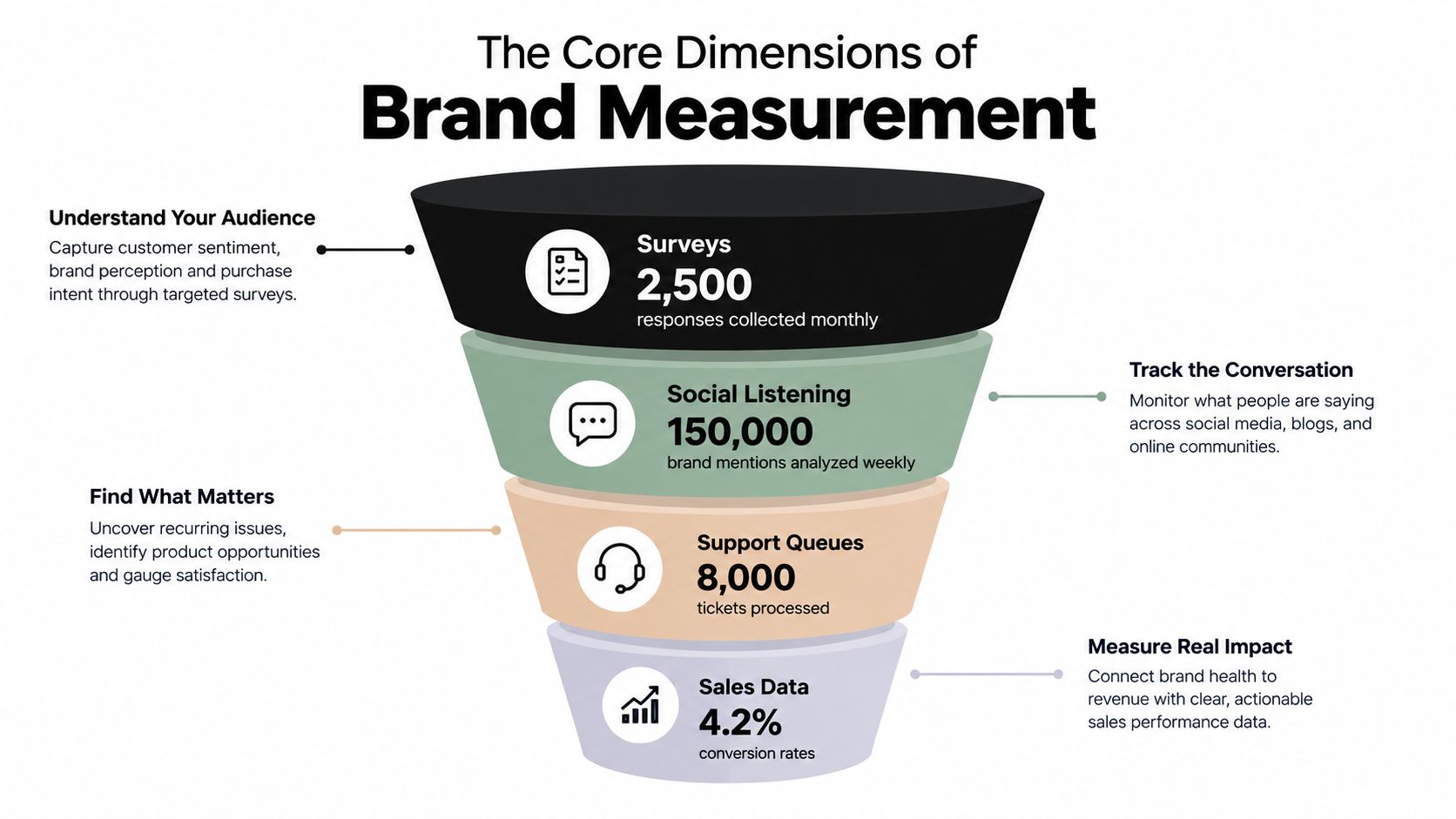
A useful framework moves from mental availability to behavior and advocacy. Brand health tracking commonly follows awareness, familiarity, consideration, preference, and recommendation over time, rather than treating a single survey result as a complete diagnosis. GWI's overview of brand health describes this repeated measurement approach as a way to compare performance against customer expectations and competitors.
The sequence matters. Unaided awareness asks whether the brand comes to mind without prompting. Aided awareness tests recognition after the brand is shown or named. Consideration, preference, usage, loyalty, satisfaction, and recommendation sit further down the relationship. Tracking these dimensions together helps teams distinguish visibility from actual choice.
Read the gaps, not just the scores
The gap between unaided and aided awareness is especially useful. If people recognize a brand when prompted but rarely name it first, the brand may have recognition without strong mental availability at decision time. That diagnosis points toward category-entry-point coverage, distinctiveness, or message clarity, not just more reach.
The same logic applies lower in the funnel. If awareness rises while consideration stays flat, more exposure isn't necessarily the answer. The problem may involve relevance, proof, positioning, or an experience that doesn't support the promise.
A longitudinal design makes these interpretations more reliable. Use repeated waves at a fixed cadence, whether monthly, quarterly, or bi-annually, and keep core wording stable. Movement can then be compared with launches, pricing changes, outages, campaigns, competitor activity, or policy changes instead of being treated as an isolated opinion.
Connect the framework to live behavior
Survey data gives you structured comparability. Social listening adds unprompted language, context, and emerging themes. Support data shows where expectations fail in a concrete interaction. Sales and retention data provide a route toward business relevance.
The relationship isn't always direct. A negative social spike may come from a meme, a coordinated spam campaign, or a temporary news event. A quiet social channel may hide serious problems among customers who contact support privately. The answer is triangulation, not replacing one source with another.
YouGov BrandIndex offers more than 20 years of historical brand data and updates daily, creating a time-series foundation for comparing brand movement across brands and markets. That historical view is valuable, but it still needs operational context. The survey trend tells you that something moved. The frontline system helps explain what customers encountered and what your organization should do next.
Unifying Surveys, Social Listening, and Support Queues
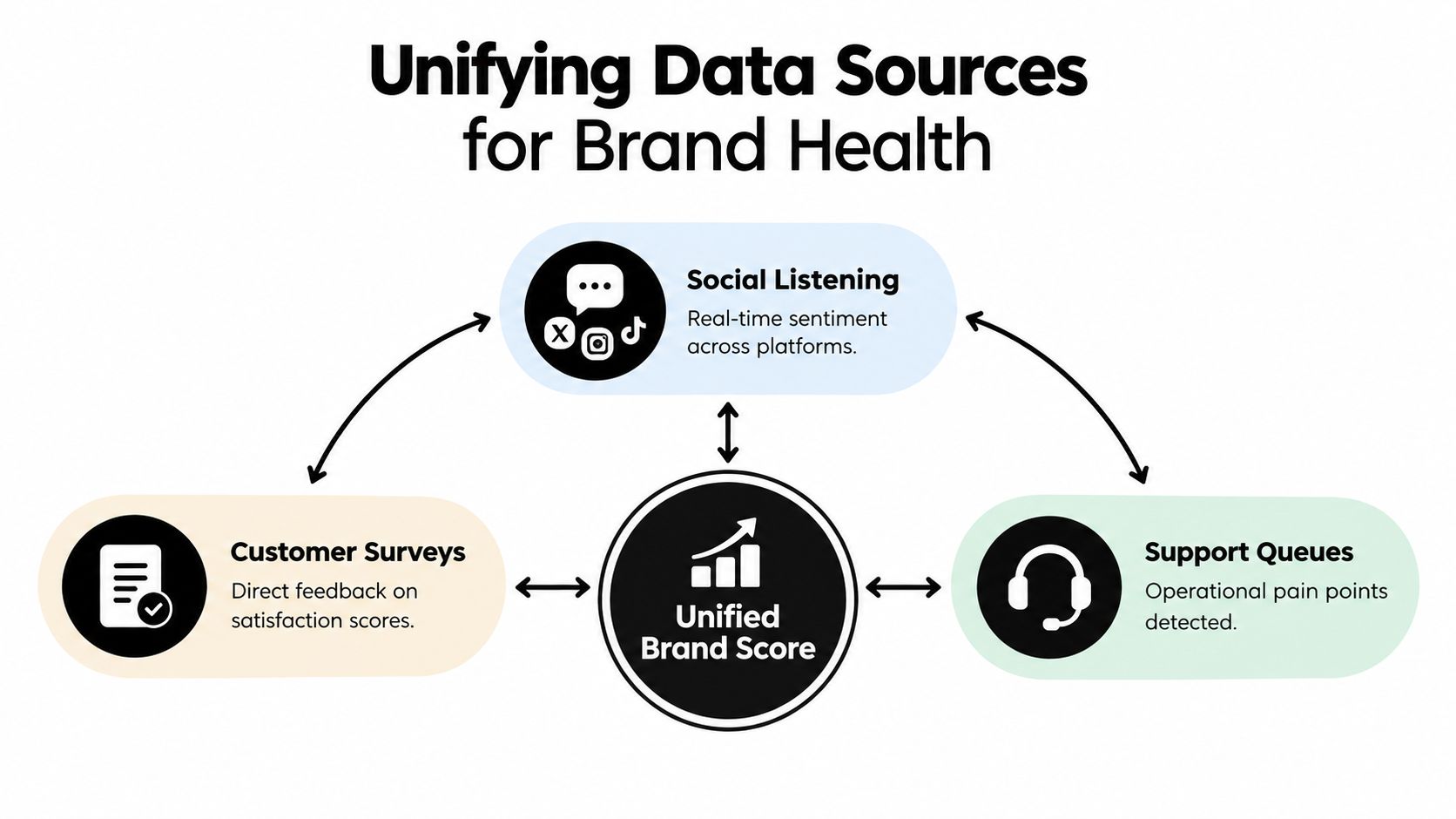
The most valuable brand health system doesn't ask social listening to impersonate a survey. It gives each source a clear job, then joins the evidence around shared themes.
Surveys provide controlled questions and comparable populations. Social listening captures spontaneous conversation across X, Instagram, TikTok, Reddit-style forums, and other communities. CRM and support queues record actual requests, outcomes, and repeat friction. Web, product, and sales analytics can test whether a perception pattern corresponds with behavior.
Build one operational view
A unified inbox consolidates DMs, comments, mentions, and reviews into one queue. For social care, that means a billing complaint in an Instagram reply and a related WhatsApp conversation can be classified under the same issue family instead of being evaluated as unrelated fragments. Community teams can bring Discord, Telegram, and forums into the same operating picture without forcing every interaction into a public social workflow.
The queue should preserve channel context while standardizing the fields executives need:
| Operational field | Why it matters for brand health |
|---|---|
| Intent | Separates support, feedback, sales questions, abuse, and PR risk |
| Topic | Connects repeated complaints to product, policy, or experience themes |
| Sentiment | Helps identify directional changes, not isolated emotional language |
| Urgency | Determines whether the issue needs immediate escalation |
| Customer status | Adds context from CRM, subscription, order, or account history |
| Owner and outcome | Shows whether the organization resolved the underlying issue |
Routing rules can classify by channel, language, sentiment, priority, or topic, then send conversations to the right agent or team. A finance queue should receive billing and refund issues. Engineering needs outage reports, crash evidence, and reproducible feature problems. Communications needs potential PR risks, coordinated narratives, and crisis escalation patterns.
Interpret language as context
Keyword matching fails in environments full of sarcasm, slang, screenshots, short videos, and memes. “Great update” may be sincere, ironic, or attached to an image showing a broken feature. A multilingual community may use local shorthand that a literal sentiment model misreads. Multimodal understanding helps, but it shouldn't remove human review from ambiguous or high-risk cases.
Use labels that describe intent and consequence, not just tone. “Negative” is a weak operational tag. “Refund blocked,” “login failure,” “policy confusion,” “feature request,” and “potential impersonation” tell downstream teams what to investigate.
The distinction between a viral spike and a sustained perception shift also depends on time and recurrence. Compare the conversation with survey movement, support contact reasons, incident records, and customer outcomes. A meme may generate attention without damaging consideration. Repeated unresolved complaints across private and public channels deserve a different response, even if overall sentiment looks stable.
Preserve the human decision layer
AI should reduce reviewer fatigue by filtering spam, grouping duplicates, and drafting routine replies. Humans should validate trend definitions, inspect representative examples, approve brand voice for sensitive responses, and decide when a pattern crosses an escalation threshold.
That division keeps the measurement system useful. Automation handles volume. People handle meaning, accountability, and exceptions.
Implementing Triage, Routing, and Alerting Workflows
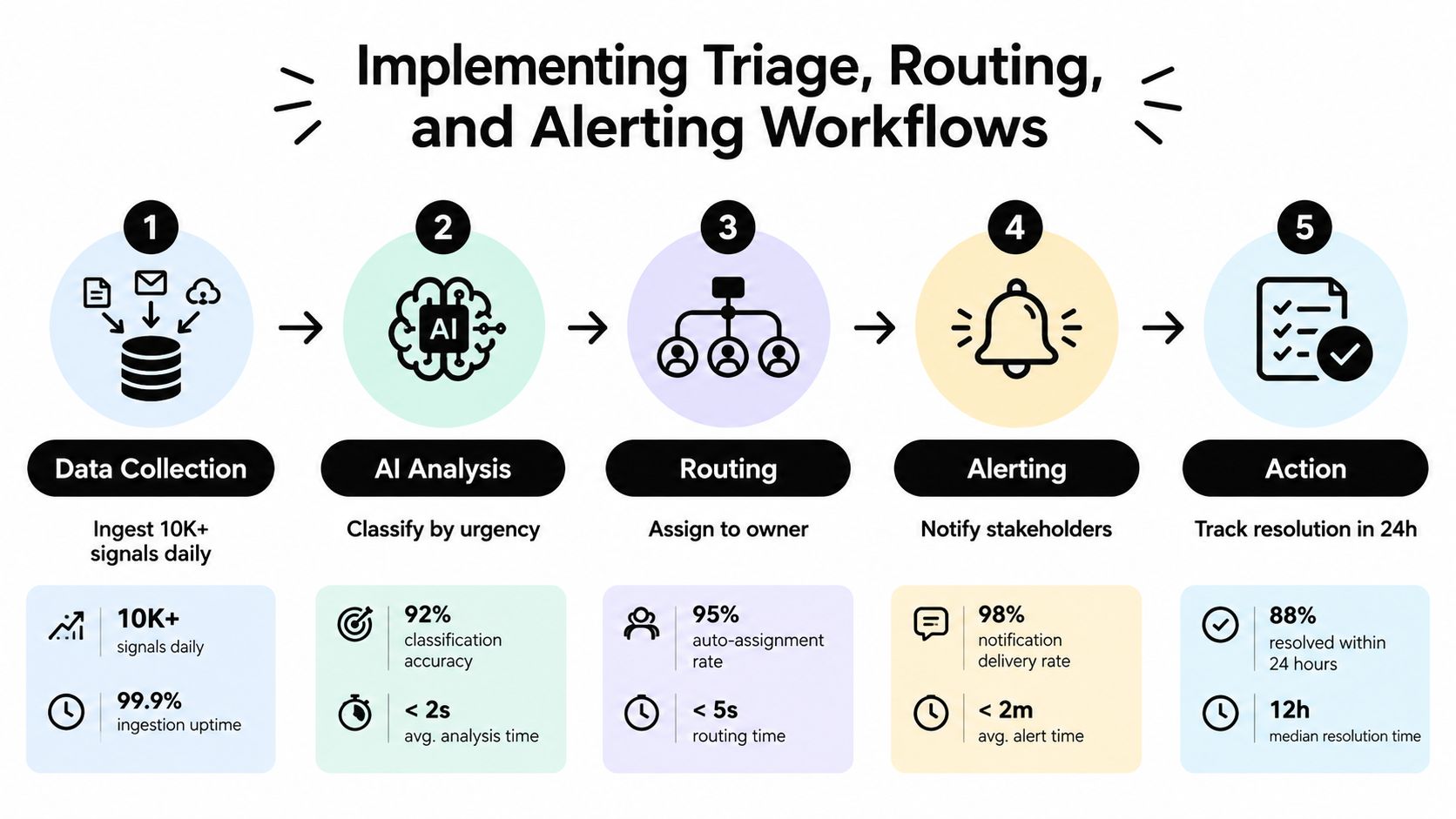
A dashboard doesn't protect a brand while an outage unfolds. The workflow must turn incoming signals into a decision, an owner, a response target, and a recorded outcome.
Start with a controlled taxonomy
Create a tag structure that reflects how your organization works. Keep top-level categories stable enough for trend analysis, then allow detail underneath.
- Intent: support request, product feedback, purchase question, complaint, praise, spam, scam, or threat.
- Topic: billing, delivery, login, outage, account access, feature request, safety, policy, or campaign.
- Urgency: routine, heightened, urgent, or crisis review.
- Destination: care, finance, engineering, product, communications, legal, or trust and safety.
- Outcome: resolved, pending customer, escalated, duplicate, abusive, or no action required.
Avoid a tag for every phrase customers use. Overly granular taxonomies create inconsistent labeling and make trend reports unreadable. Test each tag by asking whether it changes routing, prioritization, reporting, or policy. If it does none of those, remove it.
Route by consequence
Routing should reflect the cost of delay. A customer asking how to update a payment method can follow a normal care workflow. A cluster of failed charges after a billing change should notify finance and care leadership. A sudden rise in outage reports should reach engineering with examples, affected surfaces, and timestamps. A coordinated accusation in public mentions should reach communications with the source conversation and escalation history.
Channel-specific SLAs make this actionable. A social support platform example describes a 30-minute first-response SLA for WhatsApp and a 4-hour first-response SLA for email, with real-time visibility into breached or at-risk conversations and routing options such as round-robin, load balancing, and keyword assignment. See the omnichannel SLA workflow example for the mechanics.
Set the SLA from the customer promise and operational risk, not from what the queue happens to tolerate. Track first response separately from resolution. A fast acknowledgement that sends a customer into a dead end isn't a healthy outcome.
Add alerts with thresholds
Continuous alerts are appropriate for signals that can escalate quickly:
- Incident volume: repeated outage, login, payment, or delivery complaints.
- Risk language: safety allegations, fraud claims, impersonation, or legal threats.
- Narrative velocity: a new claim spreading across channels or communities.
- Owner failure: conversations approaching or breaching their response target.
- Resolution quality: repeated contacts after a supposedly resolved interaction.
Use weekly or monthly pulse checks to review emerging themes, then reserve deeper quarterly analysis for trajectory, segment, competitor, and business-outcome questions. Dynata's discussion of brand health tracking describes the value of continuous alerts, pulse checks, and deeper reviews, while recognizing that cadence should vary by category speed.
The alert should contain enough evidence to support action, including representative messages, affected channels, trend direction, related support reasons, and the proposed owner. Don't send executives a raw mention count. Send them a decision-ready signal.
For teams that need a broader view of category movements and rivals, this Hooked guide to competitor intelligence provides useful context for building monitoring around competitor narratives, not just direct brand mentions.
Close the loop
Every escalation needs a disposition. Record whether engineering confirmed a defect, finance corrected a billing process, communications issued guidance, or care updated the macro. Feed those outcomes back into tagging and alert rules.
Without outcome data, brand health tracking becomes an endless stream of observations. With it, the team can learn which frontline signals predict larger problems and which alerts create noise.
Navigating Common Tracking Pitfalls and Data Silos
The easiest way to make brand health tracking meaningless is to measure what looks busy instead of what changes decisions. Follower growth, impressions, raw mention volume, and engagement can provide context, but none explains whether customers trust the brand, can complete a transaction, or receive an acceptable resolution.
A high-volume post may attract attention without changing consideration. A low-volume issue in a high-value customer segment may matter far more. Social ops leaders should compare visibility with intent, affected customers, repeat contacts, resolution quality, and business context.
Common failure modes
| Weak approach | Operational consequence | Better discipline |
|---|---|---|
| Raw sentiment totals | Viral noise looks like a structural shift | Segment by topic, channel, audience, and time |
| One annual report | Fast incidents arrive after the decision window | Combine always-on monitoring with periodic research |
| Separate inboxes | Duplicate contacts and missed escalation patterns | Use a unified queue with shared identifiers |
| Language-blind tagging | Local slang and sarcasm distort trends | Review multilingual examples and model confidence |
| Vanity reporting | Executives see activity, not exposure or action | Tie signals to owners, outcomes, and business questions |
| Unreviewed automation | Sensitive replies create brand and compliance risk | Require human approval for complex decisions |
Data silos create a second problem. Marketing may own awareness and consideration. Care may own response time and resolution. Product may own defect volume. Communications may monitor risk. If each team uses different topic labels and time windows, leadership receives several incompatible versions of the customer experience.
Create a shared metric glossary and event calendar. Mark product releases, pricing changes, campaigns, outages, policy updates, and major media events so analysts can interpret movement against known causes. The tracker's core questions should remain stable, while operational tags can evolve as new failure modes appear.
Match cadence to market speed
Slow-moving categories can tolerate slower research cycles, while volatile digital products and communities need faster pulse checks and continuous alerts. The correct cadence separates temporary noise from a meaningful trend without forcing every signal into a crisis process.
Reviewer fatigue deserves equal attention. If agents manually inspect every mention, they'll miss the message that matters after sorting through spam, duplicate questions, scam attempts, and irrelevant replies. Measure auto-closure rate alongside reviewer sampling, escalation accuracy, unresolved volume, and SLA risk. A high closure rate is useful only when quality controls confirm that important cases weren't closed incorrectly.
Accelerating Insights with AI Orchestration
Manual triage doesn't scale across social channels and communities. It also creates inconsistent judgment, because the best agent may recognize a multilingual complaint or sarcastic meme while another reviewer files it as generic negativity. The answer isn't to hand every decision to a model. It's to put an orchestration layer between incoming volume and human attention.

An effective system ingests conversations from X, Instagram, TikTok, Discord, Telegram, WhatsApp, Facebook, and forums, then applies context-aware classification. It should identify intent, urgency, topic, language, and potential risk. It should group duplicates, filter spam and scams, route the remaining work, and draft replies that follow the approved brand voice.
That workflow makes brand health tracking more active. A feature request no longer disappears in a DM queue. A billing complaint can reach finance while care receives the customer-facing task. An outage surge can reach engineering with evidence from several channels. A PR risk can reach communications before the narrative becomes the only version visible to leadership.
Keep humans accountable
AI should automate repetitive handling, not accountability. Human reviewers need clear controls for:
- Sensitive approvals: refunds, safety issues, legal claims, crisis responses, and policy exceptions.
- Confidence thresholds: low-confidence classifications should remain visible for review.
- Role-based permissions: teams should only change workflows and data relevant to their responsibilities.
- Audit trails: leaders need to see what the system tagged, routed, drafted, closed, or escalated.
- Quality sampling: automated closures require ongoing review, especially for multilingual and multimodal content.
CRM and data synchronization connects the frontline interaction to customer history and outcome. That lets insights leaders distinguish a first-time complaint from repeated failure, and lets executives see whether operational friction is concentrated in a product, market, or customer group.
Sift AI is one example of this operating model. It combines a unified inbox with AI-powered tagging, routing, escalation, drafted responses, multilingual and multimodal interpretation, CRM and data sync, configurable brand voice, and analytics for noise-filtered conversations, auto-resolution, and proactive saves. Its role is to organize attention and evidence, while people approve difficult responses and decide what the organization should change.
The system should support the measurement framework rather than create another isolated dashboard. Connect operational tags to survey dimensions, incident categories, product themes, and executive priorities. Then review not only whether sentiment moved, but whether the team found the cause, routed it correctly, responded within the agreed SLA, and resolved the underlying issue.
The operating model works best when the dashboard and the queue share definitions. Insights leaders can investigate trend movement through real examples. Social care leaders can see why a category is escalating. Product and communications teams can act on signals with ownership and context.
A visual walkthrough can help stakeholders see how that orchestration fits into daily operations:
Brand health tracking earns credibility when it changes work. Use research to establish the trajectory, frontline signals to explain movement, and orchestration to get the right evidence to the right owner while the issue is still actionable.
Sift AI gives social care and operations teams a unified command center for filtering noise, tagging intent, routing conversations, drafting responses, and surfacing brand health signals across channels. Visit Sift AI to connect frontline social and community activity with faster triage, clearer ownership, and executive-ready insight.