Social Media Listening API: A Technical Integration Guide
"Build a production-ready social media listening API strategy. Covers channels, endpoints, rate limits, schemas, webhooks, and routing into care workflows."

An outage rarely arrives in one neat feed. Customers post billing complaints in X replies, copy the same frustration into Instagram comments, and open a fast-moving thread in Discord. Your team sees fragments, duplicates, slang, screenshots, and urgent requests, while the response-time SLA keeps running.
A social media listening API is useful only when it turns those fragments into owned work. The important output isn't a sentiment chart. It's a correctly classified item, routed to finance, engineering, support, communications, or trust and safety, with an acknowledgement, an audit trail, and a clear closure state.
Table of Contents
- What a Social Media Listening API Actually Does
- Channels and Data Types a Listening API Can Reach
- Core Endpoints and Webhook Patterns
- Rate Limits, Quotas, and the Math That Matters
- Designing a Canonical Event Schema
- Mapping Signals to Intent, Urgency, and Sentiment
- Error Handling and Webhook Reliability
- Measuring What the Pipeline Misses
- Quick Reference and Cross-References
- Go-Live Checklist for a Production Listening API
What a Social Media Listening API Actually Does
A listening API sits between platform data and operational action. It collects structured information from public conversations and permitted account surfaces, normalizes provider-specific payloads, and makes the result available to an inbox, CRM, alerting system, or analytics layer. Platform APIs made this kind of workflow possible by turning posts, comments, profiles, and engagement signals into machine-readable streams. Twitter's API, introduced in 2006, became particularly influential for analysis of public conversations, and a bibliometric study identified 33,306 Twitter-based studies across 8,914 venues through 2024 (bibliometric analysis of Twitter research).
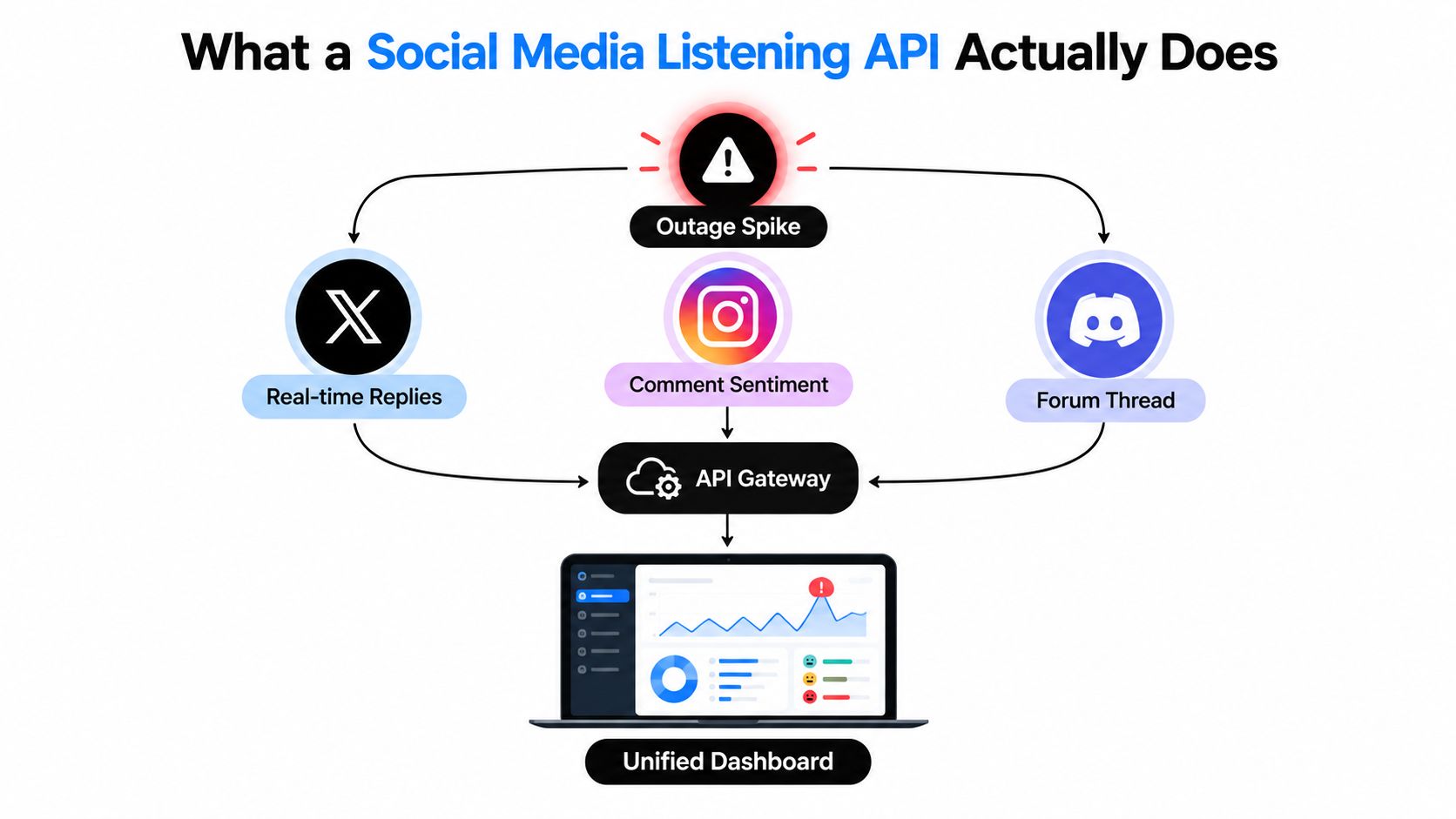
The production job has four distinct parts:
- Ingest the event from search, a stream, a webhook, or an owned forum.
- Classify its intent, urgency, language, sentiment, account context, and likely owner.
- Route the item into a unified inbox or queue with an SLA and escalation path.
- Verify delivery, acknowledgement, resolution, deletion state, and audit history.
A posting API helps your application publish content or reply through an authorized account. A listening API watches relevant conversation and creates a decision surface around it. The two may share authentication and platform objects, but their operational assumptions differ. Posting asks whether a message can be sent. Listening asks what your team can see, how confidently it can interpret that signal, and whether the right person acts before the customer or reputation risk grows.
Practical rule: Treat every detected mention as a potential work item until classification proves it is noise. Treat every unseen surface as a coverage limitation, not as evidence that nobody is talking.
The rest of the integration depends on endpoint behavior. X search provides query-driven retrieval, Instagram can send mention notifications, and Discord or an owned forum may expose event streams tied to your community. A reliable design respects those differences instead of forcing every platform into one polling loop.
Channels and Data Types a Listening API Can Reach
Coverage is never universal. A social media listening API can often retrieve public posts, comments, replies, and account-level mentions, but private messages, disappearing content, restricted groups, and platform-specific research surfaces require separate permissions or remain unavailable. The useful question isn't “Does the vendor support Instagram?” It's “Which Instagram object, under which account type, with what freshness and retention?”
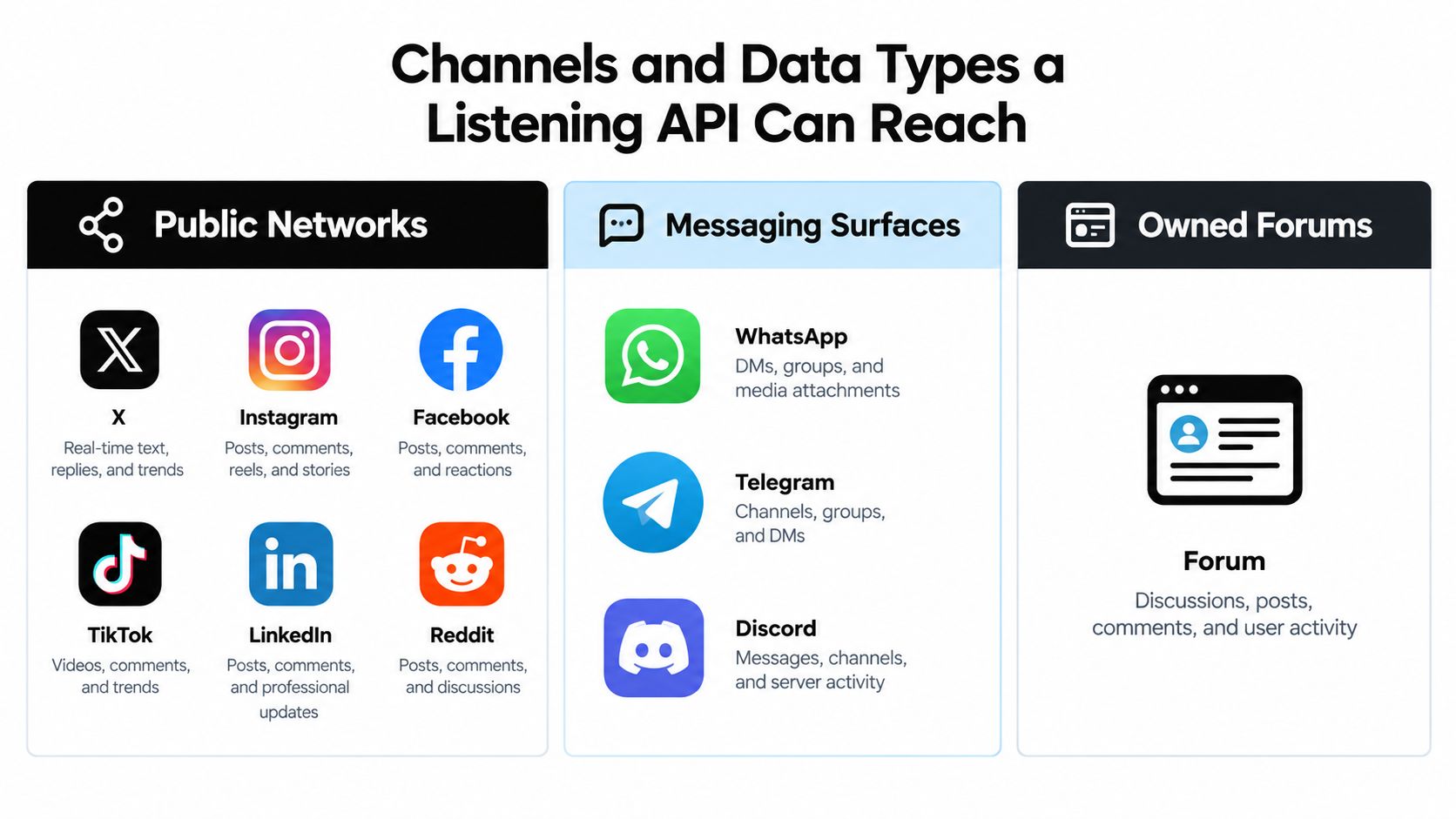
| Channel | Mention webhook | Poll-based search | Business account required |
|---|---|---|---|
| X | Provider and account dependent | Recent and full-archive search | Depends on endpoint and authorization |
| Available for qualifying Business or Creator account mentions | Supplementary collection for broader terms | Yes for the documented mention webhook | |
| Page and permission dependent | Restricted for broad public monitoring | Usually for owned surfaces | |
| TikTok | Product and access dependent | Access varies by endpoint | Often account or approved-access dependent |
| Limited and permission dependent | No assumption of broad public monitoring | Account and app permissions vary | |
| Event and API access dependent | Search and subreddit retrieval | No general business account requirement | |
| Business messaging surfaces | Not a public conversation stream | Business setup required | |
| Telegram | Bot or permitted community surfaces | Bot and community scope dependent | Bot or administrator access may be required |
| Discord | Gateway events for authorized communities | Search depends on bot and server permissions | Server authorization required |
| Owned forums | Usually available through forum events or plugins | Polling and database-backed retrieval | Forum ownership or administrator access |
The ingestion model changes the meaning of “real time.” A public X reply discovered through recent search is not equivalent to an Instagram mention delivered by webhook, and neither is equivalent to a Discord message your bot can receive directly. An Instagram Business or Creator Account can receive a notification when another user mentions it in a comment or caption. The payload identifies the mentioned account and media object, after which the API can retrieve the comment ID, text, like count, and associated media ID (Instagram webhook reference).
Public networks are useful for brand mentions, product complaints, competitor comparisons, and PR signals. Messaging surfaces expose a different operational layer, often involving opt-in business conversations or community permissions. Owned forums usually provide richer thread context, but they also create a responsibility to preserve moderation, membership, and retention rules.
Don't confuse access with completeness. Platform policies, quotas, privacy rules, language coverage, and content format all create blind spots. Teams designing collection outside official APIs should also understand the operational and compliance considerations in this web scraping at scale playbook, especially around retries, freshness, and source changes.
Core Endpoints and Webhook Patterns
A production pipeline normally combines four endpoint families rather than relying on one universal search call.
Recent-post search retrieves newly published items matching keywords, accounts, hashtags, or query rules. Use it for backstop polling, quota-aware catch-up, and channels without a usable event subscription. Full-archive search supports investigations, historical baselines, and backfills, but it should have a reserved budget so an analyst's large query doesn't starve live support monitoring.
Mention lookup enriches a detected reference. The trigger might contain a post ID, media ID, or comment ID, but the inbox needs the author, text, parent thread, engagement context, media, and permission state. Fetch the object after detection, then classify the enriched record.
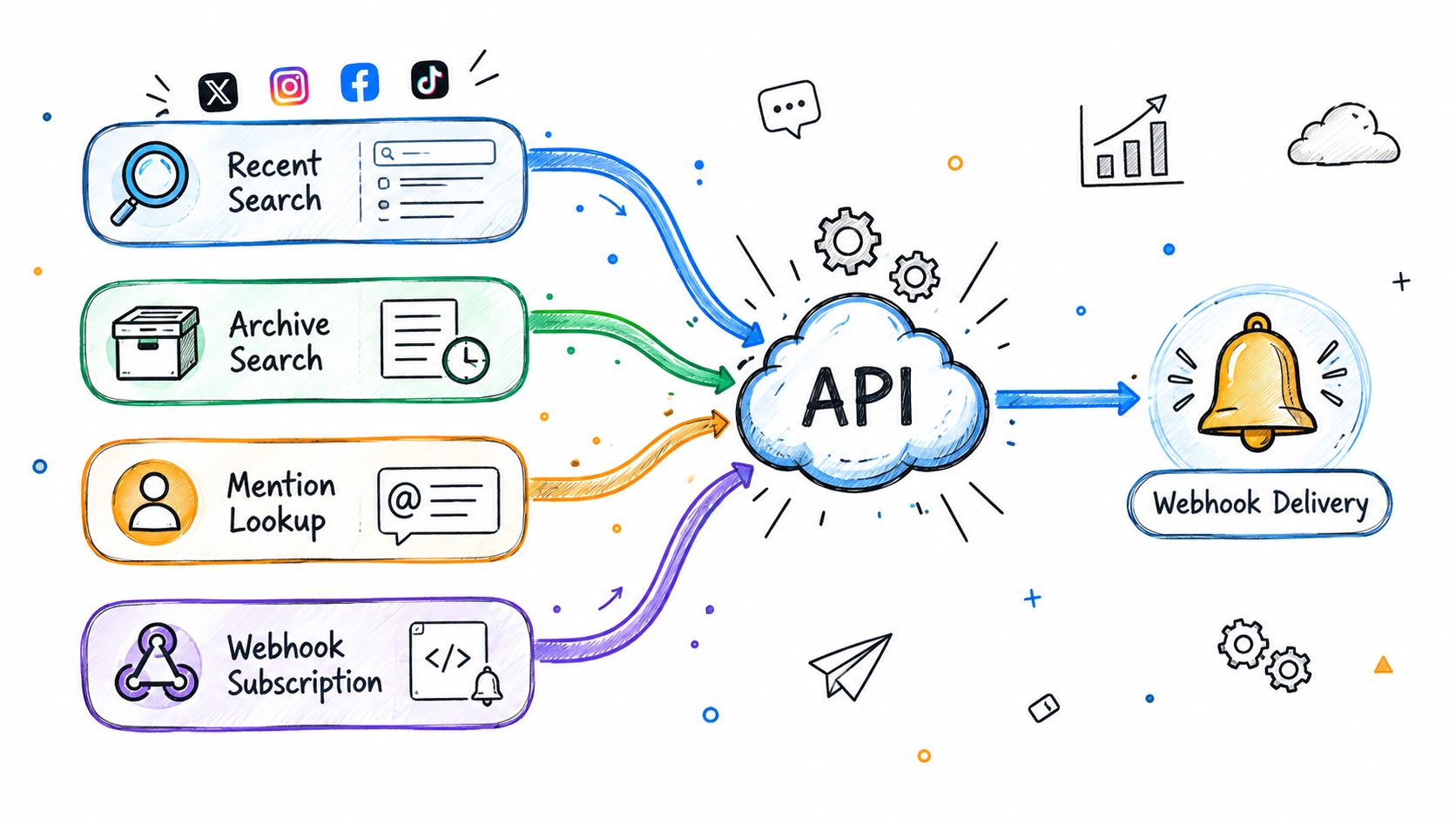
Webhook subscriptions should trigger the workflow wherever the platform supports them. The strongest pattern is notify, retrieve, normalize, classify, route. A webhook tells you that something relevant may exist. The follow-up request retrieves the authoritative object and supplies the context needed for a safe decision. Teams building this layer should pay attention to delivery retries, signatures, replay behavior, and developer-facing observability, topics covered well in this guide to webhooks developer experience.
Historical backfill is a separate workload. Run it through a queue with its own concurrency and budget, record the query and cursor, and mark imported objects as backfill events. Don't let a full-archive investigation compete invisibly with an outage alert.
For an Instagram mention, the flow can look like this:
- The subscription receives a mention notification.
- The worker validates the signature and records the delivery ID.
- The worker retrieves the referenced media and comment.
- The normalizer stores the source payload and canonical event.
- The classifier tags intent, urgency, sentiment, language, and owner.
- The unified inbox creates or updates the case.
That request-then-enrich pattern is more dependable than polling every endpoint at maximum frequency. It also gives reviewers a trace from the original provider event to the final routing decision.
Rate Limits, Quotas, and the Math That Matters
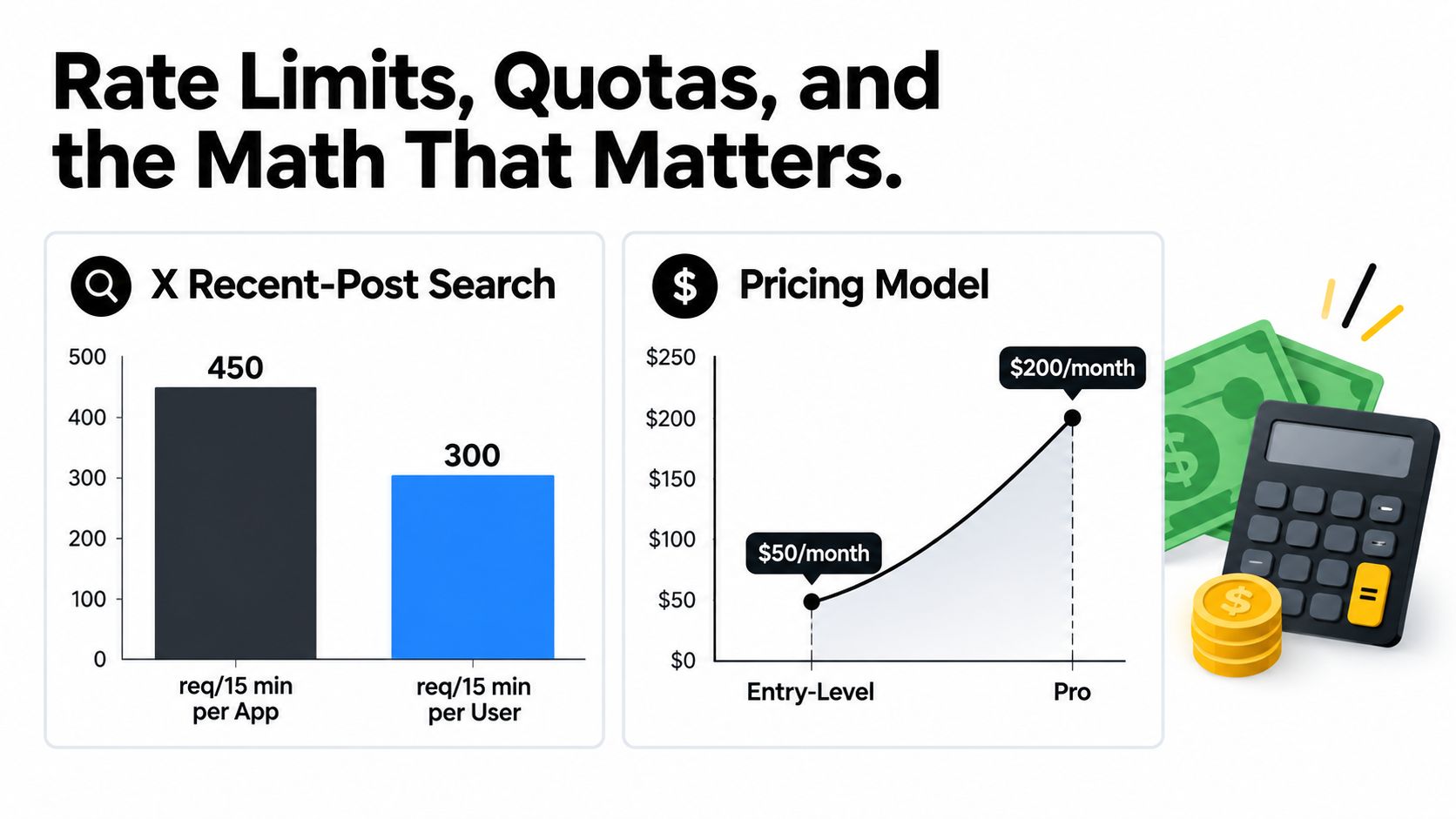
Rate limits determine whether your inbox is current during the incident that matters. X's recent-post search allows 450 requests per 15 minutes per app and 300 requests per 15 minutes per user, returns 10 results by default with a maximum of 100, and limits query strings to 512 characters (X API rate limits). Full-archive search allows one request per second, 300 requests per 15 minutes per app, up to 500 results per response, and a 1,024-character query limit.
That gives engineers a scheduling problem, not a polling preference. If a recent-search worker uses the application budget, user-scoped workers can still fail. If a query returns the maximum page size, the scheduler must account for pagination, cursor movement, enrichment calls, retries, and a reserve for escalation terms.
A sound scheduler should:
- Partition budgets: Keep live monitoring, enrichment, and historical backfill in separate queues.
- Read reset headers: Schedule the next attempt from the provider's reset timestamp instead of guessing.
- Use cursors: Continue from the last confirmed cursor, not from a clock window that can duplicate or skip posts.
- Back off on 429: Stop hammering the endpoint. A retry loop that ignores the reset window increases the backlog.
- Reserve capacity: Hold quota for outage keywords, high-risk accounts, and case enrichment.
- Measure lag: Track event time to ingestion time, then ingestion time to owner assignment.
A 429 response is not merely a technical error. During a scam wave or outage surge, it becomes a coverage event that can cause a missed acknowledgement SLA. The inbox should show quota exhaustion beside operational metrics, with the affected platform, endpoint, query family, and estimated blind interval.
Meta also applies quotas. Its Graph API documentation describes a general limit of 200 calls per hour multiplied by the number of users (Meta Graph API documentation). That model behaves differently from a flat application bucket, so a unified scheduler needs provider-specific accounting rather than one global requests-per-minute setting.
For credential handling, isolate tokens by tenant and channel, restrict scopes, rotate secrets, and log access without exposing token material. A practical review of authentication, authorization, secret storage, and abuse controls belongs in an API security guide for MSSPs.
Designing a Canonical Event Schema
Provider payloads change. Your routing logic shouldn't have to change every time a platform renames a field or nests media differently. A canonical envelope gives the rest of the system stable semantics while preserving the original payload for recovery and audit.
The W3C ActivityPub model is a useful interoperability reference because it separates actors, objects, activities, collections, inboxes, and outboxes, using ActivityStreams 2.0 serialized as JSON-LD (W3C ActivityPub Recommendation). Your enterprise schema doesn't need to implement ActivityPub, but it should borrow the separation between who acted, what object changed, and what activity occurred.
| Field | Purpose | Source of truth |
|---|---|---|
event_id |
Stable internal identifier | Generated by your system |
provider |
Identifies the originating platform | Provider adapter |
tenant_id |
Prevents cross-account data mixing | Account configuration |
source_object_id |
Supports lookup and deduplication | Provider payload |
actor_ref |
Links author or account context | Provider payload |
event_type |
Distinguishes create, update, delete, mention, reply | Adapter mapping |
created_at |
Records when the source event occurred | Provider timestamp |
observed_at |
Records when your system received it | Ingestion worker |
language |
Supports multilingual classification | Provider or classifier |
conversation_id |
Groups a thread or case | Provider payload or derived mapping |
parent_id |
Preserves reply hierarchy | Provider payload |
media_refs |
Links images, videos, and attachments | Provider payload |
visibility |
Captures public, private, restricted, or community state | Provider permissions |
deletion_state |
Preserves tombstone and removal status | Provider event or recheck |
provenance |
Records query, webhook, cursor, and retrieval path | Ingestion system |
Store the raw provider payload beside this envelope. That record supports schema migrations, legal discovery, replay, and correction when a provider edits or deletes content. It also lets you explain why a classifier made a decision after the provider changes its response format.
Make ingestion idempotent. Derive a deterministic event key from provider, tenant, source object ID, and event version, then upsert instead of blindly inserting. Use cursor-based pagination, not page numbers, because a high-volume collection changes while your worker is reading it. Preserve both provider timestamps and observation timestamps, or you won't be able to distinguish a late event from a delayed worker.
Mapping Signals to Intent, Urgency, and Sentiment
Consider a public X reply that says a customer was charged twice and can't access the account. The raw object is only the beginning. The operational value appears when the pipeline combines text, thread context, account metadata, and engagement behavior.
The classifier can produce:
- Intent: billing complaint, with a possible duplicate-charge subtype.
- Urgency: high, because payment and account access are involved.
- Sentiment: negative, while retaining the original language and confidence.
- Owner: finance or support, with engineering added if account access points to a product failure.
- Channel action: public acknowledgement first, private handling for account details.
The public reply should not ask the customer to post payment information. A human-approved response can acknowledge the issue in the thread, then move identity and transaction details to a private channel. Public outreach has its own expectation: 51% of people who contact a brand publicly expect a public acknowledgement before a private direct message, according to the Sprout Social customer service benchmark.
A routing table makes the behavior explicit:
| Signal combination | Queue | Automated action | Human approval |
|---|---|---|---|
| Billing intent plus payment language | Finance or support | Apply billing tag and create case | Approve public acknowledgement |
| Outage intent plus rapidly growing thread | Engineering and comms | Group duplicates and raise incident flag | Approve status language |
| Feature request without urgency | Product insights | Add theme and link related items | Review before roadmap reporting |
| Fraud or scam allegation | Trust and safety, finance | Preserve evidence and restrict auto-closure | Approve escalation |
| Abuse, self-harm, or safety signal | Trust and safety | Apply protected workflow | Human decision required |
Auto-tagging is appropriate for repetitive, well-understood categories. Draft replies can handle status questions when the source of truth is current. Humans should approve outage statements, fraud claims, reputation-sensitive complaints, and anything that could expose personal or payment information.
Don't create separate label definitions in the classifier, inbox, CRM, and executive dashboard. Use one intent taxonomy and one urgency policy, then pass the same identifiers through each system. That avoids a case being “billing” in the inbox and “product defect” in the report when two teams wrote different rules.
Error Handling and Webhook Reliability
A listening pipeline needs an error policy that distinguishes retryable failures from coverage failures. The response code should determine what the system does next, but every recovery should also leave an audit record.
- 401 authentication failure: Refresh the token when the platform supports it, then retry within a bounded window. If refresh fails, stop the worker and alert the channel owner.
- 403 scope or policy denial: Don't retry indefinitely. Surface the denied object or endpoint as a coverage gap and record the missing permission.
- 429 rate limit: Read the reset timestamp, pause the affected queue, and reschedule from that window. The rate-limit scheduler described earlier owns this decision.
- 5xx provider failure: Use exponential backoff with jitter, cap the retry count, and preserve the event in a durable queue.
- Webhook signature mismatch: Reject the delivery, retain minimal diagnostic metadata, and send the event to a dead-letter queue for security review.
- Missed webhook delivery: Use the provider's replay or reconciliation endpoint when available, then run a bounded search backfill.
- Deleted source object: Write a tombstone against the canonical event rather than removing the record outright.
Failure rule: A retryable error asks the worker to try again. A routeable error asks a person to intervene. A coverage event asks the organization to qualify what it can claim.
Webhook consumers should acknowledge quickly and process asynchronously. Store the provider delivery ID, signature result, receipt time, processing state, and retry count. If classification or enrichment is slow, don't make the provider wait for downstream systems.
Deletion handling deserves special care. A provider may remove content after ingestion, or a customer may delete a reply that a support case still references. Keep the case history and audit event where policy allows, but mark the source object as deleted and prevent the system from presenting it as currently available content.
Measuring What the Pipeline Misses
A dashboard that reports sentiment without coverage confidence can mislead the same executives who rely on it for escalation. Platform restrictions increasingly push large-scale analysis toward smaller or easier-to-collect datasets, which reduces the generalizability of observed trends, according to a 2025 review of social-media API restrictions. An independent audit of Meta research access found that roughly 11.45% of posts remained inaccessible under one access threshold, while rolling query and record limits further constrained retrieval, as summarized in that review.
Coverage should be attached to the alert, not buried in a methodology document. Track the platform, object type, language, geography, account class, query, last successful retrieval, and known policy restrictions. A multilingual complaint written in slang may be present but misclassified. An untagged Instagram comment may never trigger the mention webhook. A private Discord channel may be entirely outside the authorized collection boundary.
Use confidence labels that describe both interpretation and visibility:
- High visibility: The relevant source and object type are available through an active event or retrieval path.
- Partial visibility: Public mentions are available, but private messages, untagged comments, or restricted communities aren't.
- Low visibility: Quota exhaustion, denied permissions, language gaps, or provider changes affect collection.
- Unknown: The system can't establish whether the source is complete.
Coverage reporting belongs beside operational metrics. Track time-to-owner, public acknowledgement rate, escalation precision, auto-resolution quality, auto-closure rate, and proactive saves. A rising auto-closure rate is not automatically good if the classifier closes multilingual billing complaints or scam reports. Likewise, high mention volume can be less important than whether urgent cases reached the correct owner before the SLA failed.
Customer-care pressure makes this concrete. Instagram inbound messages rose from 13 to 18 per day between 2023 and 2024, while the overall response rate to social messages and comments fell from 8% to 7%, according to Sprout Social's benchmark data. About three-quarters of consumers expect a response within 24 hours or sooner, and 73% say they may buy from a competitor when a brand doesn't respond on social, based on the same source. Coverage gaps belong in the SLA report because missing data can create a false impression of timely service.
Quick Reference and Cross-References
Use this as a compact design index:
- Endpoint selection: Recent search handles live polling, full archive handles backfill, mention lookup enriches detected objects, and webhooks provide event triggers.
- Rate-limit control: Keep live, enrichment, and historical queues separate. Read reset headers and handle 429 responses according to the rate-limit section.
- Canonical storage: Preserve the provider payload beside stable event fields, cursors, provenance, timestamps, and deletion state.
- Routing: Combine intent, urgency, sentiment, account context, and thread history. Send billing to finance, outages to engineering and comms, and safety issues to human reviewers.
- Reliability: Classify 401, 403, 429, 5xx, signature failures, missed deliveries, and deletions as retryable, routeable, or coverage events.
- Reporting: Put visibility confidence beside acknowledgement time, escalation precision, auto-closure rate, and resolution quality.
Go-Live Checklist for a Production Listening API
Before enabling production routing, verify each item:
- Authorize narrowly: Confirm scopes and account permissions for every platform, object type, webhook, and private workflow.
- Budget by endpoint: Set separate quotas for live search, enrichment, backfill, and emergency terms.
- Honor reset windows: Persist rate-limit headers and schedule retries from provider timestamps.
- Verify webhook signatures: Reject invalid deliveries and retain diagnostic records in a dead-letter queue.
- Make ingestion idempotent: Derive event keys from provider, tenant, source object, and version.
- Use cursor checkpoints: Store the last confirmed cursor and replay from durable state after worker failure.
- Preserve provenance: Record query, delivery ID, retrieval time, source timestamps, and original payload.
- Handle deletion: Write tombstones and update case visibility without erasing the audit trail.
- Test routing paths: Send billing complaints to finance, outage spikes to engineering and comms, and fraud claims to human review.
- Define approval boundaries: Let AI tag, group duplicates, and draft replies. Keep escalation language and sensitive cases with people.
- Report operationally: Track time-to-owner, acknowledgement, resolution, escalation precision, auto-closure rate, and coverage confidence.
- Exercise failure modes: Simulate token expiry, denied scopes, 429 responses, provider 5xx errors, duplicate webhooks, and deleted posts.
A listening API is ready when it can explain not only what it found, but also what it couldn't see, who owned the item, whether someone acknowledged it, and why the case closed. The API should absorb noise and preserve context. Humans should approve the hard calls and remain accountable for the customer outcome.
Sift AI provides a unified inbox across social channels and communities, with AI-powered filtering, intent tagging, routing, escalation, and drafted replies while keeping humans in the loop for sensitive decisions. If you need to connect listening signals to SLAs, finance, engineering, comms, and community workflows, visit Sift AI to explore the platform.