What's the Difference Between Social Listening and Social Monitoring?
"Wondering what's the difference between social listening and social monitoring? Learn how each works, where they overlap, and which one your team needs."
Social monitoring captures and responds to what's being said about a brand, where and when it's said. Social listening takes that same captured data and interprets why people are saying it and what the organization should do about it.
The most popular advice on this topic is wrong in a specific way. It says monitoring is the tactical starter kit and listening is the strategic upgrade, so mature teams graduate from one to the other. Teams that follow that advice end up with a beautiful quarterly sentiment deck and an unanswered billing complaint sitting in the replies for three days.
The difference that matters isn't seniority, and it isn't which tool costs more. It's what each discipline produces and who owns the output. Monitoring produces individual cases that need an owner today. Listening produces patterns that need a decision this quarter. If you're accountable for SLAs, auto-closure rates and the numbers that roll up to your executives, you need both running, with a written handoff rule between them.
Table of Contents
- Social Monitoring Versus Social Listening at a Glance
- How Far Each One Reaches Across Channels
- When Each One Triggers a Response
- How Each Method Works and Where It Misses
- Use Cases Where Each Approach Pays Off
- Detecting a Crisis Against a Baseline
- Choose Monitoring, Listening or Both for Your Team
Social Monitoring Versus Social Listening at a Glance
The cleanest way to separate the two is to name what each one produces. A 2021 industry briefing on social media listening, monitoring and intelligence draws the line precisely: social monitoring is collection and immediate response, while social listening is interpretation and strategic sense-making. Monitoring tracks mentions, tags, keywords, hashtags, comments and volume spikes so a team can react. Listening analyzes sentiment, themes, drivers, audience context and emerging patterns so a team can decide.
| Dimension | Social monitoring | Social listening |
|---|---|---|
| Core question | What is being said, where and when? | Why are people saying it, and what should we do? |
| Data scope | Defined entities such as a brand name, handle, campaign hashtag or direct interaction | Wider conversation including untagged discussion, themes, competitors and cross-channel context |
| Time horizon | Real time, individual mentions and messages | Aggregated over weeks or months |
| Typical outputs | Mention volume, engagement, reach, alerts and sentiment ratios | Topic clusters, sentiment drivers, emerging issues and influencer patterns |
| Typical owner | Care and social ops queues | Insights, product, communications and leadership |
| Typical action | Reply, route, escalate | Change product, messaging or risk plan |
| Method | Deterministic rules such as keywords, accounts, hashtags, language and thresholds | Entity resolution, topic modeling, sentiment classification and human validation |
Read the rows together and the dependency becomes obvious. Monitoring is the capture layer. Listening is the analysis and meaning layer built on top of it. You can't listen to conversations you never found, and merely collecting mentions tells you nothing about intent, urgency or the business problem underneath them.
That's why the briefing treats the two as complementary rather than competing, and why it maps monitoring to real-time customer-care queues, campaign checks and escalation alerts while mapping listening to product research, reputation analysis and market trends.
Quick self-test on your own backlog: if the question in your standup is "who needs an answer today," you're working in monitoring. If it's "what's driving the billing complaints this quarter," you're working in listening.
Confusion is common here because both disciplines touch the same inbox and the same dashboards. The output is what separates them. One ends in a reply or a routed ticket. The other ends in a decision about product, messaging or risk.
How Far Each One Reaches Across Channels
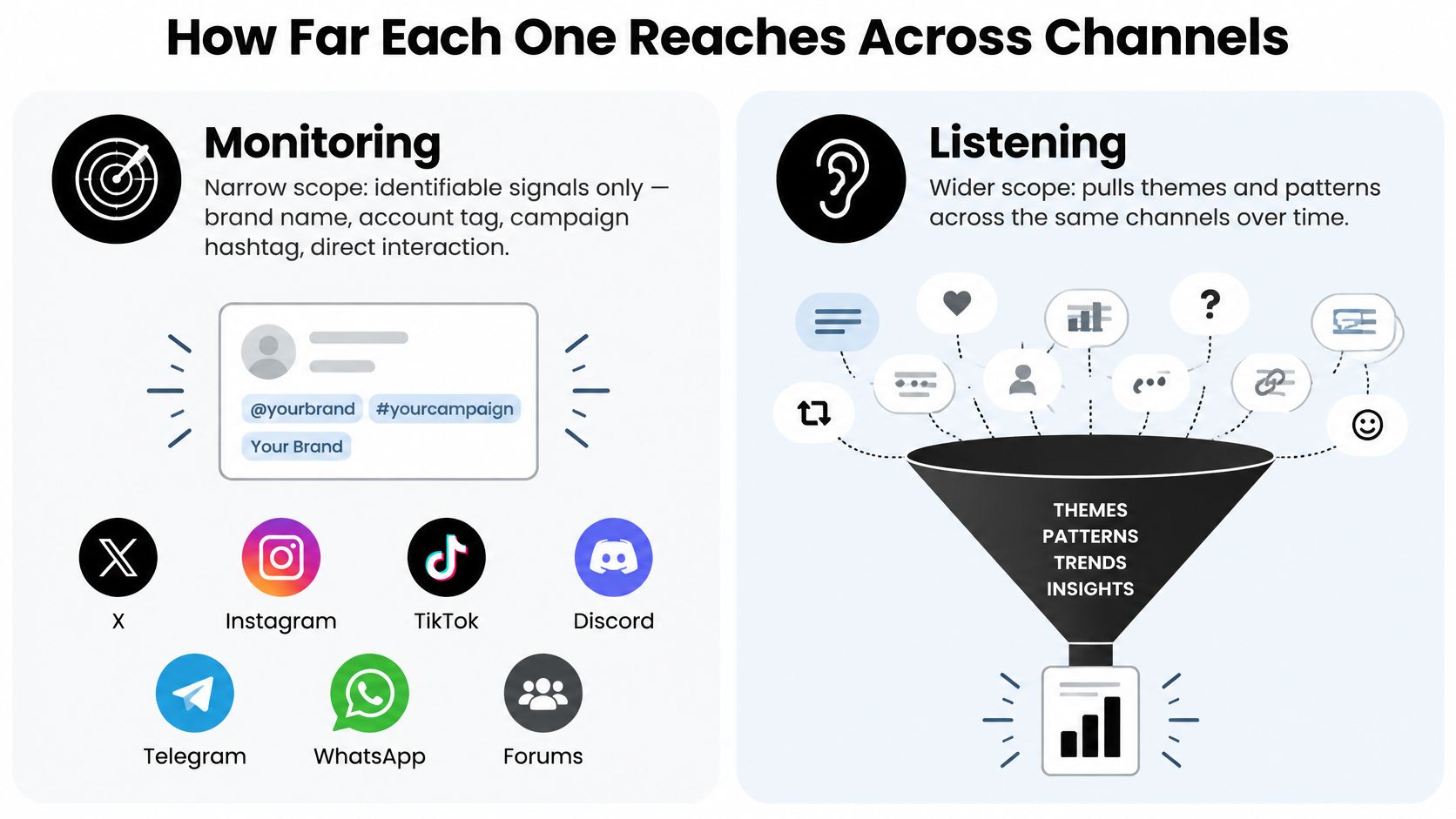
Monitoring and listening can cover overlapping channels, but they answer different questions about what happens there. Monitoring tracks individual, identifiable signals such as a brand name, account tag, campaign hashtag, or direct interaction. Listening examines discussion across sources, including untagged posts, reviews, blogs, podcasts, and competitor conversations, to find patterns tied to a topic or business question.
A monitoring setup is like a net cast for known signals. Listening is more like studying the current across many conversations. The familiar ocean-and-pool analogy captures the difference in scope: monitoring searches broadly for mentions, while listening examines a more focused body of discussion for meaning.
The channel problem nobody budgets for
A mention is not always a text keyword on a public network. Support requests can appear in comments, direct messages, private or semi-private communities, messaging apps, images, and multilingual posts. Research on social customer service channels describes a gap between customer and staff perceptions: customers may view phone and live chat as fastest, while staff rate social media as efficient. The study also reports fast first responses and stronger resolution outcomes for messaging channels such as WhatsApp.
That mismatch matters for operations. A customer might describe a failed payment in Portuguese slang in a WhatsApp community without using the English brand keyword your rules track. Monitoring based only on that keyword could miss the individual case; listening across conversations may reveal a recurring payment problem. Neither output replaces the other.
Build a channel map around the handoff between cases and patterns:
- Tagged mentions: Brand handles, campaign hashtags, and direct replies are clear signals to monitor and route to an owner.
- Direct requests in private channels: DMs, WhatsApp threads, and Discord support channels are individual cases. Monitor them for routing, while respecting which conversations the team can access.
- Untagged discussion: Forums, review sites, podcasts, and competitor threads can contribute to listening. Group conversations by topic to see whether a signal is isolated or part of a wider pattern.
The social operations lead needs both views: monitoring gives the team an owner and a path for handling cases, while listening gives insights and leadership evidence of broader themes. Define the handoff so repeated cases can inform analysis, and emerging patterns can reach the teams responsible for action.
When Each One Triggers a Response
Time horizon is where the two disciplines stop being philosophical and start being staffed. Monitoring works individual posts against channel-specific response windows. Listening aggregates signals over weeks to show which patterns deserve cross-team action.
The spread in expectations is wide enough that a single global SLA is meaningless. This table is the reference point for the rest of your routing rules.
| Channel | Expected response window | Source |
|---|---|---|
| One to three hours; 64% of users expect a reply within one hour | University of Birmingham study; consumer survey | |
| Three to six hours; 85% of users expect a reply within six hours | University of Birmingham study; consumer survey | |
| All platforms surveyed | 42% expect a reply within one hour; 32% within 30 minutes | Consumer survey |
Those figures come from survey work summarized in ICMI's guide to social media customer service. The University of Birmingham finding is the one worth pinning above your triage screen: consumers who complained on Facebook or Twitter expected responses in one to three hours on Twitter and three to six hours on Facebook, and both a faster first response and a faster concluding response increased satisfaction. Speed at the close matters as much as speed at the open, which is why auto-closure rates are a trap when they close nothing.
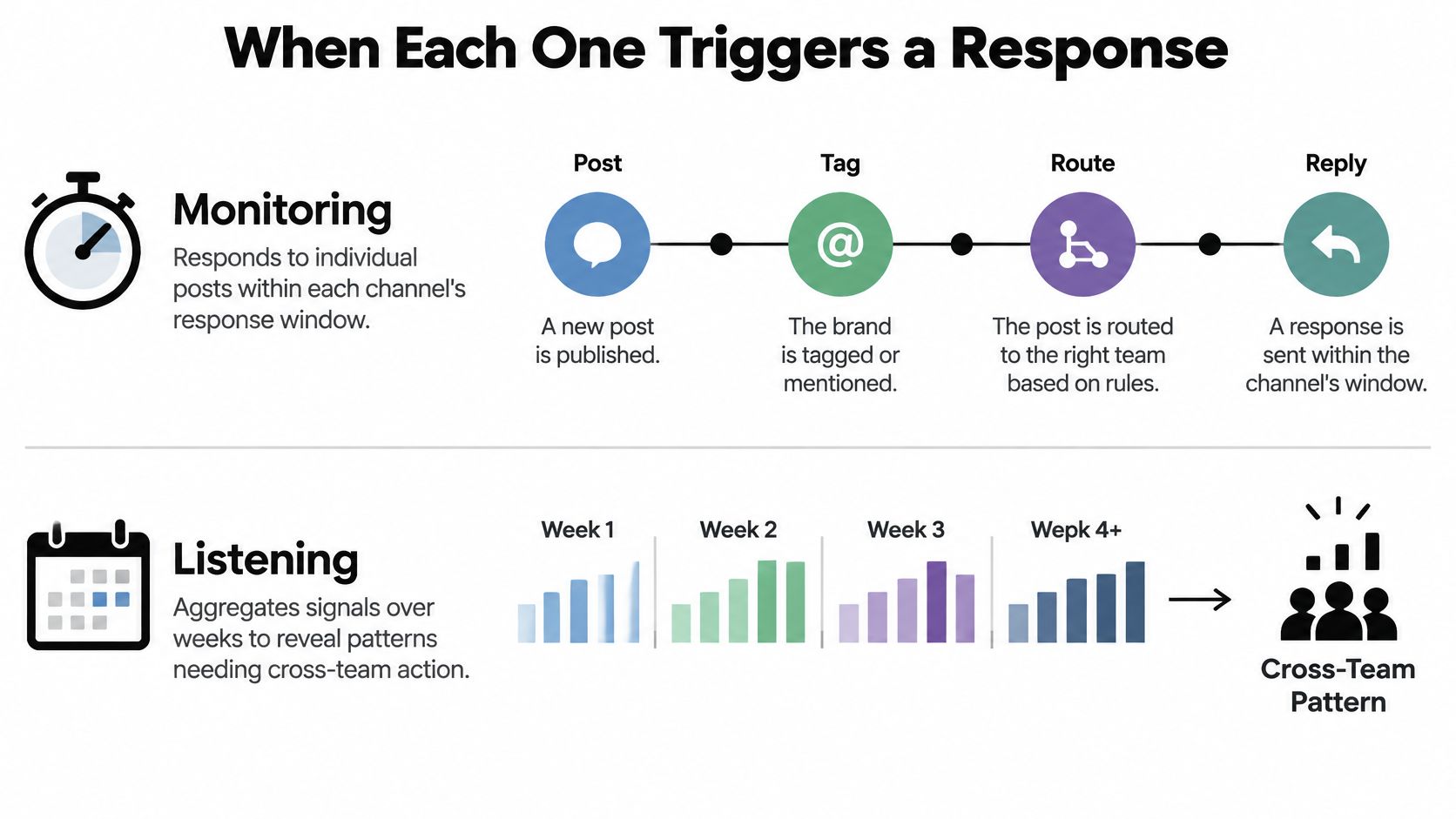
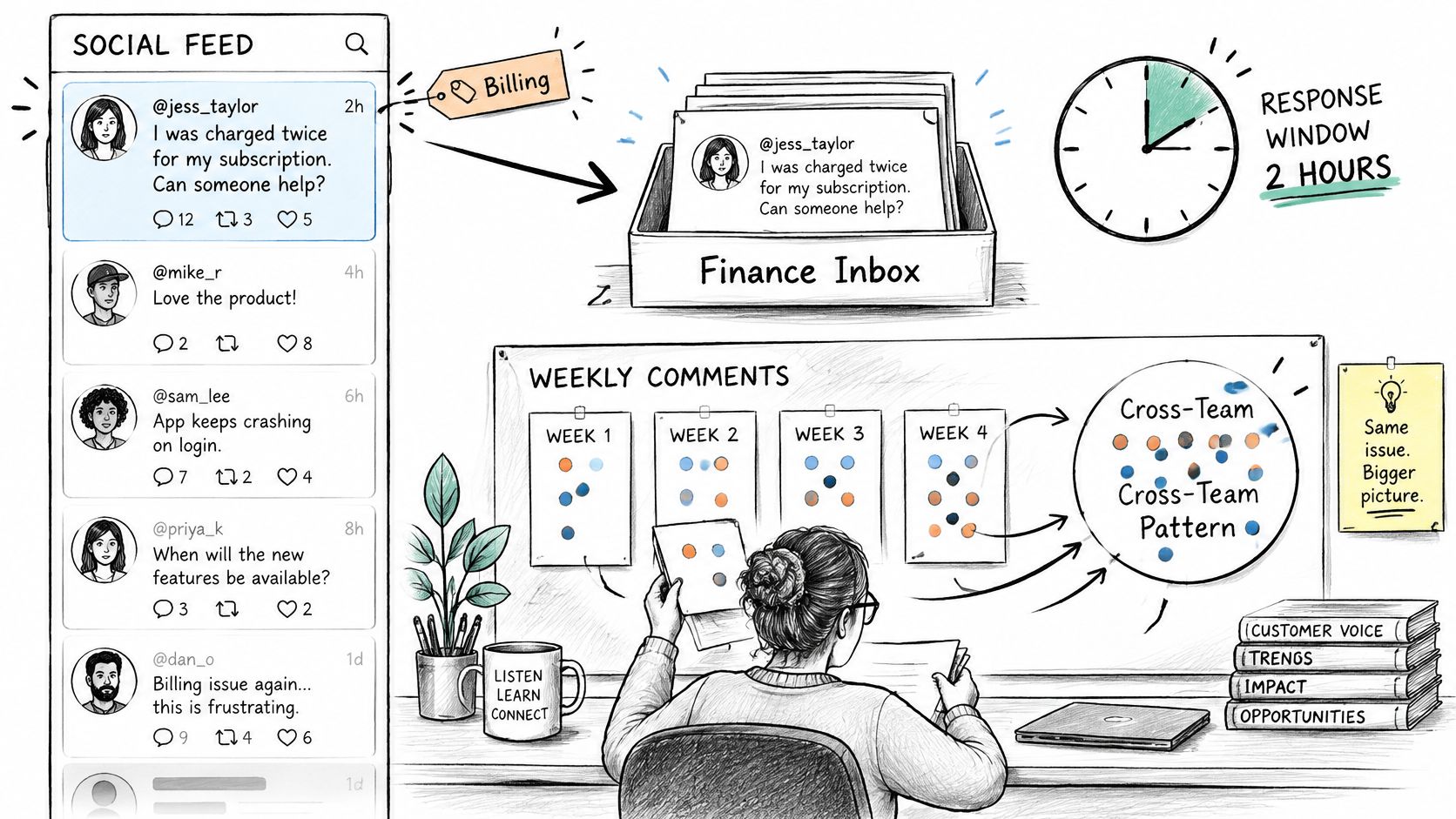
The operating rule that follows is simple to write and hard to run. An inbox detects and routes urgent complaints against these channel windows. Listening identifies the recurring billing, outage or feature-request patterns that need engineering, finance or product to change something.
The two metrics that keep both disciplines honest
- Detection-to-owner time: the clock from a post landing to a named person owning it. This is a monitoring metric, and it's the one that predicts whether you meet the window above.
- Share of recurring issues that reach an owner: the percentage of themes that surface in listening and get routed to a team with authority to act. A theme that appears in a monthly report but never reaches product isn't insight, it's decoration.
If you only track one, track detection-to-owner time. It's the number your executives feel first.
How Each Method Works and Where It Misses
Monitoring runs on deterministic rules. You define keywords, accounts, hashtags, languages and alert thresholds, and the system returns anything that matches. That's a feature: stable baselines, low-latency alerts and repeatable KPIs your finance team can audit.
Its blind spots are equally structural. Keyword rules miss paraphrases, indirect complaints, images, slang, sarcasm and any post that omits your official brand term. A customer who writes "the blue app charged me twice and support ghosted me" never appears in a search for your company name.
Listening carries a heavier processing bill: entity resolution, topic modeling, sentiment or emotion classification, author and network analysis, deduplication, language handling and human validation of ambiguous cases. That cost buys you coverage of the conversations monitoring can't see.
Why a sentiment score is a signal, not a verdict
Automated sentiment is the weakest link in the chain, and it fails predictably: sarcasm, slang, domain terminology, mixed emotion and multilingual context. Writing on the performance trade-offs between the two approaches, the practical conclusion is to treat a sentiment score as a probabilistic signal rather than ground truth.
This is how that looks in the wild.
A customer posts "great, another parcel that's vanished, love paying twice for delivery." A keyword-plus-sentiment pipeline reads "great" and "love" and files it as positive, during the exact week your courier is failing. The score isn't lying about the words. It's lying about the intent.
The benchmarks that replace mention count
Raw mention volume tells you how loud a channel is, not whether your operation works. The benchmarks worth reporting are these.
- Signal retention: the proportion of relevant posts kept after noise filtering.
- Classification precision for priority issues: how often a post the system flags as urgent is genuinely urgent.
- Alert latency: the gap between publication and alert.
- Escalation accuracy: the share of escalations that reach the right team first time.
- Cases resolved without manual handling: the share closed before a human touches them.
Combine both methods and you avoid the two classic failure modes: fast detection without understanding, or rich insight without a dependable response workflow.
Use Cases Where Each Approach Pays Off
Scenario planning beats theory here, because the discipline that owns a case is usually obvious once you name the owner. Start with the lookup table.
| Scenario | Discipline | Owner | First action |
|---|---|---|---|
| Billing complaint in replies | Monitoring | Finance via care queue | Detect, tag and route within the channel response window |
| Outage surge | Monitoring alert | Engineering | Compare volume with the 28-day baseline before paging |
| PR risk in mentions | Monitoring, then listening | Communications | Listening checks whether it's a one-off or a developing trend |
| Spam or scam wave | Monitoring, then listening | Trust and safety | Monitoring catches the wave and listening finds shared text patterns |
| Feature request in direct messages | Listening | Product | Aggregate across channels before routing |
| Multilingual slang in a community forum | Listening with human review | Community or insights team | Automated classification is weakest here, so review sampled posts |
| Campaign reporting on mention volume | Monitoring | Social media manager | Track mention volume and engagement |
| Competitor and category themes | Listening | Insights and leadership | Aggregate over weeks or months |
Walk them in order of urgency.
The outage surge comes first. A spike is a monitoring alert, and the first action is comparison against the normal range, not a page to engineering. Wake people at 2am for a genuine shift, not for a slow Tuesday.
Billing complaints in replies are next. Every one is a case with a customer attached. Detect, tag and route it to finance through the care queue inside the channel window. Reporting on social support expectations found that two-thirds of U.S. consumers want a person to respond and 73% say they may buy from a competitor if a brand does not respond. That's the cost of treating a routed complaint as a metric.
PR risk in mentions splits across both. Monitoring surfaces the posts and communications gets alerted. Listening answers the next question, which is whether this is one angry thread or a theme building across markets.
Scam waves belong to trust and safety. Monitoring catches the wave. Listening finds what the messages share (the same phrasing, the same fake link pattern, the same impersonated account name), which is what lets you write a detection rule that catches the next one faster.
Feature requests buried in DMs are pure listening. One request is a support reply. The pattern across DMs, forum posts and reviews is a product signal, and it needs aggregation before it reaches a roadmap conversation.
Multilingual slang in a community forum needs a human. Automated classification is weakest on dialect, irony and in-group language, so sample and review rather than trusting the classifier.
Campaign reporting and competitor themes sit on opposite sides of the line. Volume and engagement are monitoring. Share of voice against named competitors and category themes belong to listening, reported on a consistent cadence so movement is visible.
Detecting a Crisis Against a Baseline
Crisis detection fails when a team alerts on a raw mention count. A number with no reference point can't tell you whether 300 posts is a quiet day or the start of something serious. Build the comparison first, then the rules.
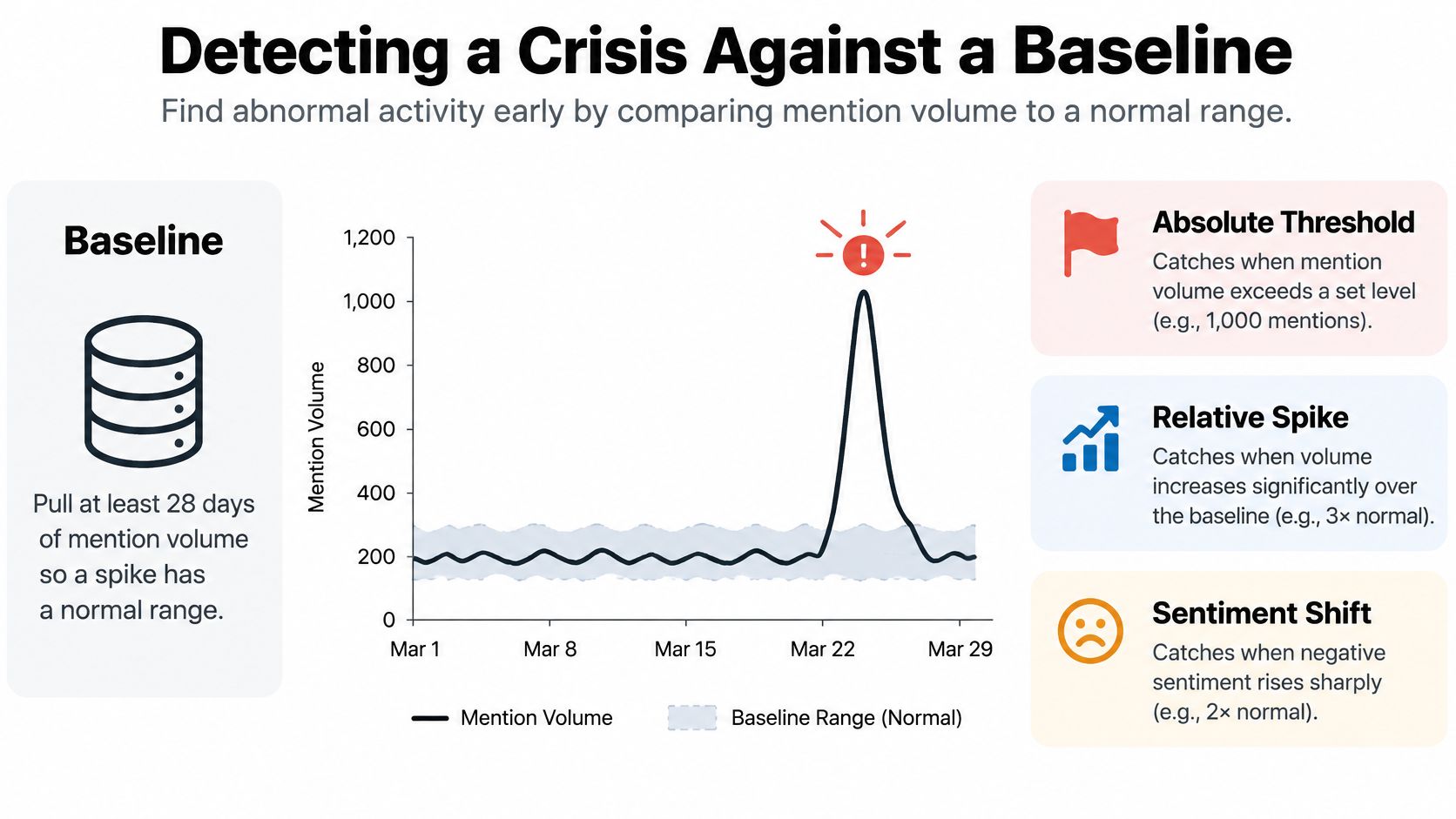
A published social monitoring methodology for crisis detection tested three alerting rules plus a safeguard. Treat this as your build order.
- Pull at least 28 days of mention volume. Without a baseline range, every spike looks like a crisis and every quiet week looks like safety.
- Set an absolute threshold of at least 500 mentions in one day. This is the blunt instrument. It works for large brands and misfires badly for small ones, because a niche account's genuine surge never reaches 500.
- Add a classical relative rule: more than the 28-day mean plus three standard deviations. It adapts to your own normal volume, but a previous spike inflates the deviation and can mask the next one.
- Add a modified z-score of at least 3.5, using the median and median absolute deviation. The median resists distortion from old spikes, which is why it catches shifts the classical rule sleeps through.
- Apply the safeguard: at least 10 mentions and at least twice the baseline median. This stops a low-volume account from triggering on noise that technically clears a statistical bar.
- Document collection gaps. A connector that dropped a channel without notice looks exactly like a calm day. Note the gap before you conclude anything.
- Sample flagged mentions before escalating. Read twenty posts. If they're bot spam or an unrelated keyword collision, you've saved engineering a pointless night.
Monitoring handles the individual posts and the immediate routing during that sequence. Listening supplies the statistical context that decides whether the shift is isolated noise or a meaningful change in how people talk about you.
Choose Monitoring, Listening or Both for Your Team
If your team is accountable for response-time SLAs, start with monitoring. It identifies individual conversations and routes them to an owner, such as finance, engineering or communications. The output is a case someone can act on. A case that never reaches an owner cannot be resolved.
Listening serves a different job. It examines patterns across conversations and produces themes, emerging risks and summaries for product or leadership. Mention counts alone cannot explain what customers are saying repeatedly or what those patterns may mean.
Teams responsible for both service levels and executive reporting need the two disciplines connected by a clear handoff. For example, a complaint is a case to monitor; similar complaints appearing across accounts or channels can prompt a listening investigation. The team can then assign the recurring theme to someone able to address its underlying cause.
An AI operating system can support that handoff. Sift AI brings messages, mentions and reviews from connected channels into one queue, and its Triage agent sorts conversations by intent and priority. Research prepares analysis of customers, competitors and products, while Brief prepares summaries for leadership and teams. Your team can review drafted replies before they go out, and decide whether agents are allowed to send on their own.
Start by mapping connected channels, setting a response window for each, and assigning an owner to each signal type. Then schedule a regular review of missed signals so the team can improve how it identifies and routes conversations.
Sift AI brings monitoring and listening work together: its agents triage, route and draft replies, while Research and Brief help turn recurring patterns into analysis and summaries. To see how Sift AI supports a shared handoff between cases and themes, visit Sift AI.