Social Media Response Strategy: How to Build One in 2026
"Build a social media response strategy with clear ownership, response-time targets, escalation triggers and brand voice rules for 2026 teams."
Your inbox shows a billing complaint, an outage report, and a pile of campaign replies. Someone has acknowledged the complaint, but finance hasn't accepted it. Engineering is investigating the outage, but nobody owns the next public update. Your response-time dashboard looks healthy. Your customers are still waiting.
For a social ops lead accountable for SLAs and executive reporting, that's the gap a social media response strategy must close. Start with ownership, not templates: who accepts each signal, who can make the decision, and who returns with the next answer. AI can filter noise and draft replies. Humans still own promises, money, account actions, and public accountability.
Table of Contents
- Response Time Targets by Message Type
- Who Owns Each Signal and Where It Routes
- Escalation Triggers That Move a Thread Up
- Keeping Brand Voice Consistent Across Human and AI Replies
- Crisis Response After the First Public Reply
- Measure Whether the Strategy Is Working
- Build the Playbook and Start on Monday
Response Time Targets by Message Type
Say a Monday billing complaint sits in replies for six hours while an outage thread grows beside it. Your team shouldn't handle both through a first-in, first-out queue. Apply message-specific targets, with a named owner attached.
First-response targets by message type
| Message type | Typical expectation | First-response target | Owner |
|---|---|---|---|
| General social question | Response within 24 hours acceptable to about three-quarters of customers | Same day | Social care queue |
| Complaint on X | About 72% expect a reply within one hour | Under 1 hour | Social care lead |
| Complaint on Facebook | 3 to 6 hours in peer-reviewed benchmarks | 3 to 6 hours | Social care queue |
| Billing dispute in replies or DMs | No reliable public benchmark established here | Set by your own SLA | Finance, via routing |
These are planning baselines, not permission to leave urgent cases waiting. In 2025, 73% of consumers surveyed in Sprout Social's Index expected a brand response within 24 hours or sooner, according to Sprout Social's customer-service guide.
The channel distinction matters. SkyCom's response-time benchmark roundup reports that approximately 72% expect a response within one hour when complaining on X and cites an Index finding that 83% of retail customer questions went unanswered. Those findings describe different operational failures: slow handling and no handling at all.
For Facebook complaints, a peer-reviewed study of complaint handling on Facebook and Twitter reports expectations of approximately 3 to 6 hours and finds that faster first and final responses each improved complaint-handling satisfaction.
Separate acknowledgment from resolution
A first reply should confirm that someone has accepted the issue, explain the next step, and set an update expectation. It shouldn't promise a refund before finance approves it or announce a fix before engineering verifies it.
Set the conclusive-resolution target separately by severity and required investigation. For billing, define your own approval and resolution commitments rather than borrowing a general social benchmark.
Practical rule: A reply stops the first-response clock. It doesn't prove that anyone has started solving the problem.
Specify coverage hours, after-hours ownership, and what happens when a target is breached. Otherwise, a same-day SLA becomes ambiguous whenever a customer posts near closing time.
Copy the table into your SLA sheet. Give every row a first-response target, a resolution target, and a named queue owner, then measure median and 90th-percentile response time by channel so averages don't conceal the customers waiting longest.
Who Owns Each Signal and Where It Routes
Every incoming signal needs one owner before anyone drafts a word. The owner coordinates the case; the decision-maker authorizes the outcome. They aren't always the same person.
A social care agent can collect billing context, but a named finance approver must authorize every refund or credit before the draft goes out. Engineering confirms incident status and fixes. Comms approves public statements, including press answers and replies to reputational risks in mentions.
Use the channel map to establish intake responsibility, then route by intent rather than platform alone.
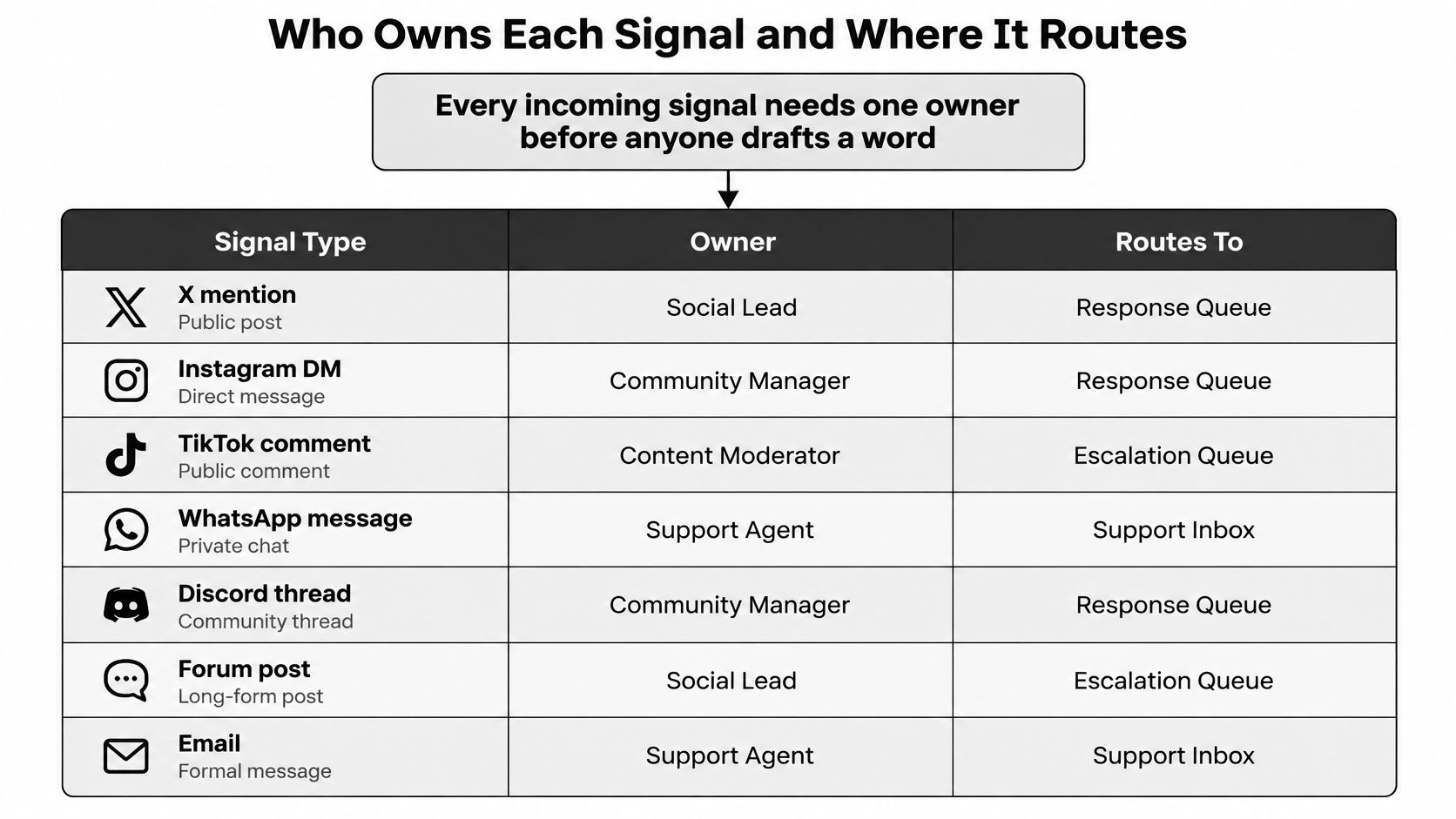
Routing and decision owners by signal
| Signal | Route to | Who decides | Reply handling |
|---|---|---|---|
| Billing dispute in replies or DMs | Finance | Named finance approver for refunds or credits | Draft reviewed by a person before sending |
| Bug or outage report | Engineering | Incident owner confirms status and fix | Holding reply, then confirmed update |
| Press question or PR risk in mentions | Comms | Comms approver authorizes public statement | Approved message only |
| Scam wave or account takeover | Trust and safety | Authorized reviewer decides account action and takedown | Human-led, with context attached |
| Feature request in DMs | Product | Product owner sets backlog priority | Tagged, thanked and logged |
| Routine how-to question | Social care | Assigned care owner decides answer and closure | AI draft, auto-closure allowed |
Make acceptance visible
A route isn't complete because someone added an engineering tag. Require an assignee, acceptance status, next action, and backup. Keep social care responsible for customer continuity until the receiving owner accepts the handoff.
Trust and safety needs the original evidence before making account decisions. Product needs a usable feature-request summary, not an unexplained DM link. Routine how-to answers can stay with care, with auto-closure limited to eligible, resolved requests that customers can reopen.
Ownership becomes harder to inspect when mentions, reviews, and community posts sit in separate tools. We bring social, reviews, and communities into one queue so the team can work from shared context.
For agency-style account separation, Linkboost's guide to managing multiple client LinkedIn accounts is a useful companion when mapping account-level responsibilities. Keep that account map distinct from the decision map: access to publish doesn't confer authority to approve compensation.
Name the owner of your top five signal types, plus the approvers for money, public statements, and account actions. Test the map against last week's messiest inbox, not the easiest how-to question.
Escalation Triggers That Move a Thread Up
Say a fintech post about failed payouts gains dozens of replies in twenty minutes. Two large accounts quote it, and customers repeat the complaint on a forum. That hypothetical case has three escalation triggers: accelerating mentions, influential-account involvement, and cross-channel replication. Route it to comms and finance, not the general response queue.
Don't wait for a large absolute mention count. An unusual cluster around a sensitive issue deserves review even when the overall inbox is quiet.
- Velocity: Mentions accelerate over a short monitoring window relative to the account's normal activity.
- Influential-account involvement: A journalist, industry voice, or large account introduces additional reach or scrutiny.
- Safety or regulatory language: Injury, data exposure, or a regulator's name requires qualified assessment.
- Cross-channel replication: The same underlying complaint appears on X, Instagram, and a forum.
Define the action behind each tier
Tier one stays with social care under its normal SLA. Tier two moves to the functional owner, with a proposed internal target of one hour after that owner receives the case. This is a team operating target, not a research benchmark.
Tier three activates a crisis lead and pauses scheduled posts and automated sends. Record who can authorize resumption. Otherwise, an unrelated promotion can publish while comms is preparing a serious incident statement.
We use triage to sort conversations by intent and priority. We flag low-confidence cases for the team, and sensitive conversations can move to a person with the context attached. Uncertainty should create a review task, not an invented confident answer.
Escalate the decision and preserve the conversation. Don't make the customer explain the incident again.
Move a public complaint into DM only after a public reply states the next step and says a person will follow up. Link the DM to the same case, preserve the public thread, and request sensitive account information privately.
Log the handoff timestamp and retain the original customer timestamp. The internal tier-two clock starts on owner receipt, but customer waiting time must remain visible so slow triage can't disappear from reporting.
Write each trigger in plain words and assign a named person, plus a backup, to each tier.
Keeping Brand Voice Consistent Across Human and AI Replies
AI acceptance isn't universal: 70% of surveyed social users were at least somewhat comfortable with brands using AI for faster customer service, while 30% were uncomfortable, according to Sprout Social's Q3 2026 Pulse Survey analysis. Treat speed as a service capability, not permission to automate every interaction.
Write a voice guide that a reviewer can apply without guessing. Include tone words, phrases to avoid, apology rules, sign-offs, and the name the organization uses during a crisis. We let teams define reply guidance per organization so drafts start closer to the right voice.
Define what AI may send
Use confidence and consequence together. A confident draft can still be unsafe when it promises compensation or interprets a legal obligation.
- Automate routine, reversible requests: Approved navigation instructions and straightforward how-to answers can qualify when the knowledge base supports them.
- Augment financial or account-specific replies: Let AI prepare the answer, but require a person to verify facts, permissions, and promises.
- Escalate uncertain meaning: Sarcasm, multilingual slang, memes, identity ambiguity, and unclear intent should trigger review rather than automatic sending.
- Keep consequential decisions human-led: Safety, legal, and high-reach issues need an accountable decision-maker, not just a tone check.
- Signal automation appropriately: Don't imply a person investigated an account when an automated workflow only retrieved an article.
Brand voice doesn't mean using the same cheerful wording everywhere. A Discord feature discussion can sound conversational; a WhatsApp billing dispute needs plain language and an exact next step. Remove celebratory punctuation from serious incident replies.
Reviewer fatigue also needs a boundary. If every draft requires extensive rewriting, narrow the automated scope and repair the guidance instead of asking reviewers to approve faster.
Choose twenty approved replies as a working reference set. Include refusals, apologies, unresolved investigations, and handoffs, not just friendly answers. Use them to assess factual accuracy and situational judgment alongside tone.
Crisis Response After the First Public Reply
The first statement isn't the whole crisis response. A 2026 study using real-comment-calibrated crisis simulations found that second-round responses had a stronger effect on public judgment than first-round responses; paths ending in immediate repair performed best, while second-round denial performed worst.
That's a reason to plan follow-through, not a guarantee that every repair statement restores trust. A company must be able to substantiate what it says it repaired.
Keep an owner for the next answer
Use a multi-round model: acknowledge the issue, publish verified facts, answer follow-up questions, correct errors openly, and show evidence of remediation. The round-one owner retains round two unless comms explicitly reassigns it.
Update an earlier statement when verified facts change, not because pressure rises. If no new facts are available, confirm that investigation continues and honor the promised update time without speculating.
A holding statement buys investigation time. It doesn't transfer accountability or finish the case.
The CIPR crisis communications social media skills guide provides an operating model spanning initial response in the first 1 to 2 hours, fact-finding in the next 2 to 4 hours, public response within 4 to 24 hours, and monitoring over 24 to 72 hours.
Crisis response windows
| Window | Timing | Core action | Owner |
|---|---|---|---|
| Initial response | First 1 to 2 hours | Identify potential harm and alert the response lead | Crisis lead |
| Fact-finding | Next 2 to 4 hours | Verify what happened and preserve screenshots and timestamps | Subject-matter owner with comms |
| Public response | 4 to 24 hours | Publish a confirmed public update | Comms approver |
| Monitoring and adjustment | 24 to 72 hours | Watch sentiment, correct errors and answer follow-ups | Social ops with comms |
Treat these as orchestration windows, not waiting periods. Potential harm requires immediate assessment. The Rallio crisis-management guide recommends preserving evidence, verifying affected populations, alerting relevant decision-makers, and reviewing scheduled promotions and automation.
Prepare evidence, not reassurance
AI can cluster outage reports, preserve context, and draft a summary. Engineering confirms service restoration; finance confirms remediation; comms approves the public wording.
Give the follow-up draft fields for confirmed impact, completed action, remaining limitations, and the next update. Recovery belongs on the crisis dashboard through correction and unresolved-thread measures, not a declaration that the conversation has calmed down.
Draft that round-two statement before you need it. Leave explicit placeholders for verified facts, and don't let a polished sentence conceal an unanswered operational question.
Measure Whether the Strategy Is Working
Build a dashboard that connects speed, ownership, and outcome. Keep channel and intent filters available so an easy Instagram queue can't conceal stalled billing cases.
- Response speed: Median and 90th-percentile time to first response by channel and intent.
- Handoff: Time to qualified handoff, including acceptance by the named owner.
- Resolution: Time to conclusive resolution by severity, with reopened cases visible.
- Quality: Resolution accuracy, repeat contacts, and escalation rate.
- Automation: Auto-closure rate and SLA breach rate, separated by automated and reviewed handling.
- Crisis: Time from anomaly detection to owner assignment, time to first verified statement, correction latency, and unresolved high-reach threads.
Pair speed with a quality check
A fast generic acknowledgment can improve first-response performance while the actual case goes untouched. Pair response time with resolution accuracy and repeat contacts. Review whether the reply advanced the case, not just whether it was sent.
A high auto-closure rate can conceal customers returning through another channel or abandoning the conversation. Inspect reopened cases and linked contacts before treating closure as success.
Likewise, a low SLA breach rate can mean the team set an undemanding SLA. Compare targets with customer expectations and review the oldest unresolved cases, including those already acknowledged.
| Speed measure | Quality check |
|---|---|
| First-response time | Helpful next step and accurate answer |
| Owner-assignment time | Correct owner and accepted handoff |
| Resolution time | Repeat contacts and reopened cases |
| Correction latency | Corrected wording across affected channels |
Hold a weekly review with the people who can change staffing, routing, and automation rules. Sample completed cases as well as breaches, because a technically compliant reply can still be unhelpful.
Keep the executive roll-up focused on SLA breach rate, repeat contact rate, and time to owner assignment in crises. Attach an accountable owner and corrective action to each material problem.
Build the Playbook and Start on Monday
A useful playbook tells the on-duty lead what to do when the inbox gets messy. Keep it alongside the working queue, with current approvers and a dated change log, rather than buried in a presentation.
Use this workflow as a checklist while building the operational version.
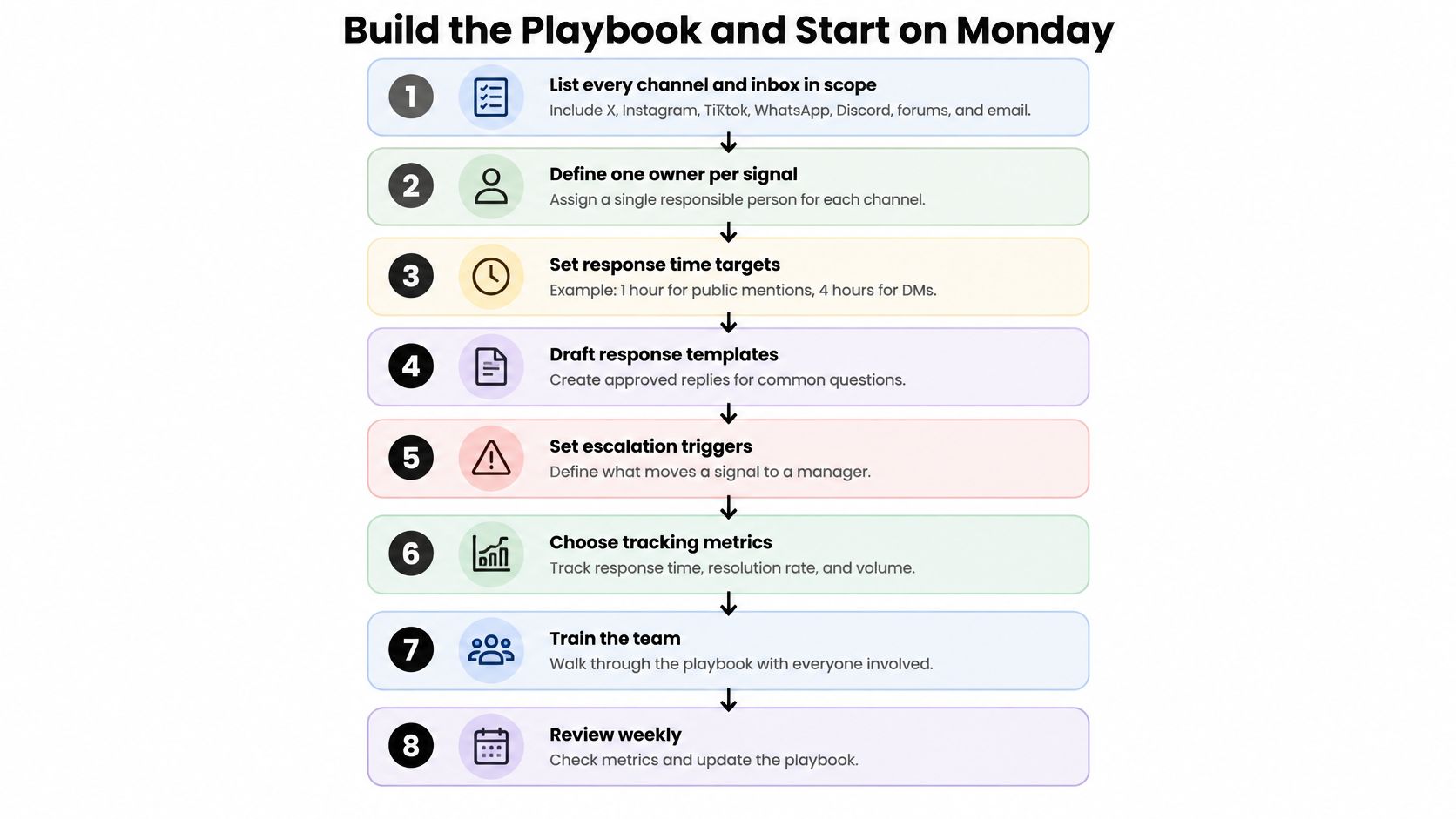
Build the working document
List every channel and inbox in scope. Include X, Instagram, TikTok, WhatsApp, Telegram, Discord, forums, and reviews. Include DMs and any email handoff destination so private conversations don't become invisible.
Pull thirty days of messages as your initial working sample. Tag billing, outages, feature requests, scam waves, and other recurring signals. Review a sample by hand because keyword tagging can miss sarcasm and multilingual slang.
Apply first-response and resolution targets. Record them separately, with coverage hours and breach actions. Don't let an acknowledgment automatically mark a case resolved.
Name an owner, a decision-maker, and a backup for every route. Test whether each approver has authority to authorize the outcome. A shared mailbox without a decision-maker will still stall.
Write escalation triggers and tiers. State what pauses when tier three opens, who receives the alert, and who can restore scheduled posts and automatic sending.
Draft voice rules and approved holding statements for high-risk categories. Include required facts and prohibited promises. An outage template shouldn't imply engineering has confirmed a cause when it hasn't.
Run a tabletop drill. Simulate an outage surge, an angry billing thread, and a misleading screenshot. Time how long owners take to accept cases and approve updates, and check whether context survives the handoffs.
Save the drill report with dated improvement targets and a named owner for the next review. Fix missing authority and broken routing before polishing templates.
Make Monday a controlled launch
Don't enable automated replies until every top signal type has a named decision owner. Check the ownership map against last month's inbox and repair any high-volume route without someone authorized to decide.
Then choose two channels for an initial pilot and let AI draft routine answers for a person to approve. Inspect edits, misroutes, and unresolved follow-ups before expanding permissions. These are proposed rollout choices, not industry performance benchmarks.
Use the accompanying video during the team walkthrough.
Sift AI can run this layer across a unified inbox: its agents triage, route, research, and reply across social channels. Your business chooses what they do and when people step in. Your team can review and send replies itself, or enable agents to send automatically for selected workflows, while retaining review elsewhere.
This week, write the owner for each of your top five signal types. Put the decision-maker and backup beside each name, then send a test case through every route.
Sift AI offers a unified inbox and AI-assisted triage, routing, research, and replies for social and community operations, with your team controlling review and automatic sending. Visit Sift AI to explore how to turn your ownership map into a working response workflow while keeping consequential decisions with people.