Social Media Reputation Monitoring: How It Works in 2026
"Social media reputation monitoring explained: signal detection, triage and routing, response workflows by severity, and the metrics that prove it works."
Your monthly executive deck shows green sentiment across every channel, yet your inbox is on fire. Forty customers spent the weekend replying to your latest product announcement about duplicate charges, a fake support handle is sliding into their replies with a phishing link, and your VP of Finance still hasn't heard a word about it.
If you lead social operations or insights, that disconnect is painfully familiar. Many teams inherit a listening dashboard built for brand campaigns and get asked to run customer care, crisis triage, and executive reporting out of it.
Real social media reputation monitoring doesn't work like a mood ring. It operates as a routing system across support, communications, finance, engineering, and trust and safety, where AI filters the noise and drafts routine replies while people approve the tough calls.
Table of Contents
- What Social Media Reputation Monitoring Covers
- How Signals Get Detected Across Channels
- Triage, Routing and Response Targets by Severity
- Spotting Scam Waves and Surge Spikes
- Prioritizing Misleading Posts and Influencer Amplification
- Measuring Whether Monitoring Actually Works
- Confirm Your Scope and Owners This Week
What Social Media Reputation Monitoring Covers
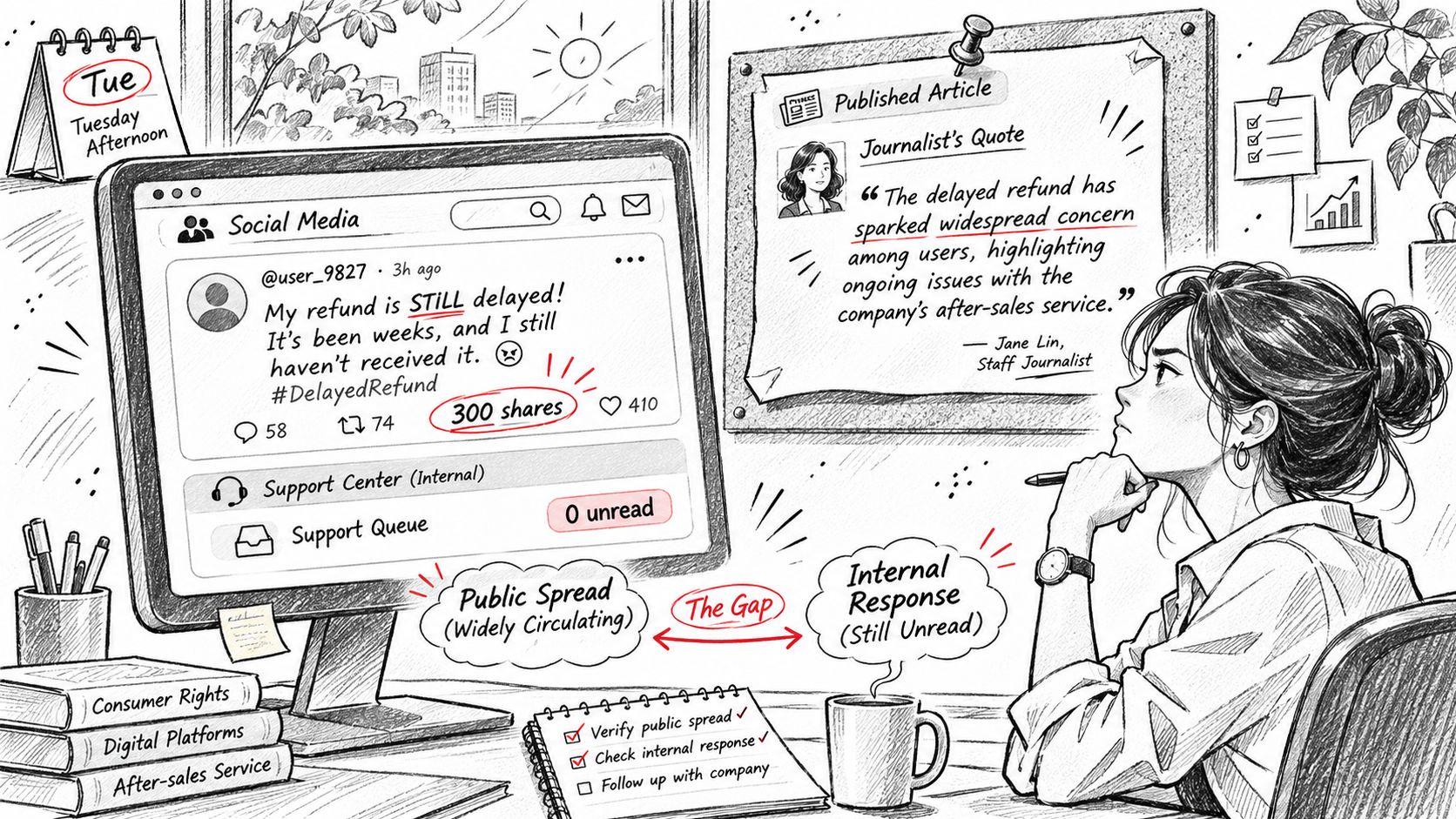
Say it's Tuesday at 2:15 p.m. A customer posts a screenshot of a refund that's three weeks overdue under your latest X thread, and before the support queue even opens the ticket, the post picks up 300 shares and a trade reporter quotes it in a newsletter draft.
That gap between public velocity and internal visibility is what creates problems for many teams. Here is how that split between a fast-moving social thread and an unread internal queue looks in practice.
In plain terms, social media reputation monitoring is the continuous collection of public and private brand signals across channels like X, Instagram, TikTok, Discord, Telegram, WhatsApp, forums, and review sites, followed by classification, routing, and response. Think of it as a smoke detector wired straight to a dispatch desk. Detection without a named owner only makes noise while the fire spreads.
Why Reputation Now Forms Before Press Responds
Public perception no longer waits for a press release or an evening broadcast to catch up. According to the Pew Research Center, 58% of U.S. adults consider social media an important way to keep up with the news, while 39% of adults under 30 regularly get news from TikTok, up from just 9% in 2020.
That 30-percentage-point jump among younger audiences shows how quickly social feeds became primary information infrastructure. A complaint in a TikTok comment section or a Discord channel can harden into an accepted narrative hours before communications sees a media inquiry.
A monitoring program that only logs mentions tells you what already happened. A dispatch system puts the right issue in front of the right owner while you can still change the outcome.
Teams also trip up when they treat monitoring as narrow content moderation or pure marketing listening. In day-to-day operations, it spans four connected jobs: social care handling account problems, operations managing SLAs and escalations, community teams watching owned spaces, and insights leads rolling patterns up to executives. To run that system cleanly, you need three stages working together: signal detection across channels, disciplined triage and routing, and measurement that tracks private resolutions alongside public sentiment.
How Signals Get Detected Across Channels
Relying on a single sentiment score is the fastest way to miss a real operational risk. A polite, neutral-toned post asking whether your checkout page is down looks harmless to a basic polarity model, even when 40 customers ask the exact same question in ten minutes.
Crisis researchers writing in Information Systems Frontiers recommend a hybrid, near-real-time monitoring architecture instead of one blended sentiment metric, noting that sentiment or emotion classifiers alone miss topic shifts, abnormal mention volume, engagement changes, misinformation, and crisis-specific language. The practical fix is to baseline five indicators together on every channel: mention volume, topic share, sentiment, interaction rate, and source mix.
You trigger an alert only when several indicators move at once. Suppose your mention volume doubles on a Friday morning after a product launch. If topic share stays tied to launch keywords and the replies come from your regular followers, that's normal campaign chatter; if volume doubles while a brand-new billing topic spikes and unfamiliar accounts start amplifying the thread, your team needs to investigate immediately.
Longitudinal Baselines and Unified Channel Context
Short-term spikes also look different when you zoom out. Run weekly views to spot sudden operational anomalies, monthly views to catch recurring friction like a broken billing flow, and quarterly views to separate a one-day PR flare-up from a steady slide in brand perception.
None of that context holds together if every platform lives in its own tab. When messages, mentions, and reviews from connected channels are brought together in a unified inbox for agents to monitor, your team can connect a private WhatsApp or Instagram DM about a failed payment to a public X thread describing the exact same bug.
Keyword rules still fail on the nuances people use online. A post reading "Great job on the three-hour wait" paired with a screenshot of a frozen checkout screen scores positive on basic keyword filters, while memes, edited screenshots, and coded slang across Spanish, Portuguese, or Tagalog slip right past English-only queries.
Seven Signal Types to Baseline on Every Channel
Before setting alert thresholds, decide which signal categories your operation needs to separate on each channel and who owns them when they spike.
| Signal | Example | Why it is an early warning | Typical owner |
|---|---|---|---|
| Billing complaint in replies | Reply under a brand post saying "charged twice this month" | Individual issue that becomes a pattern when repeated | Finance with support |
| Outage surge | Spike of "app down" replies and DMs within one hour | Volume jump that often precedes a support spike | Engineering with support |
| PR risk in mentions | Journalist or influencer repeating an unverified claim | Can reach press within hours | Communications |
| Spam or scam wave | Clone accounts offering refunds in replies | Rising fraud volume with reputational spillover | Trust and safety |
| Feature request in DMs | "Please add CSV export to the dashboard" | Low urgency, high product value | Product |
| Multilingual slang | Negative slang in Spanish, Portuguese or Tagalog | Keyword tools often miss it entirely | Local-language support |
| Sarcasm or meme | "Great job on the three-hour wait" with an image | Reads as positive to keyword filters | Support |
Triage, Routing and Response Targets by Severity
Detecting a signal only helps if your team knows where it should land and how fast it needs a reply. Customer expectations vary sharply by channel, which is why treating every mention as a generic social post creates friction fast.
In Sprout Social's State of Social Media report, 55% of consumers said they prefer contacting a company through direct messages, while 31% comment publicly and 13% tag the brand. Even among public complainants, preferences split: 33% want the brand to move the conversation to private messages, while 28% expect the issue resolved right in the comments, and 68% expect a response within 24 hours (including 24% within one to two hours and 14% within an hour).
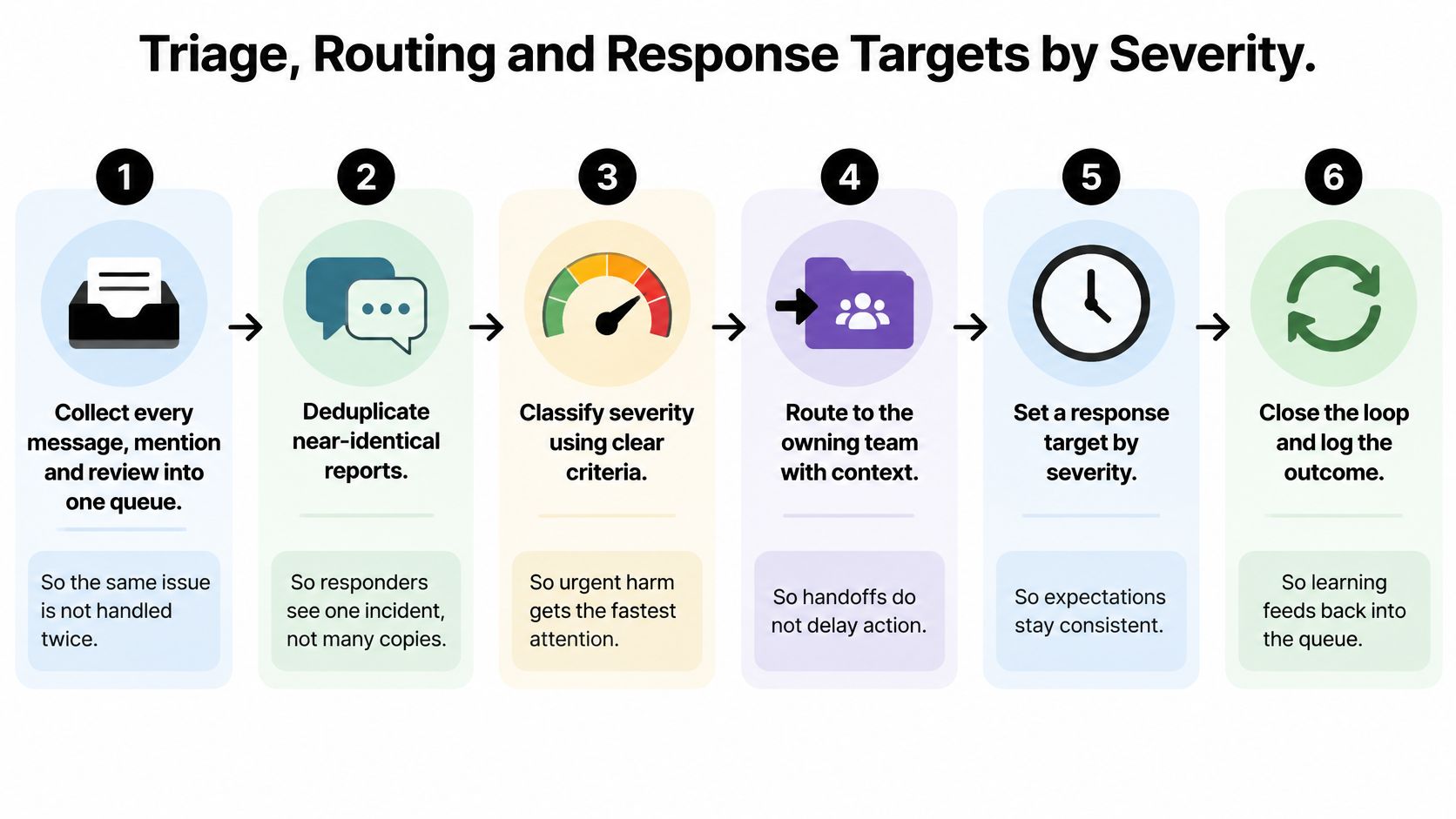
The infographic below outlines how a raw mention moves from initial capture through triage, routing, and closed-loop logging.
Six Steps From Raw Mention to Assigned Case
Run every incoming item through the same six-step sequence so routine questions don't crowd out high-risk incidents.
- Collect every message, mention, and review into one queue. Pulling public threads, private DMs, app-store reviews, and community posts into a single intake stream keeps two agents from replying to the same frustrated customer with conflicting answers.
- Deduplicate near-identical reports into one incident. If a checkout bug triggers 60 nearly identical replies in twenty minutes, group them into a single case with a live count attached. Responders need to see one escalating incident, not 60 disconnected tickets that induce reviewer fatigue.
- Tag intent and urgency cleanly. Separate billing disputes, account-access lockouts, outages, PR risks, scam attempts, feature requests, and general chatter so reporting reflects actual operational load instead of raw mention volume.
- Score severity across six risk dimensions. Rate each case on public visibility, urgency, audience influence, issue recurrence, regulatory exposure, and whether it signals a systemic product or policy failure. A recurring billing error affecting ten customers scores higher than an isolated product question, even if both look calm on the surface.
- Route to the functional owner with full context attached. Send billing disputes to finance, outage spikes to engineering, media risks to communications, impersonation waves to trust and safety, and product ideas to product. Low-confidence cases get flagged for your team, and sensitive conversations move straight to a human owner with the full thread history intact.
- Draft routine replies for approval and log channel movement. Let AI draft brand-voice responses for straightforward how-to questions, and record both where the complaint started and where it closed. Tracking whether a public complaint moved smoothly into a private DM or whether an ignored DM spilled into a public rant is how you spot broken handoffs.
Escalation rule: Track first-response time separately from resolution time, and configure automatic escalation to the next owner whenever a ticket approaches its SLA deadline without a human touch.
For a closer look at how incident triage and cross-functional escalation hold up during live social spikes, walk through the framework in this video.
Setting Response Targets and Approvers by Severity
Slow replies cost more than goodwill. The 2025 Sprout Social Index found that 73% of consumers expect brands to respond within 24 hours or sooner, and 73% said they would buy from a competitor if a brand failed to respond on social media.
Those numbers don't mean your team must resolve a complex refund or engineering bug in one hour. They set the bar for acknowledging the customer quickly, letting AI filter low-value chatter and draft routine responses while humans retain authority over refunds, policy exceptions, public outage updates, and legal language. Use the table below as a starting baseline and tune the clocks to your team's staffing and risk profile.
| Tier | Example | Owner | First response target | Human approval |
|---|---|---|---|---|
| Routine | Product how-to question | Support with AI-drafted reply | Within 24 hours | Light review of the draft |
| Billing or access | Double charge or locked account | Support with finance | Within 4 hours | Human approves any refund or exception |
| Outage or service-wide | App-down reports spiking | Support with engineering | Within 1 hour | Comms approves the public status line |
| PR or media risk | Journalist quoting an unverified claim | Comms and legal | Within 1 hour | Human writes or approves every statement |
| Scam or impersonation | Clone account asking users to pay | Trust and safety | Within 2 hours | Human approves public warning and takedown request |
Spotting Scam Waves and Surge Spikes
Impersonation accounts and fake refund offers used to be an occasional moderation annoyance. Today they drive a heavy trust-and-safety workload with direct reputational spillover.
Reporting from the Federal Trade Commission Social Media Spotlight shows reported consumer fraud losses tied to social media climbed from $261 million in 2020 to $2.1 billion in 2025, an eightfold increase in five years. Static keyword alerts can't keep up with attackers who swap handle spellings, switch languages, and reply inside your brand's own comment threads within seconds.
Instead, monitor scam signals against a rolling baseline. Track weekly counts of impersonation reports, suspicious links, and "account hacked" messages, then trigger an immediate surge review whenever volume or velocity jumps past normal variance.
Take a concrete worked example. Say your team normally logs about 12 impersonation reports across an entire week. If 90 arrive in a single Tuesday afternoon, accompanied by near-identical screenshots of a clone support handle asking customers for a verification fee, your surge threshold fires right away.
When a cluster hits that fast, investigate three likely root causes:
- Coordinated scam campaign: Fraudsters spinning up dozens of lookalike accounts to target customers replying to your brand posts.
- Compromised official account: Unauthorized access to one of your regional handles, community bots, or marketing accounts pushing malicious links.
- Opportunistic outage exploitation: Scammers watching your public replies during a real service disruption and posing as express support agents to harvest credentials or payments.
Splitting Scam Operations Between AI and Humans
Fast containment depends on dividing the repetitive sorting from the high-stakes judgment calls. Let AI deduplicate near-identical spam posts, detect multilingual variants, cluster cropped screenshots and memes, and route confirmed victim reports straight to support or finance.
Keep humans firmly in charge of validating whether a cluster is a real campaign, filing platform takedown requests or regulator notices, approving public fraud warnings, and deciding when a spike is material enough to brief executives. Never let automation publish a public accusation of fraud without a person signing off.
Preserve one complete evidence record for every flagged incident: the original post text, offending account handle, platform, URL, image or screenshot, and any reported transaction context. When trust and safety, legal, communications, and customer care all work from the same record, victims get private help while platform reports go out clean.
Platform context matters just as much as speed. In the FTC 2024 consumer alert on top scams, consumers reported losing $1.9 billion to scams that started on social media in 2024, 70% of people who reported being contacted through social media said they lost money, and Facebook generated the largest amount of reported scam losses among social platforms that year. Tracking Facebook scam signals in their own dashboard view prevents high-loss fraud waves from getting buried inside a blended cross-channel average.
Prioritizing Misleading Posts and Influencer Amplification
Ordinary customer complaints usually grow in proportion to how many people hit a bug. Misinformation behaves differently, because a single misleading claim with modest reach can explode in minutes once the right account picks it up.
Audiences are already primed to doubt official statements. According to Axios coverage of the 2025 Edelman Trust Barometer, which surveyed approximately 32,000 people across 28 countries, 70% believed government officials, business leaders, and journalists deliberately mislead people through false statements or exaggeration, lack of faith in business leaders rose 21% since 2021, and 75% said it's getting harder to tell whether news comes from respected media or from someone trying to deceive them.
That skepticism changes how brand rumors spread. A 2026 study in Psychology & Marketing analyzed 101 brand-related misinformation posts and 48,821 comments across 47 brands, finding that influencers amplify toxicity most strongly when engagement and sociopolitical salience are high and pseudonymity is low. The authors identified four recurring patterns: flame-bait firestorms, toxic debunking, consumer conflict, and trolling.
A Four-Part Check for High-Salience Claims
Because raw mention volume won't catch a slow-burning claim before an influencer lights it up, weight audience influence and topic salience above pure post count in your triage score. Run suspicious claims through four checks before anyone drafts a reply:
- Flag high-reach repetition early. Surface any claim touching product safety, pricing, labor practices, or an executive the moment an account with real audience authority repeats it, even if total brand mentions barely budged.
- Compare reply velocity against share velocity. When replies climb significantly faster than reposts or shares, conflict is already brewing inside the thread, which often signals a flame-bait firestorm forming.
- Inspect the tone of debunk threads before jumping in. Watch out for toxic debunking, where aggressive third-party corrections trigger pile-ons that push the original false claim into thousands of fresh feeds.
- Split routing cleanly under one shared record. Send verified-false narratives to communications for response strategy, while customer-facing confusion caused by the rumor goes to support so frontline agents don't improvise contradictory answers.
"Never confuse a quiet dashboard with a safe thread. One verified creator repeating a false safety claim outranks fifty routine feature complaints."
Communications owns the final call on whether to issue a public statement or hold strategic silence so you don't amplify a fringe rumor. When your team does publish a correction, don't grade it on whether comment sentiment ticks upward that afternoon. Judge whether the correction reduced confusion and slowed repeat customer questions without feeding the original post's distribution.
Measuring Whether Monitoring Actually Works
No single metric proves your monitoring operation is healthy. Public sentiment can climb during a flashy marketing campaign while urgent billing tickets sit untouched for three days, and fast response times mean nothing if agents are firing off unhelpful template replies.
The visual below pairs public perception metrics with operational execution indicators so leaders can see both sides at once.
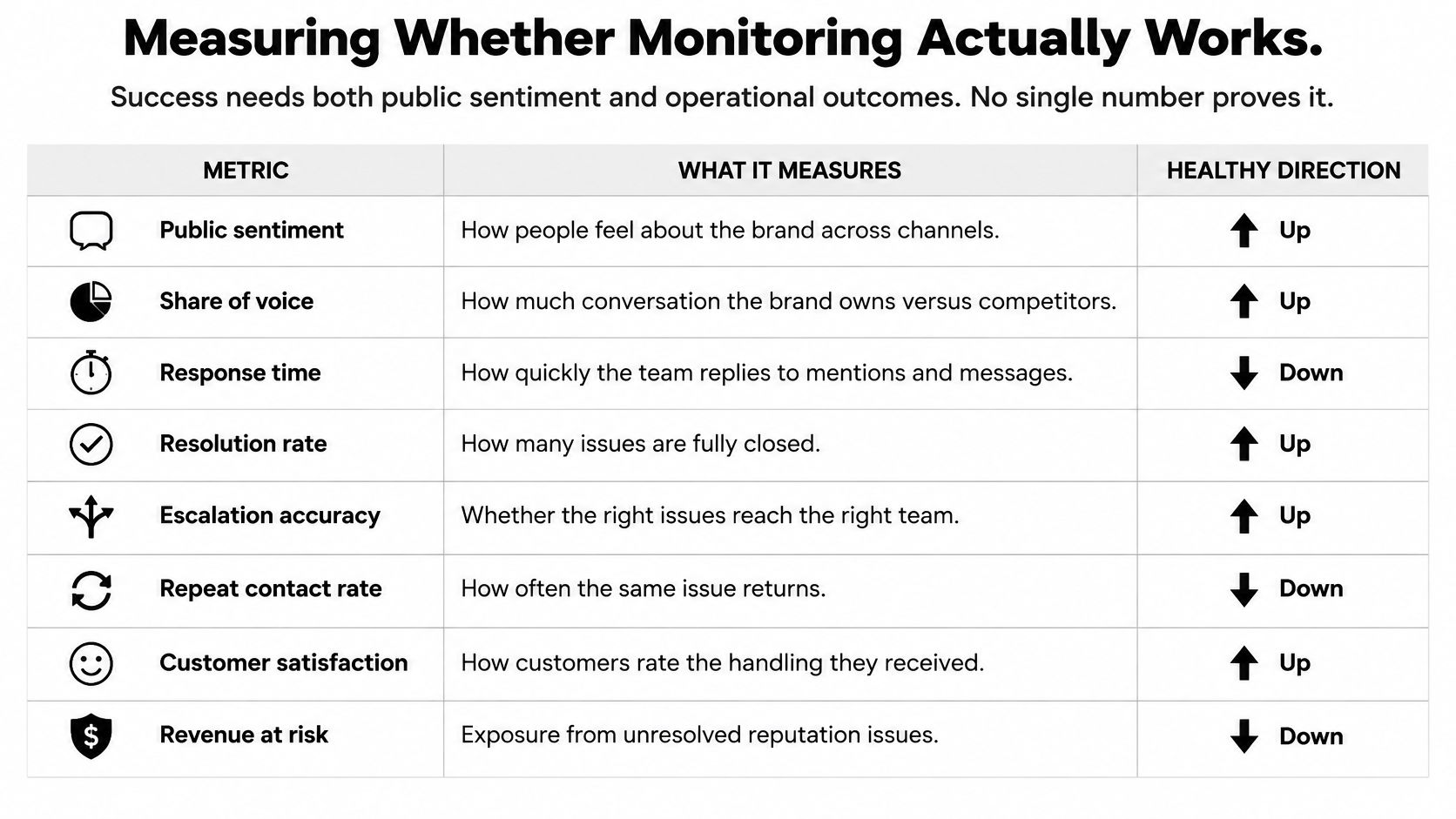
To run social ops day to day, track eight core operational metrics alongside brand perception, and watch each metric's blind spot closely.
| Metric | What it measures | Healthy direction | Common blind spot |
|---|---|---|---|
| First response time | Time from post to first human or approved reply | Falling | Averages hide a slow tail of urgent cases |
| Resolution time | Time until the case is marked resolved | Falling | Private resolutions often go unlogged |
| Auto-closure rate | Share of cases closed without human action | Rising in routine tiers only | Sensitive issues closed automatically |
| Noise filtered percentage | Share of volume classed as non-actionable | Rising | Real complaints filtered out as noise |
| SLA attainment | Share of cases answered within the tier target | Rising, by tier | One tier masking failures in another |
| Proactive saves | Issues resolved before they became public | Rising | Counting saves that were never real problems |
| Private-to-public escalation rate | Private cases that later appeared publicly | Falling | Sudden jumps show routing gaps |
| Reviewer override rate | How often humans change AI tags or drafts | Falling, then stable | Rising rate signals model drift |
Reading Metrics Against Each Other
Insights appear when you pair metrics together instead of scanning them in isolation. If first response time drops while your reviewer override rate climbs, don't celebrate faster queues; your AI drafts or intent tags have drifted out of alignment, and reviewers are burning time fixing them before hitting send.
Apply the same skepticism to auto-closure rate. High auto-closure is healthy in routine tiers like general praise, spam suppression, or basic FAQ deflections, whereas rising auto-closure on billing disputes or account lockouts signals a serious routing leak that will bounce back as angry public threads.
When communications publishes a correction to counter misinformation, measure effectiveness with two concrete checks: watch the reach of replies on the thread to confirm your response didn't extend the rumor's lifespan, and track whether repeat complaints fall over the following two weeks. Keep per-platform dashboards rather than one blended reputation score, because Facebook, Instagram, X, and TikTok carry sharply different customer behaviors, amplification dynamics, and scam patterns.
Building the Monthly Executive Roll-Up
Executives don't need a raw export of every social mention. Give leadership a tight monthly roll-up tied directly to business risk and accountability:
- Surge count by category: How many outage, billing, PR, or scam spikes crossed baseline thresholds during the month, plus time to containment.
- SLA attainment broken out by severity tier: Never blend routine how-to replies with one-hour outage or media-risk targets.
- Proactive saves with named owners: Verified cases resolved in DMs or support channels before they turned into public backlash, attributed to the functional owner who fixed the underlying cause.
Confirm Your Scope and Owners This Week
Most monitoring rollouts stall because teams buy software, switch on twenty noisy keyword alerts, and burn out reviewers in ten days. Lock down your scope, owners, and baselines first, then configure your tools to enforce them.
Walk through this seven-step setup checklist before flipping live alerts on:
- Inventory every channel where customers speak. Map out X, Instagram, TikTok, Discord, Facebook, YouTube, WhatsApp, Telegram, owned communities, forums, App Store, Google Play, and third-party review sites so blind spots don't surprise you mid-incident.
- Confirm one named owner per severity tier. Put names on finance, engineering, communications, product, and trust and safety handoffs, along with backup coverage for nights and weekends.
- Lock your first-response targets per tier. Start from 24 hours for routine questions and tighten clocks for billing, scams, outages, and media risk before publishing SLAs internally.
- Collect four weeks of baseline data first. Measure normal weekly mention volume and topic share across every connected channel for a full month before enabling surge thresholds, so ordinary campaign chatter stops paging on-call leads.
- Configure saved searches for high-risk themes. Set up dedicated saved searches for billing errors, outage language, scam indicators, and brand-name variants, routing notifications to Slack, email, or your in-app center with the full search context attached.
- Turn on triage by intent and priority. Let automated triage sort incoming conversations so routine how-to questions land in an approval-ready draft queue while high-severity cases jump straight to human owners.
- Put a monthly metrics review on every owner's calendar. Walk through SLA attainment, reviewer overrides, private-to-public escalations, and recurring root causes together so fixes reach product and engineering backlogs.
Keep the core operating principle front and center as you scale: AI filters the noise, clusters duplicates, and drafts routine replies, while people approve refunds, public statements, takedowns, and every high-stakes call. Sift AI brings that unified inbox, intent-based triage, cross-team routing, and context-rich saved-search alerting together across X, Instagram, TikTok, Discord, Facebook, YouTube, WhatsApp, Communities, App Store, and Google Play for social care, community, ops, and insights teams.
Ready to turn scattered brand mentions into a disciplined routing operation with clear SLAs and human-in-the-loop control? Sift AI gives social ops, care, community, and insights teams one command center to filter noise, triage by intent and urgency, draft brand-voice replies, and escalate high-risk cases to finance, engineering, comms, and trust and safety. Explore how your team can run reputation monitoring at social speed at Sift AI.