Social Listening Report Template: Sections and Metrics
"Build a Social Listening Report Template with core sections, metric definitions, example data and routing rules for social care and insights teams."
The most popular advice on this topic is to open with volume, a sentiment pie, and a handful of notable posts. That pack looks finished and still leaves finance, engineering, and comms with nothing to do on Monday. A social listening report template only works as an operating instrument: every number has a denominator, a named owner, a decision it informs, and a follow-up in the next period. AI can filter noise, tag intent, and draft the first pass. People approve refunds, public corrections, and whether a spike is a crisis or a stuck queue.
Table of Contents
- Social Listening Report Template at a Glance
- Scope and Methodology Panel to Fill In First
- Volume, Reach and Share of Voice Metrics Defined
- Sentiment, Themes and Intent with Auditable Denominators
- Response Time Targets by Case Type
- Routing Risk, Scam and Crisis Signals
- Linking Insights to Actions and Outcomes
- Adapting the Template to Your Business Goal
- Launch Your First Report This Week
Social Listening Report Template at a Glance
| Section | What it contains | Example value | Owner |
|---|---|---|---|
| Objective and period | Business question and reporting window | Reduce billing complaint backlog, 1-14 March | Social care lead |
| Methodology panel | Platforms, languages, query version, exclusions, dedup rule | X, Instagram, WhatsApp, 7 languages, 12% duplicates removed | Insights analyst |
| Volume and reach | Mentions, unique authors, share of voice | 41,300 mentions, 12,400 authors, 23% share of voice | Insights analyst |
| Sentiment and themes | Top themes with sentiment and intent mix | Urgent intent 6.4% of classified posts, 14% unclassified | Insights and support |
| Response performance | Median and 90th-percentile first response, SLA hit rate | Median 3.2 hours, P90 11 hours, SLA hit 81% | Social care lead |
| Risk and crisis | Scam waves, outage clusters, PR flags, escalations | 2 scam waves taken down, 1 outage cluster, 3 PR flags escalated | Trust and safety, comms |
| Action log | Decisions, owners, deadlines and status | Double-charge fix shipped by 10 March, status closed | Operations lead |
| Business impact | Outcomes linked to actions | Billing complaints 412 to 96, 46 cancellations avoided | Operations leader |
| Data quality notes | Unclassified share, model changes, validation results | 14% unclassified, model v3.2, 87% agreement on 300-post sample | Insights analyst |
| Next-period actions | Follow-up metric and target per action | Billing complaints under 10% of classified posts | Each named owner |
Read the rows in that order. Care leads use the response row for SLAs. Social managers use share of voice. Community managers use theme and thread health. Insights leaders brief executives from the objective, impact, and next-period rows.
AMEC's Integrated Evaluation Framework puts objectives, audiences, and priority issues ahead of outputs, then out-takes, outcomes, and impact. Mention volume, unique authors, and response volume are outputs. Sentiment shift and resolved issues are outcomes. A high mention count is exposure, not proof of better reputation or revenue.
Fill the methodology panel before any number. Later sections inherit its platforms, languages, query version, and exclusions. Metric formulas, routing triggers, and the outcome log come next, and each one fails if the panel is blank.
Scope and Methodology Panel to Fill In First
Write these eight fields before a chart exists.
- Reporting period. Weekly for queue owners. Monthly or quarterly for executives, so a spike is not mistaken for a lasting shift in perception.
- Platforms. Name them. X, Instagram, WhatsApp, and Discord is a coverage statement. "Social" is not.
- Languages and markets. Example: 7 languages across 3 markets.
- Query logic and version. Store the version number next to the window.
- Inclusion and exclusion. Example: Telegram excluded because access was not granted.
- Deduplication. Example: 12% of posts removed as duplicates.
- Bot and spam treatment. Say whether spam is dropped, tagged, or held for trust and safety.
- Changes since last period. A new keyword or a dropped language belongs here, not in a footnote after the argument.
Messages, mentions, and reviews from connected channels land in one queue, so state which sources feed each total. DataReportal's Digital 2025 analysis estimated 5.24 billion social media user identities worldwide in February 2025, 63.9% of the global population. Those are identities, not distinct people. Label platform totals the same way.
Practical rule: If two reports disagree, compare panels before you blame the market. Different queries produce different totals.
Volume, Reach and Share of Voice Metrics Defined
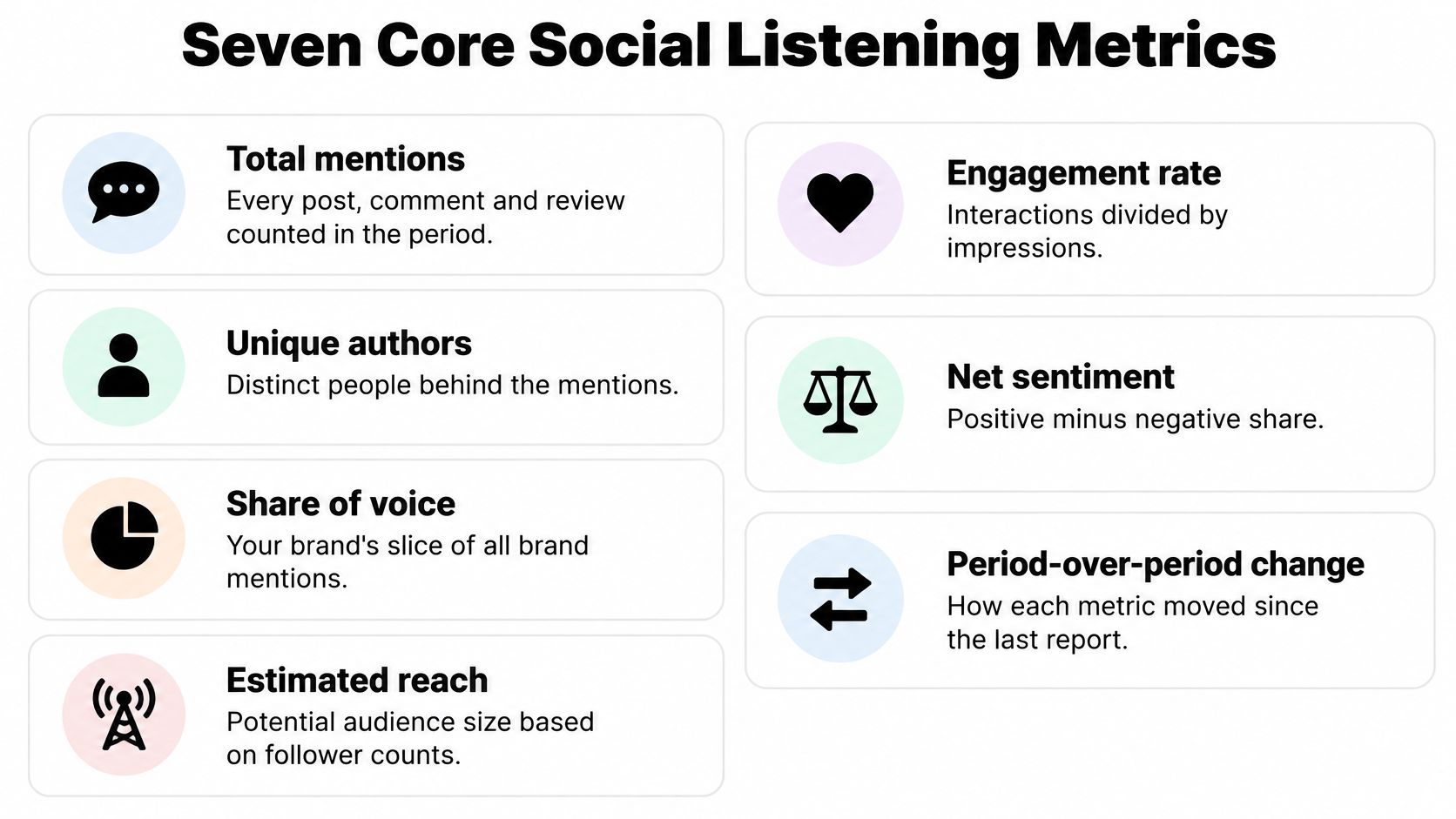
| Metric | Definition | Formula | Caveat |
|---|---|---|---|
| Total mentions | Posts, replies and reviews matching the query after deduplication | Count of unique items | Spam spikes inflate the total; check unique authors |
| Unique authors | Distinct accounts that mentioned the brand | Count of distinct author IDs | Accounts are not the same as distinct people |
| Share of voice | Brand mentions as a share of tracked category mentions | Brand mentions divided by all category mentions | Changes with the scope of the query |
| Estimated reach | Potential audience of the posts | Sum of author follower counts, or platform estimate | Measures exposure, not effect |
| Engagement rate | Interactions per post | Interactions divided by impressions or followers | Use one definition per platform |
| Net sentiment | Share of positive minus share of negative posts | (Positive minus negative) divided by classified posts | Report the unclassified share next to it |
| Period-over-period change | Shift against the prior window | (Current minus prior) divided by prior | Compare windows of equal length |
Say the brand logged 41,300 mentions inside 180,000 category mentions. Share of voice is 41,300 / 180,000, or 23%. Widen the competitor set and that percentage moves without any change in the brand's own posts. ISO 20252 treats this kind of work as research that must record data quality, sampling, and how results are reported. Put prior period, rolling baseline, target, variance, and a coverage note on every row.
Check a spike against unique authors before you call it growth. A scam wave can triple mentions and add almost no people. Net sentiment sits beside the unclassified share so the denominator stays visible. Reach is exposure. For how follower math can overstate an audience, DMpro's founder guide to reach is a useful companion. Equal-length windows only.
Sentiment, Themes and Intent with Auditable Denominators
A sentiment split with no denominator is a costume, not a finding. If the model skipped sarcasm, images, or a language it was never trained on, those posts are missing, not neutral.
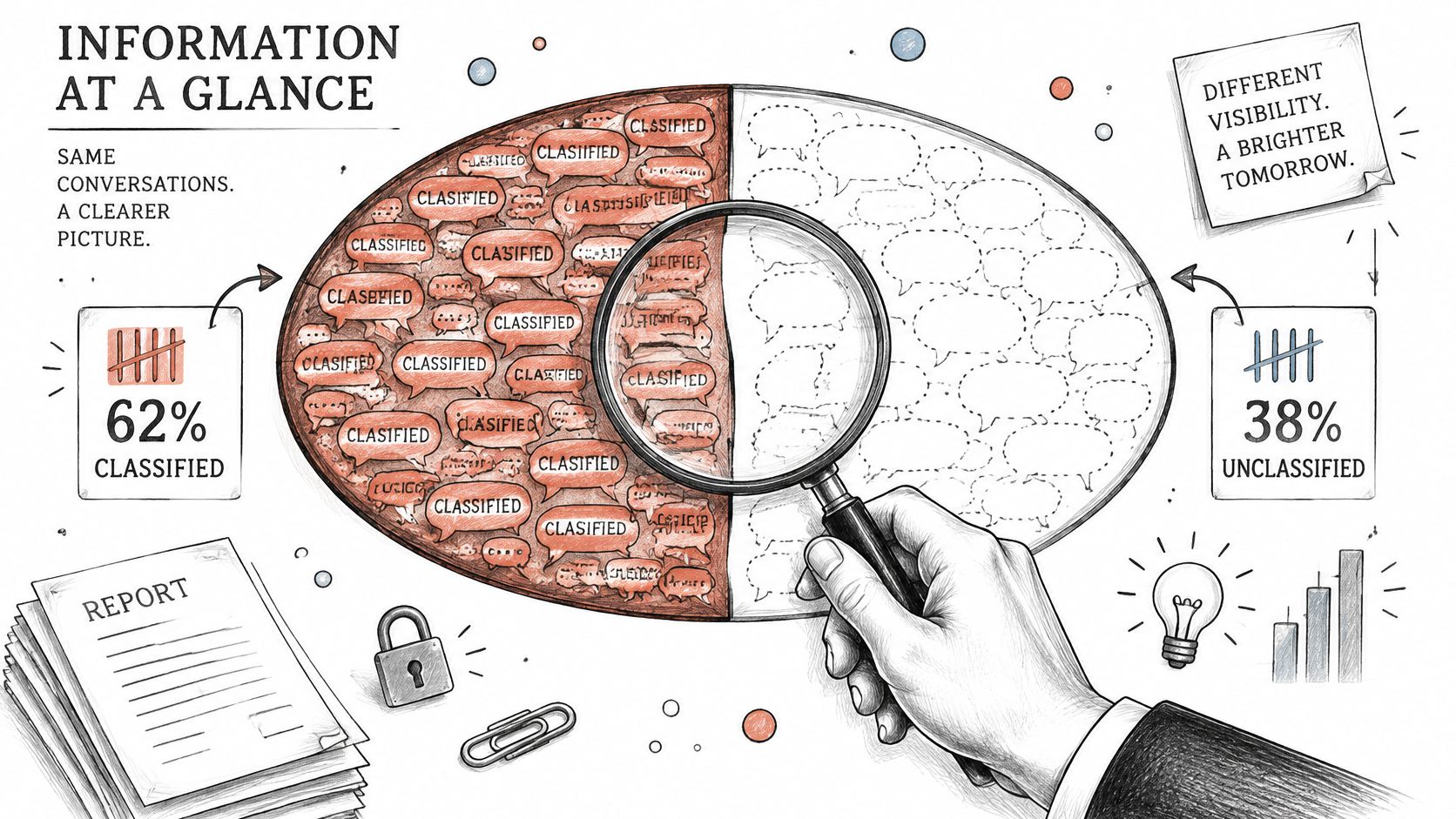
Report the classified share and the unclassified share as two numbers. Urgent-intent rate of 6.4% among classified posts, with 14% of posts unclassified and listed beside it, is an honest line. Folding the 14% into "neutral" flatters the brand and hides the queue.
Themes worth a row
Track a short list, each with a source and a review rule.
- Billing errors. Classifier plus keyword backup for "charged twice" and currency amounts. A person checks any post that names an account.
- Login failures. Intent tag "access." Route when the same error string repeats inside an hour.
- Outage reports. Cluster duplicates. Do not count each retweet as a new incident.
- Feature requests in DMs. Easy to miss in a public-only query. Tag intent "request" and count distinct accounts, not likes.
- Spam and impersonation. Separate taxonomy from ordinary negative sentiment.
- Multilingual slang and sarcasm. Keyword rules miss these. Low-confidence cases go to a reviewer who reads the thread.
Validation and drift
Pull 200 to 400 posts per language, have a person label them, and publish agreement or precision and recall in the data quality notes. Set a drift alert when the classification mix moves more than five points inside a week.
Sift flags low-confidence cases for the team, and sensitive conversations can move to a person with the context attached. The model sorts. The reviewer decides.
Every headline insight keeps a stable record ID for the posts behind it. If you can't reopen the evidence, don't brief it.
Response Time Targets by Case Type
Sprout Social's customer service statistics found that 73% of consumers expect a brand response on social within 24 hours, and 70% expect a personalized reply. Treat 24 hours as the ceiling for ordinary public questions, not the target for a locked account.
Track median and 90th-percentile (P90) first-response time apart from volume. The median can look fine while the slow tail generates the complaints.
| Case type | First-response target | Metric to report |
|---|---|---|
| Billing complaint in public replies | 4 hours, with 24-hour ceiling | Median and P90 by finance queue |
| Payment failure or account lockout | 2 hours | Time to owner handoff |
| Outage-related replies | 1 hour acknowledgement | Acknowledgement time and cluster count |
| Feature request in DMs | 48-hour acknowledgement | Requests routed to product and reply rate |
| Scam or impersonation report | 1 hour | Time to acknowledgement |
| General question or praise | 24 hours | SLA hit rate per queue |
Who writes, who sends
AI can filter repeat mentions and draft a reply in brand voice. A human approves anything that needs an account lookup, a refund, or a departure from the approved voice. Auto-closure belongs on repetitive "thanks" and status checks. It does not belong on payment failures.
Watch two numbers each week: the P90 trend and the SLA hit rate per queue. A rising P90 with a stable median means the tail is rotting. A high hit rate on general questions and a miss on billing means the wrong queue is staffed.
Routing Risk, Scam and Crisis Signals
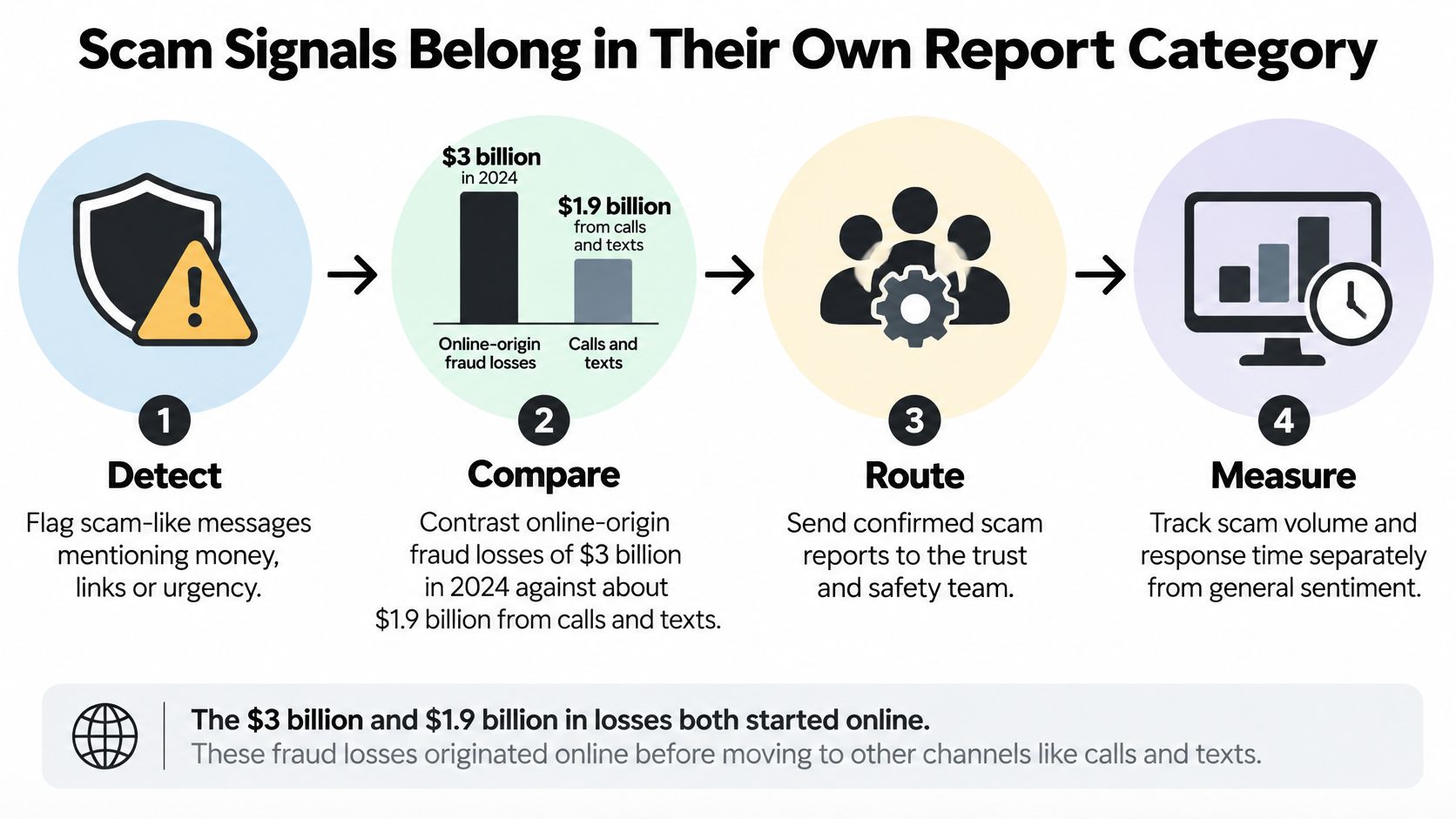
A scam wave belongs on the operating report with a denominator, a named owner, the decision that owner makes, and a check in the next period. The U.S. Federal Trade Commission reported that consumers lost more than $3 billion to scams that started online in 2024, and that many people who reported a social-media contact said they lost money. Tag the wave, the channel, and the time to escalation. Ten reports of the same lure inside 24 hours is the threshold I would use before Trust and safety escalates to legal. The next report should show whether takedown time fell or the lure returned.
| Signal | Trigger | Route to | Report field |
|---|---|---|---|
| Scam or impersonation wave | 10 or more reports of the same lure within 24 hours | Trust and safety, then legal | Scam wave count and takedown time |
| Outage or rumor surge | Duplicate complaints at 3 times baseline within one hour | Incident team and comms | Rumor volume and time to acknowledgement |
| PR-risk mention | Mention from a journalist, influencer or regulator | Comms lead | Escalations and time to approved statement |
| Feature request in DMs | Same request from 5 or more accounts | Product | Requests logged and reply rate |
| Account-specific billing complaint | Complaint containing account or payment detail | Finance | Resolved rate and refunds issued |
From detection to close
The handling line is detect, classify, route, acknowledge, correct, close. AI can cluster duplicate posts and draft a holding reply. A named person decides whether the signal is credible, approves the public line, and chooses executive escalation. Do not wait for a perfect answer before you acknowledge the question.
The report shows scam wave count, takedown time, rumor volume, time to acknowledgement, time to an approved statement, and resolved rate. Split detected spam, confirmed scams, and customer-reported losses so noise is not briefed as fraud.
Response clocks for billing, feature requests, and scams stay on the case-type targets. This table only adds the trigger, the owner, and the field you recheck next period.
Linking Insights to Actions and Outcomes
A theme list with notable posts is a reading packet. It does not show that anything changed. Hearbuyers' template guidance puts the gap plainly: most templates stop at mentions, sentiment, share of voice, themes, and posts, and never connect a metric to a named decision, an owner, and a deadline.
Split insight produced from action completed. A recurring complaint can be classified perfectly while finance, engineering, and comms do nothing.
A closed loop you can audit
Say billing complaints cluster in public replies after a price change. Finance finds a double-charge bug. Engineering ships a fix. Complaint volume falls from 412 to 96 over two weeks. The log records 46 cancellations avoided as an estimate, with the comparison window and any other launch in the same fortnight written next to it. A before-and-after drop is evidence. It is not proof.
Log fields, in this order: decision, date, owner, deadline, status, and whether the intervention worked in the next period. High negative volume might be a reputation crisis or a support pile-up. The chain tells you which.
An action stays in the follow-up column until it is closed or explicitly dropped. "Monitor" without a threshold and a date is not an action.
Adapting the Template to Your Business Goal
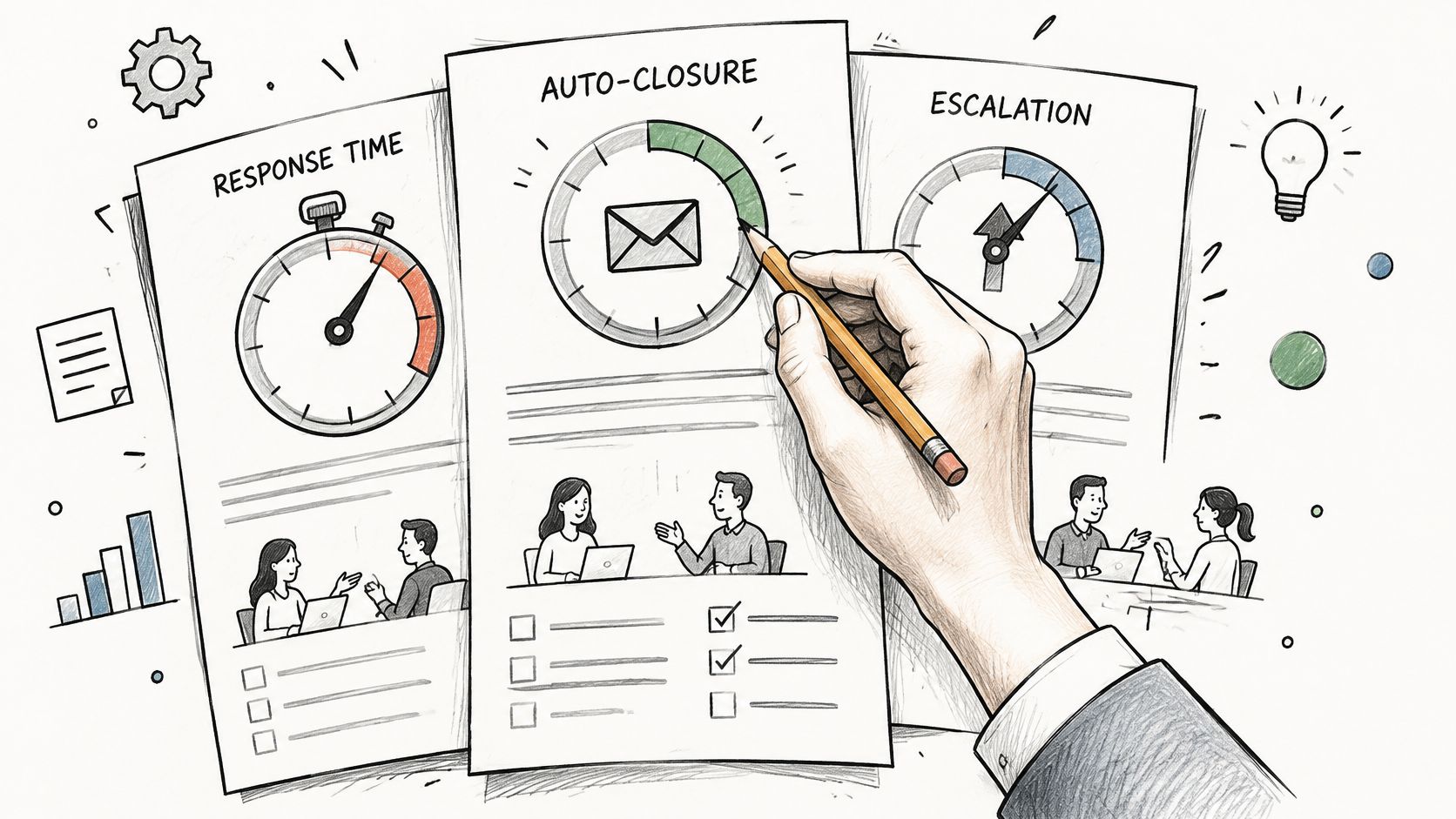
One skeleton, four headlines. Change the headline with the reader. Do not change the formula.
Social care leads lead with first-response P90, auto-closure rate, and escalation rate. Break out billing and outage queues. A blended SLA hides the queue that is missing its target.
Brand social managers lead with share of voice against the tracked category, net sentiment on campaign topics, and reach of owned posts. Any spike gets an author check before it is called momentum.
Community managers on owned forums care about thread health: repeat-question rate, time to first helpful reply, moderator workload, and member sentiment by topic. Public mention volume is the wrong scoreboard for a Discord or forum.
Insights and operations leaders count decisions the report influenced, risk exposure by signal type, and cost avoided. Each figure points at an action-log row, or it does not go in the executive pack.
Weekly versus executive
The weekly version keeps routing and response detail for the people who staff queues. The monthly or quarterly version keeps the objective, three headline metrics, the top two risks, the outcome log, and next-period actions. Raw theme lists stay in the appendix.
Same definitions in both versions. An executive number that cannot be traced to the operational view is a different metric wearing the same name.
Launch Your First Report This Week
A first report teams will act on answers one operational question and names who reopens the numbers. "Are billing complaints falling after the price change?" can be scored: unique authors as the denominator, a queue owner, a decision (keep the price message or change the macro), and a check at day 30. A brand-health folder has none of those fields, so it never forces a call.
Run the week in this order.
- Choose one question. Write it at the top and leave it there unless you version the change.
- Fill the methodology panel. Platforms, languages, and query version, before the export.
- Pull a seven-day sample. Compare unique authors with total mentions before you report a spike.
- Name an owner. One owner per section and one owner per log row, each with a deadline.
- Book the 30-day review. Compare P90, SLA hit rate, and action-log status with this first pack.
A single queue shortens step 3. Messages, mentions, and reviews from connected channels sit together, so you filter by channel instead of exporting five tools. Triage that sorts conversations by intent and priority can pre-sort that sample. A person then reviews the hard slice, not the whole firehose.
Sift AI is an operating system for social and community work: one queue across channels and communities. Agents filter noise, tag intent, and route cases to finance, engineering, or comms. They draft replies. People still decide the hard calls, including when a draft is allowed to send.
The pack stays useful only while each action still has an owner and a date you will reopen. Bring the next listening report into that single queue so triage and reply drafts sit beside the same denominators you will check in 30 days.