Pattern Recognition Software for Social Ops
"Discover how pattern recognition software transforms social operations. Learn to filter noise, detect intent, and scale support with a unified inbox."
A billing outage hits at the same time a spam wave floods your Discord server. Customers post screenshots in Instagram replies, ask for refunds on X, send feature requests through WhatsApp, and tag executives in public threads. Your team sees everything, but not in the order it matters. Agents burn time separating duplicate complaints from genuine escalation risks while finance, engineering, comms, and trust and safety wait for usable context.
That's the operational problem pattern recognition software can solve. In social care, it isn't an abstract exercise in identifying shapes or statistical similarities. It's the triage engine inside a unified inbox, helping teams filter noise, recognize intent, assign urgency, and route each signal to the person who can act on it. The important distinction is orchestration, not replacement. AI handles repetitive sorting and drafts routine responses, while people approve replies, investigate ambiguity, and own high-stakes decisions.
Table of Contents
- The Reality of Scaling Social Operations
- How Pattern Recognition Models Process Social Signals
- Core AI Techniques Driving Intent and Urgency Detection
- Evaluating Vendors for Enterprise Social Care
- Measuring Operational Impact and Auto-Closure Rates
- Navigating Data Scarcity and Model Reliability Limits
- Orchestrating the Human-in-the-Loop Workflow
The Reality of Scaling Social Operations
Social support rarely fails because a team lacks commitment. It fails because the work arrives as an unstructured stream. A billing complaint can appear as a reply to a campaign post, a direct message, a community thread, or a screenshot with no explanatory text. A product outage creates near-identical messages across platforms, while a small number of posts contain the evidence that engineering or communications actually needs.
Manual triage makes every message look equally important. Agents open posts one by one, search for context, apply tags inconsistently, and forward urgent issues through separate tools. During a surge, that process creates reviewer fatigue. The team spends its attention on volume rather than judgment.
Practical rule: Route by operational intent, not by the channel where a customer happened to speak.
Pattern recognition software gives the inbox a working interpretation layer. It can identify signals associated with a billing complaint, feature request, service outage, PR risk, spam, scam activity, or impersonation, then attach structured tags and confidence scores. Those signals can trigger routing to finance, engineering, comms, or trust and safety without asking an agent to classify every post manually.
A useful workflow might treat a short reply saying “great, another failed payment” differently from a genuine compliment. It might recognize that an image contains an error message, group repeated outage reports into one operational theme, and separate a customer asking for help from a coordinated scam wave. The system doesn't need to make the final decision in every case. It needs to put the right evidence in front of the right owner quickly.
Human capacity still matters. Teams may combine internal agents with specialized support partners, including LatHire virtual assistants when they need additional coverage for queue monitoring, context gathering, or routine follow-up. The software should make that distributed operation clearer, with permissions and escalation rules that prevent important cases from disappearing between shifts or vendors.
Customer expectations make this discipline urgent. Nearly three in five consumers say company responses to support inquiries on social media matter to them, and two-thirds prefer a person rather than automation alone, according to Customer Experience Dive's coverage of social support expectations. Pattern recognition earns its place when it protects human attention for the conversations where a human response matters most.
How Pattern Recognition Models Process Social Signals
A social triage model turns messy posts into structured operational signals through a pipeline. The quality of the final routing decision depends on every stage, not only on the classifier.
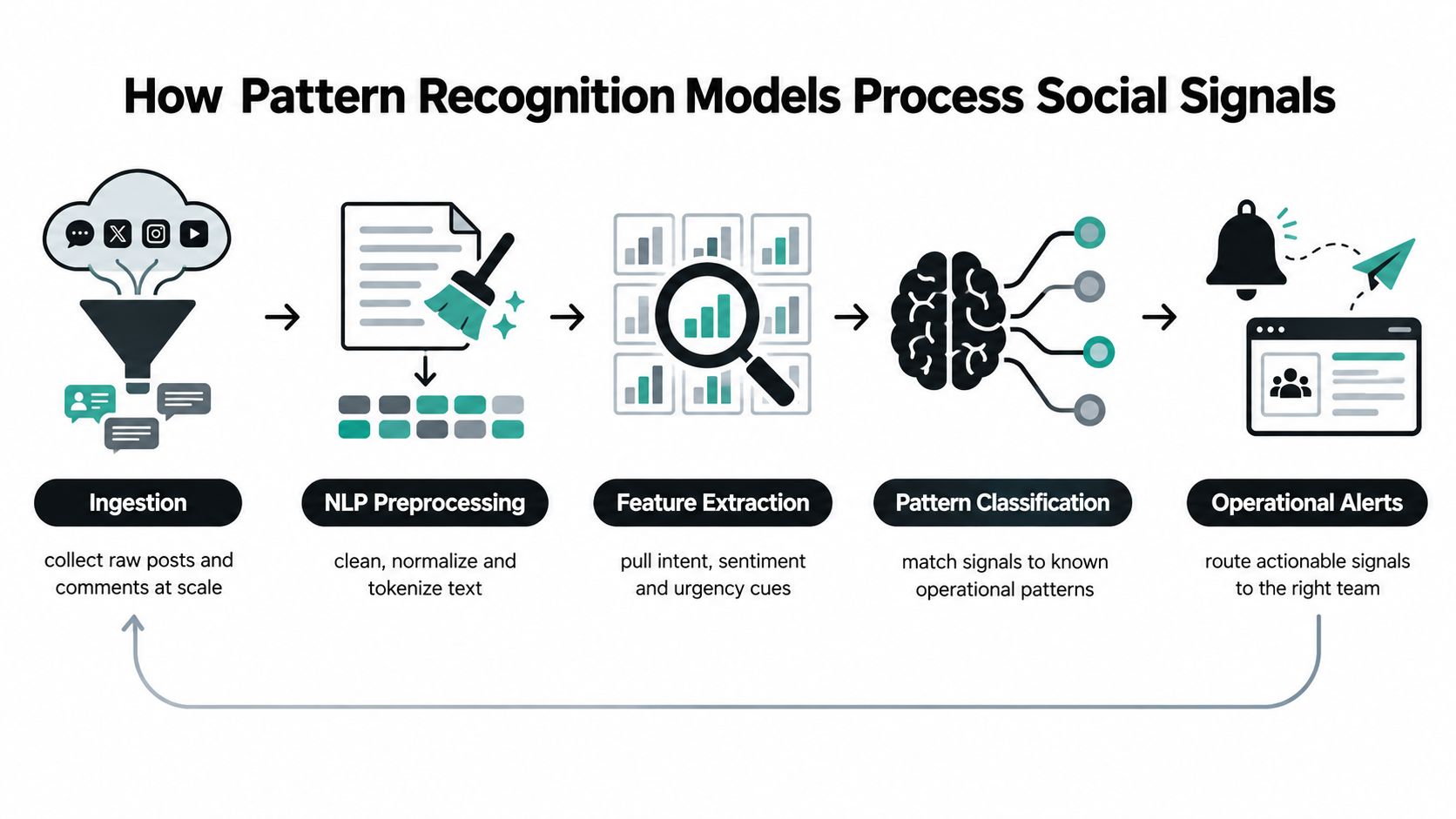
Ingestion and preprocessing
The system first collects posts, replies, comments, direct messages, images, and community activity from connected sources. It then normalizes the input. That can mean stripping HTML from a forum post, removing tracking parameters from a URL, identifying the language, expanding platform-specific abbreviations, and preserving the surrounding thread so a short reply doesn't lose its meaning.
Multilingual slang makes preprocessing especially important. “It's cooked” might describe a failed service, a joke, or a meme depending on the community. A literal keyword match can miss the intent entirely. A context-aware system should consider nearby text, conversation history, account behavior, and the type of content attached to the message.
Feature generation
Feature generation extracts the cues that help a model distinguish one operational pattern from another. Text features may include entities such as invoice references, product names, error codes, and locations. Other features can represent sentiment, urgency, repetition, language, conversation history, and whether several accounts are posting similar content within a short operational window.
Images contribute separate signals. A screenshot of a failed transaction may contain the most useful evidence, even when the accompanying caption only says “help.” Meme context can also change the meaning of a sentence, so a system that reads text without visual context will often misclassify posts.
Classification and validation
The model maps those features to categories such as billing complaint, feature request, PR risk, or spam. It may produce a confidence score and supporting diagnostics, including prediction distributions or confusion-matrix-style evaluations. Those outputs help operations leaders decide which signals can be routed automatically and which require review.
The underlying pipeline commonly combines preprocessing, feature generation, model training, and validation to turn raw text, image, or signal data into usable downstream decisions, as described in this overview of pattern recognition software workflows.
Validation should reflect the live queue, not a clean laboratory sample. Test sarcasm, multilingual messages, screenshots, duplicate outage reports, and posts that mention a competitor without requesting support. If the model confuses criticism with abuse, or a feature request with a billing issue, the routing logic can create more work instead of less.
Core AI Techniques Driving Intent and Urgency Detection
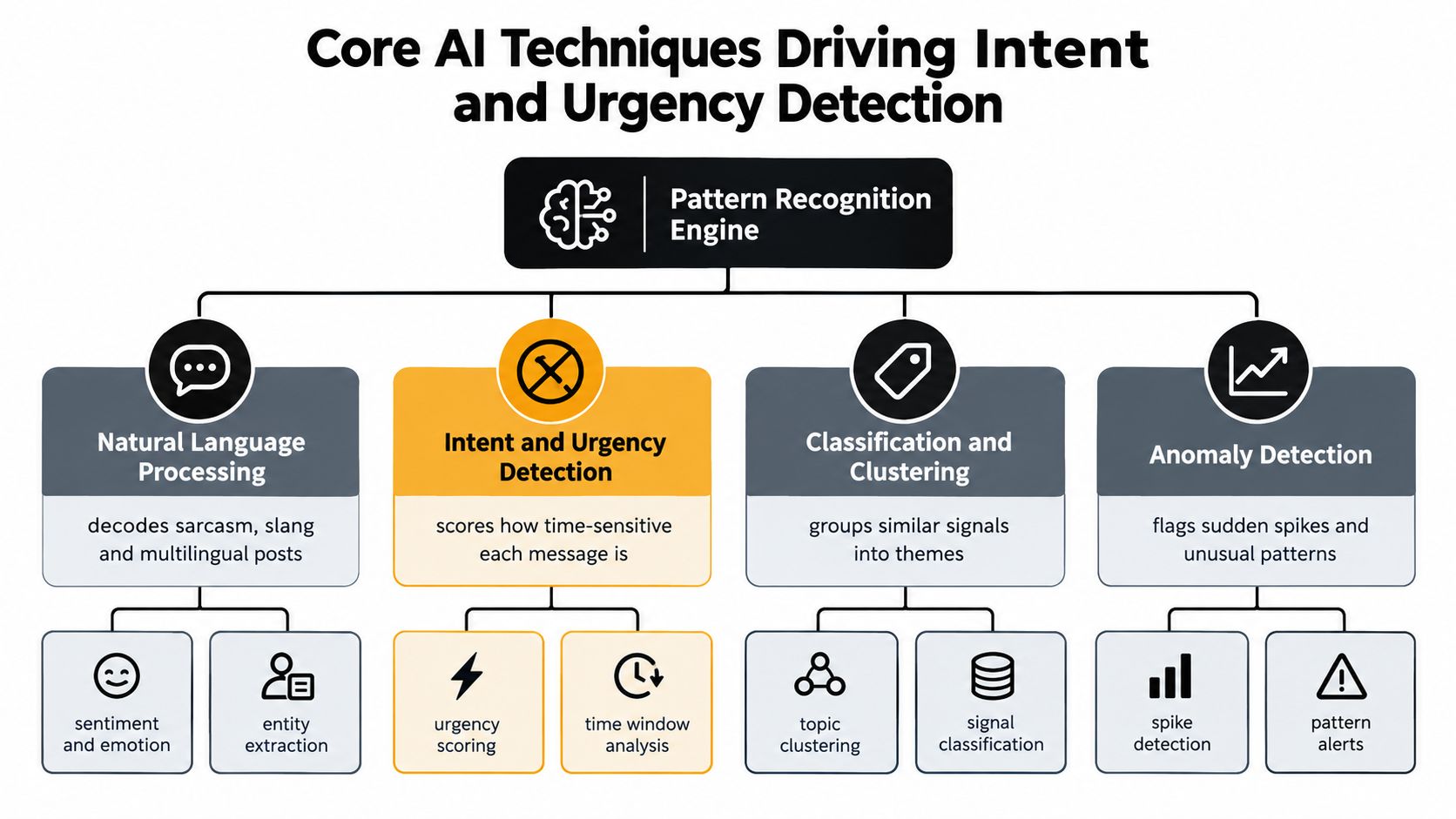
No single technique understands every social signal. A capable triage system combines language analysis, visual interpretation, classification, and anomaly detection because customer intent often spans formats and behaviors.
Natural language processing
Natural language processing, or NLP, handles the text layer. It identifies entities, sentiment, emotion, intent, and urgency, but social language makes each task harder than a standard support form. Customers use sarcasm, abbreviations, misspellings, local slang, code-switching, and platform-specific shorthand. “Love paying twice” may be a billing escalation, not positive sentiment.
NLP can also identify the difference between a request and a mention. “Does anyone know if dark mode is coming?” signals a feature request. “Dark mode broke after the update” points toward a product issue. Both may contain the same product term, but they need different tags and owners.
Computer vision
A customer who uploads a screenshot is already giving the team diagnostic material. Computer vision can help identify error codes, interface states, product defects, or evidence of a failed transaction. It can also recognize that a post includes a meme or another visual element that changes how the caption should be interpreted.
That doesn't mean the model should independently promise a refund or declare an account compromised. Visual analysis should enrich the case record and increase routing accuracy. An agent still needs to verify sensitive information and follow the organization's policy.
Deep learning and behavioral patterns
Deep learning models can represent relationships that are difficult to capture with fixed keyword rules. In social operations, that matters when spam or scam activity changes wording, uses several accounts, or combines repeated links with coordinated behavior. Anomaly detection can flag an unusual increase in similar mentions, a sudden burst of impersonation attempts, or a new pattern that doesn't match ordinary community activity.
The operational value comes from combining methods. NLP interprets the complaint, computer vision reads the screenshot, and anomaly detection adds the wider behavioral context. A frustrated customer posting a sarcastic meme about a failed transaction should not be treated like an isolated text classification problem.
The best workflow exposes these signals to reviewers in a usable way. Agents should see why a message was tagged, what evidence raised urgency, and which routing rule will fire. If the system provides only a label with no context, reviewers can't correct it efficiently and leaders can't diagnose recurring errors.
Evaluating Vendors for Enterprise Social Care
Keyword tracking and operational orchestration solve different problems. A keyword tracker can tell you that a brand name appeared. An orchestration platform should help answer what the person wants, how urgent the issue is, who owns it, whether a response is needed, and when the case can safely close.
Use a live sample of your queue during evaluation. Include billing complaints in replies, outage surges, PR-sensitive mentions, feature requests in DMs, multilingual slang, scam waves, and screenshots of errors. Ask vendors to show the complete path from ingestion to tagging, routing, review, response, escalation, and reporting.
| Evaluation Criteria | Basic Keyword Trackers | AI Orchestration Platforms |
|---|---|---|
| Context | Matches words or simple phrases | Interprets conversation, intent, urgency, language, and media |
| Routing | Sends alerts to a general destination | Routes to support, finance, engineering, comms, or trust and safety |
| Multimodal input | Usually centered on text | Can combine text, images, links, and behavioral signals |
| Human review | Manual inspection after an alert | Confidence-based queues, approval steps, and escalation controls |
| CRM integration | Often limited to exports or notifications | Synchronizes cases, ownership, status, and customer context |
| Permissions | Basic user access | Role-based permissions, auditability, and controlled actions |
| Brand voice | Separate response process | Configurable drafting and review against approved voice |
| Measurement | Mention and volume reporting | Response, resolution, routing, noise, and workflow analytics |
Questions that expose weak fits
Ask how the system handles uncertainty. A vendor that promises automatic action on every message may be optimizing for a demo rather than safe operations. You need controls for low-confidence classifications, sensitive topics, high-value complaints, and crisis escalation.
Ask how rules and models coexist. Deterministic pattern rules remain useful for exact phrases, URLs, formats, and known scam signatures. Context-aware models handle ambiguity. Enterprise teams need both, along with a clear override path when a rule catches too much or too little.
Security and governance belong in the first evaluation round. Confirm role-based access, audit logs, data retention, CRM synchronization, and enterprise readiness such as SOC 2 controls. A practical AI decision framework from Rite NRG can help structure the build, buy, or integrate discussion before procurement turns into a feature checklist.
Sift AI is one example of an AI operating system for social and community operations. It combines a unified inbox across channels and communities with intent tagging, routing, escalation, AI-drafted replies, analytics, and human review controls. Evaluate it against the same queue samples and governance requirements as every other option.
Measuring Operational Impact and Auto-Closure Rates
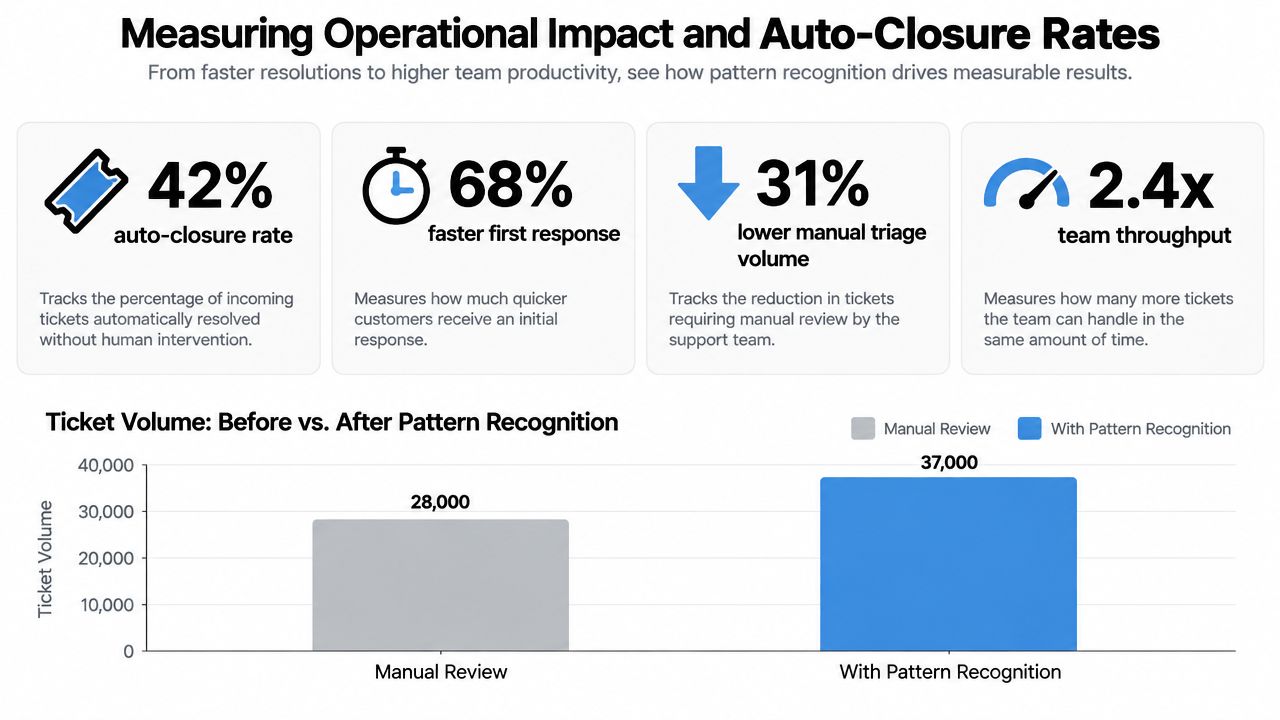
A triage deployment needs an operating scorecard, not just a model accuracy report. The executive question is whether customers receive better service while agents spend less time on repetitive sorting. The team question is whether automation reduces noise without hiding difficult work.
Start with the queue metrics that reveal service quality:
- First-response time: Measure how long customers wait before a meaningful human or approved automated response.
- CSAT: Compare satisfaction by intent, channel, language, and routing destination rather than relying only on an overall average.
- First-contact resolution: Track whether the issue is resolved without another handoff or follow-up.
- Channel-switch rate: Monitor the percentage of customers who move from one channel to another during the same conversation, using the definition in this unified-inbox operations guide.
Treat auto-closure as a controlled decision
Auto-closure rate should never stand alone. A high rate can mean the system resolved repetitive questions correctly, or it can mean the system closed cases before customers received help. Break the metric down by intent, confidence, channel, language, and escalation history.
Define eligible closure patterns explicitly. A duplicate outage acknowledgment, a resolved status question, or a known spam event may be suitable. A billing dispute, account-access concern, threat, potential fraud report, or PR-sensitive complaint should usually remain open until an authorized person confirms the outcome.
Noise filtering also needs a denominator. Track how many incoming items the model suppresses, groups, or routes away from the human queue, then sample those decisions for false negatives. The practical test is not whether the inbox looks quieter. It's whether the team can respond faster to legitimate customers without losing signals that require judgment.
Current expectations leave little room for slow handoffs. About three-quarters of consumers expect a social response within 24 hours or sooner, according to the 2025 Sprout Social Index finding. Yet only 37% of companies meet response-time expectations across channels, as reported in Kayako's 2026 customer-service benchmark coverage. Pattern recognition helps close that gap only when routing, staffing, approval rules, and escalation ownership are designed around the metrics.
Navigating Data Scarcity and Model Reliability Limits
A social care model rarely learns a community's language from a small set of clean labels. Niche slang changes quickly, platform conventions shift, and the same phrase can signal different intent across regions or communities. Training data that excludes sarcasm, images, code-switching, or adversarial behavior leaves the triage engine weakest where social operations face the most exposure.
Recent work on design pattern recognition identifies limits that apply directly to unified inboxes. A 2025 study discussed in the pattern recognition market research notes that machine-learning methods need large training sets that are difficult to collect, many approaches perform only on known patterns, and static-analysis methods depend on compilable code. In social care, a model trained on yesterday's scam language may miss tomorrow's variation. A rigid analysis method can also misread the changing context of a live community.
Build for correction, not perfection
Human review supplies the feedback loop. Give reviewers a fast way to correct an intent tag, adjust urgency, merge duplicate themes, or mark a routing decision as wrong. Store each correction with enough context to separate a model error from a deliberate policy change.
Model drift needs a routine. Review new slang, emerging scam formats, platform changes, and sudden shifts in message volume. Monitor rising reassignment rates, lower first-contact resolution, increased channel switching, and repeated agent overrides. Those operational symptoms show that the model's interpretation no longer matches the queue.
Automation should make uncertainty visible. It shouldn't hide uncertainty behind a confident label.
Ethics and security require the same operating discipline. Automated moderation can silence legitimate criticism, mishandle dialect, or escalate a vulnerable customer. A trust and safety rule designed to catch spam may also catch a genuine fraud warning. Keep high-impact actions reviewable, record why each decision was made, and give authorized staff a way to reverse it.
The unresolved issues include interpretability, durability, limited labeled data, security, and ethical risk. Social teams should therefore treat pattern recognition as a maintained operational system, with testing, corrections, and ownership, rather than software that can be installed and forgotten.
Orchestrating the Human-in-the-Loop Workflow
The strongest social operations design assigns machines the repetitive work and people the accountable work. AI can ingest messages, remove obvious noise, group duplicates, suggest intent tags, draft a response, and surface analytics. A human should approve sensitive replies, decide whether a complaint signals a wider incident, and own escalations involving money, safety, reputation, or policy.
Set the workflow around decision thresholds rather than vague automation goals. Low-risk, high-confidence questions can move through an approved response path. Ambiguous cases should enter a reviewer queue with the conversation, model rationale, customer history, and suggested owner visible together. High-urgency patterns should notify the responsible team and preserve an audit trail.
A workable routing model
- Finance: Billing disputes, refunds, duplicate charges, and payment failures.
- Engineering: Reproducible bugs, outage evidence, error screenshots, and technical regressions.
- Comms: Viral complaints, executive mentions, media attention, and potential PR risk.
- Trust and safety: Scam waves, impersonation, threats, coordinated abuse, and account-risk signals.
- Support: Routine product questions, known issues, and approved troubleshooting flows.
Drafting needs the same discipline as routing. A reply should reflect the configured brand voice, avoid unsupported promises, and make the next action clear. Agents shouldn't have to reconstruct context from X, Instagram, Discord, Telegram, WhatsApp, and a CRM while a customer waits.
The transition from reactive triage to proactive community management happens when the team can trust the queue. Leaders can identify recurring feature requests, spot outage patterns before they dominate mentions, and measure where customers switch channels because the first response failed. The system remains accountable to people, but it gives those people the clarity and control to operate at social speed.
Sift AI unifies social and community channels in one inbox, uses pattern recognition to filter noise, detect intent and urgency, route cases, draft replies, and surface operational analytics while keeping humans in control. Visit Sift AI to see how your team can replace manual triage with a governed workflow for faster, more consistent social care.