Market Sentiment Analysis for Social Operations
"Learn how market sentiment analysis works for social and community ops — from methods and data sources to KPIs, routing, and real workflows that scale."
Tuesday starts with a billing email nobody on the social team wrote. Within the hour, complaints spread across X, Reddit, and Discord. Agents are opening the same issue repeatedly, comms needs a public response, engineering wants reproducible details, and leadership asks whether the situation is getting worse. Raw mention volume can't answer that question.
Market sentiment analysis becomes useful when it operates as part of the response system, not as a decorative chart. It classifies opinion and intent at ingestion, gives reviewers context, and sends the right conversation to support, finance, engineering, comms, or trust and safety. The objective isn't to remove people from the workflow. It's to keep humans focused on decisions that require judgment.
Table of Contents
- When a Mention Surge Becomes an Operations Problem
- What Market Sentiment Analysis Actually Means for Social Ops
- Comparing Lexicon, Classical ML, Deep Learning, and Transformer Methods
- Data Sources and Preprocessing Across Modern Social Channels
- Metrics and Visualizations That Move the Needle
- Routing, Escalation, and the Human-in-the-Loop Workflow
- Real Use Cases for Care, Comms, and Product Teams
- Common Pitfalls and How to Mitigate Them
When a Mention Surge Becomes an Operations Problem
A sudden surge creates three separate problems. First, agents can't distinguish a genuine billing failure from reposts, jokes, unrelated complaints, and spam. Second, comms needs a consistent public-facing line before different agents improvise contradictory replies. Third, executives need a measure of customer impact that goes beyond how many posts arrived.
Without classification, teams sort manually in the unified inbox. They search for keywords, open threads one by one, and rely on whoever happens to recognize the issue first. That approach produces late escalations, uneven response times, and duplicated work. A negative reply from a high-authority account can sit behind dozens of low-value posts, while a routine question enters the same queue as a potential outage.
Put sentiment between ingestion and triage
A practical pipeline adds a decision layer immediately after ingestion:
- Collect the conversation. Pull mentions, replies, DMs, community posts, and thread context into one operational view.
- Tag sentiment and intent. Mark polarity, urgency, and intent such as billing complaint, outage report, refund request, feature request, or spam.
- Apply routing rules. Send billing issues to support or finance, technical symptoms to engineering, reputational risk to comms, and coordinated abuse to trust and safety.
- Prioritize the queue. Combine sentiment, intent, source authority, confidence, and escalation status rather than sorting by volume alone.
- Close only safe work. Route simple, verified answers toward self-service or auto-closure, while ambiguous or high-risk conversations remain with a reviewer.
The difference is operational. Sentiment-weighted alerting can surface a small cluster of sharply negative posts before it becomes a large public thread. Intent tags tell the inbox what the person needs, not merely how the message sounds.
Practical rule: A sentiment score should change who handles a conversation, what SLA applies, or whether a human must review it. If it changes none of those things, it's reporting decoration.
This guide focuses on workflows a social ops lead can defend in a weekly review: routing accuracy, escalation quality, reviewer load, response time, auto-closure safety, and the signals executives can act on.
What Market Sentiment Analysis Actually Means for Social Ops
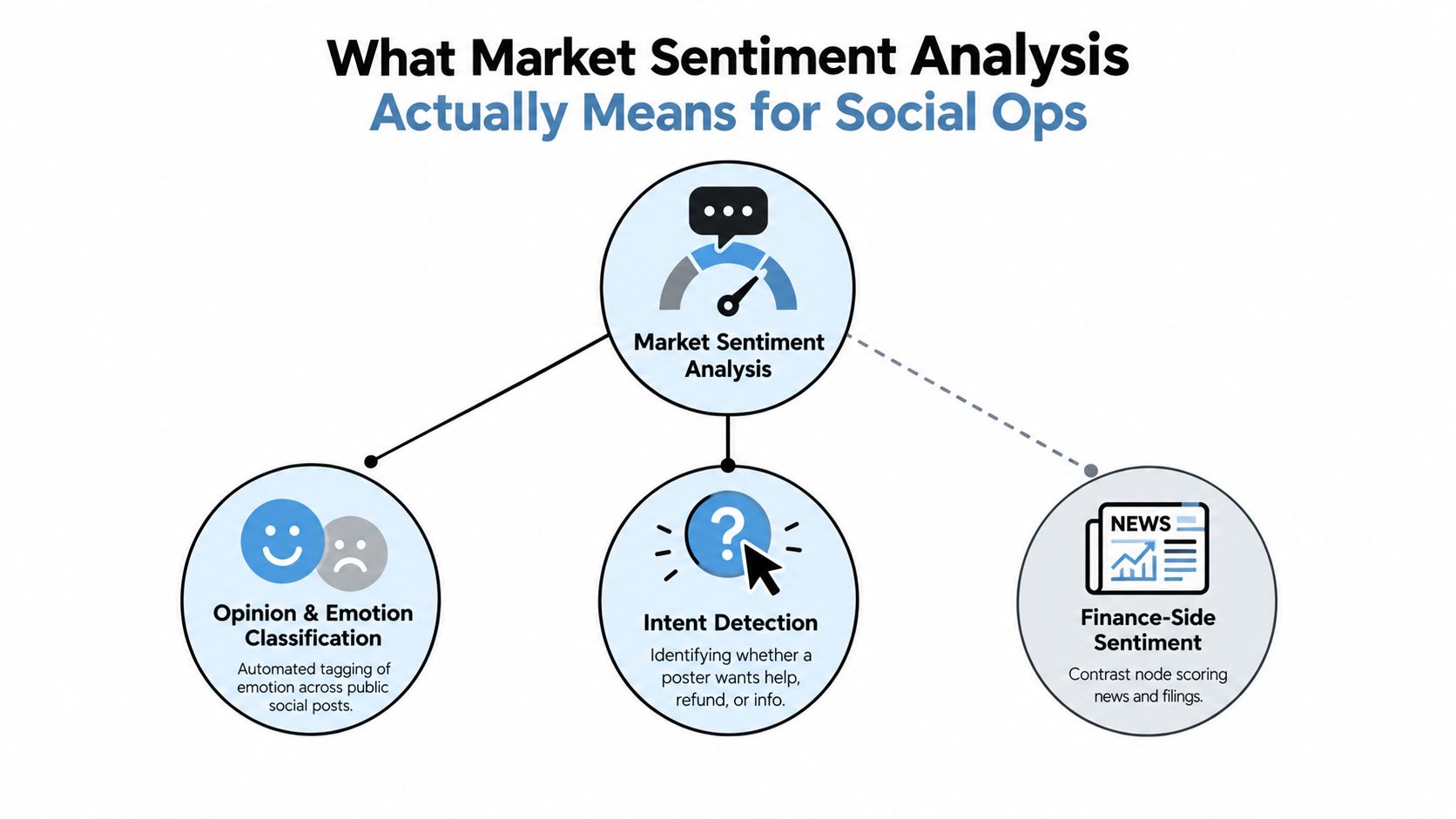
In social operations, market sentiment analysis is the automated classification of opinion, emotion, and intent across public and owned channels. That differs from finance-side sentiment analysis, which often scores news, filings, investor commentary, or price-related expectations. The social ops output isn't a line on a trading dashboard. It's a message-level record attached to a conversation while that conversation is still actionable.
A useful record might contain negative sentiment, billing complaint, high urgency, English, sarcasm risk, and medium confidence. Another might contain neutral sentiment, product question, low urgency, and strong confidence. Those tags let routing rules decide whether the message enters a support queue, a product feedback stream, a comms watchlist, or an auto-closure candidate.
Treat the model like an inbox triage nurse
The model doesn't diagnose the whole situation. It decides who should see the case first and which conversations can safely follow a standard path. A care lead still reviews the unusual symptom, the ambiguous complaint, and the message where context changes the apparent meaning.
That distinction prevents three common mistakes:
- It isn't a replacement for judgment. Sarcasm, screenshots, memes, and community-specific slang can reverse the apparent polarity.
- It isn't a vanity score. Average sentiment doesn't tell a support manager which queue is failing or which intent is driving escalations.
- It isn't English-only. Language identification and per-language evaluation are essential when communities use mixed-language text or regional slang.
The inputs include mentions, DMs, replies, nested threads, comments, and forum discussions. The outputs should include sentiment tags, intent tags, confidence scores, language labels, source authority, and drift signals. Drift matters because the same phrase can change meaning after a product release, policy change, or community event.
For broader context, long-running sentiment measurement shows why the field is more than a recent social listening trend. The University of Michigan's consumer sentiment series tracks monthly readings from November 1952 through July 2026, normalized to 1966:Q1 = 100, and its historical movement illustrates how sentiment can quantify changing expectations across economic cycles (the University of Michigan consumer sentiment series). Social ops borrows the same core idea, then turns it into a queue decision.
Comparing Lexicon, Classical ML, Deep Learning, and Transformer Methods
No single method wins across every channel. The right choice depends on language stability, post volume, latency, media content, explainability, and the cost of a false escalation.
| Method | Accuracy on Sarcasm/Memes | Latency | Cost | Best-Fit Channels | Limitation |
|---|---|---|---|---|---|
| Lexicon, such as VADER or AFINN-style scoring | Low | Very low | Low | Stable-language, low-risk DMs and simple FAQs | Misses sarcasm, memes, slang, and code-switching |
| Classical ML, such as logistic regression, SVM, or gradient boosting | Moderate on known patterns | Low | Low to moderate | High-volume text queues with labeled channel data | Requires feature engineering and regular retraining |
| Deep learning, such as LSTM or CNN text models | Moderate to strong on sequential patterns | Moderate | Moderate | Channels with recurring language and enough training data | Performs poorly on genuinely new slang or unseen formats |
| Transformer and multimodal models, such as BERT, RoBERTa, domain-tuned LLMs, or vision-text systems | Strongest for context, mixed language, screenshots, and memes | Moderate to high | Higher | X, Reddit, crisis comms, image-heavy communities | Cost, latency, explainability, and guardrail requirements |
Match sophistication to risk
Lexicon scoring works when the vocabulary is stable and the operational consequence is small. A routine WhatsApp question about account settings doesn't need an expensive multimodal model if the answer is well understood and a reviewer samples the output. Classical ML becomes more useful when a team has channel-specific labels and wants a retrainable classifier for recurring complaint types.
Deep learning can capture sequence and phrase patterns that simple word counts miss, but it still needs representative examples. Transformer models are the stronger choice for X and Reddit conversations where irony, quote-posting, screenshots, and community slang carry meaning. Multimodal analysis matters when a customer posts a payment error as an image rather than writing the error in text.
Research on financial sentiment makes the same operational point from another angle. Dictionary methods count words, while machine-learning approaches handle context and ambiguity more effectively, so teams should validate signals against outcomes rather than raw classification accuracy (cross-country evidence on sentiment methods and time horizons).
Start cheap where the risk is low. Spend model complexity where a wrong route can create a public incident, miss a customer, or exhaust a reviewer queue.
Teams working with financial communities may also find this crypto sentiment analysis guide useful for framing market-specific language, but social ops still needs to adapt the taxonomy to its own intents, channels, and escalation costs.
Data Sources and Preprocessing Across Modern Social Channels
A sentiment pipeline fails before classification if ingestion destroys context. Every source carries different metadata, permissions, thread structures, media types, and delivery constraints. Preserve what survives the API, and record what didn't arrive so reviewers don't mistake missing context for neutral context.
| Channel | Ingestion Notes | Key Metadata | Preprocessing Flags |
|---|---|---|---|
| X | Mentions, replies, quote posts, and public threads require relationship stitching | Handle, timestamp, reply depth, repost or quote status, media type | Quote-post context, sarcasm, duplicate reposts |
| Comments, mentions, and DMs often separate public and private context | Handle, timestamp, post ID, media type, reply relationship | Image captions, emojis, short replies | |
| TikTok | Comments are brief, fast-moving, and frequently video-dependent | Handle, timestamp, video ID, media indicator, reply depth | Slang, emojis, video context, repeated comments |
| Discord | Server, channel, role, thread, and reply context affect meaning | User, server, channel, timestamp, role, thread ID | Community slang, nested replies, bot messages |
| Telegram | Group and channel structures produce different authority signals | User, chat, timestamp, message relationship, media type | Forwarded posts, multilingual text, scam patterns |
| WhatsApp Business | Inbox context is private and often tied to an account or case | Customer identifier, timestamp, conversation ID, attachment type | PII handling, voice notes, language detection |
| Reddit and forums | Subreddit, forum, thread, and author history can change interpretation | Handle, community, timestamp, score, thread depth, media type | Cross-post deduplication, quoted text, community vocabulary |
Preprocess in the order the model needs
Start with language identification, before sending text to an English-only classifier. Then normalize Unicode, expand emojis into interpretable text, remove formatting noise, and preserve meaningful punctuation. Deduplicate cross-posts without deleting the original source, because a copied complaint appearing in several communities can be an operational signal.
Next, stitch replies to their parent posts. “Great, exactly what I needed” can be positive, sarcastic, or hostile depending on the preceding message. A meme or screenshot should receive a high-risk media flag, not a forced polarity label. Human review is safer than confident guessing when the text doesn't contain the actual meaning.
Mixed-language messages need their own path. A Hindi-English, Portuguese-Spanish, or Tagalog-English complaint can be routed incorrectly if language detection chooses the dominant token count rather than the language carrying the intent.
Preprocessing rule: Anything scoring below 0.6 sarcasm confidence bypasses auto-closure, regardless of sentiment polarity.
That rule deliberately favors review over false certainty. It also gives the ops lead a measurable place to tune the system: sarcasm confidence, language accuracy, duplicate rate, and the share of messages that arrive without usable thread context.
Metrics and Visualizations That Move the Needle
Executives rarely need another follower or impression total. Social ops needs measures that explain whether the pipeline is reducing work safely and protecting response obligations.
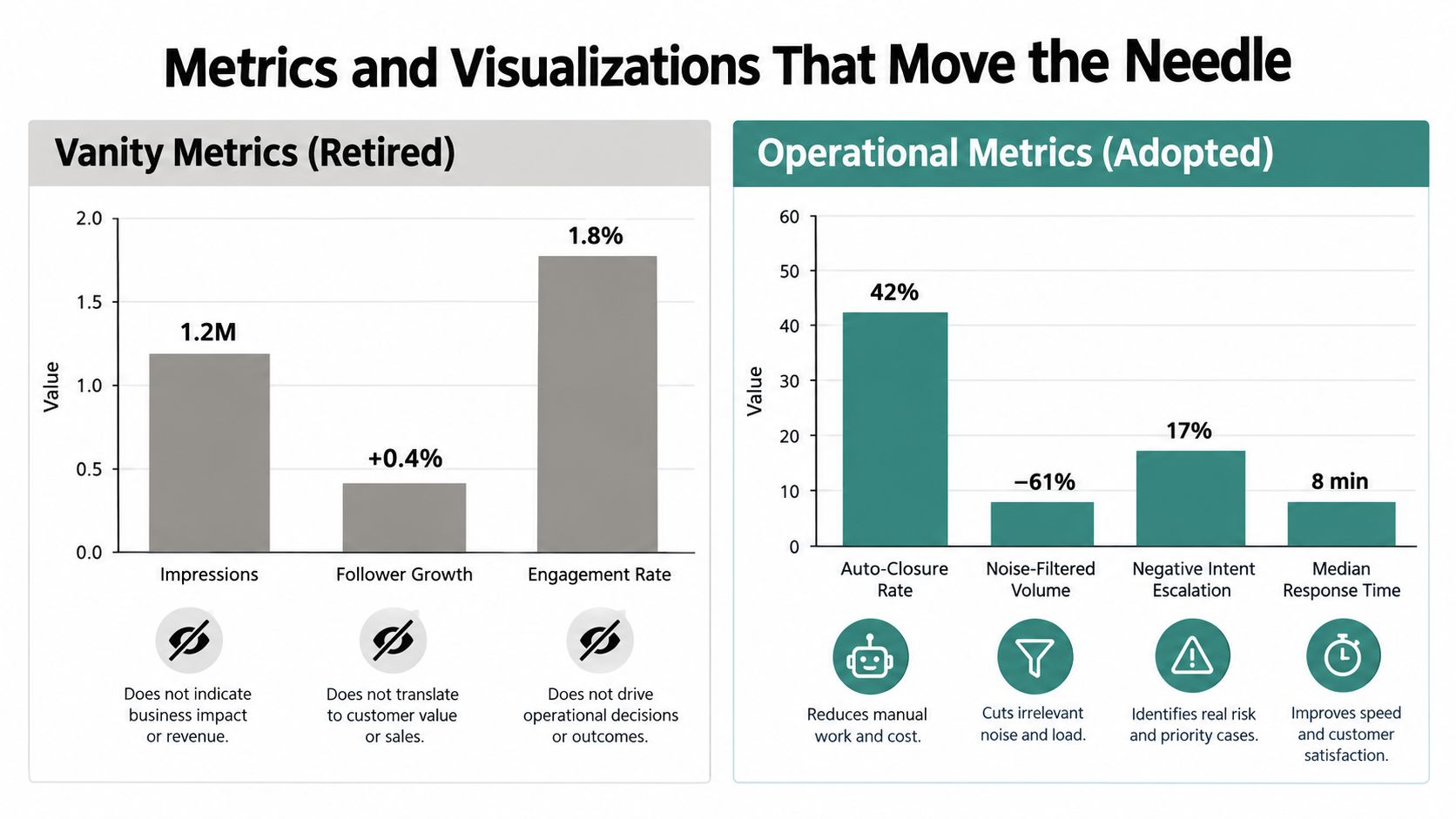
Measure work removed, risk exposed, and speed protected
Auto-closure rate should be segmented by intent and sentiment, not reported as one flattering total. Track neutral FAQ conversations separately from negative billing complaints marked resolved without human touch. A high total can conceal unsafe closure in a sensitive category.
Noise-filtered percentage shows how much incoming content the system classified as spam, duplicate, irrelevant, or otherwise outside the active work queues. Pair it with reviewer sampling. Filtering more messages isn't success if the system hides genuine product feedback.
Sentiment drift compares the distribution of positive, neutral, and negative messages across rolling 24-hour and 72-hour windows. Use a stacked area chart by intent. A negative shift in outage reports deserves a different response from a negative shift in feature requests.
Mention-versus-sentiment divergence overlays mention volume with negative share. Negative sentiment rising while total mentions remain quiet can identify a concentrated PR issue before a broad spike. Conversely, a large positive-volume surge may be a campaign, repost event, or bot wave rather than genuine satisfaction.
A peer-reviewed study of 48 brands found that volume metrics explained the most for brand awareness and purchase intent, while bottom-up sentiment extraction better explained brand impression, satisfaction, and recommendation (the study of brand sentiment and volume metrics). The operational lesson is simple: use volume to understand reach and sentiment to understand experience.
Build views around decisions
- Stacked area chart: Sentiment distribution by intent, channel, and time.
- Divergence line chart: Mention volume overlaid with negative share and authority-weighted negative share.
- Channel-by-hour heatmap: Incoming load, SLA breaches, and reviewer capacity.
- Executive tile: Open high-risk conversations, SLA exposure, median response time, and unresolved negative intent.
Don't lead with average sentiment. A neutral average can contain a small severe cluster and a large number of harmless positive replies. Distribution, velocity, intent, and authority give an executive a decision surface.
Routing, Escalation, and the Human-in-the-Loop Workflow
Production routing should be explicit enough that a new shift lead can understand it without opening the model code. The pipeline is straightforward: ingest, normalize, score sentiment and intent, route, draft, review, and learn.
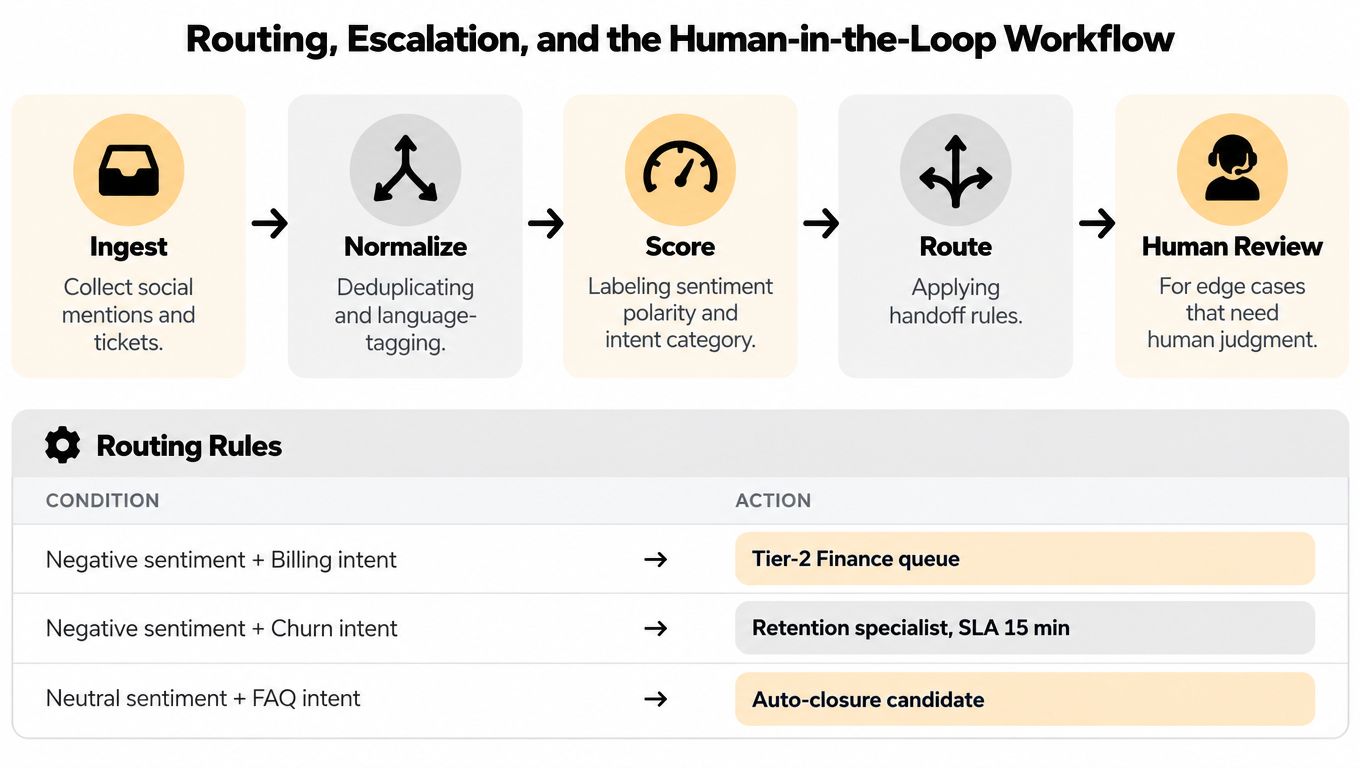
Write rules that map to owners
A workable rule set can look like this:
- Negative sentiment plus billing intent: Send to Tier 1 support or finance with a 30-minute SLA. Attach the account or transaction context only where permitted.
- Negative sentiment plus outage intent: Escalate to comms, attach a draft response, and link related engineering signals.
- Negative sentiment plus regulatory or legal language: Send to trust and safety or legal review regardless of the stated intent.
- Feature request with recurring product language: Route to product feedback aggregation rather than treating every message as an individual support case.
- Neutral FAQ intent with strong confidence: Mark as an auto-closure candidate, subject to sampling and the sarcasm rule.
The unified inbox should show the reviewer a sentiment badge, intent tag, suggested reply, confidence score, source authority, thread context, and escalation flag. A reviewer shouldn't need to copy a post into a separate analytics tool to understand why it landed in the queue.
Approval gates protect the brand voice. A high-confidence answer to a known FAQ may proceed through an approved automation path. Anything below the configured confidence threshold, involving a sensitive topic, or containing sarcasm and media risk stays in human review.
Human review isn't a failure of automation. It's the control that makes automation safe to scale.
Play the workflow as a short training artifact for new reviewers:
Every correction should enter a retraining queue. Review weekly for false routes, missed escalations, unsafe drafts, and disagreement between reviewers. Reviewer disagreement rate deserves its own KPI because rising disagreement usually signals unclear labels, drift, or a taxonomy that no longer matches the work.
Real Use Cases for Care, Comms, and Product Teams
A sentiment pipeline earns credibility through handoffs. The following scenarios show how the same classification layer can support different owners without turning every negative post into a crisis.
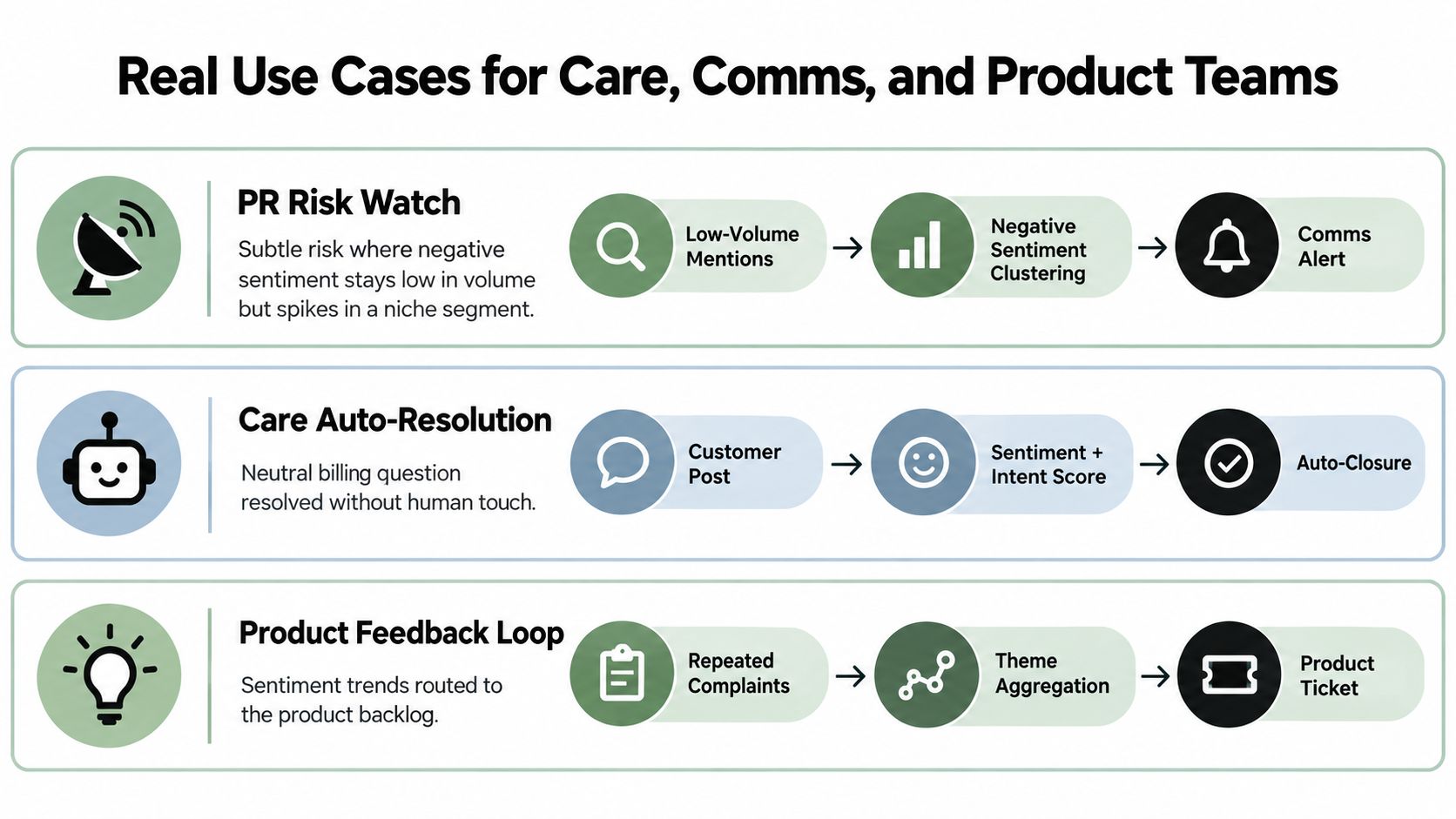
A quiet PR risk in mentions
Negative sentiment remains low in total volume, but the messages cluster among high-authority accounts. The reviewer sees a negative sentiment badge, reputational-risk intent, account authority, and a shared theme in the thread view. The comms playbook fires, attaching an approved statement and opening a monitored thread rather than sending individual improvised replies.
The SLA belongs to comms, not the general support queue. The system also keeps watching the cluster for sentiment drift, new authorities, and a shift from criticism to direct customer impact.
An outage across X and Discord
A surge arrives on X and Discord. Sentiment crosses a 60% negative threshold, and intent tags separate billing complaints from outage reports. Billing complaints go to support responders, outage reports connect to engineering and comms, and trust and safety watches coordinated DDoS chatter rather than mixing it into the care queue.
The reviewer sees the channel, thread depth, sentiment confidence, outage intent, billing intent where applicable, and the active incident identifier. Support can use a consistent response while engineering receives reproducible symptoms instead of a pile of links.
A multilingual scam wave
WhatsApp and Telegram show a localized cluster in Portuguese, Spanish, and Tagalog. Low-resource language detection flags the cluster for the regional trust and safety lead, while scam intent and media indicators raise the escalation priority. The reviewer sees the original text, language label, translated working view where available, sender context, and related messages.
No automatic reply is sent to the suspected scam cluster. The regional lead decides whether to warn users, block known patterns, notify comms, or route evidence to the appropriate investigation team. That is the orchestration principle in practice: the model narrows the work, while accountable people make the consequential call.
Common Pitfalls and How to Mitigate Them
A working classifier doesn't guarantee a working operation. Most failures appear in the handoff layer, where a plausible label triggers the wrong queue or consumes attention that should go elsewhere.
| Pitfall | Operational Impact | Mitigation |
|---|---|---|
| Sarcasm false positives | Jokes and ironic support replies enter escalation queues | Use sarcasm-aware models, retain thread context, and require review when confidence is low |
| Missing source authority | Bots or low-quality accounts outweigh verified voices | Add weighted authority scoring and show the reason for the weight |
| Volume versus sentiment confusion | Quiet coordinated negativity disappears behind loud positive activity | Alert on divergence between mention volume and negative share |
| Label drift after retraining | Old routing thresholds silently stop matching new labels | Audit thresholds and sample routes after every retrain |
| Language ID errors | Hinglish and mixed-script complaints reach the wrong team | Maintain per-language evaluation sets and review mixed-language samples |
| Poorly tuned auto-replies | Repetitive drafts create reviewer fatigue and brand-voice problems | Limit automation by intent, confidence, risk, and reviewer capacity |
| Unbounded escalation | Raw scores flood a small specialist team | Set escalation caps based on available reviewer capacity |
Audit the system where work breaks
Sarcasm needs more than a better polarity model. Keep a separate sarcasm-risk label, preserve quoted and parent text, and send ambiguous posts to reviewers. Source authority should also remain visible. A high-authority complaint may matter even when its wording is restrained, while a bot-generated negative burst shouldn't automatically define the incident.
Thresholds require change control. After a retrain, compare old and new routes on a fixed evaluation set, inspect per-language performance, and review whether the same confidence threshold still produces safe closure. Mixed-script messages deserve dedicated examples because token-level language detection can mistake a complaint's structure for noise.
Industry crisis guidance commonly combines mention volume, sentiment, and source authority, with an example escalation trigger of a 3x mention spike plus a 20% sentiment drop within an hour (crisis management guidance on combining social signals). Treat that as a starting pattern, not a universal setting. Your team should calibrate thresholds against capacity, incident history, and the cost of a missed escalation.
Response speed must also be designed into routing. A 2025 social media index cited by Sprout Social reported that 73% of social media users expect brand responses within 24 hours (Sprout Social guidance on sentiment analysis and response expectations). That expectation makes queue ownership and SLA visibility operational controls, not dashboard polish.
Sift AI is one option for teams that want a unified inbox across social and community channels, with AI tagging for sentiment and intent, routing to support, comms, product, finance, or trust and safety, drafted replies, and analytics for noise-filtered work and sentiment trends. The platform keeps human approval in the workflow, which is the right control for ambiguous conversations and high-risk escalations.
If your team is still sorting billing complaints, outage reports, feature requests, and PR risk by hand, map the intents and escalation rules first, then test them in a unified inbox. Visit Sift AI to see how social and community conversations can be tagged, routed, reviewed, and measured as one operational system.