How Can Social Media Listening Increase Customer Advocacy?
"Wondering how can social media listening increase customer advocacy? See the four-stage loop, triage rules, setup steps and metrics that prove it."
92% of consumers trusted recommendations from friends and family more than other forms of advertising in a Nielsen study spanning 56 countries and approximately 40,000 respondents, as summarized by SHNO's customer advocacy statistics. For a social care team leader, that makes a resolved complaint more than a cleared ticket. It can become a customer's reason to recommend you.
So, how can social media listening increase customer advocacy? Connect what customers say to someone who can act, confirm the outcome, and give satisfied customers room to tell their own story. More alerts and faster acknowledgements won't compensate for a billing dispute that never reaches finance.
Table of Contents
- How Listening Turns Service Into Advocacy
- Why Being Heard Still Fails to Earn Trust
- Triage Rules for Public, Private and Silent Replies
- Four Scenarios Where Listening Creates Advocacy
- How to Set Up Listening for Advocacy in Seven Steps
- Metrics That Prove Advocacy Is Growing
- Confirm the Loop in One Queue Before You Scale
How Listening Turns Service Into Advocacy
Social media listening increases advocacy through detect, respond with context, resolve visibly, and amplify with permission. Each stage requires the team to do something useful with the signal, not record it.
In a 2017 Conversocial survey summarized by Bayelsa Watch, 46.7% of respondents said a personalized brand response would strengthen their loyalty; positive loyalty effects from social engagement were strongest among respondents aged 18–24 at 57.5% and 25–34 at 55.1%. That supports personalization as a starting point, not a guarantee of recommendations. An agent still needs authority, an owner, and a workable resolution.
Messages, mentions, and reviews from the customer's channels should reach agents together. Across X, Instagram, TikTok, Discord, Telegram, WhatsApp, and forums, the operational objective is continuity: a frustrated customer shouldn't become an apparently new case whenever they change channels.
The four stages from listening to advocacy
| Stage | What listening catches | What the team does | Advocacy effect |
|---|---|---|---|
| Detect | Intent, urgency and dissatisfaction in public posts, DMs and reviews | Tag the case and route it to the owner within its SLA tier | The team can catch the problem before it spreads to followers |
| Respond | The customer's specific issue, emotion and context | Reply with context and move personal details to a private channel | The customer feels recognized rather than scripted |
| Resolve | The underlying cause, not only the surface complaint | The owner fixes or decides, and the team confirms the outcome with the customer | The customer has a reason to stay loyal and recommend |
| Amplify | Satisfied customers and recurring praise | Ask permission before sharing the customer's own story | Peer proof replaces brand claims |
The sequence makes the handoffs explicit.
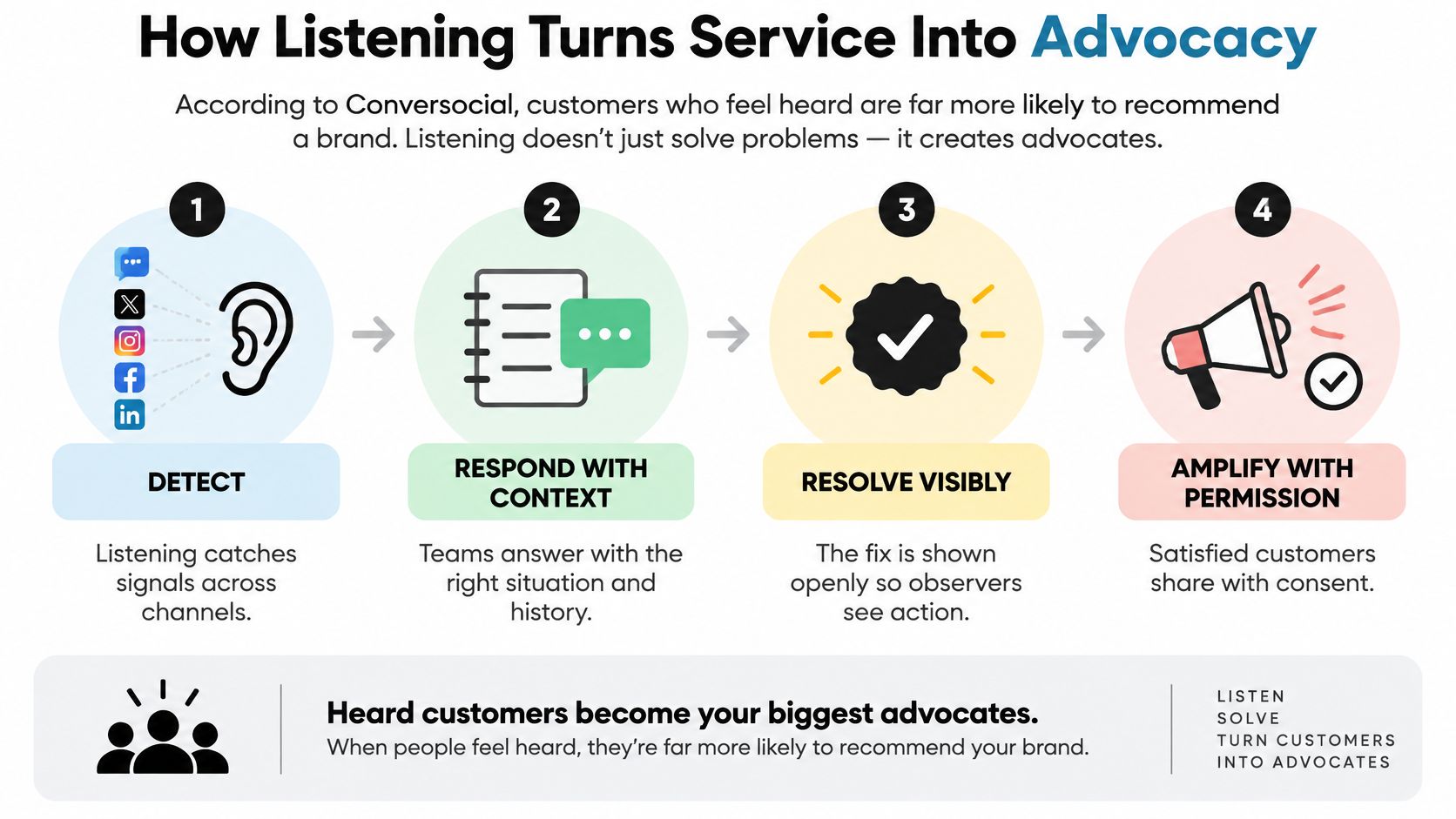
Detection without context produces generic replies. Context without ownership produces sympathetic dead ends. Resolution without confirmation leaves the customer uncertain whether the fix applies to them.
A smoke alarm doesn't put out the fire. It sends the right people to the right room before the damage spreads. Advocacy is what customers may do once the room is safe, not a reward for how loudly the alarm sounded.
Practical rule: Treat a recommendation as an earned outcome, not the next mandatory field in a support script.
Listening doesn't manufacture advocacy. It creates the conditions in which a satisfied customer is likely to speak up and be seen.
Why Being Heard Still Fails to Earn Trust
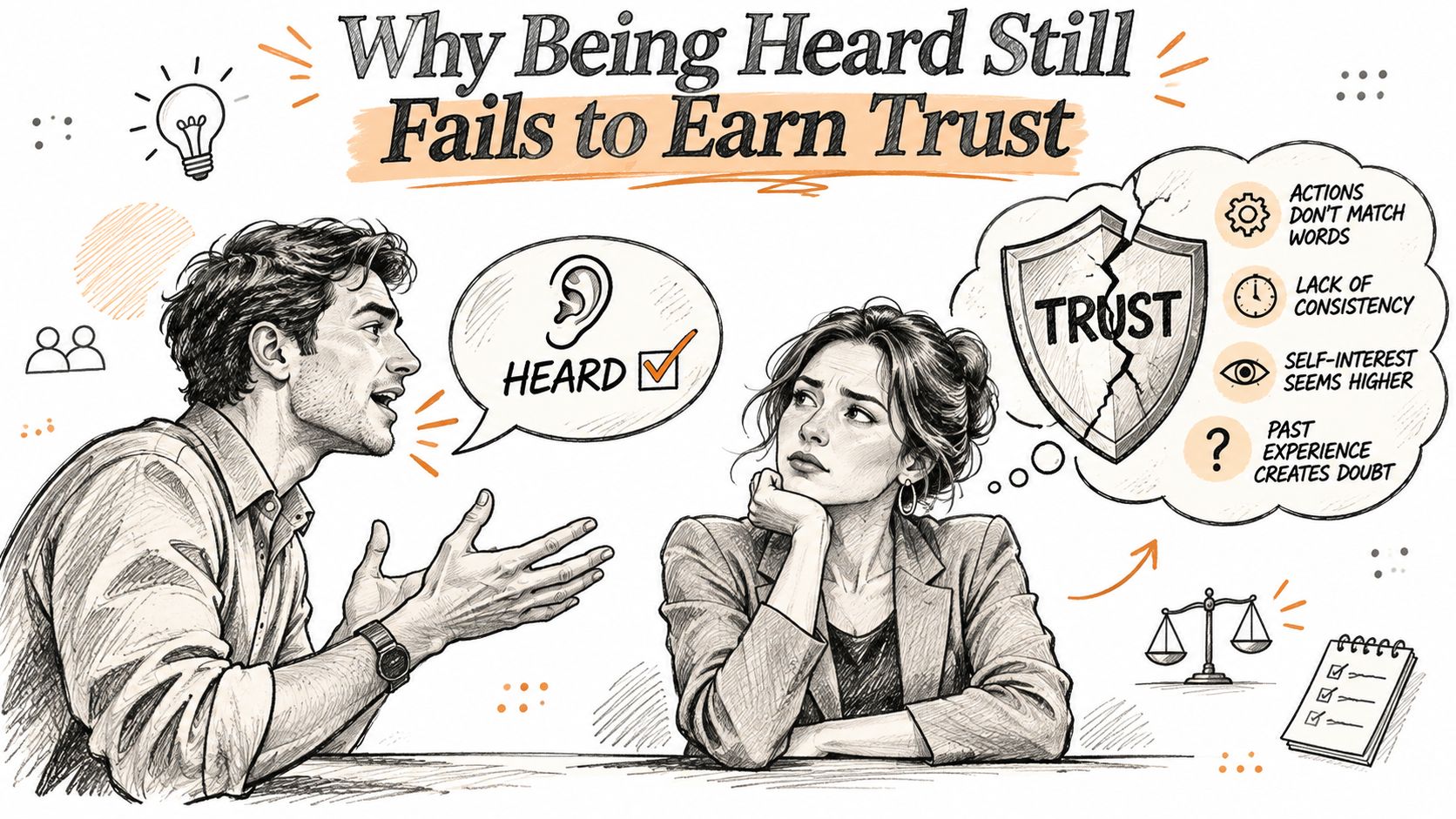
A fast reply isn't evidence that the business acted. In the Sprout Social Q4 2025 Pulse Survey, 55% of users said companies generally listen to social feedback, but only 31% said companies both listen and act on it.
That gap is where social care teams lose credibility. Sentiment reports describe customer reactions, and reply counts describe agent activity. Neither tells you whether finance reversed a charge or engineering repaired a defect.
A green SLA can conceal an unresolved case
Say a customer reports a double charge and receives a reply within 20 minutes. In this hypothetical case, they then wait three weeks, send two follow-ups, and see no change. Their next public post is sharper, and other customers join the replies.
The agent met a response target. The organization failed the customer. Finance should own the billing decision, engineering should own a reproducible defect, and comms should own any public claim about the scope of the problem.
The distinction is visible in a broken handoff.
Ask of every high-impact case: Was there a documented action, and did the customer's behavior change afterward? Record the action, responsible owner, customer confirmation, and any subsequent recommendation or favorable follow-up.
Closed-loop advocacy rate is the share of high-impact conversations that produce a documented action and subsequent positive customer behavior.
Listening without follow-through is a notification, not a service.
Publish an internal account of what changed because of customer feedback. Include a corrected billing rule, a shipped fix, or a clarified policy, not just favorable screenshots. Segment outcomes by issue type, channel, language, and resolution quality so team leaders can identify where customers are heard but still left waiting.
Triage Rules for Public, Private and Silent Replies
Public responses can demonstrate accountability, but visibility isn't always worth the exposure. Older complaint-handling findings summarized by Managing Communities associated responses with roughly a 20% advocacy lift on social platforms and about a 25% lift in forums. Those findings don't justify discussing account details in an open thread.
Use visibility value and resolution sensitivity to select the path. Visibility value asks who else benefits from the answer. Resolution sensitivity asks what harm could follow from discussing the case publicly.
Response path by conversation type
| Conversation type | Visibility value | Resolution sensitivity | Response path |
|---|---|---|---|
| Widespread product failure or outage | High | Low to medium | Public acknowledgement, then status updates |
| Billing or payment dispute | Low to medium | High | Public acknowledgement without account details, then authenticated support |
| Account access or identity issue | Low | High | Private handoff only |
| Safety or harm claim | Medium | Very high | Escalate to trust and safety; public reply only after review |
| Feature request in DMs or forums | Medium | Low | Log to product and reply with thanks |
| Positive praise or product enthusiasm | High | Low | Thank publicly; amplify only with permission |
| Spam, scam or bad-faith engagement bait | Low | Low | Hide or suppress; do not reply or amplify |
| Public PR or misinformation risk in mentions | High | Medium | Comms drafts a factual public reply; a human approves before it posts |
An outage deserves a public acknowledgement because other customers need operational information. A billing dispute needs a discreet account investigation, even when the original complaint is public. For identity and access cases, don't confirm that an account exists or reveal its recovery status.
Safety claims need specialist review, not an agent improvising an empathetic response under an expiring SLA. Feature requests should retain their original context when routed to product. Praise needs a genuine thank-you, while reuse of the customer's words requires separate permission.
Scam suppression must not become a convenient label for criticism. A suspected phishing wave can require silent removal of malicious posts alongside a broader customer warning. For misinformation, comms should correct verified facts without repeating unnecessary inflammatory details.
Give the next owner a usable case
Triage sorts social conversations by intent and priority. Escalation routes sensitive conversations to the customer's team with context attached, including the original thread, relevant history, attempted troubleshooting, and unresolved decision.
The public part acknowledges and sets expectations without personal details; the private part resolves. A private message alone may still be insufficient for identity verification, so use authenticated support when account information is involved.
Keep the workflow in view when evaluating response decisions.
Human owners keep the final call on refunds, policy exceptions, and crisis language. Don't let a draft promise compensation or declare an incident resolved before the responsible team has confirmed it.
Four Scenarios Where Listening Creates Advocacy
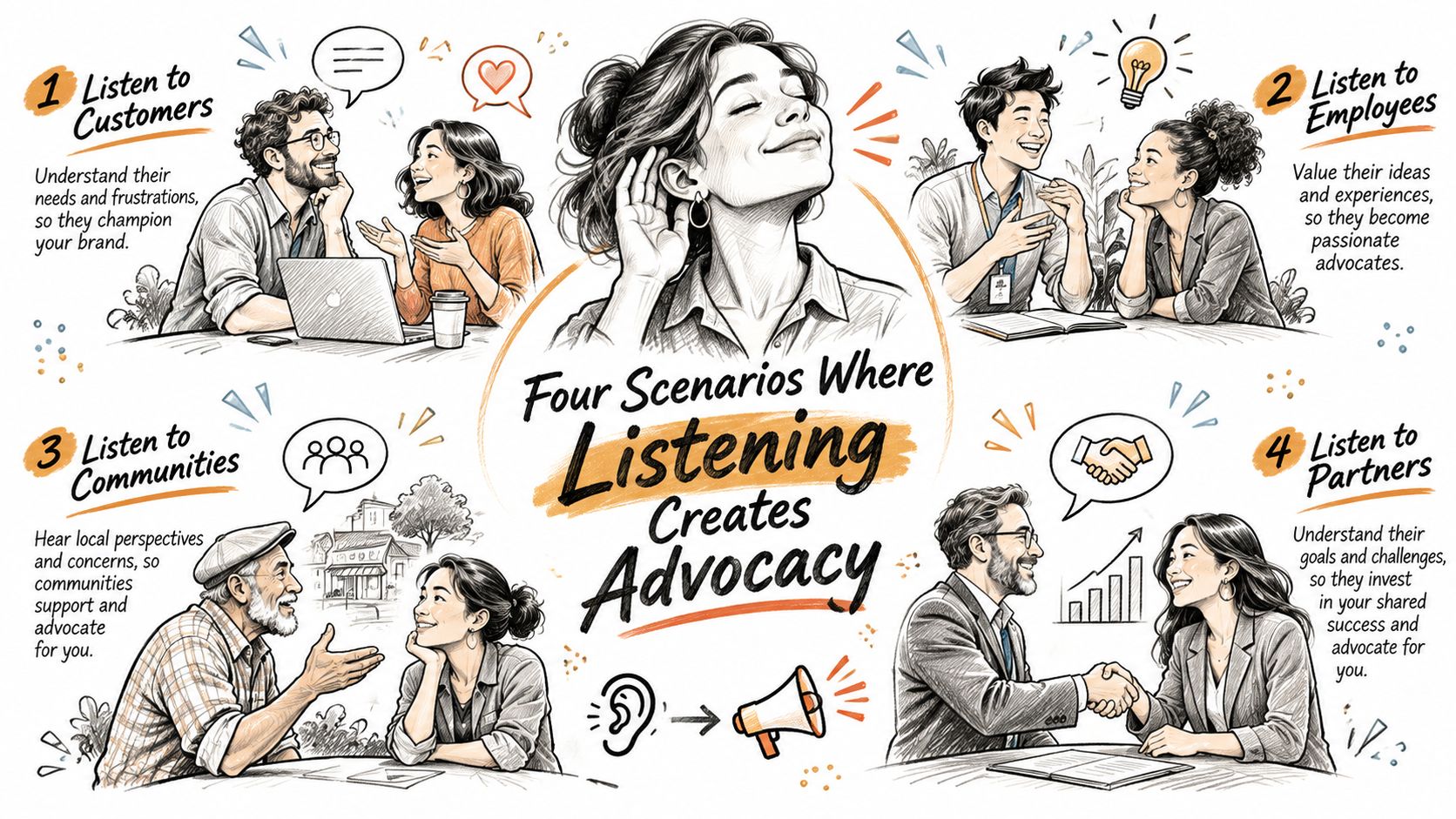
Listening builds advocacy when the right owner acts and the customer can see the outcome. These four scenarios show how teams can connect a signal to a decision, then close the loop.
Duplicate charges after a pricing change
Suppose a pricing change triggers 40 replies on X about duplicate charges. Group related complaints under a parent incident, tag the billing intent, and route the investigation to finance while preserving each customer's case.
Care acknowledges the issue publicly and moves account details into authenticated support. Once finance confirms corrections, comms approves a public update. Customers who see their own charges fixed can then update their posts with that outcome.
Advocacy outcome: customer-authored corrections give other customers a concrete reason to trust the update. Human decision: finance determines which charges qualify for reversal; an agent should not assume every complaint has the same cause.
An outage across community channels
Reports that customers can't complete a transaction arrive across Discord, Telegram, and WhatsApp. Group repeated outage posts, separate spam and unverified status claims, and route the incident to engineering and comms.
Engineering owns diagnosis; comms owns the approved explanation. A reviewer checks the status update against confirmed facts before publication, and care agents use it without promising a restoration time. Customers get consistent information they can share instead of speculation.
Advocacy outcome: community members can pass along a trustworthy update. Human decision: the incident owner confirms recovery before anyone announces it.
The same symptom can require different owners, depending on what decision will resolve it.
A feature request buried in informal DMs
A customer describes an export problem in slang and mixed languages. Apply the team's taxonomy without reducing the message to negative sentiment, and preserve the requested workflow when routing it to product.
Product determines that the request fits its roadmap. When the feature ships, the care owner returns to the original conversation with instructions and asks whether they solve the problem. A customer who wants a direct dialogue with builders can start a conversation with makers, alongside the product team's follow-up.
Advocacy outcome: the customer has a specific improvement to describe in a review. Human decision: product commits to a supported capability; care does not promise an unapproved delivery date.
Praise that keyword rules miss
An Instagram customer uses slang and celebratory emoji to describe how a support agent recovered an important order. A reviewer checks the surrounding thread, confirms it refers to a real service outcome, and thanks the customer.
Before using the message as a testimonial, ask permission for the exact excerpt, attribution, and intended use, then record that permission in the case. A customer who declines still receives the same support.
Advocacy outcome: the customer's own account stays intact rather than being rewritten as advertising. Human decision: the reviewer checks consent and context before sharing the praise.
How to Set Up Listening for Advocacy in Seven Steps
Start with shared definitions and explicit ownership. Otherwise, agents will label the same issue differently, and each department will report success against a different version of resolved.
Establish the operating rules
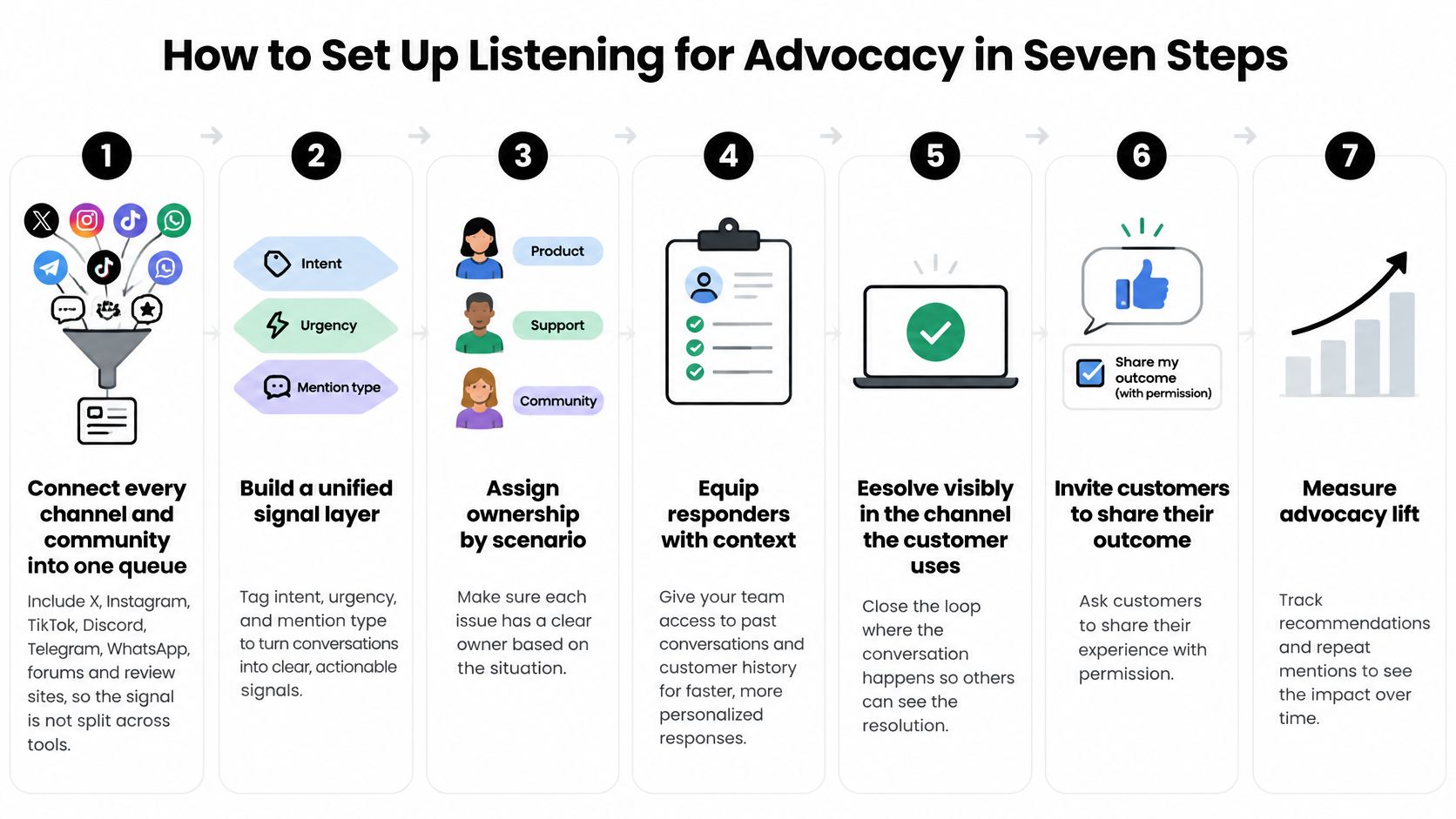
Connect every channel and community into one queue. Include X, Instagram, TikTok, Discord, Telegram, WhatsApp, forums, and review sites within your authorized coverage; we bring social, reviews, and communities into one queue for the team. Preserve source links and access controls so consolidation doesn't strip context or expose restricted conversations.
Build a taxonomy covering intent, sentiment, issue type, urgency, and advocacy signal, including praise, referrals, and repeat purchase. Use the customer's existing tag names where they exist, and distinguish a reported purchase from a verified one. Without one queue and one taxonomy, later routing and reporting run on incompatible definitions.
Set response-time tiers by urgency. In an Emplifi survey of nearly 1,000 U.S. consumers reported by Customer Experience Dive, one-third expected a social support response within an hour, while only 4% were willing to wait 72 hours or longer. Put outage and safety cases first, billing and access next, then general questions, with an escalation path for coverage gaps rather than an unsupported promise of continuous staffing.
Assign owners before activating automation: finance for billing, engineering for defects, comms for public claims, and trust and safety for harm. Specify a fallback owner and what constitutes an accepted handoff. Sending a notification isn't the same as someone accepting responsibility.
Set approval rules before enabling sending. AI drafts replies and flags low-confidence cases, while humans approve refunds, legal exposure, safety issues, and reputational risk; sensitive conversations can move to a person with context attached. The common slip is allowing drafts to go out unreviewed to save time, including unsupported promises that happen to match the brand voice.
Tag potential advocates and request permission before sharing their stories. Record the approved wording, attribution, destination, and any limits in the case. Don't interpret public praise as blanket consent for marketing reuse.
Hold a weekly closed-loop review. Check which issues were resolved, which customers showed positive behavior afterward, and which owners were slow or never accepted the case. Sample auto-closed cases too, so a rising auto-closure rate doesn't conceal abandoned requests.
The sequence works as an operational checklist, not just a listening configuration.
Keep automation accountable
AI should remove duplicate review work, surface intent, and prepare context-rich drafts. Humans should approve, decide, and own the hard calls rather than reconstructing cases from disconnected notifications.
Approval boundary: Give automation permission by scenario, not blanket permission based on how confident its wording sounds.
Metrics That Prove Advocacy Is Growing
Genesys research covering 7,176 consumers across seven Asia-Pacific markets, reported by Marketing-Interactive, found that 41% recommended a company after a good service experience, 46% of those who posted about a service interaction did so because it was positive, and 49% valued first-interaction resolution, compared with 48% who prioritized fast responses.
Response and resolution are different measures. An automated acknowledgement can reassure someone that a message arrived. It doesn't establish that the underlying issue closed or that the customer would recommend the company.
Advocacy metrics, formulas and watch-outs
| Metric | How to calculate | What it tells you | Watch-out |
|---|---|---|---|
| Closed-loop advocacy rate | High-impact conversations with documented action and later positive behavior ÷ all high-impact conversations | Whether listening produces change customers notice | Incomplete owner logging understates the rate |
| Time to first human response | Minutes from post to first person-reviewed reply | Whether urgent cases reach a person quickly | Automated acknowledgements shouldn't count |
| First-contact resolution | Cases closed on the first interaction ÷ all cases | Whether the workflow solves problems rather than replying | Segment by issue type; averages hide billing delays |
| Public-to-private handoff completion | Moved cases resolved privately ÷ all moved cases | Whether handoffs finish | Cases can disappear between channels |
| Repeat-contact rate | Customers contacting again within a defined window ÷ all resolved customers | Whether the fix held | Match the window to the issue and count repeat contacts about that issue |
| Positive mention share | Positive mentions ÷ all brand mentions, segmented by language and audience | Direction of sentiment over time | Models can misread slang, sarcasm, and memes |
| Unsolicited to incentivized recommendation ratio | Unprompted recommendations ÷ incentivized recommendations | Balance of independent and rewarded advocacy | Intent is difficult to verify; referral codes alone don't prove a recommendation was unsolicited |
| Referral or branded-search lift | Change among exposed audiences compared with change in a control group | Effect beyond the original thread | Without a holdout, don't claim credible incremental lift |
Choose consistent eligibility rules before reporting improvement. Define high impact, positive behavior, resolved, and the observation window, then retain those definitions across reporting periods.
Don't treat reduced escalation alone as proof of advocacy. A customer might stop contacting you because they gave up. Recommendations and favorable follow-ups provide stronger positive evidence; silence should remain unclassified unless another signal supports the interpretation.
Separate attribution from coincidence
Referral traffic can increase during a campaign that has nothing to do with service recovery. Branded searches can rise because of unfavorable publicity. Compare exposed audiences with an appropriate control group, and account for baseline differences before attributing change to the listening workflow.
Report uncertainty when exposure or identity matching is incomplete. A careful directional finding is more useful than a precise-looking lift that the measurement design can't support.
Reply speed belongs on the dashboard as a health check, not as the headline advocacy number.
Confirm the Loop in One Queue Before You Scale
I'd start with a 30-day pilot in one queue rather than a company-wide rollout. Choose a dense signal source, such as X replies or a Discord support channel, and an issue type with clear owners, such as billing or access problems.
Before starting, record baselines for time to first human response, first-contact resolution, public-to-private handoff completion, and closed-loop advocacy rate. Apply the setup steps only within that pilot's scope, preserving the same definitions throughout.
Review decisions, not just totals
- Acted on: The owner documented a decision or fix, and the customer received the outcome.
- Unresolved: Work remains open, with a named owner and next action.
- Stalled: A dependency or missing decision prevents progress and needs escalation.
Review those states weekly and publish a short internal note describing what changed because of customer feedback. Include blocked cases so leadership can address authority gaps rather than asking agents to send another apology.
Sift AI's Social Support agents triage, route, and draft replies, and the customer chooses when they're allowed to send. Our agents can also research and reply across social channels, flag cases for the team, and step back when the business decides a person should take over.
Scale only when closed-loop advocacy rate and handoff completion rise together. Keep reply speed as a health check, and investigate any apparent improvement that coincides with more repeat contacts or unexplained closures.
Sift AI brings social and community conversations into a unified inbox, with AI agents that filter noise, tag intent, route cases, and prepare replies while your team controls the hard decisions. Visit Sift AI to explore a listening workflow that connects customer signals to accountable owners and confirmed outcomes.