Customer Touch Points Explained and Mapped for Social
"Learn what customer touch points are, how to map them across social channels, prioritize intent signals, and route them to the right team with Sift AI."
A customer posts on X that your company charged them twice. Within minutes, replies from other customers mention the same problem. An Instagram DM arrives with a screenshot of a bank statement. Someone posts in Discord that the service is failing, while a Telegram group starts comparing errors in several languages. Your support team sees fragments. Customers experience one incident.
That's why customer touch points can't be managed as a checklist of channels. Each interaction changes the next one. A public complaint may become a private support case, an outage signal, a finance investigation, or a communications risk, depending on what happens after the first message.
Table of Contents
- When a Billing Reply Turns Into a Brand Battle
- What Customer Touch Points Really Are
- Mapping Touch Points Across Social and Community
- Prioritizing Signals Instead of Counting Messages
- Routing Signals to the Right Team
- Turning Touch Points Into Useful Analytics
- Why More Touch Points Can Make Experience Worse
When a Billing Reply Turns Into a Brand Battle
The original X post looks like a routine billing complaint. A support agent could reply with a standard request for account details, but the thread is already changing. Other customers are adding screenshots, asking whether the issue is widespread, and tagging journalists or industry accounts.
At the same time, an Instagram DM contains account-specific information that shouldn't be handled publicly. In Discord, a customer describes a failed payment alongside a service error. Telegram users begin coordinating their reports, and a moderator asks whether the company knows about the problem. One touch point has become a sequence of related signals across several surfaces.
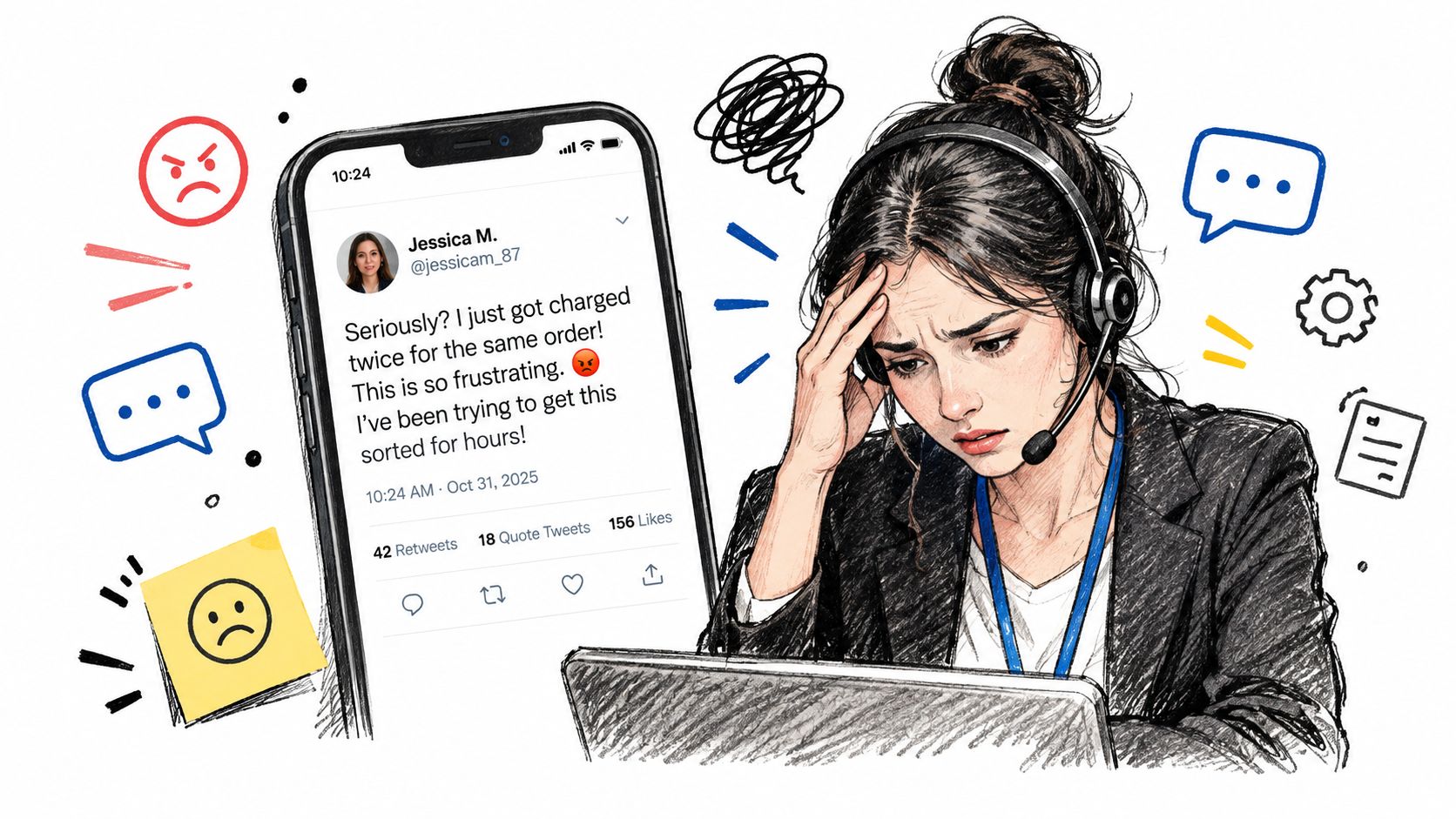
A team working from separate native inboxes might answer the same issue repeatedly. One agent could promise a refund while finance is still investigating. Another might close the Instagram DM because the customer already received a reply on X, even though the private case still needs account verification. The customer sees delay and contradiction, not internal ownership boundaries.
A unified inbox with AI triage watches the sequence instead. It can group related complaints, identify billing intent, recognize an outage pattern, preserve the customer's previous contact, and route the public risk to communications while sending transaction details to finance. People still decide what to say and what action to take, but they don't have to discover the whole story manually.
Practical rule: Treat the first message as the beginning of an investigation, not as an isolated ticket.
Speed matters because an unanswered social issue can become a purchase decision. The 2025 Sprout Social Index reports that 73% of social users would buy from a competitor if a brand doesn't respond on social, and 73% expect a response within 24 hours or less. A fast acknowledgement won't solve a duplicate charge, but it can show that a person owns the next step.
What Customer Touch Points Really Are
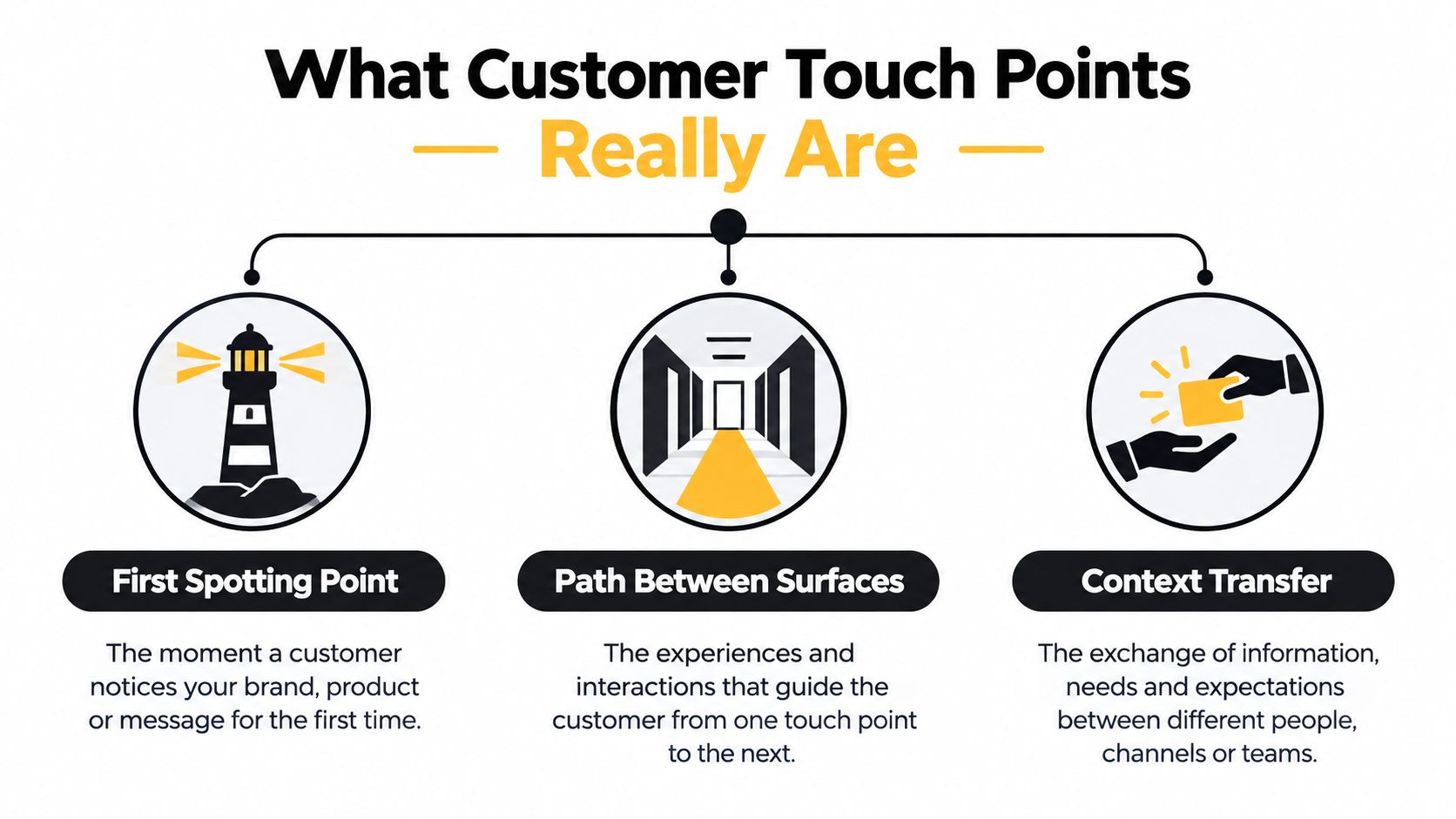
A useful definition starts with three images.
The first is a lighthouse. A customer spots your brand through a product page, a review, a TikTok comment, a recommendation in a community, or a post on X. That moment matters because it reveals where attention or intent first appears. It isn't necessarily a conversion, and it isn't merely an impression. It may be the first sign that someone has a question, a need, or a concern.
The second is a hallway. Customers move between surfaces. They research on a website, compare reviews, ask a question in a Discord server, open a WhatsApp conversation, and return to a product page. The hallway is the path between those places, including the points where information can be lost.
The third is a handoff. A customer moves from a public reply to a private DM, from social care to finance, or from community management to engineering. A touch point becomes operationally valuable when the team captures intent, urgency, identity, history, and next ownership.
Research summarized by Knexus Group reports that nearly 50% of consumers now regularly use more than four touchpoints before purchase, up from an average of two historically, and 86% of shoppers regularly move between at least two channels during the buying process (Lytics' summary of the multi-channel purchase process). The important lesson isn't to add more channels. It's to make context portable when customers change surfaces.
For a practical way to connect journey stages, ownership, and orchestration decisions, the customer journey orchestration playbook offers a useful planning reference. Apply its logic to social care by mapping what the customer needs next, not just where the customer spoke first.
A touch point, then, is a moment in a sequence where the customer's situation can be understood and advanced. That definition works for a comment, a review, a support ticket, a community reply, or a follow-up after resolution.
Mapping Touch Points Across Social and Community
Start with the surface, then record the signal it usually produces. This prevents a map from becoming a list of logos.
Public conversation surfaces
X often produces fast-moving complaints, product questions, outage alerts, and PR-sensitive mentions. A billing reply may be public, short, and emotionally charged, yet still require finance to investigate.
Instagram combines marketing and care. Comments can contain simple product questions or public allegations, while DMs often carry order details, account-access issues, and screenshots. A 2025 consumer survey found that 55% of frequent social users turn to Facebook and 47% to Instagram for customer-service problems (Emplifi's 2025 consumer brand survey). The distinction between a campaign surface and a support surface has already blurred.
TikTok tends to compress attention. A visual demonstration, sarcastic comment, or creator response can spread quickly, so image and video context matters. Keyword matching alone won't reliably distinguish a harmless meme from a real product failure.
Community and private channels
Discord and forums hold longer conversations. Members may document a feature request across several replies, explain a workaround, or identify a recurring technical issue before support sees it. The original post may not contain the full intent, so thread history belongs with the signal.
Telegram can combine announcements, group discussion, multilingual slang, and coordinated complaint or scam activity. Teams need to recognize repeated reports without assuming every repeated message is a separate case.
WhatsApp is often better suited to private, account-specific conversations. Billing, identity, delivery, and account-access issues need secure handling, clear authentication rules, and a visible link back to the originating context.
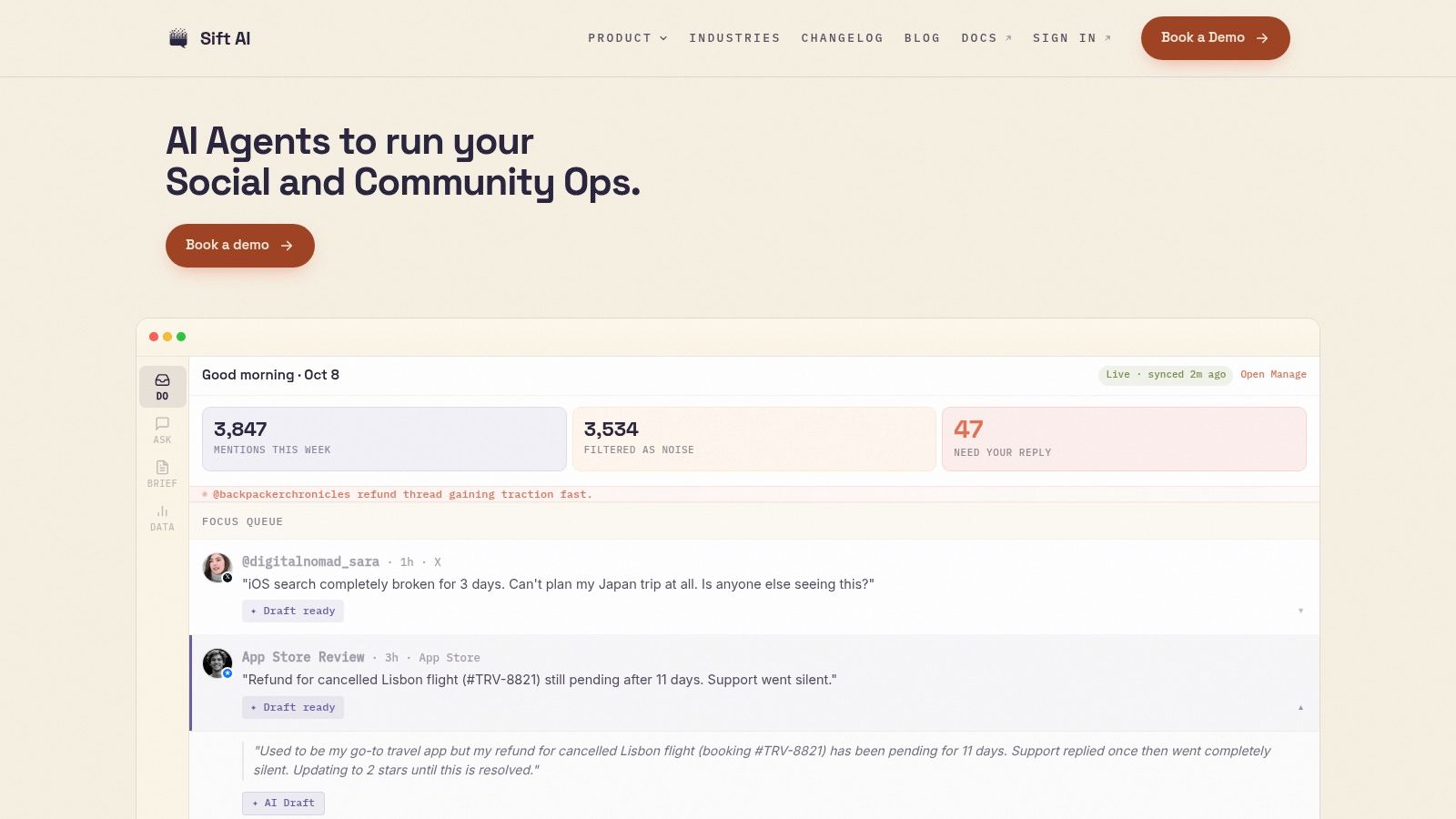
A unified inbox should show the channel, but it shouldn't make the channel the primary unit of work. The case is the customer's situation. The surfaces are evidence gathered along the way.
The operational question isn't “Where did this message arrive?” It's “What does this signal require next, and who needs the context?”
Map each touch point with a consistent set of fields: customer or account link, intent, urgency, language, conversation history, public or private status, current owner, and resolution state. That structure lets a social care lead compare an X reply with a Discord thread without pretending they behave identically.
Prioritizing Signals Instead of Counting Messages
A queue that treats every mention equally will exhaust its reviewers and weaken judgment. A meme, a sarcastic complaint, a suspected outage, and an account lockout can all contain the brand name, but they don't deserve the same response path.
Use a signal hierarchy that combines intent, urgency, confidence, history, and reach. Reach alone shouldn't decide priority. A quiet message about fraud may require more immediate attention than a popular joke.
Four practical tiers
- Outage alerts: Posts describing widespread failures, repeated error patterns, or service unavailability should receive an early human review and a link to the relevant incident workflow.
- Urgent complaints: Billing disputes, account lockouts, fraud concerns, safety allegations, and unresolved escalations need clear ownership and a response plan.
- Low-confidence or ambiguous mentions: Sarcasm, slang, mixed languages, images, and short replies should be classified with confidence thresholds. Route uncertain cases for review instead of forcing a confident label.
- Low-actionability conversation: Memes, duplicate reposts, promotional spam, and casual brand mentions can be grouped, monitored, or auto-closed when policy allows.
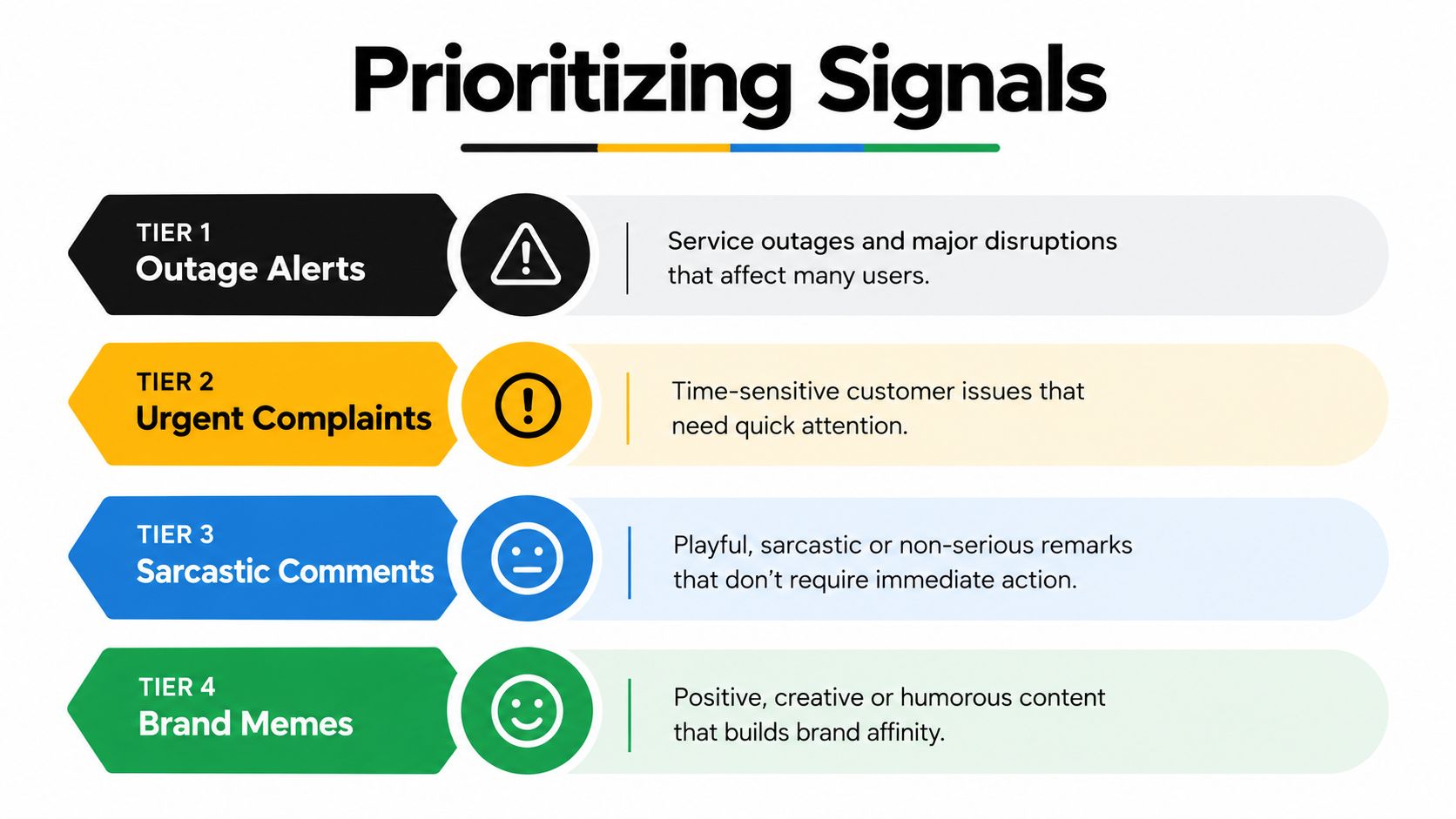
The distinction between noise filtering and dismissal matters. A repeated complaint may be duplicate traffic, or it may be evidence that an incident is spreading. AI should cluster related messages, surface the earliest credible signal, and preserve examples that help engineering or communications understand the issue.
A peer-reviewed integrative review mapped 133 touchpoints. It found that 94% were consumer-brand interactions and 6% were peer-to-peer, while social media appeared in only 22% of the reviewed studies, compared with 68% for physical stores and 58% for websites (the integrative review of touchpoints). That gap matters because peer conversations can alter the meaning and urgency of a brand signal before the company responds.
Set human review rules for sensitive categories. Refunds, safety claims, legal threats, suspected fraud, crisis language, and emerging reputational risks shouldn't be auto-closed because the wording resembles a routine complaint. On the other hand, agents shouldn't spend their shift manually reviewing every duplicate meme or scam post.
Reviewer safeguard: Automate repetition, not responsibility.
A good triage model makes the queue calmer without making it blind. It gives people fewer items to inspect, while making the items that remain more explainable.
Routing Signals to the Right Team
Prioritization answers what deserves attention first. Routing answers who should own the next action. Those decisions overlap, but they aren't interchangeable.
A public reply about a double charge needs visible acknowledgement and a private path to finance. An outage surge may need one approved status line from communications, while individual account diagnostics go to engineering. A feature request buried in a Discord thread belongs with product, especially when the thread contains useful detail about the customer's use case.
| Signal type | Best owner | Response style | Risk if misrouted |
|---|---|---|---|
| Duplicate charge or billing dispute | Finance with social care support | Public acknowledgement, then secure account handling | An agent promises a refund or exposes transaction details |
| Widespread outage reports | Communications and engineering | Consistent public status, individual technical follow-up | Contradictory updates or a flood of duplicate replies |
| Fraud, abuse, or safety allegation | Trust and safety, with legal or comms as needed | Careful acknowledgement and controlled escalation | A sensitive claim is minimized or handled publicly |
| Feature request with supporting context | Product, with community or social care | Confirm receipt and preserve the use case | Valuable feedback disappears in a general inbox |
| Spam or scam wave | Trust and safety or operations | Cluster, restrict, and monitor | Reviewers waste time while genuine cases wait |
The public-to-private move deserves its own step. Sprout Social's Q4 2025 Pulse Survey found that 51% of people who contact a brand publicly expect the brand to acknowledge them publicly before moving the conversation into a private direct message (Sprout Social's social customer service statistics). A private DM without a public acknowledgement can look like avoidance to everyone watching the thread.
Write the handoff so the receiving team can act without asking the customer to repeat everything. Include the original post, relevant replies, account reference, detected intent, language, urgency rationale, previous contacts, and the commitment already made. That record protects the customer from repetition and protects the agent from guessing.
Teams comparing inbox and support platforms may also find a structured best gorgias alternative comparison useful when evaluating which workflows support routing, ownership, and context continuity. The product choice matters less than whether the system can preserve the sequence.
Turning Touch Points Into Useful Analytics
Response counts are easy to report and easy to misunderstand. A team can send more replies while missing the same customers, repeating the same answer, or routing issues to the wrong owner.
Start with the operational measures that show whether the sequence improved:
- Noise-filtered percentage: How much repetitive, irrelevant, or clearly low-risk traffic was removed before human review?
- Auto-closure rate: Which categories can close safely, and how often do customers reopen them?
- Time to appropriate owner: How long does it take for finance, engineering, comms, or trust and safety to receive a usable case?
- Acknowledgement time: How quickly does the brand confirm ownership on the public surface?
- Resolution time: How long until the customer's actual issue is resolved, not merely answered?
- Containment after first handoff: Did the receiving team solve the case, or did it bounce between queues?
- Sentiment change after intervention: Did the customer's language improve, worsen, or remain unresolved after the response?
- Proactive saves: Which signals allowed the team to contact or assist customers before they created repeated public complaints?
The distinction between acknowledgement and resolution is especially important. A public reply may happen quickly while finance verifies a transaction in private. Report both timestamps, then examine whether the handoff preserved enough context for a clean outcome.
A study of 46,000 customers found that shoppers using multiple channels spent at least 4% more per in-store occasion and 10% more online than single-channel shoppers, and made 23% more repeat store visits (the multi-channel customer touchpoint analysis). The useful conclusion for social care isn't to maximize channel activity. It's to measure whether continuity helps customers move forward.
For a broader measurement framework, a developer's guide to engagement KPIs can help teams separate interaction volume from meaningful engagement. In a weekly review, retire metrics that reward busywork and keep the ones that expose missed ownership, repeated contact, and unresolved risk.
Why More Touch Points Can Make Experience Worse
Adding another channel doesn't automatically add another useful touch point. Without portable context, it creates another place for the customer to repeat the problem and another queue for the team to monitor.
The failure pattern is familiar. A customer posts publicly, receives a generic reply, opens a DM, submits a form, and then explains the issue again to support. Each channel is technically active. The journey still feels broken because no system carries the customer's history, promise, urgency, and owner forward.
A longitudinal study of 542 consumers found reciprocal influence across touchpoints. The usefulness of one touchpoint affected later perceptions of others, and combinations influenced repurchase through different pathways (the longitudinal touchpoint study). A poor handoff therefore doesn't stay local. It can shape how the customer judges the next response.
Keep five rules close to the operating model:
- Sequence over channel count: Follow the customer's movement from discovery to question, escalation, resolution, and follow-up.
- Signal quality over message volume: Group duplicates, detect patterns, and preserve the messages that explain the underlying issue.
- Public acknowledgement before private handoff: Show ownership where the customer raised the concern, then protect sensitive details in a secure channel.
- Ownership over generic response: Route billing to finance, outages to engineering and comms, safety concerns to trust and safety, and product feedback to product.
- Resolution over activity: Track whether the next interaction improved the customer's position, not whether an agent sent a reply.
AI has a specific role in this model. It can filter noise, detect intent, identify urgency, cluster related conversations, preserve multilingual or multimodal context, and draft a response in the approved brand voice. Humans should approve refunds, safety decisions, legal exposure, crisis language, and ambiguous cases.
That balance is orchestration. The system handles scale and repetition. The social-care team keeps judgment, accountability, and the relationship.
Sift AI brings comments, mentions, DMs, reviews, and community posts from channels such as X, Instagram, Discord, Telegram, WhatsApp, and forums into a unified inbox, where AI can tag intent, filter noise, draft replies, and route cases to the right owner. Visit Sift AI to see how your team can manage customer touch points as one connected signal chain while keeping humans in control of the hard calls.