Brand Voice vs Tone: What Changes and What Stays Fixed
"Brand Voice vs Tone explained: what stays fixed across social replies, when tone should shift, and how to approve it for complaints, outages and crises."
Your X replies are filling with billing complaints, Instagram DMs contain account questions, and someone has turned a login failure into a meme. The drafts all sound polished. One is also far too cheerful for a customer who thinks you've charged them twice.
That's the practical problem behind brand voice vs tone. Your social care team needs more than instructions to sound friendly. It needs fixed language rules, permitted tone ranges, and approval gates that make clear when AI can help and when a person must decide.
Table of Contents
- Brand Voice vs Tone at a Glance
- Where Voice Holds Steady and Tone Moves
- Lock the Voice Invariants Before Tone Changes
- Tone Tiers by Incident Severity and Approval
- Public Acknowledgment Before Private Resolution
- Measuring Whether Tone Kept the Voice Intact
- Confirm Your Voice Rules Before You Adjust Tone
Brand Voice vs Tone at a Glance
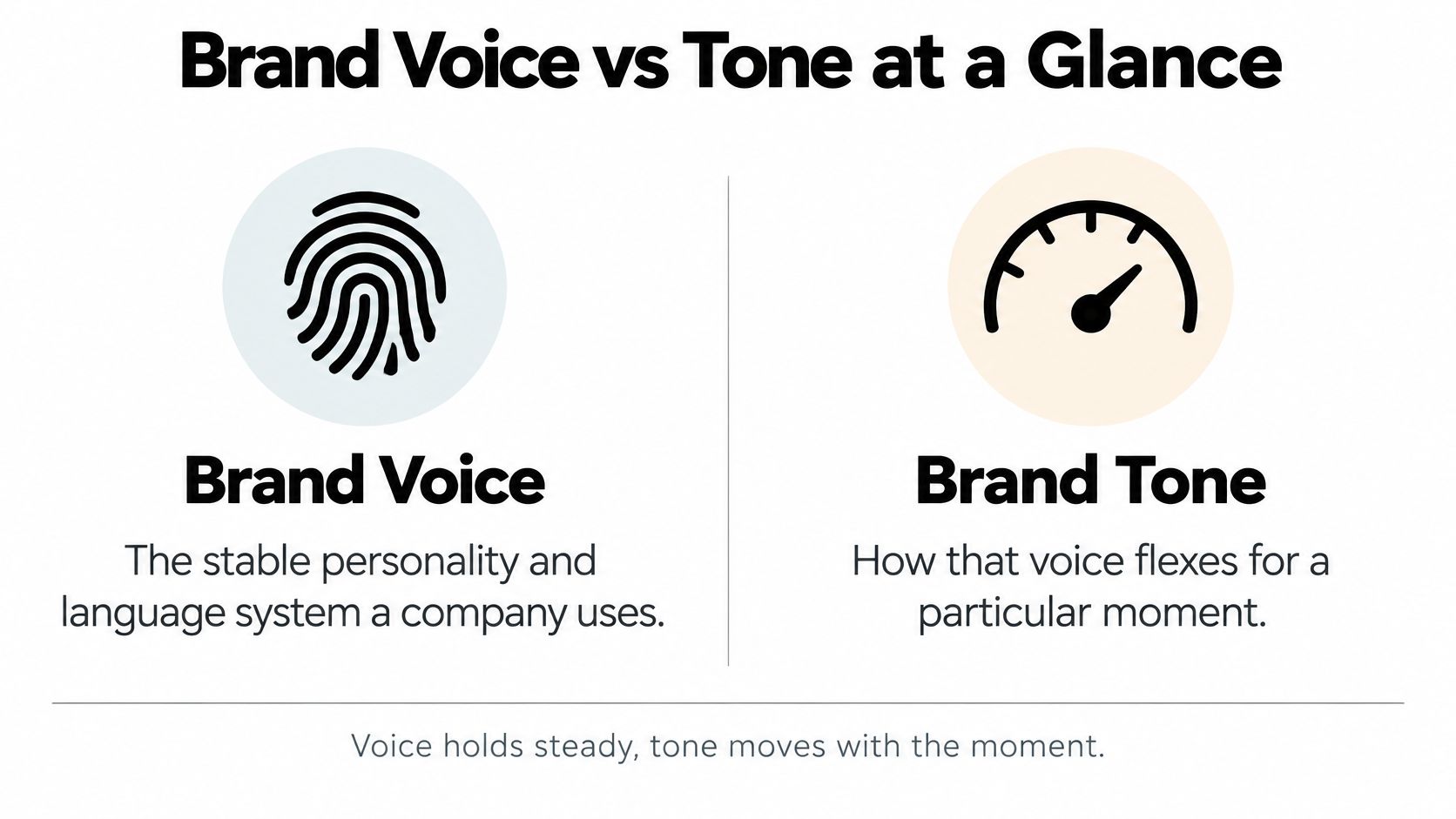
Brand voice is the stable personality and language system a company uses. Brand tone is how that voice flexes for a particular moment.
Brand voice and brand tone compared
| Dimension | Brand voice | Brand tone |
|---|---|---|
| What it is | Stable personality and language system | Situational modulation of that voice |
| Typical examples | Authoritative, direct, empathetic as core traits | Empathetic after a service failure, energetic for a launch |
| How often it changes | Rarely, only when brand principles are revised | Per conversation, incident or channel |
| Who sets it | Brand, comms and legal leads | Support leads and reviewers per incident type |
| What it governs | Point of view, terminology, prohibited claims, formality | Warmth, urgency, directness, optimism |
| Failure mode | Replies sound like a different company | Replies sound scripted or wrong for the moment |
The distinction is easier to apply when you separate identity from emotional delivery.
Recognizable doesn't mean identical
An authoritative company doesn't need to sound stern in every reply. A playful company doesn't need to make a joke when a payment fails. Consistency means preserving recognizable identity, not repeating identical wording across every touchpoint.
The operational problem isn't new: a Demand Metric–Lucidpress survey summarized by MarketSplash found that 62% of participants said off-brand materials were created always, often, or sometimes. That finding concerns brand consistency broadly, not the effectiveness of a particular support tone.
Consider a wedding-planning business. Someone looking for visual ideas might browse Puglia wedding inspiration from Princess Apulia®, while someone concerned about a booking needs precise, reassuring language. Those interactions can express the same attentive identity without sharing the same emotional register.
The reviewer's test
Change the emotional temperature of a draft without changing its commitments or vocabulary. If it still sounds like the same company, you've adjusted tone. If it sounds like an unrelated business, you've changed the voice.
The table's rows should become review checks, not just brand-workshop terminology. A reviewer should be able to identify the broken rule instead of rejecting a draft because it feels off.
Practical rule: Fix voice at the principle level. Allow tone to move only where it helps the customer understand the situation and take the next step.
Where Voice Holds Steady and Tone Moves
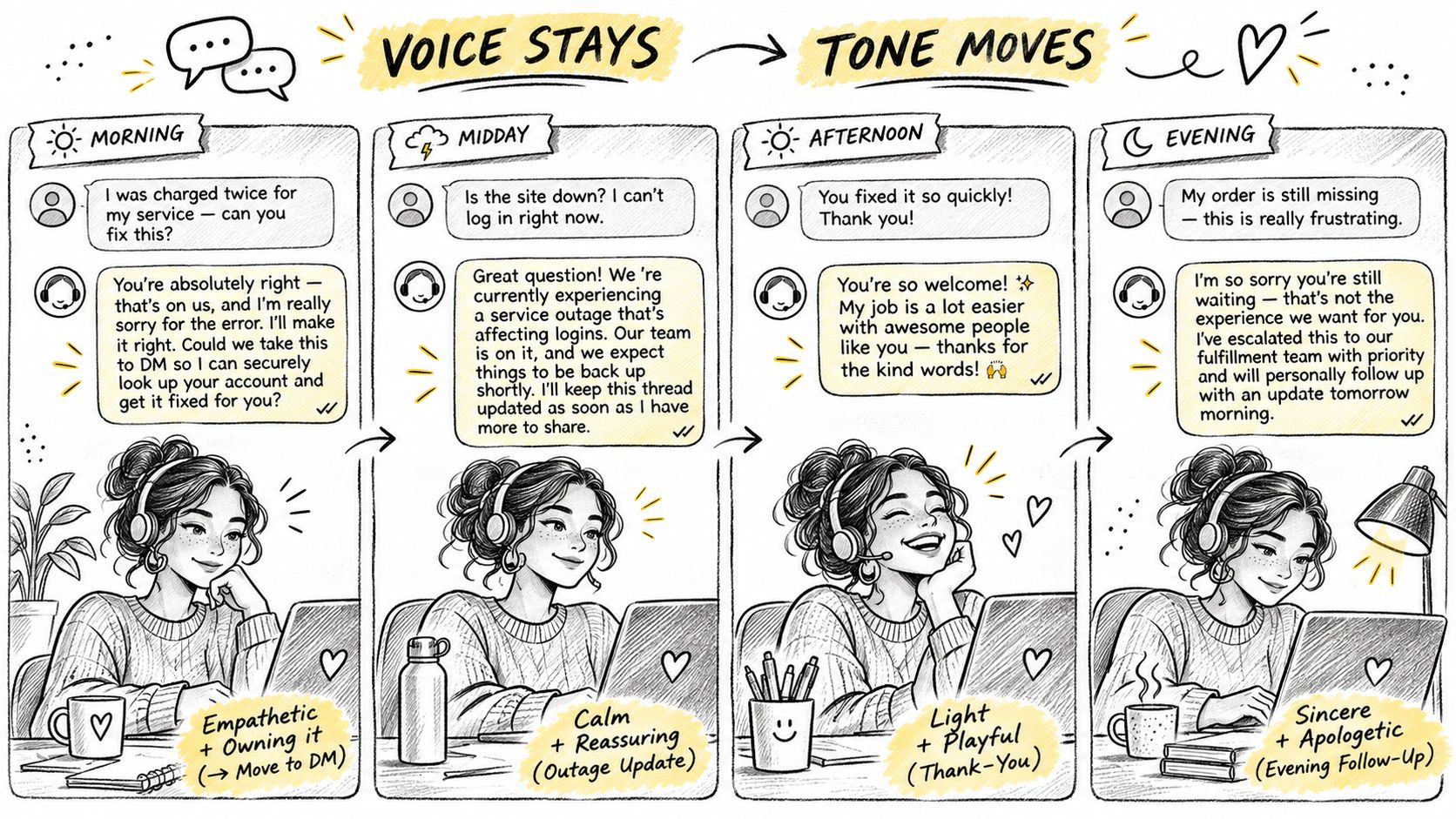
Say your brand handles these conversations during the same working day. The emotional range is wide, but the underlying identity shouldn't change.
The illustration shows the difference between a consistent voice and a repetitive response.
Billing and outage replies
A customer on X asks why their charge doubled. If finance has confirmed a duplicate charge, the reply acknowledges the error, apologizes, and explains how to continue privately. If it hasn't, the draft acknowledges the concern without inventing an admission.
What stays fixed: the company speaks as we, uses approved billing terminology, maintains the billing formality floor, and doesn't blame the customer. What moves: warmth increases, humour disappears, and the next step becomes explicit.
Then login-related mentions surge. The reply becomes short and status-first: describe the confirmed impact, explain what engineering is investigating, and give the approved update location. Don't turn a suspected outage into a confirmed root cause.
The same point of view, product terminology, formality floor, and refusal to blame remain. Urgency and directness increase; conversational warmth becomes less prominent.
Launch humour and product feedback
A customer posts a playful meme about the new feature. An energetic response can work if the joke targets the situation rather than the customer. Approved feature names and the brand's minimum standards still apply, even when humour increases.
A feature request buried in an Instagram DM needs something different. Thank the customer, clarify the use case if necessary, and route the request to product with the relevant context. Keep the same terminology and accountability, but reduce enthusiasm enough that gratitude doesn't become an implied roadmap promise.
For another explanation of the distinction, this video provides a useful companion.
In our workflow, Brand applies the business's guidance to replies, while Draft prepares responses using conversation context. That separation matters: style guidance alone can't tell a draft whether engineering has confirmed an incident or whether the customer already tried troubleshooting.
Review the result with a simple question: could this be your brand in a different mood? If yes, the tone adjustment works. If another company could have written it without changing anything, inspect the voice constraints.
Lock the Voice Invariants Before Tone Changes
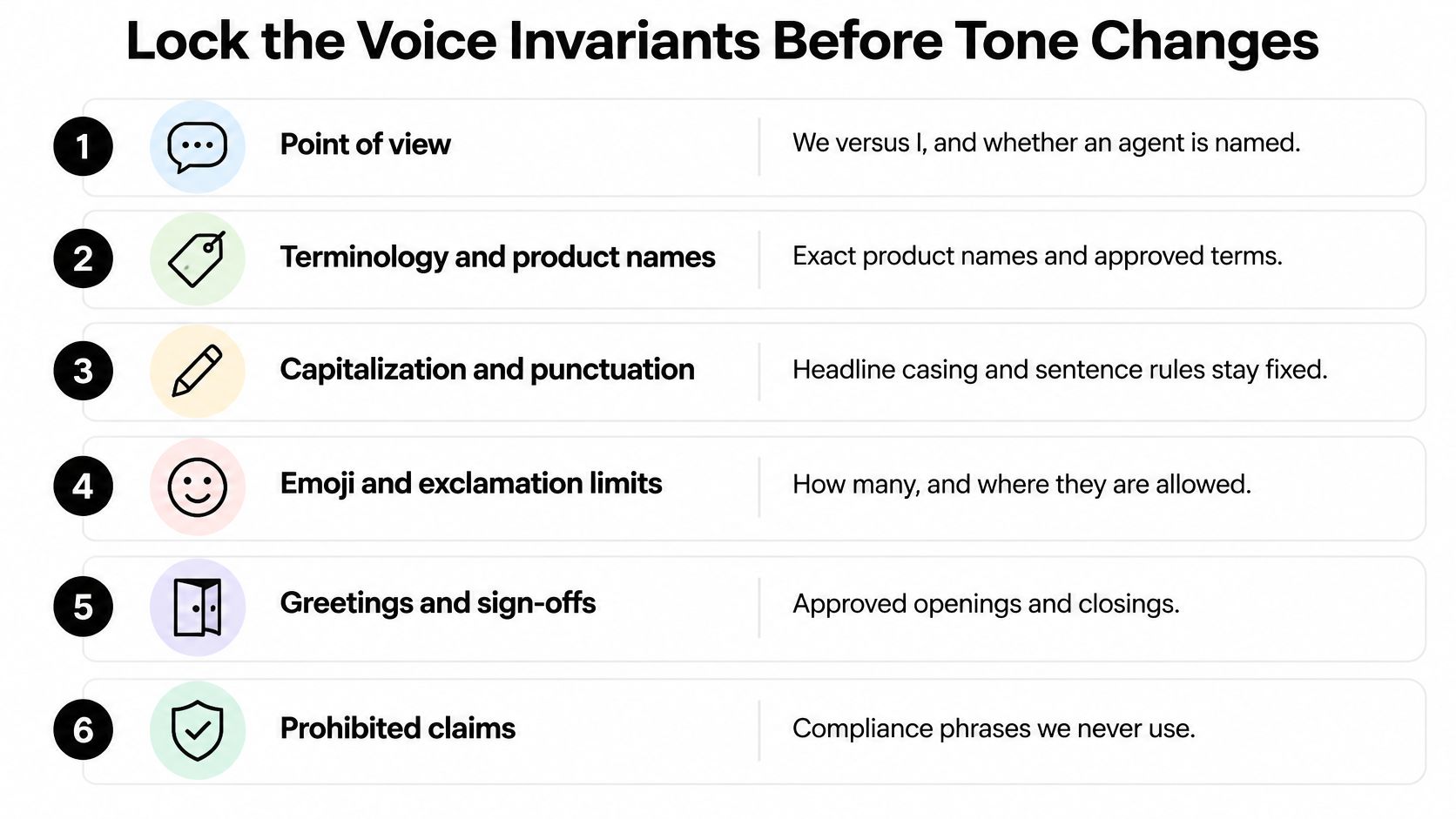
A voice guide becomes useful when a reviewer can mark a draft as compliant or noncompliant. Start with rules that survive a change in channel, customer emotion, or incident severity.
Turn personality into enforceable rules
Point of view. Decide when replies use we or I, whether an agent signs their name, and who owns commitments. Don't let a draft impersonate a named employee.
Terminology and product names. Record exact names and approved alternatives. Distinguish a pending authorization from a completed charge rather than treating both as money taken.
Formality floor. Specify the minimum standard for sensitive subjects. A reasonable billing rule is no slang, teasing, or celebratory punctuation, even when the customer writes casually.
Prohibited claims. Ban unapproved refund promises, unsupported security assurances, and root-cause speculation. A confident sentence isn't evidence that the statement is true.
Honesty commitments. Don't say a fix is live until it's verified. State what's known, what remains uncertain, and what the team is doing next.
Accountability language. Own confirmed mistakes and name the next action. Avoid passive wording that conceals responsibility or asks the customer to restart an investigation you already have.
Use a compact visual checklist alongside the operational rules, including mechanical choices such as punctuation, emoji, greetings, and sign-offs.
Apply tone only after the constraints pass
Once the draft passes those checks, adjust empathy, urgency, directness, and optimism. A confirmed service failure needs acknowledgment; an unresolved investigation needs restraint. Neither permits an invented promise.
Nielsen Norman Group's tone-of-voice research found measurable changes in perceived friendliness, trustworthiness, and desirability using five-point scales, and found that perceived trustworthiness strongly predicted willingness to recommend the organization. That's a reason to evaluate the customer's interpretation, not just whether preferred words appear.
The checklist approach has an operational parallel in housekeeping. A resource such as Avistar on consistent room turnovers offers a useful comparison: define repeatable checks rather than asking each person to interpret a broad quality adjective. In social care, the equivalent is checking promises, terminology, and ownership before polishing phrasing.
Our teams can define reply guidance per organization, so drafts start closer to the right voice. Keep that guidance versioned and shared between human writers and AI drafting tools, with an owner, effective version, and examples of prohibited wording.
A sympathetic draft that makes an unauthorized promise is still a failed draft.
Tone Tiers by Incident Severity and Approval
Use incident risk to determine the available tone range. Don't ask an agent to infer permission from how casually a customer writes.
Column Five's explanation of brand voice and tone distinguishes the stable identity from its situational expression. For live social care, turn that distinction into a lookup that includes send authority, not just adjectives.
Set the approval threshold
Tone and approval by incident severity
| Severity tier | Typical social example | Tone | Approval before sending |
|---|---|---|---|
| Routine question | How do I change my plan? | Warm, concise, helpful | AI sends inside approved templates |
| Individual complaint | Customer says a charge was taken twice | Empathetic, explains next step | Reviewer checks account-specific replies |
| Outage surge | Many users ask whether login is down | Brief, transparent, status-first | Comms lead approves public wording |
| Crisis or PR risk | Mentions linking the product to harm | Cautious, plain, no speculation | Comms and legal sign off |
| Safety or vulnerable customer | Message mentions fraud or self-harm | Calm, direct, safety-first | Routed to a trained person with context |
Put the actual person or staffed role into your routing configuration. An approval gate assigned to an unattended queue isn't a working control.
Routine automation should be narrow. A plan-change question can use an approved answer when the request is informational, the policy is current, and no account-specific exception appears. The same words inside a complaint about an unauthorized plan change require a different path.
Account context changes risk. Don't classify a reply as routine merely because its opening sentence matches a familiar FAQ.
Bound the permitted movement
Keep honesty, clarity, and accountability fixed throughout the table. Within each tier, define whether warmth can increase, how direct the language should be, and whether informality is permitted.
For an outage, an appropriate acknowledgment might be restrained rather than highly empathetic. Customers need confirmed status and an actionable next step, not elaborate emotional language repeated beneath every mention.
For potential harm, remove clever phrasing and unsupported reassurance. Don't promise that everything is safe or invite detailed public disclosure just to make the exchange sound helpful.
Our system flags low-confidence cases for the business's team, and sensitive conversations can move to a person with context attached. Configure those handoffs around uncertainty and risk, not only sentiment: a politely worded fraud report still needs attention.
This is the missing control in an adjective-only guide. Examples show what a good reply resembles; thresholds determine whether anyone is allowed to send it.
If a draft is more relaxed than its tier permits, move it up a level for review before sending. Tighten the language only after checking whether the relaxed wording also concealed a classification error.
Public Acknowledgment Before Private Resolution
A public complaint and its private resolution are separate service stages. Your team needs to show that it's handling the issue without exposing account information in an Instagram comment or an X reply.
Set stage-specific expectations
Response expectations by stage
| Stage | Benchmark or expectation | Tone | Owner |
|---|---|---|---|
| Public acknowledgment of a post | HubSpot's summary reports 79% expect a reply within 24 hours; 39% within 60 minutes | Short, visible, reassuring | AI drafts, reviewer approves |
| First acknowledgment in mentions | The Metrigy survey found a majority considered five minutes or less acceptable; 15.6% of social-service users received a response that fast | Brief holding line | AI drafts, reviewer approves |
| Move to DM | Sprout Social reports 51% of consumers contacting a brand publicly expect acknowledgment before being moved to DM | Neutral, invites details privately | Human decides for account or payment issues |
| Average business response | About five hours, in the HubSpot summary cited above | Not applicable, benchmark only | Social ops lead sets per-channel targets |
| Facebook and X averages | 1 hour 56 minutes on Facebook; 33 minutes 44 seconds on Twitter/X, in the same HubSpot summary | Not applicable, benchmark only | Social ops lead sets per-channel targets |
These are different survey contexts, not a single universal SLA. Use the mention findings to establish a fast first-acknowledgment target, then validate whether staffing and approval capacity can sustain it. Don't label an automated holding line as resolution.
Run the public-to-private handoff
Classify intent and urgency. Tag billing, access, outage, security, or product feedback before drafting. Check for an existing incident so separate mentions don't become disconnected investigations.
Acknowledge visibly. Confirm that the team is checking the issue and identify the next step. Don't repeat payment amounts, email addresses, or other sensitive details from the customer's post.
Continue privately. Use DM for appropriate account information and troubleshooting. Never request passwords or authentication codes.
Pause risky transitions. Account security, possible outages, harassment, and legal exposure need human judgment about what to say publicly and where to continue.
Attach the context. Include the original post, previous replies, relevant tags, incident association, and unanswered questions. Don't make the customer reconstruct the thread.
The public line can be warm and brief. The DM should become neutral and precise, especially when asking the customer to distinguish a pending payment from a completed transaction.
We route sensitive conversations to the customer's team with context attached. That preserves continuity when finance, engineering, or communications takes over.
Service boundary: A private handoff should protect information, not hide the complaint or erase public accountability.
Set separate targets for public posts, replies, and private messages. Track the acknowledgment clock separately from the investigation and resolution clocks, and show ownership when work leaves the social care queue.
Measuring Whether Tone Kept the Voice Intact
Metrics for voice and tone quality
| Metric | What it measures | Signal to watch |
|---|---|---|
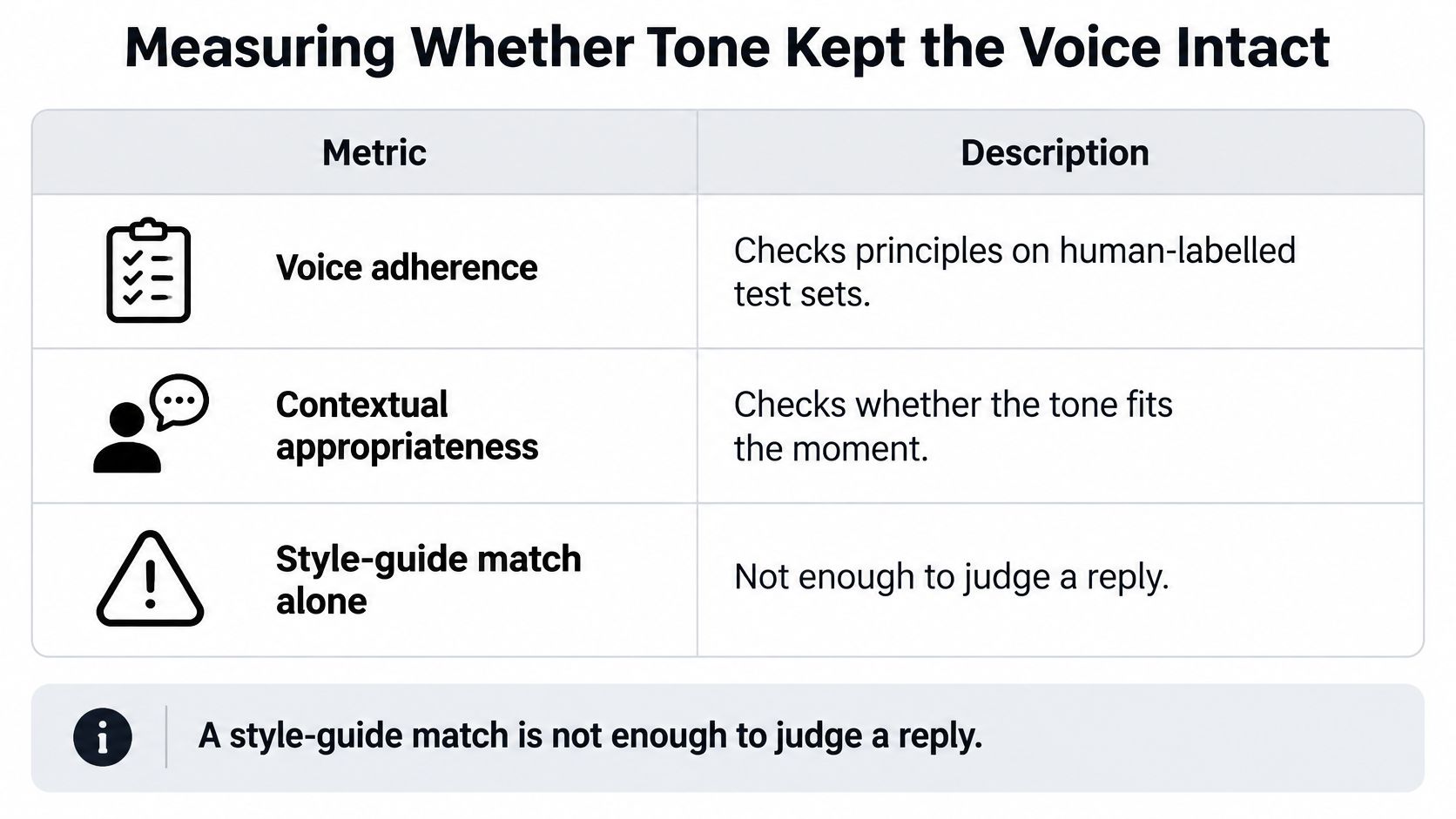
| Voice adherence | Principles kept across replies | Reviewer agreement on labelled test sets |
| Contextual appropriateness | Tone fits the incident type | Reviewer rework and rejection rate |
| Escalation accuracy | Right items reach the right owner | Correct routing and missed handoffs; field-study escalation mix below |
| Resolution outcome | Problem solved without repeat contact | Seven-day retrial rate and reopened conversations |
| Trustworthiness | Whether the reply is credible and dependable | Reviewer and customer ratings |
Test meaning, not just wording
A style-guide match isn't enough. A draft can contain every approved phrase and still dismiss a billing concern, misstate an outage, or route a vulnerable customer into the wrong queue.
Build human-labelled test sets covering routine questions, outages, billing disputes, and safety-sensitive complaints. Include multilingual slang, sarcasm, and short messages whose meaning depends on the preceding exchange. Score voice adherence separately from contextual appropriateness so a correct tone doesn't conceal a prohibited claim.
Set targets from your own baseline and risk tolerance. For escalation accuracy, inspect both missed escalations and unnecessary handoffs; neither raw escalation volume nor automation volume establishes quality.
Use the visual as a reminder of the distinction reviewers need to preserve.
Tighten controls where handoffs become costly
A field study summarized by Stealth Agents examined 11,069 AI-eligible chats handled with supervision: algorithm-triggered technical escalations accounted for 4,879 chats, or 44.1%, emotional escalations for 954, or 8.6%, and people initiated another 1,362, or 12.3%.
In that study, technical escalations took 19.1% longer than comparable human-handled chats. Emotional escalations took 40.8% longer, increased seven-day retrial rates by six percentage points, and reduced ratings by 0.928 points on a five-point scale.
Those results come from a single field study, not your social inbox. Check the pattern against your own conversations rather than treating its escalation mix as a target or attributing every difference to tone.
The practical response is to inspect anger, repeated failure, and technically complex handoffs more closely. Check whether the system recognized the need for a person early enough and whether that person received usable context.
Track first acknowledgment, human-owned resolution, and auto-closure rate separately. Review auto-closed spam and duplicates for missed customer issues, and watch reviewer fatigue: frequent rewrites, repetitive corrections, and abandoned drafts can indicate weak guidance or poor triage rather than an understaffed approval queue.
Confirm Your Voice Rules Before You Adjust Tone
A billing apology goes out during an outage, sounds warm, and cites a compensation rule your team has not approved. The tone felt reasonable; the voice rule was broken. Run this checklist before any sender gets wider latitude.
Put the controls into operation
Publish a one-page voice principle set. Adopt the invariant checklist covering point of view, terminology, formality, prohibited claims, honesty, and accountability. Attach approved and rejected examples from billing, access, and product conversations so reviewers can compare a draft against a rule.
Define the permitted tone range for each severity tier. Record which parameters can move, which expressions are excluded, and who approves exceptions: the support lead for routine care, the incident owner for urgent service disruption, legal or safety for regulated and safety claims. Keep channel preferences inside the risk classification.
Build a test set from past threads. Use billing disputes, outage surges, and safety messages with context preserved and sensitive information protected. Score drafts for voice adherence first, then for whether the chosen tone stayed inside the tier assigned to that incident.
Review outcomes after a quarter. Examine escalation accuracy, resolution, repeat contact, and reviewer rework by tier and intent. Change permissions through the named approval owner, based on where drafts failed, instead of widening autonomy because routine replies looked clean.
Keep the send decision explicit
For brand channels where identity is central to the experience, start voice-first. In service replies, meet the customer's immediate emotional and informational needs only within the tier's permitted range. Tone never overrides a safety or crisis rule.
Sift AI's Social Support agents triage, route, and draft replies to social conversations, and your team chooses when they are allowed to send. Keep anything above routine behind an explicit approval gate, with the thread history, intent, and risk signals attached for the person making the decision.
The operating model is orchestration: AI filters noise and prepares replies, while people approve, decide, and own the hard calls. Contact Sift AI to map your voice invariants and tone tiers to human-controlled approval workflows.