AI Workflow Automation for Social Ops
"Master AI workflow automation for social care and community ops. Learn to orchestrate agents, hit SLAs, and scale human-in-the-loop triage with Sift AI."
The popular advice about AI workflow automation is backwards. Most organizations don't need another chatbot, prompt library, or isolated AI experiment. They need to redesign how work enters the queue, who owns it, what gets escalated, and which decisions can safely close without a human.
Social operations exposes that problem quickly. A billing complaint in an Instagram reply isn't equivalent to a feature request buried in a Discord thread. A sarcastic post on X can look positive to a keyword rule, while a harmless meme may trigger a moderation queue. During an outage, thousands of messages can arrive across channels while finance, engineering, support, comms, and trust and safety each need a different slice of the same signal.
That's why AI workflow automation should mean orchestration, not replacement. AI filters noise, identifies intent, drafts routine replies, and prepares context. Humans approve sensitive responses, resolve ambiguity, and own the decisions that affect customers and reputation. The workflow becomes faster because the team spends less time sorting and more time exercising judgment.
Table of Contents
- The Reality of AI Workflow Automation in Social Ops
- How Agentic Orchestration Powers the Unified Inbox
- Core Components of a Resilient Social Architecture
- Enterprise Use Cases for Social Care and Community Ops
- Implementation Roadmap and SLA Measurement
- Vendor Evaluation Criteria for Social Operations
- Designing Workflows That Scale With Your Team
The Reality of AI Workflow Automation in Social Ops
More AI tools don't automatically produce better workflows. The workflow itself may still have unclear ownership, weak escalation rules, fragmented channel data, and no agreement about when a conversation is resolved.
The market's scale makes that distinction more important. The workflow automation market was valued at USD 23.77 billion in 2025 and is projected to reach USD 40.77 billion by 2031, a 9.41% compound annual growth rate, according to Mordor Intelligence's workflow automation market analysis. The same analysis says cloud deployment represented 62.15% of market size in 2025 and software platforms represented 66.55% of spending. Automation is enterprise infrastructure now, not a small productivity experiment.
Yet social care remains difficult because the input is unstructured and public. Language changes by platform and community. Multilingual slang, sarcasm, screenshots, images, memes, and partial context all affect intent. A language model attached to a helpdesk won't solve that if the surrounding process still sends every uncertain item to the same overloaded queue.
Practical rule: Automate the decision preparation before you automate the decision.
The business pressure is real, but adoption and operational embedding are different things. McKinsey's State of AI research reports that 62% of respondents say their organizations are at least experimenting with AI agents, while 23% are scaling an agentic system in at least one function and 39% are still experimenting. PwC also reports that 79% of executives say AI agents are being adopted in their companies, and 88% plan to increase AI-related budgets in the next 12 months because of agentic AI.
The scarce capability isn't model access. It's operational redesign. Leaders must decide which team owns a PR-risk mention, whether finance can receive a private billing conversation, how engineering sees a reproducible bug, and what happens when confidence is low. A useful guide to AI automation for product managers makes a similar process point from a product perspective, but social ops adds public urgency, brand voice, and channel-specific SLAs.
How Agentic Orchestration Powers the Unified Inbox
A unified inbox is only useful if it turns a stream of messages into accountable work. The system needs to ingest conversations from X, Instagram, TikTok, Discord, Telegram, WhatsApp, and forums, preserve channel context, then make a defensible recommendation about what happens next.
That recommendation can involve several connected actions:
- Filter noise: Suppress obvious spam, duplicate posts, scams, and low-intent chatter before they consume reviewer attention.
- Tag intent: Distinguish billing, outage, cancellation, product feedback, abuse, partnership, media risk, and general praise.
- Route ownership: Send a payment issue to finance, a reproducible defect to engineering, a public narrative risk to comms, and a safety concern to trust and safety.
- Prepare the response: Retrieve approved knowledge, summarize the thread, and draft a reply in the configured brand voice.
- Escalate exceptions: Pause or redirect the workflow when confidence, urgency, privacy, or reputational risk crosses a defined threshold.
Agentic orchestration differs from a basic chatbot. A chatbot waits for a user to ask a question. An orchestrated workflow observes an event, gathers context, selects tools, applies policy, and moves the item toward the right owner. It still needs guardrails. The agent can recommend a response, but a human should approve a sensitive refund explanation, crisis statement, or account-specific action.
The measurement challenge is completion, not activity. AutomationBench evaluates AI agents on 657 tasks across six business domains and 40 simulated app environments, including Gmail, Google Sheets, Slack, Salesforce, Zendesk, Jira, and HubSpot. Its scoring uses proof of outcome and nearly 12,000 assertions, which makes it relevant to social operations because a workflow should be judged on whether it completed the cross-application process correctly, not merely whether it triggered an action. The benchmark details are available from AutomationBench.
For a command center, completion might mean the right tag was applied, the correct team acknowledged the item, the customer received an approved answer, the CRM was updated, and the exception was logged. A green “automation ran” status proves very little if the customer still waits in the wrong queue.
Core Components of a Resilient Social Architecture
A resilient architecture has to interpret content, enforce policy, and preserve accountability. A fast model without those layers creates a faster way to misroute work.
Context before action
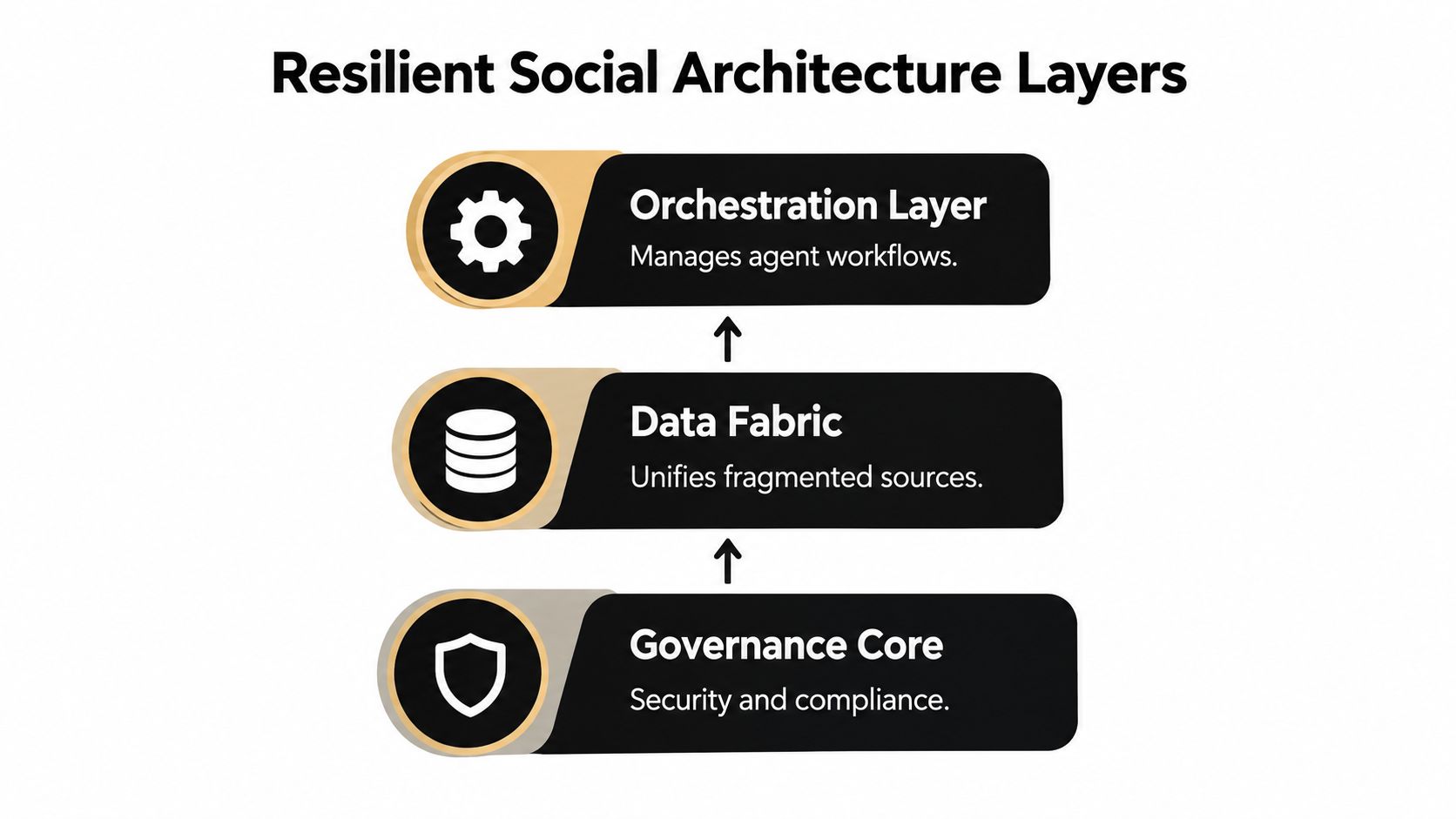
The first component is a data fabric that unifies fragmented sources. The system should retain the message, thread history, author context where permitted, channel, language, attached media, prior cases, and relevant CRM information. Without that context, “my payment failed again” could be routed as a generic complaint instead of a finance issue connected to an existing case.
Multimodal understanding matters as well. A screenshot of an error, a meme about an outage, or an image containing a scam link may carry the decisive signal. Keyword matching can identify “refund,” but it won't reliably distinguish a legitimate billing dispute from a sarcastic comment, a quoted post, or a coordinated scam wave.
Routing with accountability
The second component is an orchestration layer with explicit ownership rules. Each route should answer four questions:
- Who receives the item? Support, finance, engineering, product, comms, or trust and safety.
- What context travels with it? The original post, thread summary, detected intent, urgency, language, customer history, and draft response.
- What action is allowed? Tagging, assignment, drafting, notification, reply, private follow-up, or closure.
- What stops the workflow? Low confidence, regulated information, threats, potential media interest, account access, or an unresolved contradiction.
A rule that says “send anything containing refund to finance” is too crude. A better rule combines intent, channel, customer state, language, confidence, and risk. Finance may need to receive a private case reference rather than a public reply. Comms may need visibility into an outage cluster without owning every individual response.
Confidence is a policy decision
Confidence thresholds should be tied to consequences, not treated as a universal model setting. High-confidence, low-risk items can be auto-tagged, answered from approved content, or auto-closed when the customer's request is clearly complete. Mid-confidence items should receive an AI draft and a human review task. Low-confidence or high-risk items should escalate immediately, with the reason visible to the reviewer.
Community moderation offers a useful model. A practical three-band system auto-removes content above a top confidence threshold, sends mid-confidence items to a human, and auto-approves content below a bottom threshold. That structure is safer than either blanket human review or unrestricted automation. It also recognizes that moderation creates operational work of its own. A 2025 study of 156 Reddit communities found that adding bots increased volunteer moderators' work by about 21%, concentrated on subjective-rule decisions rather than obvious violations, as summarized in this analysis of online community moderation.
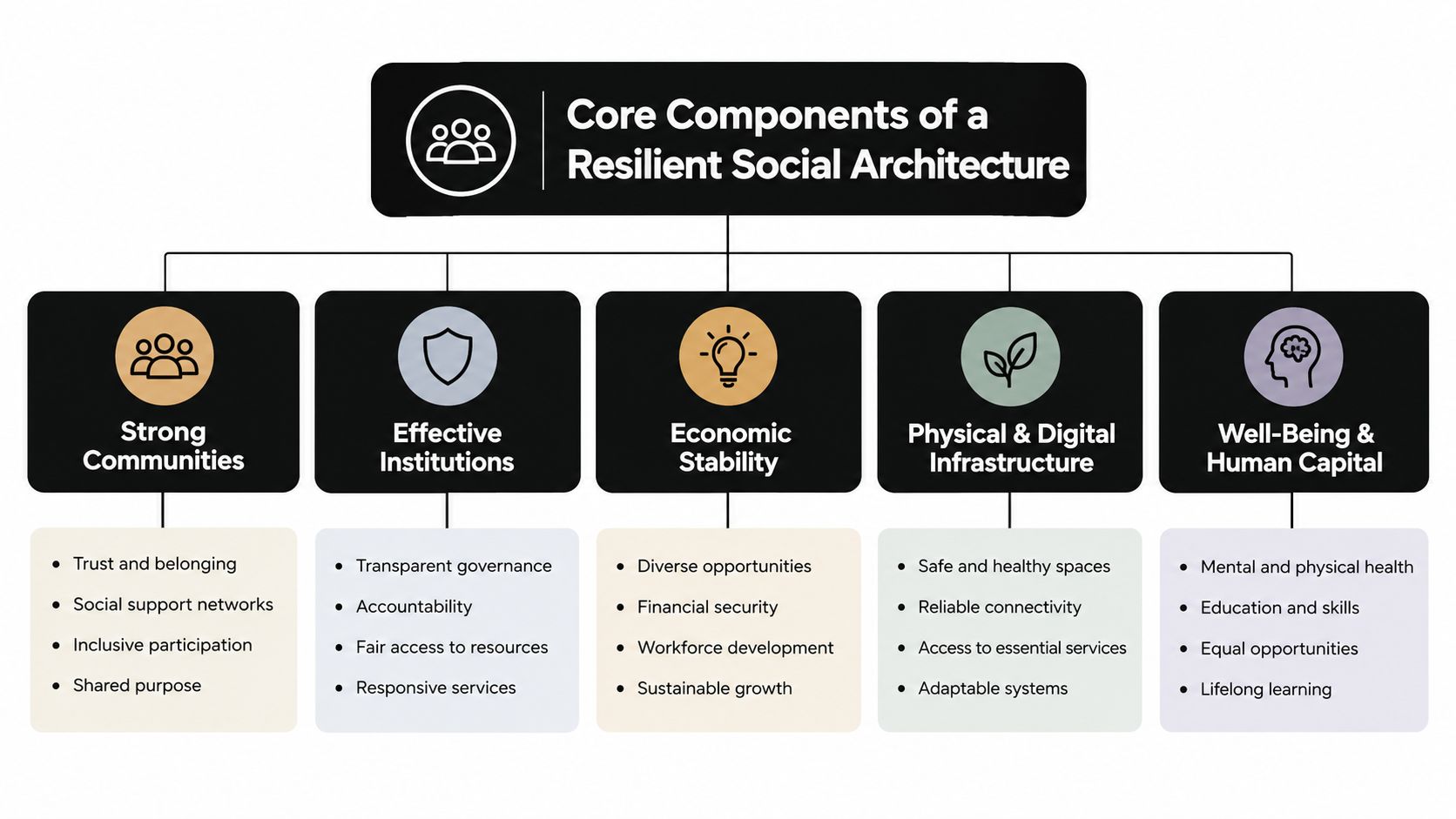
Governance completes the architecture. Role-based permissions should control who can approve a public response, expose account data, change a routing rule, or override an escalation. Audit trails should show the input, classification, action, approver, and final outcome. Brand voice controls should constrain drafts without turning every response into identical corporate language.
Enterprise Use Cases for Social Care and Community Ops
An outage surge on X tests the whole operating model at once. The system should cluster related complaints, identify the likely incident, separate affected customers from reposts and spam, and notify engineering and comms. Support agents can review a holding response grounded in approved incident language, while the workflow keeps urgent account-specific cases visible instead of allowing the public volume to bury them.
The response-time gap makes this operational rather than cosmetic. A 2025 benchmark summary reports that 78% of customers who complain on Twitter expect a response within 1 hour, while industry-average social response times are often 4 to 5 hours, according to Ringly's customer service response-time benchmarks. AI can't make an outage disappear, but it can reduce the time spent finding the signal and preparing a consistent first response.
Billing needs a different path
Consider a billing complaint in Instagram DMs. The workflow should detect payment intent, identify whether the customer is asking about a charge, failed payment, refund, or duplicate transaction, and move the case to finance without exposing sensitive information in a public reply. The support agent still decides how to communicate, especially if policy, identity verification, or goodwill compensation is involved.
A feature request in a Discord channel follows another path. AI can summarize the request, merge similar suggestions, identify the product area, and route the signal to product or engineering. The agent shouldn't promise delivery or convert enthusiasm into a roadmap commitment. It should preserve the customer's language and attach enough context for a product manager to assess the underlying need.
Spam waves require selective intervention
A coordinated spam or scam wave in a forum can create reviewer fatigue quickly. The workflow should detect repeated patterns, identify likely duplicates, apply confidence bands, and escalate unusual or ambiguous content. Obvious violations can be handled automatically under policy, while borderline cases remain with a human reviewer.
The same orchestration applies to multilingual slang and crisis escalation. A phrase may be harmless in one community and threatening in another. The system should surface the language and uncertainty, not hide them behind a binary label. A human reviewer needs to know why an item was routed, what evidence supported the decision, and what the system couldn't determine.
Implementation Roadmap and SLA Measurement
Successful deployment starts with governance, not a launch announcement. Before enabling automated replies, map the current flow from message arrival to closure. Include every handoff, duplicate queue, approval dependency, and exception that experienced agents handle informally.
Establish the operating contract
Write the policy before configuring the agent. Define the allowed actions, prohibited actions, data access, escalation destinations, review roles, retention requirements, and approved knowledge sources. Create a small set of risk classes, such as routine information, account-specific support, financial issue, safety concern, crisis signal, and potential PR risk.
Then run the workflow in shadow mode. Let AI classify, tag, summarize, and recommend routes without changing the live queue. Compare its decisions with experienced reviewers, record false positives and false negatives, and refine the taxonomy. Shadow mode reveals whether the model understands the team's actual language, not the language used in a strategy document.
Move from assistance to controlled action
Progress in stages:
- Drafting: AI produces summaries and replies, while agents approve every send.
- Routing: High-confidence items receive assignments and tags, with exceptions held for review.
- Limited closure: Low-risk, clearly resolved intents can auto-close under a documented policy.
- Continuous review: Managers inspect escalations, reopened conversations, edits, and customer reactions.
A useful measurement system separates speed from quality. Track noise-filtered percentage, routing accuracy, draft acceptance, auto-closure rate, reopen rate, escalation reasons, reviewer fatigue, and proactive saves. Executives need to see whether the system shortens real handoffs and protects customer experience, not just how many AI actions occurred.
A social media SLA is a documented agreement covering responsibilities and expectations between a company and its social team. Sprout Social defines SLA adherence as the percentage of queries resolved within the agreed timeframe. Under that definition, a 3-hour response goal reaches 100% adherence only when every inquiry is answered within 3 hours, as explained in Sprout Social's customer service metrics guidance.
Channel expectations should shape the SLA rather than sit beneath one global target. Microsoft research cited in a 2022 SLA article found that 37% of global respondents expected a same-day social reply, 28% expected a reply within one hour, and 18% expected an immediate response. The CM.com overview of SLA-driven customer service also identifies Facebook, YouTube, Instagram, Twitter, and LinkedIn as major customer service channels with different usage patterns.
For implementation examples that show how teams structure automation projects, see DataLunix AI automation case studies. Use those examples as prompts for process questions, not as a substitute for your own queue data.
Vendor Evaluation Criteria for Social Operations
Social operations buyers should test vendors with real transcripts, not polished demonstrations. Give the platform a sarcastic complaint, a screenshot, a multilingual message, a duplicated outage post, a billing request, and a potential crisis signal. Then inspect the classification, evidence, route, draft, confidence, and audit record.
A legacy automation platform can still be useful for deterministic actions. Keyword rules, status triggers, and fixed integrations handle predictable work reliably. They become fragile when the same word means different things across channels or when the correct action depends on conversation history.
| Capability | Legacy Automation | AI Operating System |
|---|---|---|
| Input handling | Keyword, form, or status triggers | Context-aware interpretation across posts, threads, media, and channels |
| Triage | Fixed categories and rules | Intent, urgency, language, sentiment, and risk classification |
| Routing | Predefined assignment paths | Dynamic routing to support, finance, engineering, comms, or trust and safety |
| Response | Templates and scripted messages | Contextual drafts constrained by knowledge and brand voice |
| Exceptions | Manual queue inspection | Confidence thresholds, reason codes, escalation, and human approval |
| Measurement | Trigger counts and completion status | SLA adherence, auto-closure, reopening, routing quality, and proactive saves |
| Governance | Basic permissions | Role-based access, audit trails, data controls, and approval policies |
Ask vendors how they handle multilingual slang, sarcasm, memes, and cross-channel context. Ask whether a reviewer can see why a conversation was escalated and whether a manager can change a threshold without engineering work. CRM synchronization matters when a social interaction must become a customer record, while auditability matters when a public answer requires post-incident review.
Security and administration should be tested in the same workflow. Evaluate role-based permissions, SOC 2 readiness, ISO readiness, data controls, approval scopes, and activity logs. A platform that drafts excellent replies but can't constrain who may send them is not ready for enterprise social care.
Inference efficiency also affects scale. In benchmark results tied to agentic workflow optimization, one method reduced LLM calls by up to 11.9% while increasing task success by up to 4.2 percentage points, according to the published agentic workflow optimization benchmark. Better tool selection and orchestration can reduce cost and latency while improving completion quality, but buyers should validate the trade-off on their own workload.
Designing Workflows That Scale With Your Team
The strongest social teams do not use AI to remove judgment. They use it to reserve human judgment for conversations where context, risk, or customer impact makes automation unreliable.
Redesign the command center around ownership. AI can remove obvious spam, cluster an outage, tag a billing issue, summarize a long Discord discussion, and draft a response. A support lead decides whether the customer needs empathy or policy clarification. Finance owns the transaction question. Engineering owns the defect. Comms owns the crisis narrative. Trust and safety owns the risk decision.
Start with a queue audit. Identify where agents copy context between tools, urgent items wait behind low-intent volume, and auto-closure creates reopened cases. Define confidence thresholds, test them in shadow mode, and measure outcomes by channel and intent. A workflow earns approval when the right people receive the right work with enough context to act, not when it produces a high volume of classifications.
Sift AI is one option worth testing against your own transcripts. Run difficult cases, such as a sarcastic complaint or a multilingual screenshot, through the platform and compare its classification, supporting evidence, and audit record with what your reviewers would produce. The useful evaluation question is whether it handles exceptions consistently and gives managers enough control to change the workflow without creating new operational risk.
Scale comes from treating AI as an orchestration layer. Let the system handle volume and preparation, then give people clear authority over exceptions, accountability, and customer moments that should not be automated away. The scarce capability is coordinated decision-making, not model access.