Multi Channel Messaging Platform: A Practical Buyer's Guide
"What a multi channel messaging platform actually does, the features that matter, and how enterprise teams should evaluate, implement, and measure one in 2026."
At 8:02 on Monday morning, an enterprise customer sends a billing complaint by email. The same issue appears on X, then Threads, then LinkedIn, followed by a direct message that lands in a separate queue. Three agents open five tabs, one swipes away a notification and closes the wrong thread, and two people send replies that contradict each other. The legal escalation arrives as a DM before anyone has linked it to the original complaint.
By mid-morning, the team has duplicate work, misattributed SLAs, inconsistent tone, and no reliable view of severity. The on-call lead finally says what everyone already knows: “We need one inbox.”
That failure isn't caused by a lack of channels. It comes from the absence of an orchestration layer. Social channels don't aggregate themselves, language doesn't translate itself, and urgency doesn't route itself to finance, engineering, comms, or trust and safety. A multi channel messaging platform has to make those decisions visible, controllable, and safe for human agents.
Table of Contents
- The Monday Morning a Unified Inbox Stops Being Optional
- What a Multi Channel Messaging Platform Actually Is
- The Six Capabilities That Separate a Platform From a Tool
- How Routing and Triage Play Out in Real Enterprise Work
- An Evaluation Checklist and RFP Criteria That Hold Up
- Implementation, Integrations, and Security Without Surprises
- The Metrics That Prove the Platform Is Working
- A Short Vendor Selection Framework You Can Use This Week
The Monday Morning a Unified Inbox Stops Being Optional
The first agent handles the public reply on X and asks the customer to send account details privately. The second agent sees the same complaint on LinkedIn and offers a different explanation. The third is watching Instagram DMs, WhatsApp, and a community forum, trying to identify whether the messages belong to one incident or several unrelated issues.
Nobody has a complete customer record. Nobody knows which response started the SLA clock. The customer repeats the billing problem in every channel because the conversation history doesn't travel with them. Meanwhile, a sarcastic post about the issue looks positive to a basic sentiment filter, and a screenshot of an invoice sits unread because the queue only recognizes text.
This is the daily cost of treating channels as separate destinations. Messaging apps and social networks are already a mainstream communication layer. DataReportal's 2026 mid-year global update says 93.6% of online adults use chat apps and messenger platforms each month, while 96.7% use at least one social network or messenger service monthly. A team that supports only an email inbox is not managing the customer's actual communication behavior.
The operational volume makes manual monitoring even less defensible. One 2026 messaging-app usage report estimates that more than 100 billion messages are sent daily across messaging platforms, with WhatsApp accounting for 42 billion daily messages and 2.65 billion monthly active users. Those figures don't tell you what your queue will receive, but they do explain why filtering, tagging, and intent-based prioritization are core infrastructure rather than optional add-ons.
Practical rule: If an agent has to remember which tab contains the legal escalation, your workflow is already relying on luck.
The rest of this guide treats the platform as a control layer for human-in-the-loop social care. The question isn't how many channels a vendor can display in a brochure. It's whether the system can ingest a surge, preserve context, identify intent, route the work, and keep a human accountable for the hard call.
What a Multi Channel Messaging Platform Actually Is
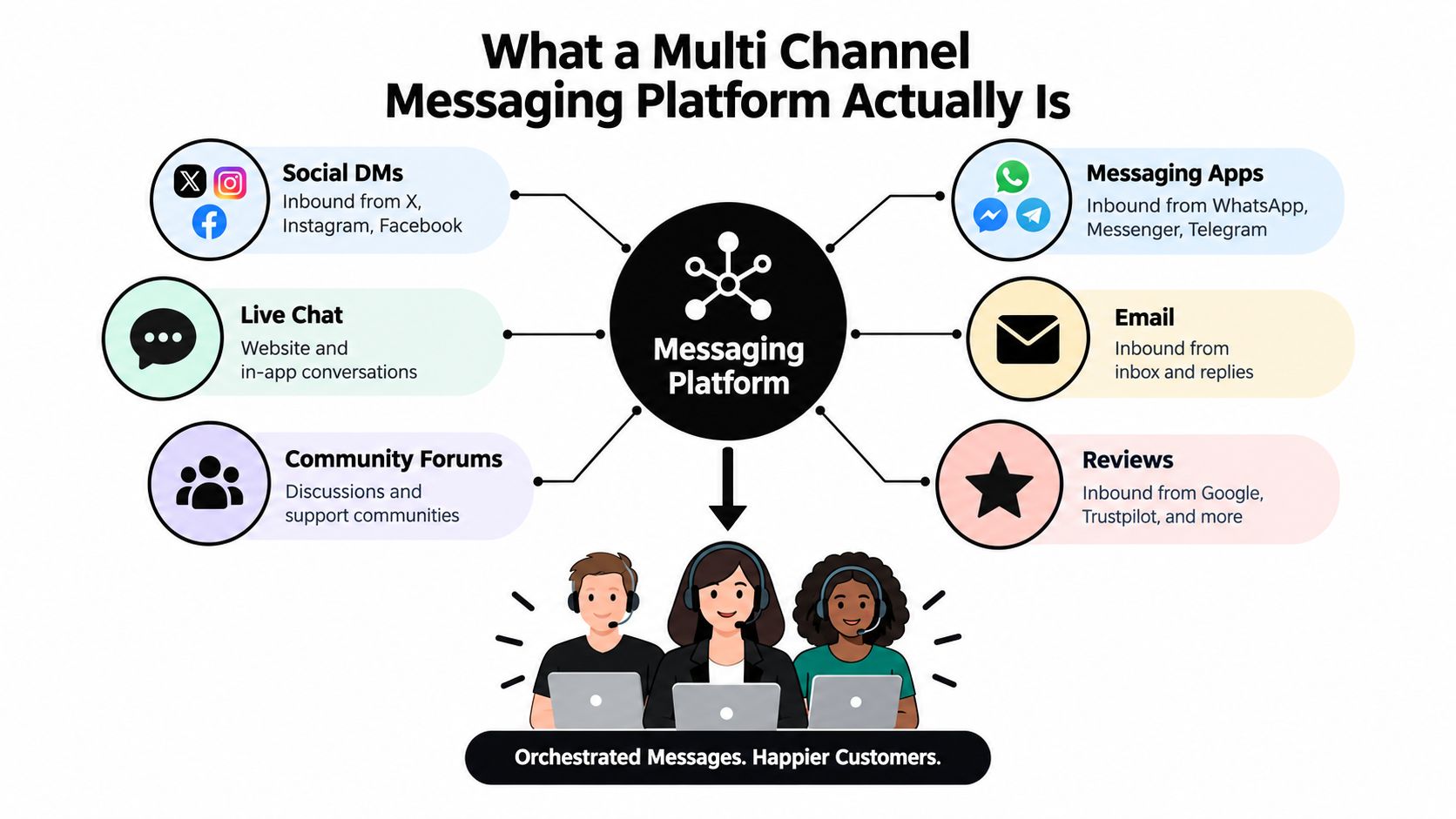
A multi channel messaging platform sits between inbound conversations and the people responsible for resolving them. It connects social DMs, public replies, live chat, messaging apps, email, reviews, and community forums, then performs three jobs:
- Ingest the interaction: Pull messages, attachments, replies, and relevant metadata into a common workspace.
- Understand the interaction: Detect intent, language, urgency, topic, sentiment, and customer context.
- Orchestrate the response: Assign the work, start the right SLA, suggest or draft a reply, and escalate when automation shouldn't act.
That definition separates the category from adjacent tools. Sprout Social may help a social media manager schedule and publish content, but a care team needs a queue that can classify a billing complaint in a reply and send it to finance. Zendesk Talk is designed around voice support, while social DMs require public-versus-private handling, channel-specific context, and rapid triage. ServiceNow can manage structured IT tickets, but a customer complaint arriving as an Instagram reply doesn't begin as a clean ticket.
Social care needs its own operating model because the work is public, real-time, multilingual, and reputation-bearing. An answer intended for a private DM can create risk when posted publicly. A complaint that looks routine in isolation can become a crisis when hundreds of customers repeat it. A request for a feature can matter to product even when it contains no obvious support question.
A credible platform therefore combines:
- Unified inbox: One workspace for messages, conversation history, assignments, and internal notes.
- Triage and tagging: Structured labels for intent, urgency, topic, sentiment, product, and risk.
- Routing and escalation: Rules that move work to the right queue, team, language group, or on-call owner.
- Human review: Approval gates for sensitive, uncertain, or externally visible replies.
- Analytics: Operational reporting on volume, SLAs, auto-closure, deflection, sentiment, and recurring topics.
- Governance: Permissions, auditability, retention, redaction, and security controls.
The platform isn't replacing agents. It gives them a reliable system in which humans approve, decide, and own the interactions that require judgment.
The Six Capabilities That Separate a Platform From a Tool
A tool displays messages. A platform manages the work created by those messages. The difference becomes obvious during a product launch, an outage, a scam wave, or a multilingual complaint surge.
1. Ingestion that survives channel change
The platform needs durable connectors for X, Instagram, TikTok, Discord, Telegram, WhatsApp, forums, reviews, email, and live chat. Ask how it handles rate limits, deleted posts, attachments, threaded replies, webhook delays, and a brand-new channel. A connector that works in a quiet demo but drops context during a surge isn't production-ready.
2. Routing that reflects responsibility
Routing should combine deterministic rules with AI suggestions. A billing complaint goes to finance, a reproducible bug goes to engineering, a safety issue goes to trust and safety, and a potential PR incident goes to comms. Language, customer tier, product line, business hours, and after-hours fallback should all affect assignment.
3. Auto-tagging built around intent
Keyword matching misses how customers write. A vague post such as “your new package has charged me again” should be classified as a billing dispute and linked to the relevant SKU when the surrounding context supports it. Require confidence scores and editable taxonomies, not a black-box label that agents can't correct.
4. Multilingual and multimodal understanding
Support teams deal with slang, transliteration, sarcasm, screenshots, memes, and voice notes. Translation alone isn't enough. The system should extract text from an invoice screenshot, transcribe a voice note, understand the language, and preserve the original content for review.
5. Human-in-the-loop controls
Automation should draft routine replies and close obvious spam, but it shouldn't independently answer a legal threat, promise a refund, or respond to an uncertain crisis post. Agents need approval queues, override controls, brand voice guidance, and a clear record of who approved what.
6. Analytics and governance
Operational reporting should expose queue health, agent-level SLAs, channel volume, deflection, sentiment trends, and topic clusters. Governance must cover SSO, RBAC, PII redaction, audit logs, retention, residency, and legal hold. These capabilities form one system. Weak ingestion corrupts analytics, weak tagging breaks routing, and weak governance makes automation impossible to defend.
| Capability | What It Does | Live Workflow Example |
|---|---|---|
| Ingestion | Collects messages, metadata, attachments, and replies across channels | An Instagram reply and its private follow-up remain connected |
| Routing | Assigns work by intent, language, team, tier, and urgency | A payment dispute reaches finance instead of the general queue |
| Auto-tagging | Identifies intent, topic, sentiment, urgency, and product | A vague X post is labeled as a billing issue for a specific SKU |
| Multilingual and multimodal understanding | Interprets language, slang, images, memes, and voice notes | OCR extracts an order number from a screenshot before an agent replies |
| Human review | Places risky or uncertain actions behind approval | A possible legal escalation waits for comms or legal review |
| Analytics and governance | Measures performance and controls access and retention | A manager audits an SLA breach and verifies the assigned role |
How Routing and Triage Play Out in Real Enterprise Work
A billing complaint arrives as an X DM. The platform identifies the intent, matches the customer to a CRM record, and sends the conversation to the billing pod. The agent sees the prior interaction, account context, language, and SLA timer instead of asking the customer to start again.
The target can be explicit. One architecture guide describes a large-scale transition toward broker-based, horizontally scaled messaging around 10,000 active users, with roughly 1,000 to 5,000 messages per second and sub-500 millisecond latency targets requiring load balancing, caching, and a message broker rather than direct synchronous processing. The architecture guidance is useful because it connects response expectations to infrastructure, not just interface design.
Billing complaints need ownership
If routing fails, the general queue receives a finance question. The agent may provide a generic answer, miss the SLA, or request sensitive information in a public reply. During a demo, ask the vendor to show the CRM context, assignment timestamp, escalation path, and internal notes visible from the same conversation.
Outages need controlled scale
During an outage, the queue should recognize the incident pattern, prioritize affected customers, and present approved macros for common questions. Routine FAQ responses can be drafted or deflected to self-service, while safety-sensitive, account-specific, or legally significant replies stay with humans. The system must show whether automation reduced work or only hid unresolved contacts.
PR risk needs uncertainty handling
Sarcasm can look positive to a shallow classifier. A post that says “love paying twice for the same service” should not receive an upbeat automated reply. Sentiment confidence, escalation thresholds, and a human review queue matter more than a headline accuracy claim.
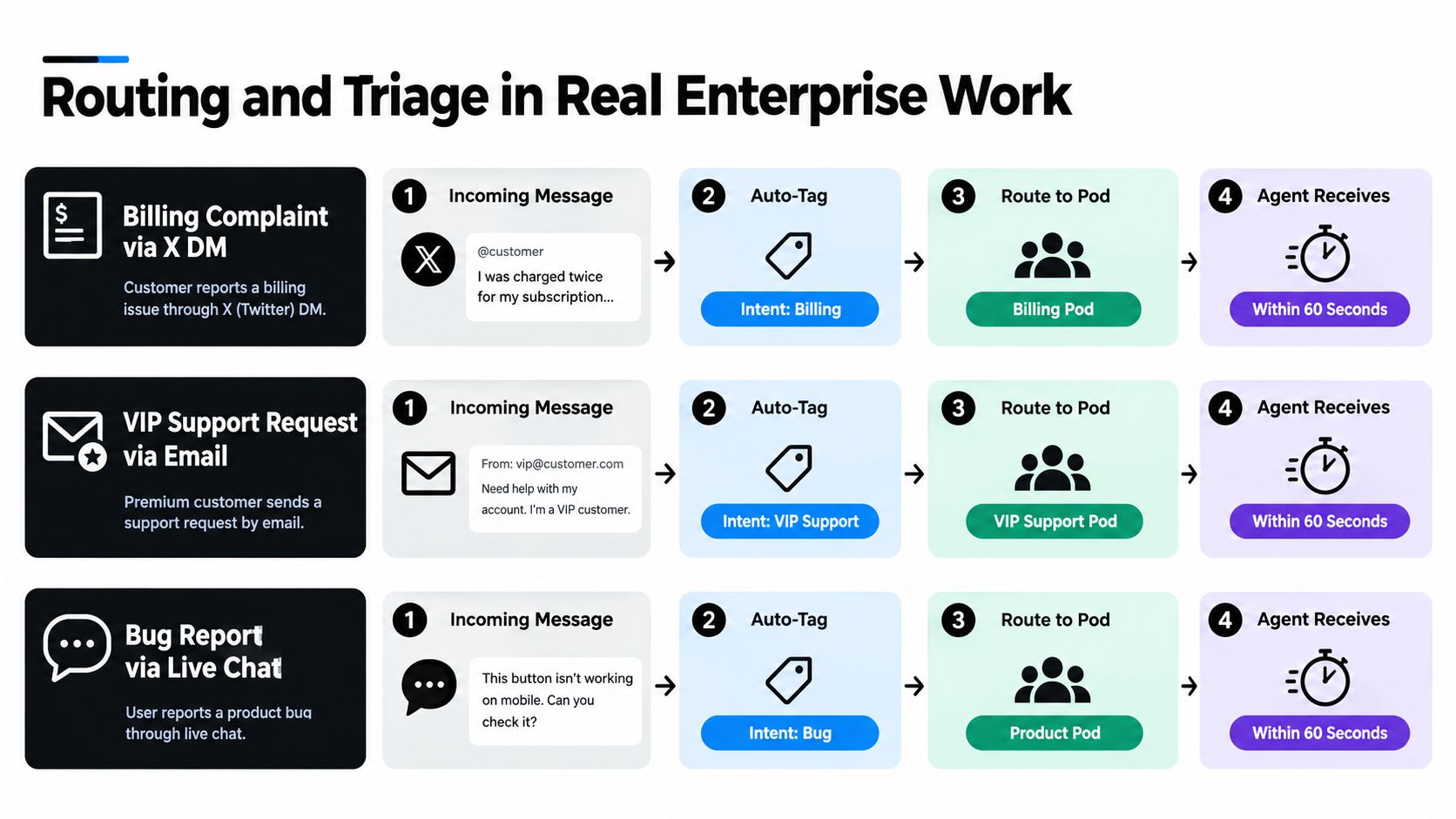
Watch the live workflow, not just the final dashboard.
Queue-level SLA visibility, confidence scores, override controls, and explicit escalation paths are the signals that separate useful triage from automated noise.
An Evaluation Checklist and RFP Criteria That Hold Up
Procurement teams should evaluate failure modes, not feature counts. A vendor can claim broad channel coverage and impressive AI accuracy while giving agents no way to inspect a misclassification or recover from a connector outage.
Start with this ten-item checklist:
- Ingestion latency: Can the vendor show message arrival time, processing time, and assignment time?
- Language coverage: Does it handle your actual languages, slang, transliteration, and mixed-language messages?
- Auto-tagging accuracy: Can your team test intent, topic, product, and urgency against its own examples?
- Sentiment confidence: Does uncertainty lower automation privileges and trigger review?
- Human override: Can agents correct tags, reroute work, stop a draft, and reopen an auto-closed interaction?
- SLA timers: Are timers visible by queue, channel, priority, and business hours?
- Audit logs: Can governance teams trace ingestion, classification, edits, approvals, and sends?
- Role-based access: Can finance, engineering, comms, and contractors see only the fields they need?
- Data residency: Can the vendor document storage and processing locations?
- Channel coverage: Does the connector support the exact surfaces your customers use, including communities and reviews?
For the RFP, require evidence rather than presentation slides. The Procright procurement analysis page offers useful context on the information modern procurement teams should request and the gaps they often miss.
| Criterion | Weight | Evidence Requested | Red Flag |
|---|---|---|---|
| Ingestion and channel reliability | High | Connector documentation, outage process, event logs | “Real time” with no measurable event trail |
| Intent and language handling | High | Held-out test set, confusion matrix, sample outputs | Vanity accuracy with no error breakdown |
| Routing and SLA control | High | Live queue demo with escalation and timers | Manual reassignment required for common cases |
| Human approval workflow | High | Approval, override, reopen, and audit demonstration | Automation sends without policy gates |
| Integrations | Medium | CRM, case system, warehouse, and webhook documentation | Context is copied manually |
| Security and governance | High | SSO, RBAC, redaction, retention, residency controls | Vague compliance language |
| Total cost of ownership | High | Surge, channel, seat, storage, and exit pricing | Per-channel SKUs multiply during launch |
On demo day, provide a 15-message mixed-language, mixed-channel sample containing a billing complaint, outage question, feature request, scam report, sarcastic post, screenshot, and escalation. Score intent accuracy, routing speed, confidence handling, and tone consistency. If the vendor won't run your workload live, don't accept a polished generic demo as proof.
Implementation, Integrations, and Security Without Surprises
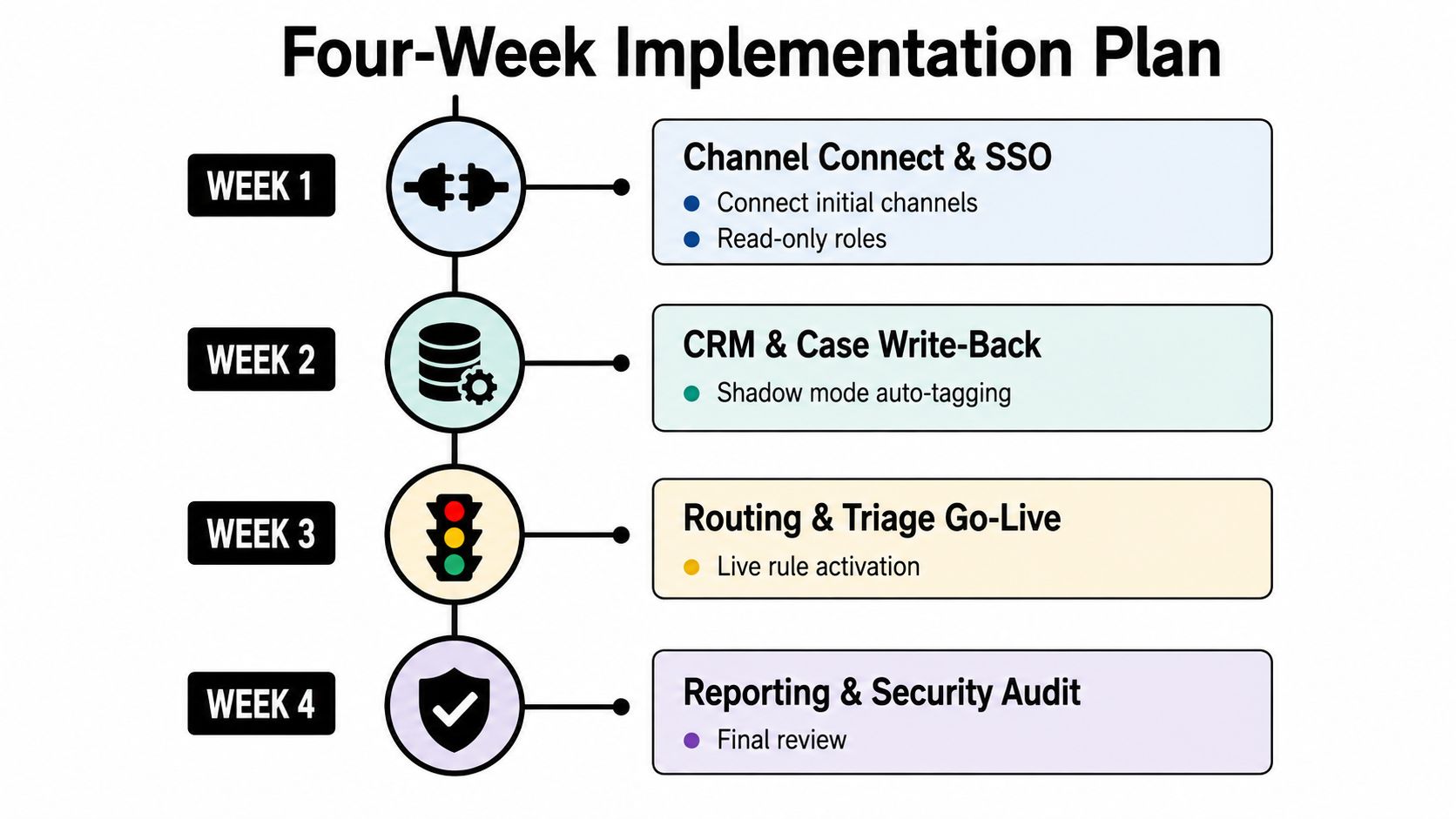
A rollout should prove control before it enables automation. Use a four-week plan that gives agents time to inspect the system while the platform learns your taxonomy.
Week one
Connect the initial channels and configure SSO. Give most users read-only roles so they can validate ingestion, conversation merging, permissions, and historical context without changing live workflows.
Week two
Connect the CRM and case management system for write-back. Add identity resolution, analytics warehouse exports, and webhooks. Run auto-tagging in shadow mode, compare labels with agent decisions, and fix taxonomy gaps before routing depends on them.
Week three
Activate routing for two pilot queues. Require human review on every send, including macros and AI drafts. Measure missed assignments, duplicate records, language errors, and escalation timing.
Week four
Cut over the remaining queues, publish the macro library, and complete the security audit. Keep a rollback plan and an incident owner who can disable automation without taking the inbox offline.
Don't negotiate away SOC 2 Type II, ISO 27001, region pinning, encryption at rest and in the field, audit logs with legal hold support, RBAC, field-level redaction, and subprocessor disclosure. Ask how a departing employee loses access, how an agent sees masked payment details, and how legal teams export a complete interaction history.
If the platform uses external model providers, evaluate the boundary separately. A secure LLM API gateway can provide useful context for reviewing model access, policy enforcement, and security controls, but your vendor still needs to document its own architecture and subprocessors.
Pricing creates its own surprises. Test whether per-seat charges expand when temporary responders join an outage, whether surge traffic changes the bill, and whether each new channel requires a separate SKU. A launch that adds WhatsApp, Telegram, or community coverage shouldn't automatically create a second procurement problem.
The Metrics That Prove the Platform Is Working
Follower growth and message volume are useful context, but they don't prove that social care works. The operating dashboard should answer four questions: Are urgent conversations seen? Are agents handling them consistently? Are customers getting resolution? Is automation removing work without creating more contacts?
Track median first response time by channel, SLA breach rate, auto-closure rate, deflection to self-service, sentiment trend, agent handling time, and re-contact rate within 24 hours. The time window is operationally important because a fast first reply can still be a poor outcome if the customer returns the next day with the same problem.
A healthy dashboard should place queue depth, SLA risk, and unresolved urgent intents at the top. Below that, show channel volume, first response time, handling time, auto-closure, deflection, re-contact, and sentiment by topic. Add a view of routing corrections and human overrides. If agents repeatedly fix the same classification, the model isn't reducing reviewer fatigue, even if its aggregate label count looks strong.
| Metric | What It Measures | Hidden Failure Mode | Trigger Threshold |
|---|---|---|---|
| Median first response time | Speed to initial human or approved response | Easy work is answered first while urgent cases wait | Set by channel and contractual SLA |
| SLA breach rate | Share of interactions missing the promised response window | Queues are misconfigured or ownership is unclear | Any sustained upward movement |
| Auto-closure rate | Work closed without agent handling | Customers are closed before resolution | Review by intent and re-contact |
| Deflection to self-serve | Contacts resolved through approved guidance | Macros reduce queue volume but frustrate customers | Compare with repeat contacts |
| Sentiment trend | Direction of customer tone by topic and channel | Average sentiment hides a concentrated incident | Investigate sharp topic-level changes |
| Agent handling time | Effort required after assignment | Agents receive incomplete context or poor routing | Compare by intent and queue |
| Re-contact within 24 hours | Whether the first interaction solved the issue | Fast replies create unresolved loops | Rising rate after automation changes |
Run a weekly review with social care, product, finance, comms, and engineering. Look for combinations, not isolated wins. Falling response time alongside rising re-contact usually means routing is serving easy work first, not improving service.
A Short Vendor Selection Framework You Can Use This Week
Build a one-page scorecard and force every vendor through the same evidence standard. Weight capability coverage, language support, integration depth, security posture, observability, roadmap credibility, and total cost of ownership. List price isn't enough. Include surge handling, channel expansion, data export, implementation labor, and exit costs.
Use five actions:
- Shortlist through reference calls: Speak with three customers who operate comparable social care queues. Ask about outages, missed SLAs, model errors, support quality, and contract changes.
- Use your own data: Require a live demo with the mixed-language, mixed-channel sample your agents handle.
- Demand an incident postmortem: Ask for a real customer outage review, including detection, communication, recovery, and prevention.
- Test the operating model: Verify unified ingestion, intent tagging, routing to finance or engineering, escalation to comms, human approval, and auditability.
- Negotiate control: Focus on commit language, surge pricing, data export, termination assistance, retention, and exit rights rather than only seat counts.
A practical scorecard should make trade-offs visible:
| Category | Buyer Question |
|---|---|
| Capability coverage | Does the platform manage public replies, DMs, communities, reviews, and escalation in one workflow? |
| Language support | Can it interpret slang, transliteration, sarcasm, screenshots, and voice notes? |
| Integration depth | Does customer and case context move between the inbox, CRM, warehouse, and webhooks? |
| Security posture | Are access, redaction, residency, audit, retention, and subprocessors documented? |
| Observability | Can managers inspect queue health, model confidence, SLA risk, and agent overrides? |
| Roadmap credibility | Does the vendor show shipped capabilities and explain channel dependency risks? |
| Total cost | What happens to pricing during a surge, channel launch, or temporary staffing change? |
For additional vendor evaluation strategies, focus on evidence that procurement, security, operations, and frontline agents can all defend. A platform such as Sift AI fits this orchestration model by unifying social and community ingestion, interpreting multilingual and multimodal messages, routing intent to the right owners, and keeping humans in the loop for consequential replies.
Sift AI gives social care teams a unified inbox across social channels and communities, with AI-powered noise filtering, intent tagging, routing, escalation, and draft replies while humans approve the decisions that matter. Visit Sift AI to see how your team can turn fragmented social conversations into an accountable, SLA-ready operating workflow.