10 Customer Care Strategies for Social Teams
"Explore 10 customer care strategies for enterprise social teams, with implementation steps, KPIs, pitfalls, and real-world community examples."
A billing failure hits during a product outage. On X, customers reply angrily to an old launch post. Instagram fills with comments asking whether charges went through. Discord members share screenshots and speculate about a security incident. WhatsApp messages contain account details that need careful handling. The problem isn't just message volume. It's deciding what matters, who owns it, how quickly it needs action, and when AI must hand control to a human.
That's the operating challenge behind effective customer care strategies for social teams. Sift AI treats social and community operations as an orchestration problem. AI filters spam and duplicate noise, detects intent and urgency, summarizes context, and drafts replies in the brand voice. People still approve responses, investigate sensitive cases, make policy decisions, and own escalations to finance, engineering, communications, or trust and safety.
The ten strategies below work as one operating model. Triage without routing creates queues. Routing without SLAs hides breaches. Automation without review creates trust problems. Analytics without accountable owners produces another dashboard nobody acts on.
Table of Contents
- 1. Unified Inbox Triage with Intent Detection
- 2. Noise Filtering and Signal Preservation
- 3. Smart Routing and Escalation Workflows
- 4. Multi-Channel Sentiment and Urgency Scoring
- 5. AI-Drafted Responses with Brand Voice Compliance
- 6. Auto-Closure with Human-Controlled Rules
- 7. Multilingual and Multimodal Understanding
- 8. Proactive Issue Detection and Community Pulse Monitoring
- 9. SLA Management and Breach Prevention
- 10. Unified Analytics and Actionable Insights for Leadership
- 10-Point Customer Care Strategy Comparison
- Turn Social Care Metrics Into Better Decisions
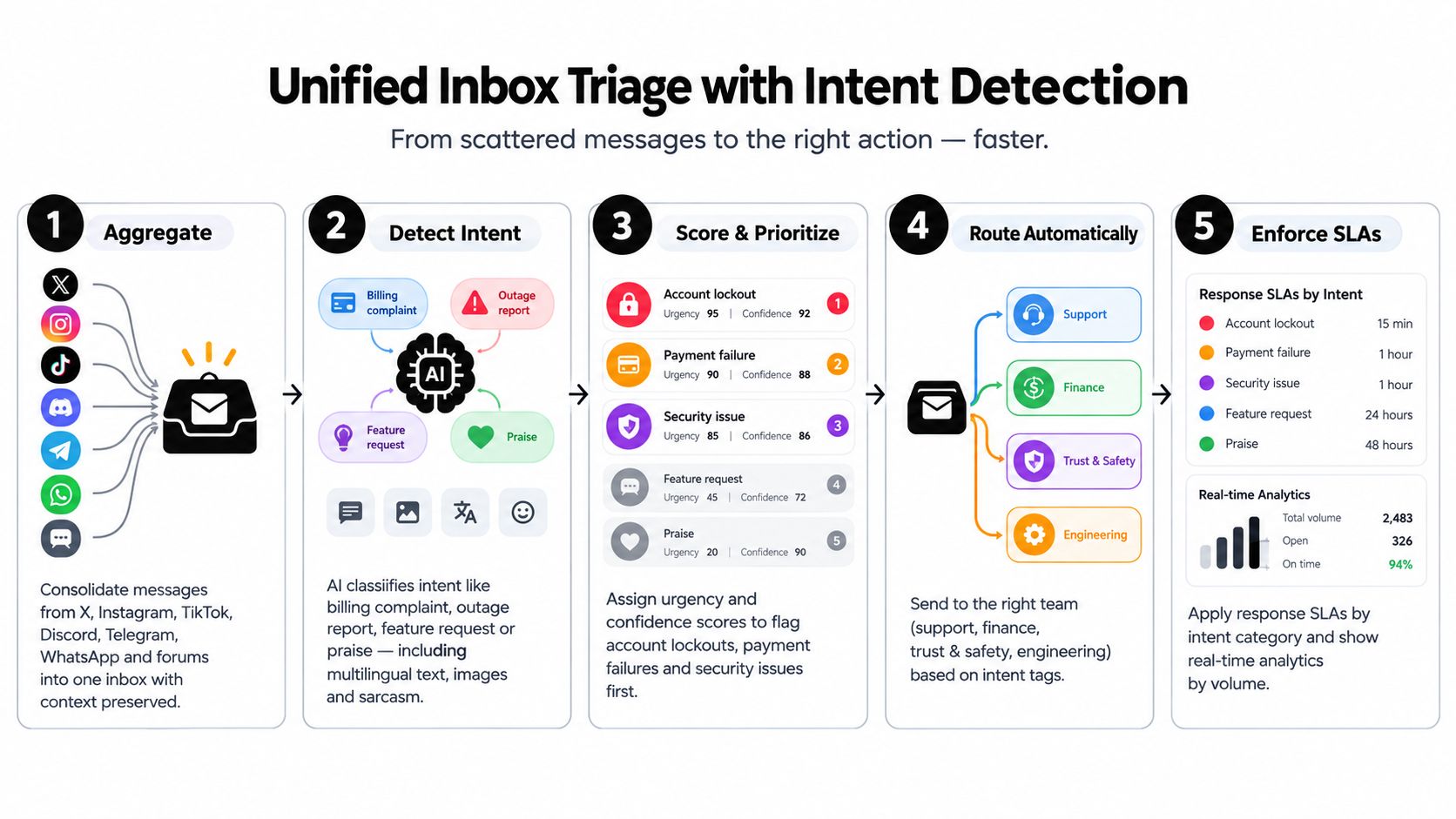
1. Unified Inbox Triage with Intent Detection
Social care breaks down when agents have to jump between X, Instagram, TikTok, Discord, Telegram, WhatsApp, and forums to reconstruct the same customer story. A unified inbox gives the team one working queue, while intent detection identifies what each message is asking for. “Why was I charged twice?” needs a different owner from “the app crashes after login,” even if both appear in the same reply thread.
Start with a small taxonomy. Billing complaint, outage report, account access, security concern, feature request, product question, and praise are usually more useful starting points than dozens of narrow labels. Tie SLAs to those intents, not merely to the platform. A high-risk account issue should outrank a low-urgency feature request whether it arrives through X or WhatsApp.
Lyft, for example, could route “ride not charged” to finance, “driver safety” to trust and safety, and “app crash” to engineering from one Twitter reply thread. Coinbase needs a similar separation during market volatility, distinguishing genuine support requests from general trading sentiment. In a Discord community, feature requests belong with product, while routine questions can receive an approved FAQ response.
Practical rule: Low-confidence classifications should go to human review. A wrong automatic route is often more expensive than a slower correct one.
Review routing accuracy weekly. Begin with the five to ten intents that account for most work, set confidence thresholds, inspect false positives, and use intent trends to surface product or communications problems before they become formal escalations.
2. Noise Filtering and Signal Preservation
A busy social feed contains spam, scam attempts, bot activity, duplicate complaints, affiliate links, and brand mentions that have nothing to do with customer care. If reviewers treat every item as a ticket, genuine support signals disappear under volume and agents spend their attention proving that noise isn't important.
Sift AI can filter obvious noise before it reaches the active queue, while preserving an audit trail for review. That distinction matters. A filtered message shouldn't vanish without explanation, especially when scammers imitate a company's support handle or customers repeat the same complaint across several channels.
Coinbase may see market speculation and affiliate links around its brand alongside legitimate account or transfer issues. Lyft can quarantine phishing links that impersonate support. A Discord team can suppress off-topic spam while keeping member questions visible. The appropriate threshold differs by channel. Public X mentions may tolerate aggressive filtering, but support DMs and WhatsApp conversations need a more conservative gate.
Track noise-filtered percentage as an operational measure, but don't treat a higher number as automatically better. It only represents efficiency when the team can demonstrate that meaningful customer signal remains available.
- Start with obvious noise: Filter clear bot spam, repeated promotional links, and irrelevant mentions before tightening rules.
- Keep an audit log: Let reviewers inspect filtered items and correct misclassifications.
- Measure reviewer fatigue: If agents spend less time dismissing junk, they can focus on unresolved customer needs.
- Review false positives: Recalibrate rules when genuine complaints repeatedly land outside the working queue.
3. Smart Routing and Escalation Workflows
Intent tells you what a customer needs. Routing makes someone accountable for resolving it. Without explicit ownership, a security concern may sit in a general support queue while a public complaint gains traction.
Map the destinations before writing automation rules. Typical queues include support tiers, finance, engineering, product, communications, trust and safety, and legal. Then create a small number of high-value rules. A message containing “account compromised” should reach trust and safety with a high-priority flag. A payment failure should go to finance or the designated billing team. A product defect should create a linked engineering issue without forcing the customer to repeat the story.
Escalation needs both severity and time. A case should rise when its SLA is close to breach, when a high-value customer remains unanswered, or when several people report the same issue. Public visibility and risk also matter. A Discord report about a fake moderator may require trust and safety and communications at the same time.
For example, Coinbase could route “I lost funds” to senior finance agents and flag regulatory language for communications. Lyft could escalate an account-hacked report to trust and safety. A community team could attach screenshots, prior replies, and account context to the escalation so the receiving team starts with evidence, not a blank ticket.
Test rules in a sandbox and measure first-touch routing accuracy. If agents regularly reassign work, the problem is usually unclear ownership, over-segmentation, or an intent taxonomy that doesn't match how teams operate.
4. Multi-Channel Sentiment and Urgency Scoring
A keyword such as “bad” tells you little without context. “Still waiting three days for a response” signals frustration and an SLA problem, while “yeah, great service 🙄” may be sarcastic even though the literal words appear positive. Social care teams need sentiment and urgency scores that incorporate tone, history, platform conventions, and the issue itself.
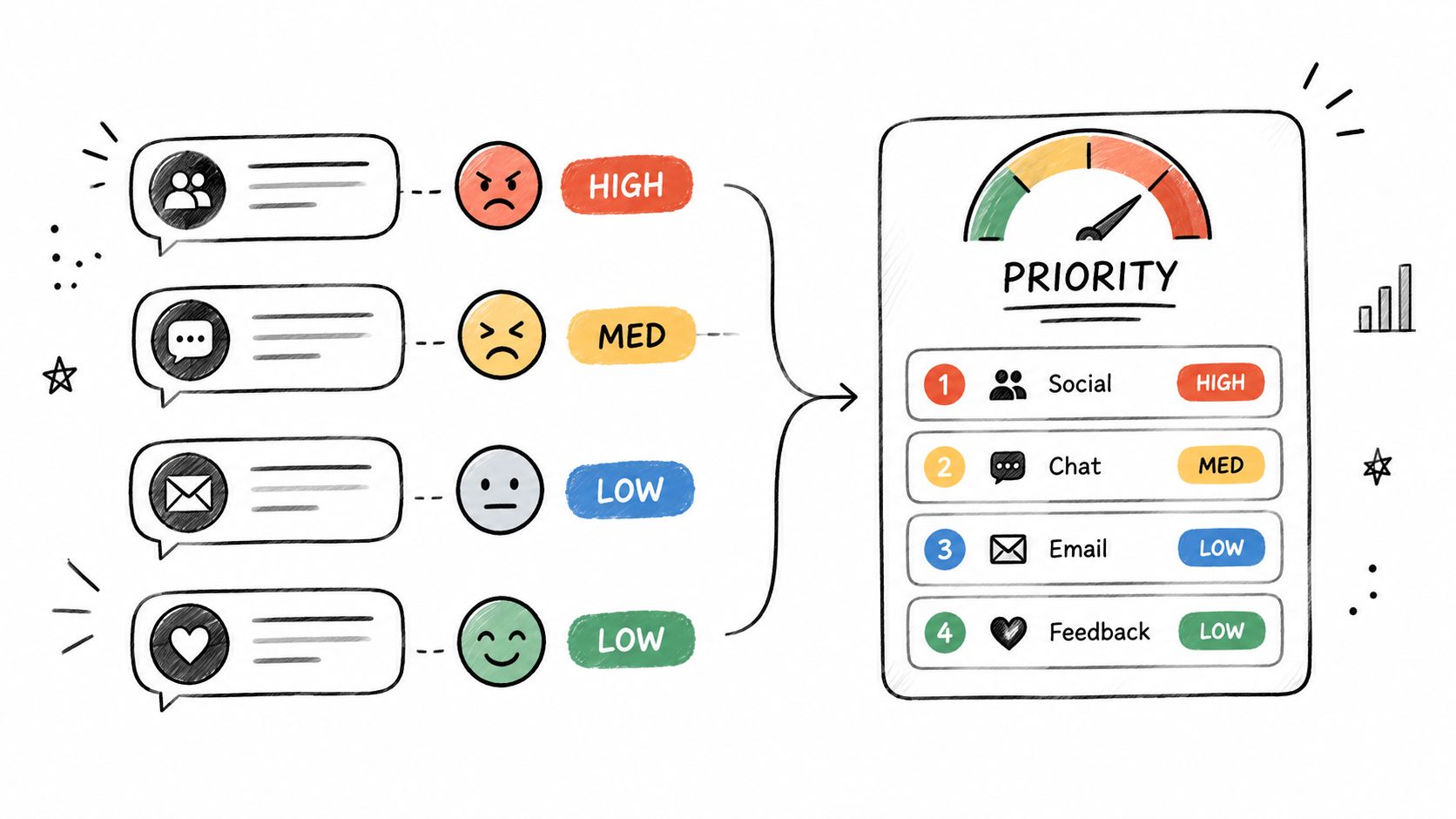
Use the score to prioritize review, not to make every decision automatically. A frustrated customer with an account lockout deserves different treatment from a frustrated customer requesting a roadmap update. High urgency combined with a security or payment intent should move quickly. Low urgency combined with a feature request can enter a product backlog.
Platform context changes interpretation. TikTok comments, Discord slang, and X replies often express dissatisfaction differently. A community manager may respond naturally to sarcasm in a casual forum, while a financial-services team should use a more controlled tone.
Sentiment is a routing signal, not a verdict on the customer.
Keep high-emotion conversations out of automatic closure unless another human-approved rule explicitly permits it. Review calibration regularly. If urgent scores produce too many false alarms, add issue type, account status, or conversation history rather than lowering sensitivity. Sentiment should help agents decide where to look first, not become a gate that dismisses customers whose language the system misunderstands.
5. AI-Drafted Responses with Brand Voice Compliance
AI drafting works best when the question is common, the answer is documented, and a human can verify the result quickly. It isn't a license to send generic replies to every angry mention. The agent remains responsible for the final message, especially when it includes financial language, legal terms, account details, or a promise the business may not be able to keep.
A Lyft agent handling “my ride didn't charge me” might receive a draft with troubleshooting steps and the relevant refund path. The agent checks the account context, edits the wording, and sends it. A Coinbase team can use a draft for an account question, but legal or compliance review may still be required before any regulated financial statement goes out. Circle's community responses may need a technical but informal voice for repeated questions about tokens, staking, or gas fees.
Build the draft system around approved knowledge, previous high-quality replies, and a version-controlled brand voice profile. Review accepted and edited drafts to identify where the system helps and where it produces bland or risky language. A strong draft should preserve context from the thread, acknowledge the actual issue, and give the customer a clear next action.
For teams working across channels, master brand voice consistency means more than repeating approved phrases. It means adapting tone without losing accuracy, boundaries, or accountability.
- Draft low-complexity replies first: Use tracking, billing guidance, and recurring FAQ requests.
- Require human approval: Don't auto-send sensitive or high-emotion responses.
- Track draft-assisted response time: Measure speed while preserving the agent's contribution.
- Inspect edits: Frequent rewrites indicate weak context, poor knowledge content, or an unsuitable tone profile.
6. Auto-Closure with Human-Controlled Rules
Auto-closure should remove repetitive work, not remove accountability. A safe rule combines intent, sentiment, urgency, message context, and expected follow-up. A neutral request for a tracking link may close after the approved answer. A security report, angry billing dispute, or unresolved outage complaint should remain open for human ownership.
The most useful rules are explicit. For example, an order-tracking intent with low urgency and neutral sentiment can receive a tracking link and close if there's no indication that the customer needs more help. The same intent from a customer reporting a missing delivery should route to a person instead.
Lyft could close a simple “where is my ride” question after returning current status. Coinbase could answer a dashboard-navigation question with a verified account link. A Discord community could close a repeated contract-address question after serving the pinned FAQ. None of these rules should apply blindly to VIP customers or cases involving money, identity, safety, or access.
Monitor reopen rate alongside auto-closure rate. A high closure rate with frequent reopenings means the system is optimizing queue size rather than resolution quality. Also separate closure rules by channel. A public reply may need a visible acknowledgement, while a WhatsApp conversation may require a more complete handoff.
Auto-close only what a reasonable reviewer would already consider resolved.
Introduce rules conservatively, preserve an audit trail, and give agents an easy way to override them. The objective is a cleaner queue and better attention allocation, not the largest possible automation percentage.
7. Multilingual and Multimodal Understanding
Social care teams don't receive clean, formal text. They receive slang, abbreviations, memes, screenshots, GIFs, voice messages, emoji, and videos. A screenshot of an error code may be more actionable than a paragraph describing a failed transaction. A meme with Portuguese text and a frustrated expression may carry urgency that literal translation misses.
Language detection should support routing, not become a reason to close a conversation. If Spanish, Portuguese, French, Tagalog, or another language represents meaningful volume, route messages to an agent who understands both the language and the local communication norms. A phrase that looks like a support request in translation may be praise, while regional slang can reverse the apparent sentiment.
Coinbase may need to distinguish positive Spanish feedback from a request for assistance. Lyft could route a TikTok comment containing Tagalog slang and a meme to a Filipino-speaking agent. In a multilingual Discord, “ça buggé grave” should be understood as a serious bug report and sent to engineering with its original context intact.
The human reviewer still checks cultural fit, translation quality, and the meaning of visual evidence. A draft that is grammatically correct but socially awkward can damage trust faster than a short delay.
8. Proactive Issue Detection and Community Pulse Monitoring
Customers often describe a product problem publicly before they open a support case. Repeated mentions of payment failures, login errors, or an unavailable feature can form an early warning pattern. The social care team's job is to turn that pattern into a named issue with an accountable owner.
A useful alert includes the evidence, affected channel, likely intent, sentiment direction, and recommended destination. Engineering needs the error language and examples. Communications needs the public narrative and risk level. Product needs a clean summary of feature requests, not a stream of ungrouped comments. Support needs an approved response while the investigation continues.
A cluster of “withdrawal failing” mentions on X may warrant a technical investigation and a communications draft before the queue becomes unmanageable. A Discord community repeatedly asking when a feature will arrive should enter a product digest, with a clear owner for the eventual roadmap response. The same signal can serve care, operations, community, and insights teams when they share context.
Avoid channel-blind thresholds. A small community may show a meaningful shift through a handful of repeated reports, while a large public platform may require a broader pattern. Human review should confirm that the alert represents a real issue rather than a campaign, joke, or unrelated event.
When engineering fixes a detected problem, close the loop. Record the fix, update the knowledge base or status guidance, notify agents, and track whether similar contacts decline afterward. Proactive detection only creates value when the alert changes an operating decision.
9. SLA Management and Breach Prevention
Response speed matters, but speed without durable resolution can produce a fast, frustrating loop. Common support benchmarks include a first response under one hour for email and under one minute for chat, with first-contact resolution commonly benchmarked at 70% to 79%, world-class teams reaching about 90%, and reopen rates below 10%, according to widely used customer support metric benchmarks. These are reference points, not universal promises. Your SLA should reflect customer impact, risk, staffing, and channel expectations.
Social channels need their own operating rules. About three-quarters of consumers expect a social response within 24 hours or sooner, while the common benchmark for social care is a first reply within about one hour, as summarized by social customer service statistics. Industry benchmarks place best-in-class social response around one hour and average brands closer to four to five hours, which makes escalation ownership more important than a generic “respond quickly” instruction, as described in response-time benchmark guidance.
Prioritize by time remaining, not just severity. A low-urgency VIP case approaching breach may need attention before a high-urgency item that has just entered its queue. Give supervisors a live view of unassigned work, aging conversations, paused SLAs, and queues likely to miss target.
- Set separate targets: Outages, account access, billing, and feature requests shouldn't share one SLA.
- Escalate before breach: The receiving team needs time to act, not merely a breach notification.
- Audit pauses: Repeated pauses can hide unresolved ownership.
- Pair speed with quality: Review resolution, reopen rate, and customer effort alongside response time.
10. Unified Analytics and Actionable Insights for Leadership
Leadership needs an operational view that connects inbound demand, routing quality, response time, resolution quality, SLA compliance, auto-closure, filtered noise, sentiment, channel performance, customer effort, and emerging issues to clear ownership. A care platform for SaaS startups can help connect those signals to decisions.
That view should answer practical questions: Which intent consumes human capacity? Which queue receives the most reassignments? Where do reopenings cluster? Which channel misses its SLA during an outage? Are product teams receiving feature requests in a usable form? Does a high auto-closure rate reflect successful self-service, or do customers return through another channel?
Social care metrics also inform growth decisions. Customer experience research cited by Forbes reports that companies with a customer experience mindset generate revenue 4% to 8% higher than the rest of their industries, while customer-centric companies are about 60% more profitable. The same source reports that 84% of companies improving customer experience report revenue increases, and 96% of customers say customer service is important to brand loyalty. These figures do not show that dashboards create growth. They support connecting care signals to retention, product quality, and operational investment.
Leadership reporting should end with an assigned action. If billing complaints rise, finance and product need a shared owner. If sentiment shifts during an outage, communications needs an approved message and timestamp. If agents spend their day correcting routes, operations needs to fix the taxonomy.
10-Point Customer Care Strategy Comparison
| Item | Implementation Complexity 🔄 | Resource Requirements ⚡ | Expected Outcomes & Impact ⭐📊 | Ideal Use Cases 💡 | Key Advantages ⭐ |
|---|---|---|---|---|---|
| Unified Inbox Triage with Intent Detection | 🔄 Medium–High, cross‑platform ingestion, model training (2–4 weeks) | ⚡ Data labeling, API integrations, ML ops, ongoing tuning | ⭐📊 Faster triage (≈60–80% time reduction); intent-based prioritization and SLA enforcement | 💡 Multi‑channel support teams, high volume social mentions, outage detection | ⭐ Consolidates channels, intent routing, real‑time analytics |
| Noise Filtering and Signal Preservation | 🔄 Medium, continuous rule/model updates, channel tuning | ⚡ Behavioral models, monitoring, quarantine workflows | ⭐📊 Reduced reviewer fatigue; higher signal‑to‑noise, noise‑filtered % KPI | 💡 Noisy channels (Twitter/X, TikTok), community moderation, phishing protection | ⭐ Removes spam/scams, preserves genuine cases, improves SLA accuracy |
| Smart Routing and Escalation Workflows | 🔄 Medium–High, rule builder + escalation logic, LTV integration | ⚡ CRM integrations, routing rules maintenance, cross‑team SLAs | ⭐📊 Fewer reassignments; ~20–30% handling time saved; faster escalations | 💡 Organizations with specialized teams (finance, trust & safety, engineering) | ⭐ Accurate first‑touch routing, audit trail, SLA‑aware escalation |
| Multi‑Channel Sentiment and Urgency Scoring | 🔄 High, platform‑specific tone models, sarcasm & context handling | ⚡ Advanced NLP models, labeling, continuous retraining | ⭐📊 Prioritizes angry/urgent messages; faster detection of outages and churn risk | 💡 Churn prevention, PR risk monitoring, CX prioritization | ⭐ Emotion‑aware routing, prevents inappropriate auto‑responses |
| AI‑Drafted Responses with Brand Voice Compliance | 🔄 Medium, KB & voice profile integration, human‑in‑loop workflow | ⚡ KB connectors, template/version control, legal/compliance checks | ⭐📊 Dramatically reduced response time (e.g., 30min → ~2–5min); consistent tone | 💡 High‑volume FAQs, junior agent enablement, channels needing brand control | ⭐ Scales replies, ensures brand/compliance, agent productivity boost |
| Auto‑Closure with Human‑Controlled Rules | 🔄 Low–Medium, rule builder with safety gates and audit logs | ⚡ Rule tuning, monitoring reopen rates, analytics dashboard | ⭐📊 High auto‑closure rates (50–70%) possible; fewer tickets requiring human review | 💡 Order tracking, simple FAQs, low‑complexity intents | ⭐ Reduces workload, cost savings, improves SLA calculations |
| Multilingual and Multimodal Understanding | 🔄 High, language/dialect models + image/video/voice analysis | ⚡ Multilingual models, OCR/vision, higher compute and regional data | ⭐📊 Better global coverage; accurate routing and native‑language replies; fewer escalations | 💡 Global user bases, media‑rich channels (images/GIFs/voice) | ⭐ Native‑language responses, captures multimodal intent, improves satisfaction |
| Proactive Issue Detection & Community Pulse Monitoring | 🔄 Medium, trend detection, clustering, alerting rules | ⚡ Real‑time analytics, alert routing, integration with ops workflows | ⭐📊 Faster MTTR, early PR/bug detection, informed product feedback | 💡 Outage detection, product telemetry complement, community trend spotting | ⭐ Early warning system, reduces ticket volume, informs roadmap decisions |
| SLA Management and Breach Prevention | 🔄 Medium, SLA definitions, countdowns, breach prediction | ⚡ Real‑time queue priority, analytics, staffing data integrations | ⭐📊 Reduces SLA breaches (≈40–60%); staffing optimization and exec reporting | 💡 SLA‑driven support orgs, VIP customer handling, regulated industries | ⭐ Enforces prioritization, breach prevention, actionable visibility for leaders |
| Unified Analytics & Actionable Insights for Leadership | 🔄 Low–Medium, data aggregation and dashboarding | ⚡ Data pipelines, BI tools, access/permission controls | ⭐📊 Single source of truth for KPIs (response time, auto‑close %, sentiment, SLA) | 💡 Executive reporting, resource planning, product/ops decision‑making | ⭐ Consolidated metrics, drill‑down analytics, drives data‑led decisions |
Turn Social Care Metrics Into Better Decisions
The strongest customer care strategies form a closed measurement loop. First, filter noise without hiding meaningful signal. Then classify intent, urgency, language, and context. Route each conversation to an accountable owner, give that owner the right history, and keep a human in control of sensitive decisions. After resolution, measure whether the customer stayed resolved, whether the issue reopened, and whether the same pattern is appearing elsewhere.
That operating model reflects how customer care has changed. The telephone, electronic mail, toll-free numbers, and organized call centers expanded access and routing over time. Modern teams now optimize more than answer volume. Common CX metrics tracked by business leaders include CSAT at 31%, retention at 31%, and response time at 29%, according to this history of customer service operations. Social care adds its own operational signals, including routing accuracy, SLA compliance, noise-filtered percentage, auto-closure rate, reopen rate, reviewer fatigue, and proactive saves.
AI adoption makes execution discipline more important, not less. 82% of senior leaders said their teams invested in AI for customer service in the last 12 months, and 87% planned to invest in 2026, while only 10% reported mature deployment at scale, according to Intercom's customer transformation research. The gap is operational. Teams need governance, clear owners, review thresholds, reliable data, and change management across support, product, engineering, communications, finance, and trust and safety.
The human role also needs careful definition. A 2025 consumer-expectations study found that 48% of respondents strongly prefer a human agent, compared with 5% who strongly prefer AI, while another 2025 CX report found that 56% of consumers care most about receiving information quickly, according to Verint's AI-powered CX study. Those findings point to a practical division of labor. AI can remove noise, identify patterns, summarize context, draft routine replies, and recommend routes. People should approve sensitive messages, investigate ambiguous intent, handle emotion, make exceptions, and own risk.
Roll out the operating model in stages. Instrument the current workflow before changing it. Launch the unified inbox, intent categories, and basic routing. Add human-reviewed drafts for repetitive, well-documented queries. Test conservative auto-closure with clear exclusions. Then introduce proactive alerts tied to engineering, product, communications, and support playbooks. Each stage should have a rollback path and a named owner.
The leadership question is direct: which queue, escalation path, or metric is currently obscuring the customer issue that needs action? Answer that first, then configure automation around the decision. Sift AI can serve as one option for unifying social and community signals, routing conversations, supporting human-reviewed responses, and giving operations leaders visibility into the work that matters.
Sift AI unifies social and community channels into a command center that filters noise, detects intent and urgency, routes issues to teams such as finance, engineering, and comms, and drafts responses for human approval. Visit Sift AI to connect your social care workflow with clearer triage, controlled automation, and actionable operational insight.