Customer Feedback Loops That Actually Close the Loop
"Learn how to build customer feedback loops that capture signal, route it fast, and prove action across social and community support channels."
A billing complaint lands as an Instagram comment during a busy afternoon. An agent replies publicly, asks the customer to send a direct message, and moves on. The DM arrives, but it sits outside the support queue. Finance never sees the refund dispute. Two days later, the same customer posts on X, now with screenshots and a sharper accusation.
The team thinks it has answered the customer twice. The customer knows nobody has taken ownership. That gap is where customer feedback loops break, especially when comments, DMs, mentions, community threads, and support cases live in separate logins.
This isn't a survey problem, and it isn't mainly a tone problem. It's an orchestration problem. A working loop must move a signal from the right channel to a named owner, produce a visible response, and carry the underlying pattern into product, policy, operations, or communications.
Table of Contents
- The Moment a Customer Feedback Loop Breaks
- What a Customer Feedback Loop Actually Is
- The Four Stages of a Working Loop
- Metrics That Prove the Loop Is Working
- Routing Feedback to the Right Team by Channel
- Where AI Fits Without Replacing Humans
- Operationalizing the Loop at Enterprise Scale
- Closing the Loop Is a Credibility Problem
The Moment a Customer Feedback Loop Breaks
The public Instagram reply looked handled because someone responded quickly. But a public acknowledgment isn't the same as a resolved case. The customer still needed a refund decision, finance needed the transaction details, and the support team needed a case record that connected the comment to the DM.
Without that connection, each team sees only a fragment. The social agent sees an unhappy reply. The support agent may see an unassigned message. Finance sees nothing. When the customer returns on X, the new post appears to be a separate incident even though it's the same unresolved issue.
Fragmentation creates false closure
Enterprise care teams encounter this pattern across every channel. A product bug appears in an X mention, then receives a fuller explanation in a Discord thread. A scam report arrives through WhatsApp while trust and safety is monitoring a forum. A feature request sits in Instagram DMs because it doesn't match a support macro.
A reply can satisfy a response-time dashboard while failing the customer. Fast acknowledgment without ownership is open-loop work dressed up as service.
Operational rule: If an issue has no owner, urgency level, response obligation, and closure state, it hasn't entered a reliable feedback loop.
The economic case for closing the loop is also stronger than the case for collecting opinions. A 2025 industry synthesis reports that 85% of companies prioritizing customer feedback reported revenue growth, while only 7% actively seek feedback, and that only 48% follow up with dissatisfied customers. The same source says a 5% increase in customer retention can boost profits by over 25%, reinforcing why follow-up belongs in operating design, not just customer-service etiquette. Read the industry synthesis on customer feedback loops.
The practical question isn't whether your team collects feedback. It's whether every meaningful signal can travel from capture to action and back to the customer without depending on one agent remembering what happened.
What a Customer Feedback Loop Actually Is
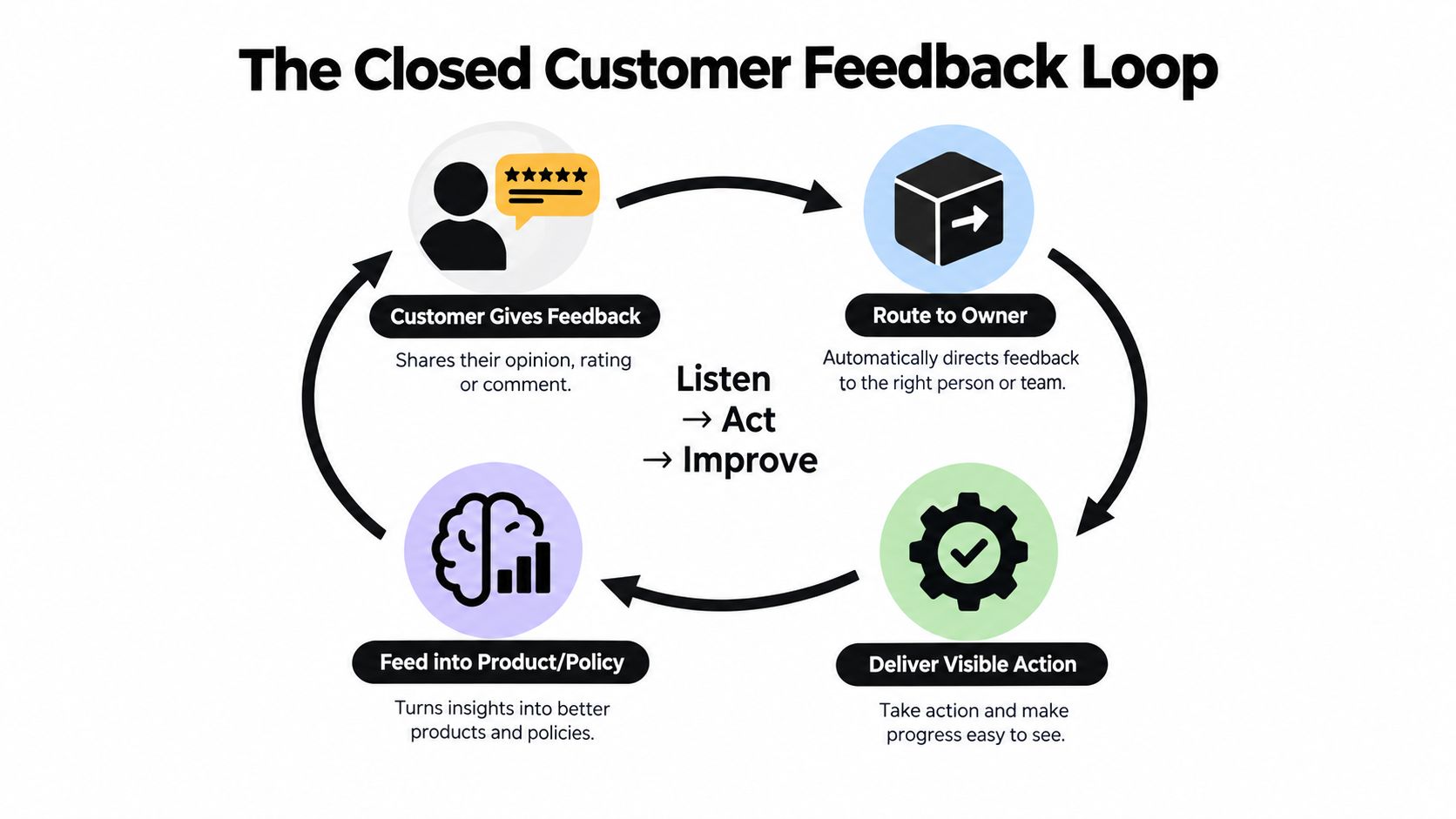
A customer feedback loop is a closed operating cycle that captures a customer signal, routes it to the right owner, delivers a visible action, and feeds the underlying pattern into the work that prevents recurrence.
For social care, the cleanest model has four stages:
- Capture the signal from every relevant channel.
- Triage it by intent, urgency, context, and ownership.
- Close the individual case with a response and confirmed outcome.
- Learn from repeated themes and convert them into system-level action.
These stages belong on one timeline. A customer shouldn't have to repeat the issue because the organization treated capture, analysis, response, and improvement as unrelated projects. Traditional external surveys often produce response rates of 5% to 15%, with email-only surveys often below 10%, while in-product microsurveys typically range from 10% to 30% and post-interaction prompts from 10% to 25%, according to a 2026 benchmark report. See the benchmark report on feedback collection and response timing.
The inner loop protects the relationship
The inner loop is one-to-one recovery. An agent or specialist responds to the individual customer, gathers missing context, resolves the issue or explains the decision, and records the outcome inside the applicable SLA. A billing dispute may require finance. A compromised account may require trust and safety. A bug may need engineering input before care can provide a credible update.
The inner loop is time-sensitive because the customer's confidence is still moving. Guidance for closed-loop programs recommends contacting detractors within 24 to 48 hours, particularly when retention recovery is at stake. Review the inner-loop and outer-loop retention framework.
The outer loop fixes the system
The outer loop is one-to-many improvement. It aggregates recurring signals, identifies a root cause, assigns a cross-functional owner, and turns the theme into a product fix, policy adjustment, engineering ticket, trust-and-safety control, or communications update.
Use the map to diagnose your own process. If agents reply but customers repeat themselves, the inner loop is weak. If agents resolve individual cases but the same issue keeps returning, the outer loop is weak. If a product team ships a fix but nobody tells the affected customers, both loops remain incomplete.
The Four Stages of a Working Loop
Capture gives every signal somewhere to land
Capture shouldn't mean copying screenshots into a spreadsheet. Pull X mentions, Instagram comments and DMs, WhatsApp Business chats, Discord threads, branded forums, app reviews, and the help inbox into a unified queue. Preserve the original text, channel, timestamp, customer identity, attachments, language, and conversation history.
Channel context changes the operational meaning of a message. A refund request in a private WhatsApp conversation is a finance case. The same request on X is also a public brand-risk event. A feature request in Discord may contain technical detail that a short Instagram comment doesn't.
A unified inbox prevents feedback from living only in a moderator's personal login. It also gives supervisors a complete view when a customer moves from a public comment to a private conversation.
Triage separates signal from repetition
Triage turns raw messages into work. Tag intent such as billing, bug, account, shipping, feature request, outage, or trust and safety. Add urgency based on the customer's language, the potential impact, the visibility of the channel, and whether similar messages are arriving in a surge.
Deduplication matters. During an outage, one customer may post in X replies, a Discord channel, and a forum thread. Those messages shouldn't create three disconnected investigations. Link them to a common incident while preserving each channel's context and response obligation.
Close means confirming the outcome
A reply isn't closure. The agent must answer inside the channel-specific SLA, connect the case to the customer record, and confirm whether the customer can proceed. If finance approves a refund, the response should communicate the actual next step. If engineering owns a bug, care should explain what can be confirmed without promising an unsupported date.
Learn turns themes into accountable work
The learning stage needs a backlog with a named owner per insight. Product owns feature themes. Engineering owns recurring defects. Trust and safety owns scam patterns. Policy owns workflow failures. Comms owns public explanations and one-to-many updates.
A weekly review should ask what repeated, what escalated, what was misrouted, and which customers need an update. The point isn't to produce another sentiment report. It's to show what changed because customers spoke.
Metrics That Prove the Loop Is Working
A response-time dashboard can look healthy while the feedback loop remains broken. Measure each stage against the failure it should expose, then read the metrics together rather than celebrating one isolated number.
Noise-filtered volume is the first sanity check. If the queue grows because spam, repeated outage posts, and low-intent mentions aren't separated, agents spend their attention on volume instead of customer risk. Intent-classification accuracy then tests whether triage is sending billing to finance, bugs to engineering, and safety concerns to the right escalation path.
Auto-closure rate needs careful interpretation. A high rate can mean approved macros are resolving routine order-status questions. It can also mean the system is closing cases before a human verifies an ambiguous issue. Review samples, especially cases with negative sentiment, language ambiguity, sarcasm, or image-based context.
Read speed beside outcome
Track first response and full resolution by channel. X, WhatsApp, Discord, and forums have different expectations and different conversation shapes, so one blended SLA hides operational weaknesses. Independent CX reporting associates closing the loop within 48 hours with about 12% higher retention, and reports that consistent loop closure can produce roughly a 6-point NPS improvement. Review the reported relationship between response time, retention, and NPS.
Use detractor recovery rate to test whether follow-up changes the relationship. Pair it with rolling NPS or CSAT movement to see whether outer-loop improvements affect customer perception over time.
| Metric | Loop stage | Failure mode it catches |
|---|---|---|
| Noise-filtered volume | Capture | The queue is drowning in spam, duplicates, or low-intent mentions |
| Intent-classification accuracy | Triage | Messages reach the wrong team or require repeated manual reassignment |
| Auto-closure rate | Close | Automation may be deflecting well, or closing cases prematurely |
| First-response SLA by channel | Close | Agents acknowledge customers too slowly |
| Full-resolution SLA by channel | Close | Replies happen, but ownership or resolution stalls afterward |
| Detractor recovery rate | Close | Follow-up doesn't restore confidence after a poor experience |
| NPS or CSAT movement | Learn | System-level changes aren't improving perceived experience |
Use this decision rule: if SLA hit rate is high but detractor recovery is flat, the team is closing conversations without closing problems.
Routing Feedback to the Right Team by Channel
Ownership should be decided before the message arrives. A routing matrix makes that decision visible, enforceable, and reviewable. It should combine issue type with channel risk, because the team that resolves an issue isn't always the team that should control the first public response.
| Channel | Issue type | Owning team | SLA tier |
|---|---|---|---|
| Instagram DM or WhatsApp | Billing or refund dispute | Finance operations | Four-hour finance-specific SLA |
| X mention or Discord thread | Product bug | Engineering | Severity-tagged tier |
| Any channel | Trust, safety, scam, or reputation risk | Trust and safety | Escalation before public reply |
| X, Instagram, or community channel | Press-sensitive or executive-visibility complaint | Communications | One-hour acknowledgment window |
The four-hour finance SLA and one-hour communications acknowledgment are operating choices for this routing model, not universal benchmarks. Teams should adjust them to contractual obligations, staffing, risk, and channel expectations.
Channel changes the risk profile
A billing complaint on X still belongs to finance for resolution, but comms may need to approve the public acknowledgment. A feature request in Discord belongs to product or engineering, yet community management should preserve the conversation and explain what happens next. A scam report in a forum belongs to trust and safety, even if the forum moderator receives it first.
A practical social-feedback framework recommends routing billing and urgent WhatsApp messages to finance or billing support, Discord feature requests to product or engineering, high-visibility X mentions tagged as PR risk to comms, and scam reports in forums to trust and safety. Review the channel-based routing examples.
Make the matrix executable
Create rules in the unified inbox using intent tags, channel tags, customer tier, visibility, and urgency. Add an owner tag, an SLA tier, and an escalation state. Preserve the source conversation when the case moves into CRM, a finance queue, Jira, or a trust-and-safety case system.
Teams building broader customer service governance from Doczen can use the same principle: automation should enforce accountability, not hide it. Every reassignment should leave an audit trail, and every closure should record the outcome that justified it.
Where AI Fits Without Replacing Humans
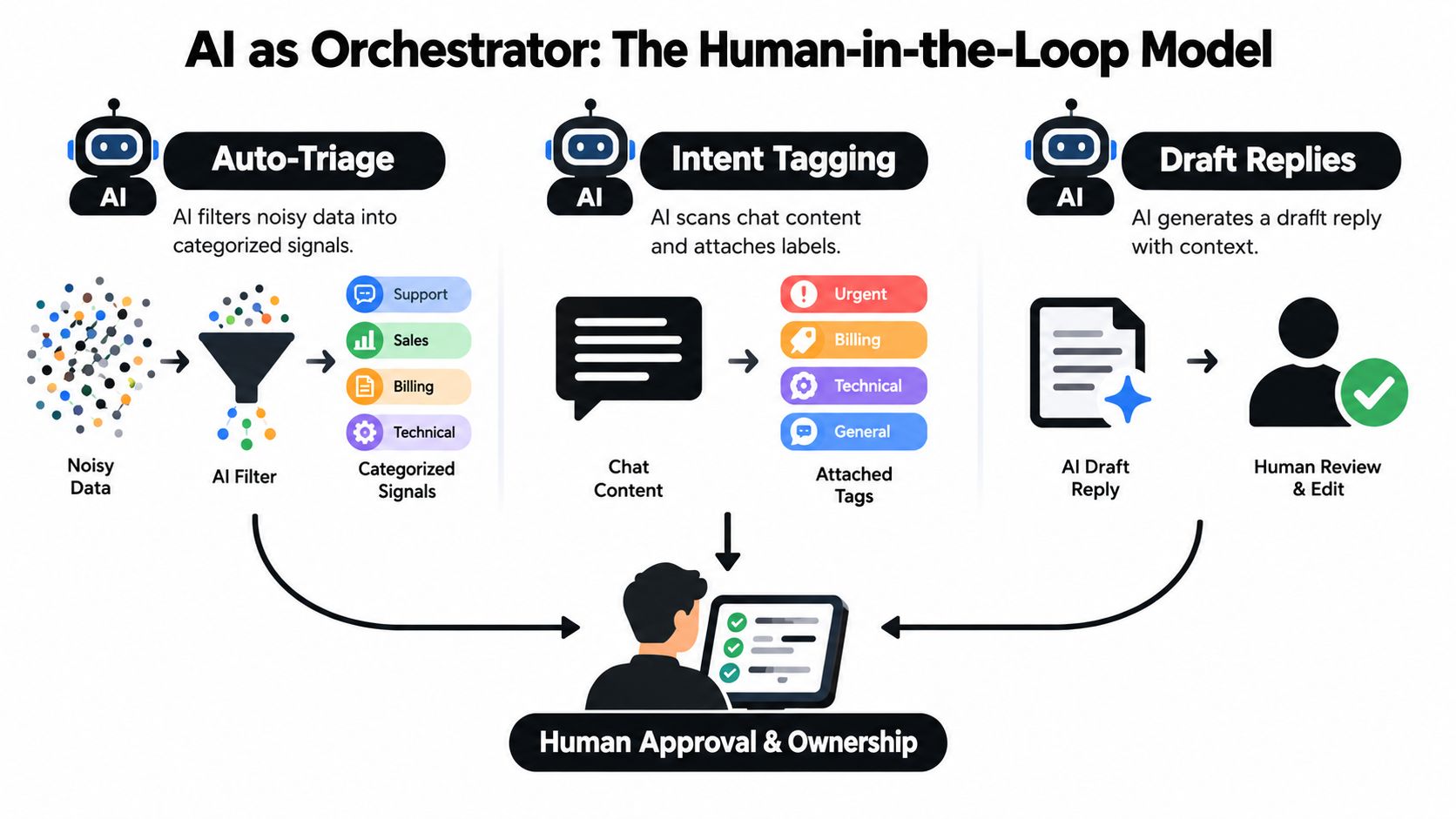
AI belongs between capture and human judgment. It can filter noise, classify intent, score urgency, draft a response, and route the case. It shouldn't decide alone whether a refund is valid, whether a public accusation creates legal exposure, or whether a safety signal can be dismissed.
Auto-triage reduces manual sorting
Suppose a customer sends an urgent refund demand through WhatsApp. An AI layer can identify billing intent, detect urgency, attach the conversation to the customer record, route it to finance, and prepare a brand-voice draft. A finance agent still verifies the transaction and approves the response.
The same pattern works during an outage surge. AI can group repeated reports, recognize multilingual slang and screenshots, link related conversations to the incident, and surface the messages that require individual attention. Humans then decide what the company can confirm publicly.
Auto-response needs a confidence boundary
Routine questions such as order status or KYC steps can use approved macros when intent is clear and the answer is current. If the customer adds a disputed charge, account-security concern, sarcasm, or an unusual exception, the system should stop drafting for automatic delivery and send the case to a human.
Sift AI is one example of an orchestration layer that brings social and community conversations into a unified inbox, applies AI tagging and routing, drafts replies, and keeps humans involved in approval and ownership.
Escalation should pause outbound action
Regulatory language, legal threats, self-harm references, credible safety concerns, and high-risk reputation claims require a human decision. The system should flag the message, preserve context, identify the owner, and pause outbound replies until the responsible team signs off.
The trade-off is simple: AI without an owner is faster noise. Human-only triage preserves judgment but doesn't scale across fragmented channels.
Set confidence thresholds for auto-tagging and auto-response. Require human approval for sensitive outbound messages. Review misroutes weekly, including false closures, incorrect language interpretation, duplicate cases, and replies that reached the wrong team.
Operationalizing the Loop at Enterprise Scale
Enterprise feedback operations need a structure leadership can approve, audit, and improve. A vendor feature list isn't enough. The organization needs clear ownership for the queue, the decision, the escalation, and the resulting change.
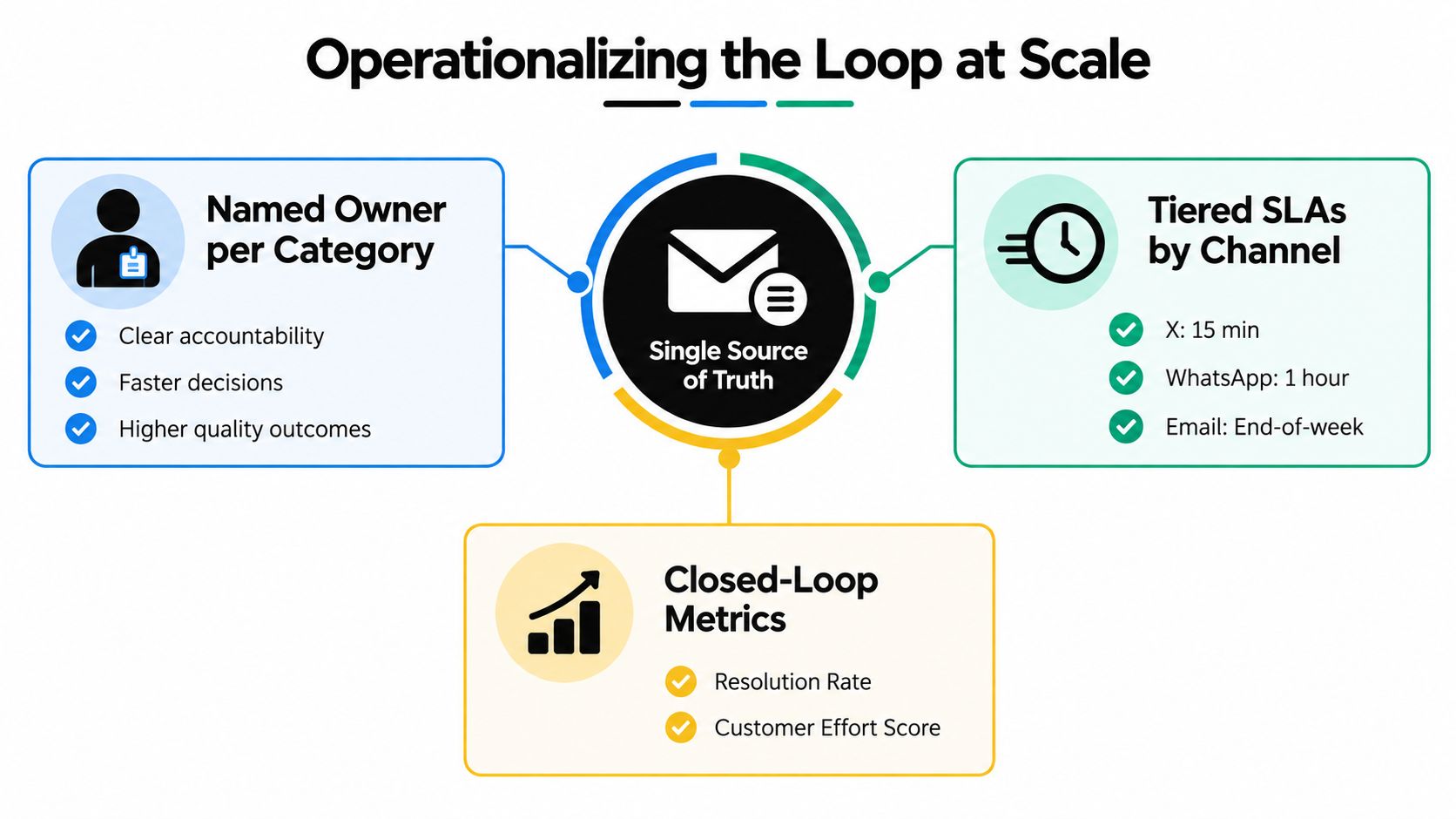
Start with the unified inbox as the single source of truth. Every channel record should retain source context, customer history, tags, routing events, approvals, response drafts, and closure notes. If an agent must search personal logins or reconstruct a thread from screenshots, the system has already lost operational integrity.
Assign ownership to artifacts
Care operations should own response-time definitions, queue health, and SLA reporting. Trust and safety should own escalation policy and restricted-response rules. Product should own the conversion of recurring themes into roadmap decisions. Engineering should own bug severity and technical resolution. Comms should own press-sensitive responses and public explanations.
Use tiered SLAs by channel and risk. A team may choose 15 minutes on X, one hour on WhatsApp, and end-of-week review for forums as internal targets, but those values must reflect actual staffing and customer commitments. A 2026 enterprise social-care guide recommends aiming to respond to social messages within one hour during business hours because speed affects satisfaction and brand perception. Review the social customer-engagement guidance.
Build controls around the workflow
Role-based permissions should separate agents who draft or classify from approvers who authorize sensitive replies. Immutable audit trails should show who changed a tag, reassigned a case, approved a response, or closed an escalation. Those records matter for compliance, coaching, and post-incident review.
Executive rollups should show themes, unresolved risk, owner aging, SLA performance, detractor recovery, and the product or policy decisions linked to customer evidence. Don't send executives a sentiment cloud without the associated action owner.
A benchmark article reports that only 37% of companies meet customer response-time expectations across channels, while 76% of customers expect a social response within 24 hours and the average brand takes four to five hours to respond on social media. Review the cross-channel social-service benchmark. The operational answer isn't merely hiring more agents. It's making sure the right signal reaches the right person before urgency becomes escalation.
Closing the Loop Is a Credibility Problem
Customers lose trust when a DM disappears after acknowledgment, neutral feedback receives no follow-up, or a product fix ships without anyone telling the people who reported the issue. Those failures make the company look attentive in public and absent in practice.
Ship these fixes this week:
- Assign one person to publish weekly fix posts covering what changed because of customer input.
- Set a 24-hour follow-up rule for neutral sentiment so passive dissatisfaction doesn't disappear behind louder complaints.
- Audit last week's lost DMs and name the routing owner for every unresolved thread.
Feedback operations earn credibility when customers can see the handoff, the decision, and the outcome. If a customer says they were heard, the next touchpoint should prove it.
Sift AI brings X, Instagram, TikTok, Discord, WhatsApp, Telegram, and forums into a unified command center, then uses AI to filter noise, tag intent, route issues, and draft responses while humans approve and own the hard calls. Visit Sift AI to see how your team can connect social feedback to accountable resolution and visible customer outcomes.