Social Media Crisis Management Playbook for Teams
"Master social media crisis management with detection, triage, escalation and response playbooks built for enterprise social ops teams."
The first sign is usually not a press inquiry. It's a billing complaint buried in replies on X, followed by outage reports in Instagram DMs, scam screenshots on TikTok, and a Discord thread where customers have already connected the dots. By the time the social media manager spots the pattern, support is answering from one inbox, comms is drafting another statement, engineering is watching dashboards, and trust and safety is handling a wave of suspicious accounts.
That fragmentation creates the crisis. A negative post may be manageable. A negative post that reaches the wrong owner, waits for approval, and receives a generic reply can become a public demonstration that the company doesn't understand what's happening.

Table of Contents
- Introduction Why Social Crises Escalate So Fast
- Detecting Early Warning Signals Before They Explode
- Triage and Escalation That Actually Works Under Pressure
- Responding With Speed Tone and Cross Functional Coordination
- Post Crisis Review Metrics and Tooling That Prevents the Next One
- Putting Your Social Media Crisis Playbook Into Practice
Introduction Why Social Crises Escalate So Fast
A social media crisis is more than an angry comment or an isolated service failure. It's a fast-moving issue that threatens customer trust, operational continuity, safety, legal standing, or brand reputation across public and private channels. The trigger might be a payment failure, a product defect, an insensitive post, a data concern, a viral executive controversy, or a fabricated screenshot that looks authentic enough to spread.
Social is no longer just the place where a company publishes a polished statement after the response has happened elsewhere. In a Q2 2026 survey of 2,250 social media users across the US, UK, and Australia, 50% said they most likely hear about a brand crisis first on social media, 64% said it's important for brands to post on social when a crisis occurs, and 84% said response speed changes how they perceive the brand, according to Sprout Social's State of Social Media research. The audience is already watching the channel where the issue formed, and it expects the brand to meet the moment there.
The operational failure behind the visible backlash
Manual triage breaks down because the same incident produces different signals in different places. A customer might report a failed charge in a reply, attach a screenshot in a WhatsApp message, use slang in a TikTok comment, and ask for a refund in a forum. Each message looks separate until someone connects them.
A unified inbox gives the team one operational view across X, Instagram, TikTok, Discord, Telegram, WhatsApp, and forums. AI can filter routine noise, tag intent, identify likely urgency, and draft a reply. It shouldn't decide whether the company admits fault, pauses a campaign, issues compensation, or makes a safety disclosure. Those decisions belong to accountable people.
Operational rule: Automation should shorten the path to a decision, not remove decision ownership.
The workflow is straightforward under pressure, even if the situation isn't. Detect the early signal, assess severity, acknowledge the issue, route work to the right owner, publish verified updates, and review what failed afterward. Crisis communication is one part of that system. Social care, product operations, community management, trust and safety, legal, and executive communications all need to work from the same incident picture.
The teams that handle these moments well don't try to answer every message manually. They create enough structure for AI to absorb repetitive volume while humans focus on risk, judgment, empathy, and accountability.
Detecting Early Warning Signals Before They Explode
Detection starts before the word “crisis” appears in an internal channel. Your monitoring setup should identify changes in conversation shape, not just mentions of the company name.
Academic reviews describe an effective sequence that begins with early monitoring, moves through severity assessment and preparation, and reaches a fast, dialogic response rather than a one-way broadcast. That operating pattern is documented in research on social media crisis communication workflows. The practical implication is clear: detection needs to feed an owner and an action, or it's only a dashboard.
Build triggers around conversation changes
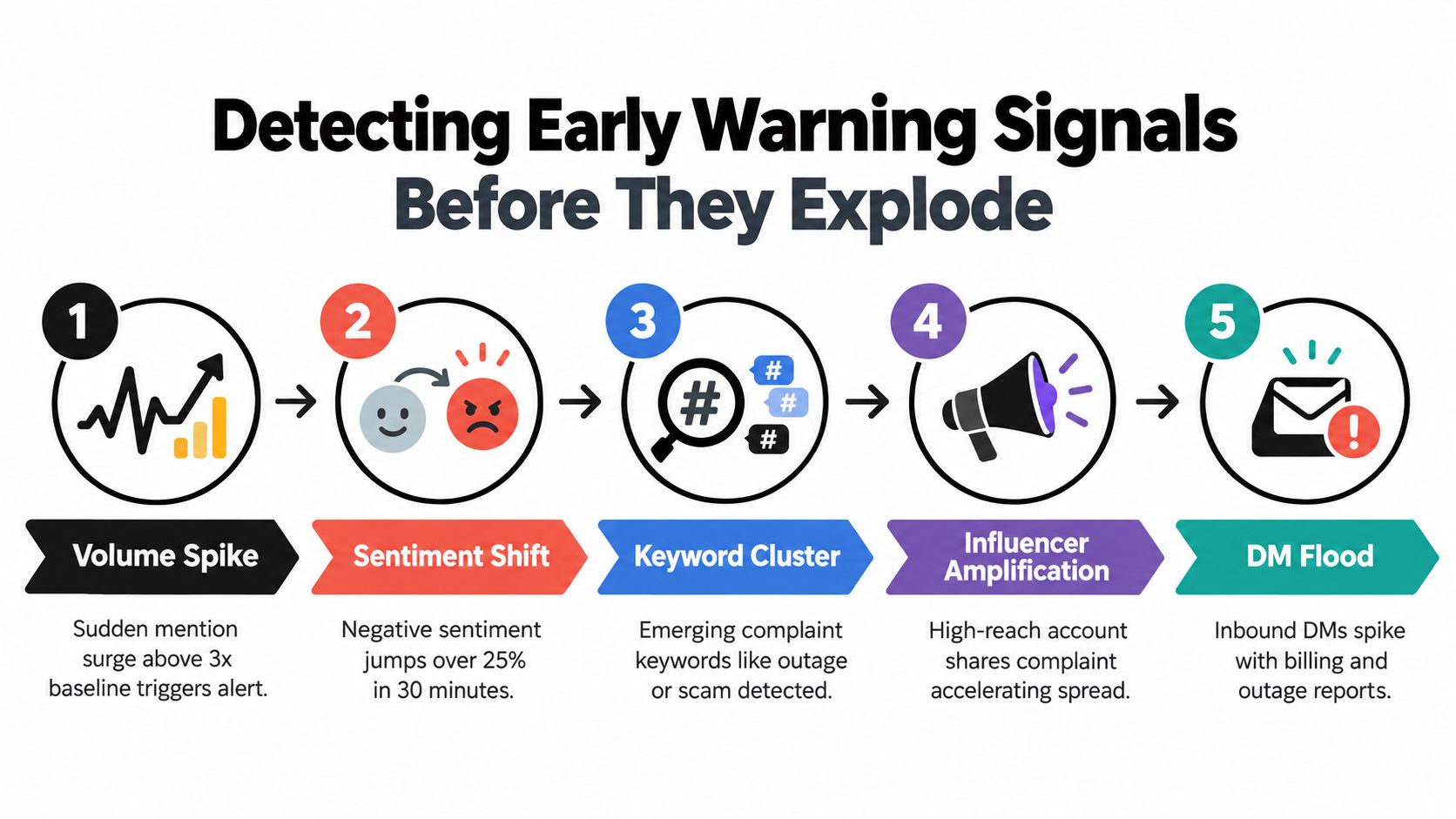
Start with a baseline for normal activity by channel, product, language, and customer segment. Then watch for combinations of signals:
- Volume movement: A sudden rise in replies, mentions, DMs, or community posts matters more when it appears across several platforms.
- Sentiment movement: A shift from ordinary product questions to anger, fear, or accusations can indicate a developing incident.
- Keyword clusters: “Outage,” “charged twice,” “scam,” “locked out,” or “unsafe” should be tagged by intent and connected to the relevant product or process.
- Influencer amplification: A complaint from a high-reach account can change the priority even before overall volume becomes large.
- Visual evidence: Screenshots, memes, videos, and logo references may reveal a shared incident that text-only monitoring misses.
- Private-channel pressure: A spike in DMs often contains the clearest operational evidence, especially for billing, access, delivery, and account issues.
Don't build alerts around a single keyword. Customers may describe the same failure with local slang, misspellings, sarcasm, or another language. Multilingual and multimodal classification helps teams see meaning rather than matching exact terms.
Cross-platform duplication is another useful signal. If the same screenshot or phrase appears on X, Instagram, TikTok, Discord, Telegram, and a forum, treat it as one developing event with multiple surfaces. A unified inbox should preserve the original post, replies, customer history, channel, language, and any attached media so the reviewer doesn't have to reconstruct context manually.
Separate signal from noise
A trending topic isn't automatically a brand crisis. Ask whether the conversation involves a real customer impact, a credible safety or legal concern, coordinated abuse, a service disruption, or a claim that could materially change public behavior. AI can group repeated posts, remove obvious spam, tag intent, and surface representative examples. It can also flag uncertainty for a reviewer when a screenshot or video needs verification.
If your team needs to compare listening approaches for X, a practical resource on Xholic AI Twitter listening tools can help frame the monitoring requirements around mentions, keywords, and emerging conversation patterns. The tool choice matters less than the operating connection between alert, context, owner, and SLA.
An alert should create a work item, not another notification. Assign it to social ops for assessment, attach the relevant messages, identify the likely owner, and start an incident timeline. That's how early detection becomes crisis readiness instead of reviewer fatigue.
Triage and Escalation That Actually Works Under Pressure
Triage is where a signal becomes an operational decision. The question isn't “How negative is this post?” It's “What could happen if we treat this as routine?”
Use severity levels that combine impact, reach, urgency, credibility, and reversibility. A billing complaint with no spread may belong to support. A cluster of duplicate charges across channels belongs with finance and support. A product outage with a growing public conversation requires engineering, customer care, and comms. A credible safety allegation, executive misconduct claim, or suspected fraud wave may require legal, trust and safety, and leadership involvement.
| Severity Level | Trigger Example | Primary Owner | Target Response Time |
|---|---|---|---|
| Level 1, contained issue | Isolated billing complaint, delivery problem, or feature request | Social care or customer support | Within the applicable social care SLA |
| Level 2, emerging incident | Repeated outage reports, multiple customers reporting the same payment failure, or a growing scam pattern | Support lead with finance, engineering, product, or trust and safety | Immediate internal routing and a timely public acknowledgment |
| Level 3, active crisis | Cross-platform spread, high-reach amplification, credible safety or legal risk, or a rapidly escalating PR issue | Crisis lead with comms, legal, support, product, and executive stakeholders | Activate the war room and publish an approved holding response quickly |
The response-time expectation is unforgiving. One survey summary reports that 53% of customers expect a reply on X within one hour, rising to 72% when the post is a complaint, while 76% expect a response within 24 hours across social platforms, as reported by Kayako's social customer service statistics. Those figures shouldn't become a promise to reply instantly to every message. They should force clarity about which messages need a human response, which can be resolved automatically, and which require escalation.
Route by intent, not by channel
A common mistake is assigning all Instagram issues to the Instagram team or all X issues to social media. The channel is where the message arrived. Intent determines who owns the next action.
- Billing and refunds: Route to finance or customer support, with account context protected in private follow-up.
- Outage and degraded performance: Route to engineering or product, while support receives approved status language.
- Scam, impersonation, or coordinated abuse: Route to trust and safety, with evidence preserved.
- Reputation, executive conduct, or media attention: Route to comms and legal, with one designated spokesperson.
- Feature requests buried in DMs: Tag and route to product insights rather than treating them as ordinary support contacts.
- Privacy or regulatory risk: Escalate to legal and the designated privacy owner before publishing specifics.
AI should recommend tags, group duplicates, identify likely VIP or legal-risk cases, and draft responses in the configured brand voice. A human reviewer should approve claims, promises, compensation, admissions, and anything that could affect safety or legal exposure. That division protects speed without turning automation into unsupervised judgment.
Reviewer standard: If a reply changes the customer's rights, money, safety, or understanding of the incident, a qualified human owns approval.
Set a clear handoff record. It should show the original message, related posts, customer history, classification, severity, current owner, next action, approval status, and deadline. Without that context, every escalation starts from zero and reviewers burn time rereading the same thread.
Responding With Speed Tone and Cross Functional Coordination
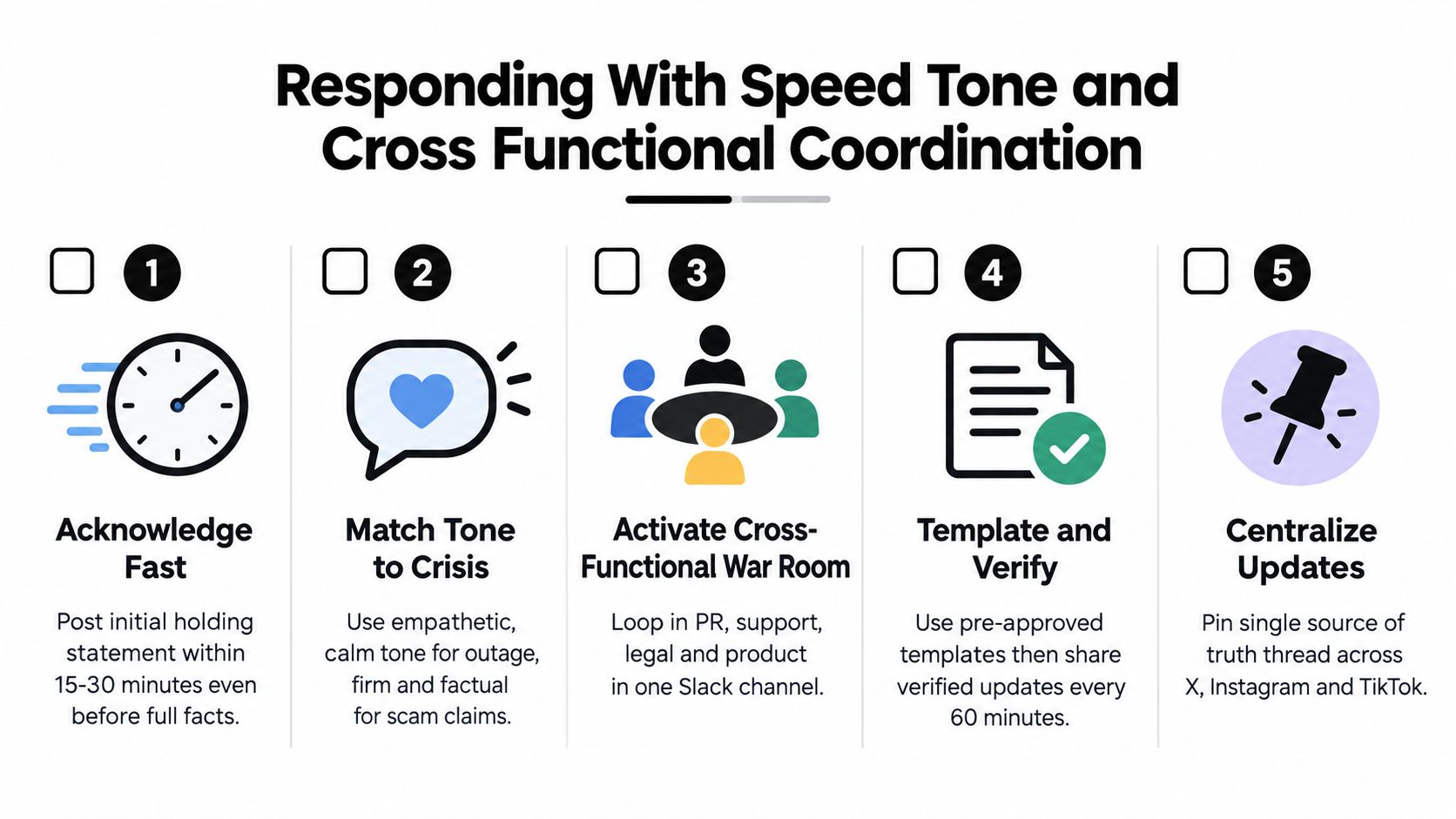
The first public response has one job: establish that the company has seen the issue, understands its seriousness, and has assigned people to investigate it. It doesn't need to contain every fact. It does need to avoid speculation, defensiveness, and promises no team can keep.
Research on Facebook crisis communication found that, in a health-crisis scenario, a response posted one day after the incident generated more trust than a response posted one week later. Responses posted within one hour and one day didn't differ significantly in trust, which suggests that waiting beyond the first day can materially damage credibility, as described in the relevant crisis communication research.
Use a two-stage message
The holding statement should contain four elements:
- Recognition: State what the team knows without repeating an unverified allegation as fact.
- Impact awareness: Acknowledge the inconvenience, concern, or potential harm.
- Action: Explain what support, engineering, comms, or trust and safety is doing.
- Next update: Give a clear point at which the audience will hear more.
For an outage, the tone should be calm and accountable: “We're aware that customers are having trouble accessing the service. Engineering is investigating, and support is helping affected customers. We'll share a verified update on this thread when we have more to report.”
For a scam wave, avoid implying that every reported account is confirmed fraudulent. Say that the team is reviewing the reports, warn customers not to share credentials or payment information, and direct them to the verified support route. A scam response needs factual firmness, not casual empathy that could sound uncertain about the risk.
Make approval fast and visible
Create one war-room channel with comms, support, product, engineering, legal, and trust and safety. Name a response lead, a message drafter, a fact owner, and an approver. The fact owner supplies confirmed details. The drafter turns them into platform-appropriate language. The approver decides whether the message is accurate and safe to publish.
Sift AI can support this workflow by filtering noise in a unified inbox, tagging intent, routing issues to teams such as support, finance, engineering, comms, or trust and safety, and drafting replies for human approval. That makes it useful for operational volume, but the company still needs people to verify the facts and own the hard calls.
A publishing workflow that helps teams post to all social media at once can reduce repetitive channel work, but synchronized publishing isn't the same as blindly copying one message everywhere. Adapt the format, length, accessibility, and customer action for X, Instagram, TikTok, Discord, Telegram, WhatsApp, and forums while keeping the facts consistent.
Treat synthetic media as an evidence problem
A fake screenshot or deepfake can force a response before the team knows whether the content is authentic. Recent guidance says generative AI has made fabricated quotes, fake screenshots, and convincing deepfake videos easier to produce, and a 2026 guide cites deepfake volume at approximately 8 million in 2025, as reported by Hootsuite's social media crisis management guidance.
Don't declare a fake based on instinct. Preserve the original URL and media, check account history and timestamps, compare the claim with internal records, ask the relevant product or security owner to verify it, and label uncertainty clearly. If the content is false, explain what can be verified and point to the authoritative source. If verification is incomplete, say that the team is investigating rather than amplifying the fabricated claim with unnecessary detail.
Post Crisis Review Metrics and Tooling That Prevents the Next One
A crisis review shouldn't be a blame session or a screenshot folder. It should explain how the incident moved through the system, where ownership failed, which messages helped, and what the organization will change.
Start with a blameless timeline. Record the first signal, the point at which the pattern was recognized, the severity decision, each handoff, approval delay, public acknowledgment, verified update, resolution, and recovery point. Include social posts, DMs, community threads, CRM records, engineering status changes, and legal decisions. The objective is to expose process gaps, not identify a convenient person to punish.
Measure operational control
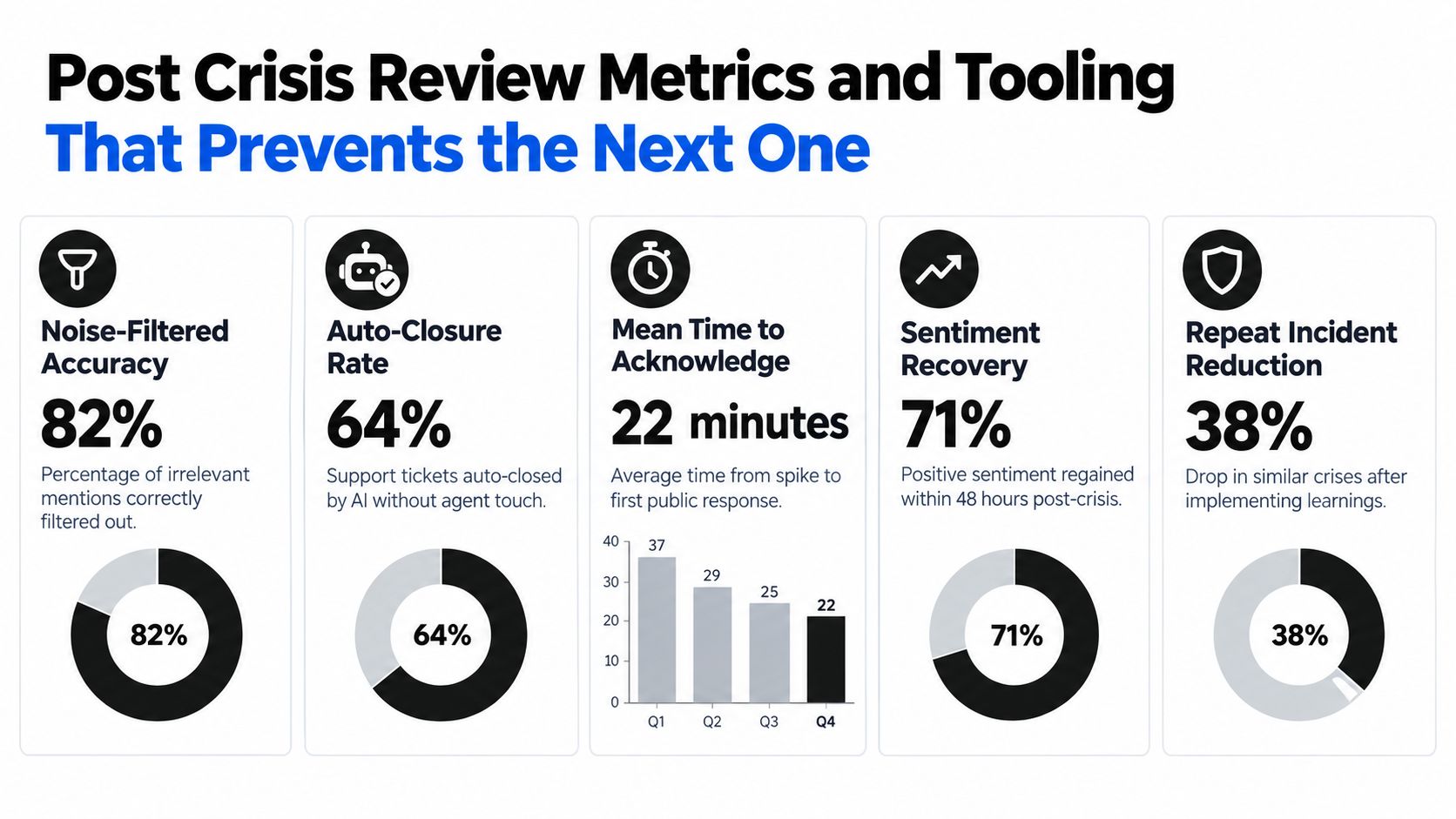
Executives need more than total mentions. Report whether the team reduced unnecessary work and improved the path from signal to resolution.
- Noise-filtered percentage: How much irrelevant content was correctly excluded before human review?
- Auto-closure rate: How many routine support conversations were resolved without agent touch, and were any closed incorrectly?
- Mean time to acknowledge: How long did it take from the first meaningful spike to the first approved public response?
- SLA adherence: Which queues met their commitment, and where did routing or approval create delay?
- Proactive saves: Which issues were identified and assigned before customers or media amplified them?
- Recovery quality: Did customer questions become more specific and solvable after the update, or did confusion continue?
The metric definitions matter. A high auto-closure rate can hide poor customer outcomes if the system closes messages that needed a human. A fast response time can hide weak communication if the message contains unverified facts. Pair speed with reopen rate, escalation accuracy, resolution quality, and reviewer feedback.
Feed the findings back into the system
Every review should produce concrete changes. Add new slang and multilingual expressions to intent rules. Create a new tag for the scam pattern. Adjust routing when finance receives engineering issues or comms receives routine billing cases. Update templates that caused confusion, and remove templates that encouraged defensive language.
Synthetic media needs its own review track. Record how the team found the manipulated content, how long verification took, which platforms carried duplicates, and whether the first public message accidentally increased reach. The next playbook should include evidence preservation, source validation, escalation to security or legal, and a human approval gate for corrective claims.
Teams that want broader context on reputation management online can use that work to connect crisis response with the longer recovery cycle. The operational lesson is simple: reputational recovery depends on what the company changes after the incident, not only on the statement it published during it.
Post-incident test: If the same signal appeared tomorrow, could the system identify it, assign it, and show the reviewer the relevant context without manual searching?
That question should drive tooling decisions. A unified inbox, AI-assisted tagging, routing, CRM synchronization, audit history, configurable brand voice, and analytics are valuable only when they shorten the route from customer signal to accountable action.
Putting Your Social Media Crisis Playbook Into Practice
A crisis playbook works when it gives people fewer decisions to invent under pressure. It should define what counts as an incident, which signals trigger review, how severity is assigned, who owns billing complaints, outage reports, PR risk, scams, product feedback, and legal concerns, and which human approves each type of message.
Keep the operating sequence visible:
- Detect: Monitor volume, sentiment, intent, reach, duplication, screenshots, videos, memes, slang, and private-channel pressure.
- Triage: Classify the issue by impact and urgency, then route it to support, finance, engineering, product, comms, legal, or trust and safety.
- Acknowledge: Publish a clear holding response before perfect information is available, without guessing.
- Coordinate: Run one incident record and one war room, with a named owner, fact source, drafter, and approver.
- Update: Keep the audience informed through a consistent source of truth, while adapting language to each platform.
- Review: Measure response time, SLA adherence, routing accuracy, noise reduction, auto-closure quality, and proactive saves.
The biggest mistakes are predictable. Teams wait for complete facts, argue with customers, publish a generic statement on the wrong channel, let scheduled content continue, or treat every message as a moderation problem. Social media crisis management is an orchestration discipline. AI can absorb noise and prepare the next action, but humans must decide what the company stands behind and what it will do next.
Sift AI gives social and community teams a unified inbox across channels, AI-powered filtering and intent tagging, routing to owners such as finance, engineering, comms, and trust and safety, and human-approved response drafts. Visit Sift AI to see how your team can turn crisis signals into coordinated action without giving up human control.