Social Media Compliance for Social Ops Leaders
"Master social media compliance for enterprise teams. Map DSA and FTC rules, build audit trails, and orchestrate AI triage with human oversight."
The most popular advice about social media compliance is also the least useful: archive everything, retain it forever, and let IT solve the problem. That model breaks the moment a billing complaint arrives in an Instagram reply, an outage floods X, a feature request sits inside a WhatsApp conversation, or an AI agent routes a legal threat to the wrong queue.
For social ops leaders, compliance is an operating discipline. It governs how teams ingest, classify, route, approve, publish, edit, delete, and escalate customer signals across public channels, private messages, and owned communities. The record that matters isn't only the final post. It's the full decision path behind it.
Table of Contents
- Redefining Compliance for Modern Social Operations
- Mapping the Regulatory Rules That Social Teams Must Operationalize
- Architecting Audit Trails and Access Controls
- Governing AI Triage and Automated Responses
- Navigating Encrypted DMs and Private Communities
- Executing Incident Response and Escalation Protocols
- Measuring Compliance Through Operational KPIs
Redefining Compliance for Modern Social Operations
A technically defensible program treats posts, comments, direct messages, moderation actions, approvals, edits, and account-access events as governed records, not merely marketing content, as NIST guidance on security and privacy controls makes clear. That distinction changes the work of a social care or insights team. A reply drafted by an agent, an AI intent tag, a reassignment to engineering, and an exception approved by a manager all become part of the operational history.
Static archiving captures an artifact. It doesn't necessarily explain who acted, which policy applied, whether the message was changed before publication, or why a case was closed. An export of public posts may show what customers saw, while omitting the private DM, deleted draft, reviewer decision, or account-access event that explains how the response came to exist.
Compliance starts at ingestion
A defensible workflow begins when a message enters the unified inbox. Each event should receive a durable identifier and retain its channel, actor, timestamp, content state, policy version, disposition, and escalation history. That structure supports reconstruction when an internal auditor asks why a billing complaint was sent to finance, or when legal needs to understand whether a safety report received an appropriate response.
The operating model should cover the full path:
- Ingest: Capture the relevant post, comment, DM, attachment, and available context.
- Triage: Apply intent, urgency, language, privacy, and risk signals.
- Route: Send the case to support, finance, engineering, communications, or trust and safety.
- Decide: Record automated handling, human approval, exception logic, or escalation.
- Resolve: Preserve the final response, closure reason, and any appeal or correction.
- Review: Test whether the workflow performed consistently across channels and languages.
Resources such as the Head of Agents marketing hub can help teams think beyond campaign publishing and toward the broader orchestration of customer-facing work. The useful question isn't whether the archive is full. It's whether the operation can explain its decisions.
Practical rule: If a reviewer can't reconstruct the route from incoming signal to final disposition, the team has stored content but hasn't created an audit trail.
The shift also prevents a common failure mode: forcing agents to handle sensitive cases informally because the formal workflow is too slow. Well-designed controls make the safe path the fast path. Low-risk acknowledgments can move through automation, while high-risk cases receive structured review without disappearing into an unlogged side conversation.
Mapping the Regulatory Rules That Social Teams Must Operationalize
Social teams do not need every agent to become a lawyer. They do need workflow triggers that convert legal duties into routing decisions. A moderation action, a creator relationship, or wording that could disclose material corporate information should determine what happens next, who reviews it, and what evidence the team retains.
The EU Digital Services Act shows how regulation becomes an operating requirement. The Council adopted it on 4 October 2022, and its general rules began applying on 17 February 2024, according to the Council of the EU overview of the Digital Services Act. Its strictest obligations apply to very large online platforms and search engines with more than 45 million monthly active users in the EU, a threshold equal to roughly 10% of the EU's approximately 450 million consumers. The European Commission designated 17 platforms and 2 search engines on 25 April 2023, and those services faced the enhanced obligations from 25 August 2023.
For social operations, the effect extends beyond removing content. Platforms must assess and mitigate systemic risks, explain advertising and moderation practices, cooperate with regulators, and report certain criminal offences. Hosting services must also notify users when content is restricted and provide a reason in a statement of reasons, as described by the European Commission's DSA transparency guidance.
Translate the trigger into a queue action
The FTC framework creates a separate operational test for endorsements. A financial, employment, personal, or family relationship with a brand can be a material connection requiring disclosure. Free or discounted products and other perks may qualify, even when the brand did not specifically request a post. The disclosure should appear with the endorsement, use understandable language, and remain visible rather than sitting behind a profile link or apart from the content, according to the FTC guidance for social media influencers.
The SEC sets another routing boundary for public companies. Regulation FD requires material information to be distributed through a method reasonably designed to reach the general public broadly and non-exclusively. Social media can support announcements when investors have been told that the channel will serve that purpose, as explained in SEC guidance on company announcements through social media. A customer reply containing potentially material financial or corporate information should leave the ordinary support queue and receive appropriate review.
| Regulation | Operational Trigger | Required Workflow Action |
|---|---|---|
| Digital Services Act | Content restriction, moderation decision, systemic-risk signal, or appeal | Preserve the reported item, applicable rule, statement of reasons, notice, and review outcome. Route systemic-risk issues to the designated trust and safety owner. |
| FTC endorsement framework | Influencer, employee, customer, or creator appears to have a material connection with the brand | Verify the relationship, inspect the disclosure's placement and language, and escalate ambiguous promotional content before publication or response. |
| SEC Regulation FD | Reply or post may contain material product, financial, or corporate information | Pause ordinary publishing, route to legal or investor relations, and use the approved disclosure channel when the information is material. |
The DSA's enforcement structure shows why these controls must connect to live queues rather than sit in a policy folder. The Commission can impose fines of up to 6% of a provider's worldwide annual turnover, while periodic penalties can reach 5% of average daily worldwide turnover for certain failures, as described in the Council overview above. National Digital Services Coordinators supervise services in their member states. The Commission oversees the largest platforms and their systemic-risk duties.
For teams handling AI-assisted triage, encrypted DMs, and public replies, the practical test is traceability across channels. A case should retain the trigger, governing rule, reviewer or automation path, and final action, so an urgent response remains defensible after the conversation moves from a public thread into private support.
Architecting Audit Trails and Access Controls
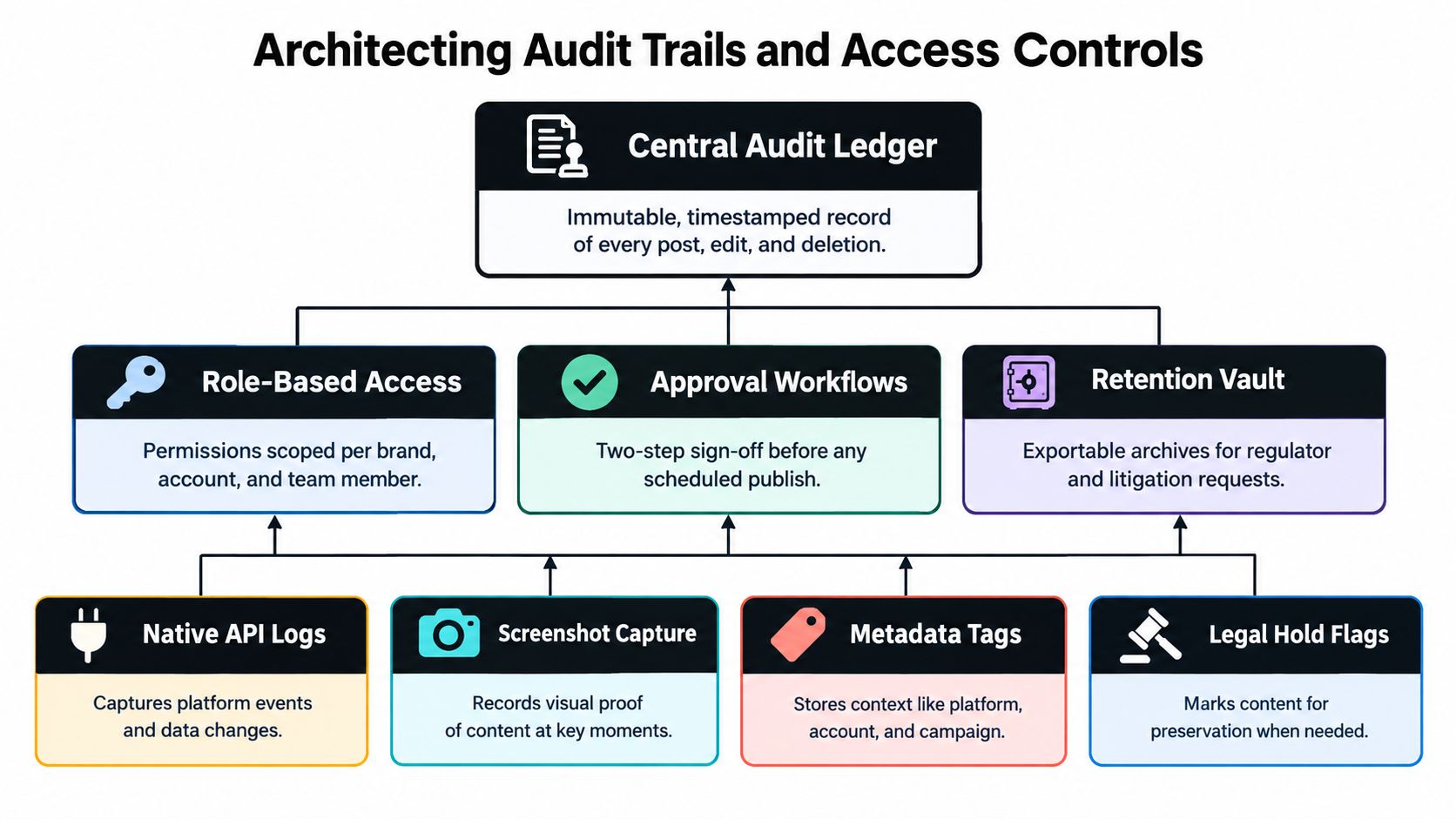
A CSV of tweets isn't an audit system. It usually lacks the policy version, approval state, deleted-content history, API event, and access record needed to explain what happened. Build the control layer around the event, not around the channel.
Build the ledger first
Start with a central event ledger that records every governed action. A content event should carry a durable identifier, source channel, account, actor, timestamp, content version, policy version, automated classifications, human decisions, disposition, and escalation history. Capture edits and deletions as events rather than overwriting the earlier state.
Next, separate permissions by function. Monitoring and analytics users don't need publishing rights. A support agent may reply to an assigned customer case but shouldn't change a brand-wide escalation rule. A community moderator may manage a forum queue without accessing sensitive finance-related DMs.
Make approval proportional to risk
Use approval workflows where publication or closure carries meaningful exposure. A draft answer to a general product question may need one named reviewer or a controlled automation rule. A response involving a safety allegation, legal complaint, regulated claim, executive issue, or potential investor disclosure should require a higher-risk route.
The control shouldn't force two people to approve every sentence. It should make the exception visible and preserve who approved it, when, under which policy, and with what supporting context.
Retain for a purpose
Indefinite storage looks safe until it creates a larger privacy and discovery burden. Retention and deletion should follow the legal purpose, case type, jurisdiction, and any litigation hold. The U.S. Department of Energy's social media security guidance connects social media controls with authentication, logging, records management, retention schedules, freedom-of-information duties, and litigation holds.
A practical architecture should also include:
- Strong administrator authentication: Protect publishing and account-recovery privileges with multi-factor authentication.
- Input validation: Sanitize inbound text, links, media, and automated processing inputs before they reach downstream systems.
- API and human logs: Record actions taken by platform integrations and named staff.
- Legal-hold flags: Suspend routine deletion when an investigation or dispute requires preservation.
- Scoped analytics access: Redact or restrict personal and sensitive information before it appears in dashboards.
Controls work when they reduce ambiguity without adding avoidable friction. An agent can respond quickly when the system automatically attaches context and records the route. The agent slows down when the team must search several tools, copy messages into spreadsheets, and reconstruct approval history from memory.
Governing AI Triage and Automated Responses
AI changes the audit question. The issue is no longer only whether a message was stored. It is whether the organization can reconstruct the automated decision that followed.
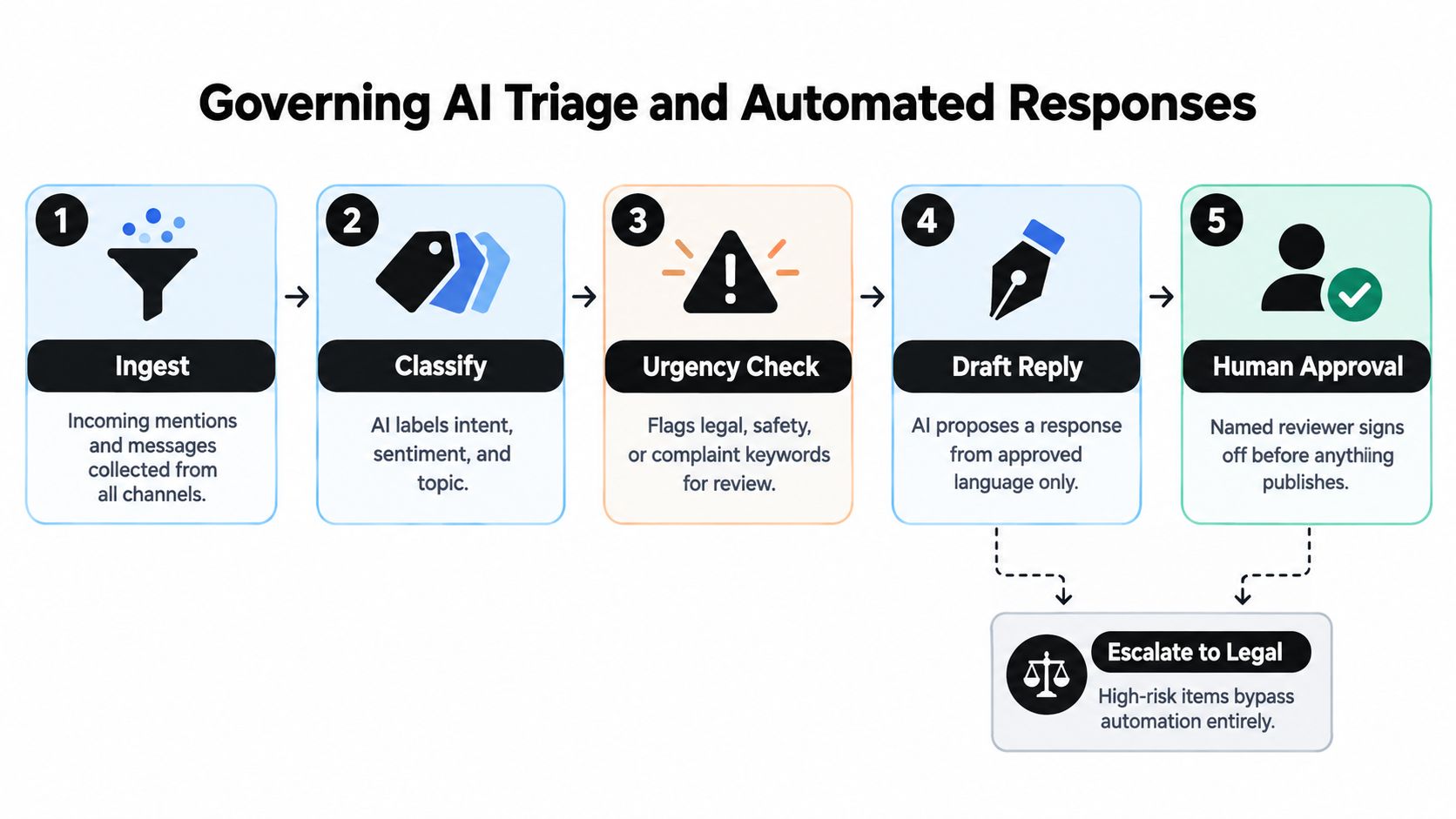
An AI classifier may label a post as a billing complaint, detect urgency in a safety report, recognize multilingual slang, draft a response in the brand voice, and close a duplicate case. Each action needs an explainable event trail. Preserve the original content, model or workflow version, relevant context, confidence or uncertainty signal, routing decision, draft response, reviewer action, and final disposition.
Set thresholds instead of banning automation
The safest policy isn't human review of everything. That approach creates reviewer fatigue, slows response times, and encourages staff to work around the system. Use risk tiers that match the consequence of a mistake.
Low-risk automation can handle acknowledgments, duplicate grouping, known spam patterns, and routine status guidance when the response comes from approved language. Human approval should be required for:
- Payments and billing: Disputes, refunds, account access, or financial hardship.
- Safety and vulnerability: Product harm, self-harm references, threats, children, or vulnerable users.
- Legal exposure: Litigation threats, privacy complaints, regulatory references, or demands for formal records.
- Reputation risk: Coordinated criticism, crisis allegations, executive issues, or media escalation.
- Regulated communication: Endorsements, financial claims, investor language, or advice that may be subject to sector rules.
The contrarian point is that more automation can improve compliance. A structured agent applies the same routing rule repeatedly and leaves evidence. Manual handling often produces the opposite: a quick reply in a personal tool, an unrecorded exception, or a closure reason that exists only in an agent's memory.
A useful AI control set includes false-negative testing, sampled review of automated closures, policy-version tracking, and an appeal path. If a user disputes a moderation decision, the team should be able to retrieve the original content, the rule applied, the notice sent, and the review outcome. Teams evaluating AI governance can also consult Spark's guide to EU regulation for broader context on regulatory expectations around artificial intelligence.
A unified inbox such as Sift AI can support this model by bringing social and community conversations into one workspace, applying intent tags, routing cases to teams such as finance, engineering, communications, and trust and safety, and keeping humans responsible for high-risk decisions. The important control isn't the product label. It's whether the system preserves context and makes the decision path reviewable.
Navigating Encrypted DMs and Private Communities
Public posts and private messages shouldn't follow the same capture rule. A public reply is visible by design, while a WhatsApp DM, Telegram exchange, Discord thread, or private forum may contain personal information, sensitive account details, or conversations that users didn't expect to enter an enterprise archive.
Blanket prohibition creates a support blind spot. Indiscriminate capture creates a privacy and surveillance problem. A minimum-necessary capture model provides a more defensible middle path.
Compare the channel before collecting
| Channel context | Main exposure | More defensible operating response |
|---|---|---|
| Public mentions and replies | Broad visibility, impersonation, spam, and fast-moving reputational risk | Capture the relevant content and context, classify intent, and route publicly visible risk signals. |
| Private support DMs | Personal data, account information, consent, and jurisdictional transfer issues | Capture only what supports a documented care, safety, or regulatory purpose. Restrict access by case role. |
| Encrypted communities | Limited platform visibility, uncertain export scope, and sensitive group context | Document platform limitations, define approved support pathways, and avoid treating absence of capture as proof that no risk exists. |
| Employee-created groups | Blurred personal and business communication, uneven oversight, and privacy concerns | Separate employee communications from customer-care records and define clear policy and escalation boundaries. |
The first decision is purpose. If the customer reports a payment failure, capture the message and the minimum surrounding context needed for support. Don't ingest an entire personal conversation just because the platform makes broad collection technically possible.
Redact before analysis
Privacy controls should operate before analytics and broad dashboard access. Remove unnecessary account identifiers, payment details, health information, and other sensitive fields before the case reaches trend analysis. Keep a restricted version when investigators need the original context, and record who accessed it.
The same principle applies to retention. A customer-care case may need one policy, a safety investigation another, and a litigation hold a different treatment. The team should explain why it captured the message, who could see it, how long it would remain available, and how deletion or correction requests are handled.
For private communities, set expectations explicitly. Tell users which channels are monitored for support or safety, don't imply that encrypted messages receive the same coverage as public posts, and provide an approved route for urgent issues. A transparent limitation is easier to defend than a hidden monitoring gap.
Executing Incident Response and Escalation Protocols
A routine social case becomes an incident when its consequence exceeds the normal queue. A surge of scam replies, a credible product safety complaint, a suspected account compromise, or a post containing material corporate information each requires a named owner and a controlled evidence path.
Use one incident record
The unified inbox should create an incident record that links the triggering message to related posts, accounts, AI detections, human decisions, and external communications. Don't scatter the evidence across a moderation tool, a CRM note, and a private chat.
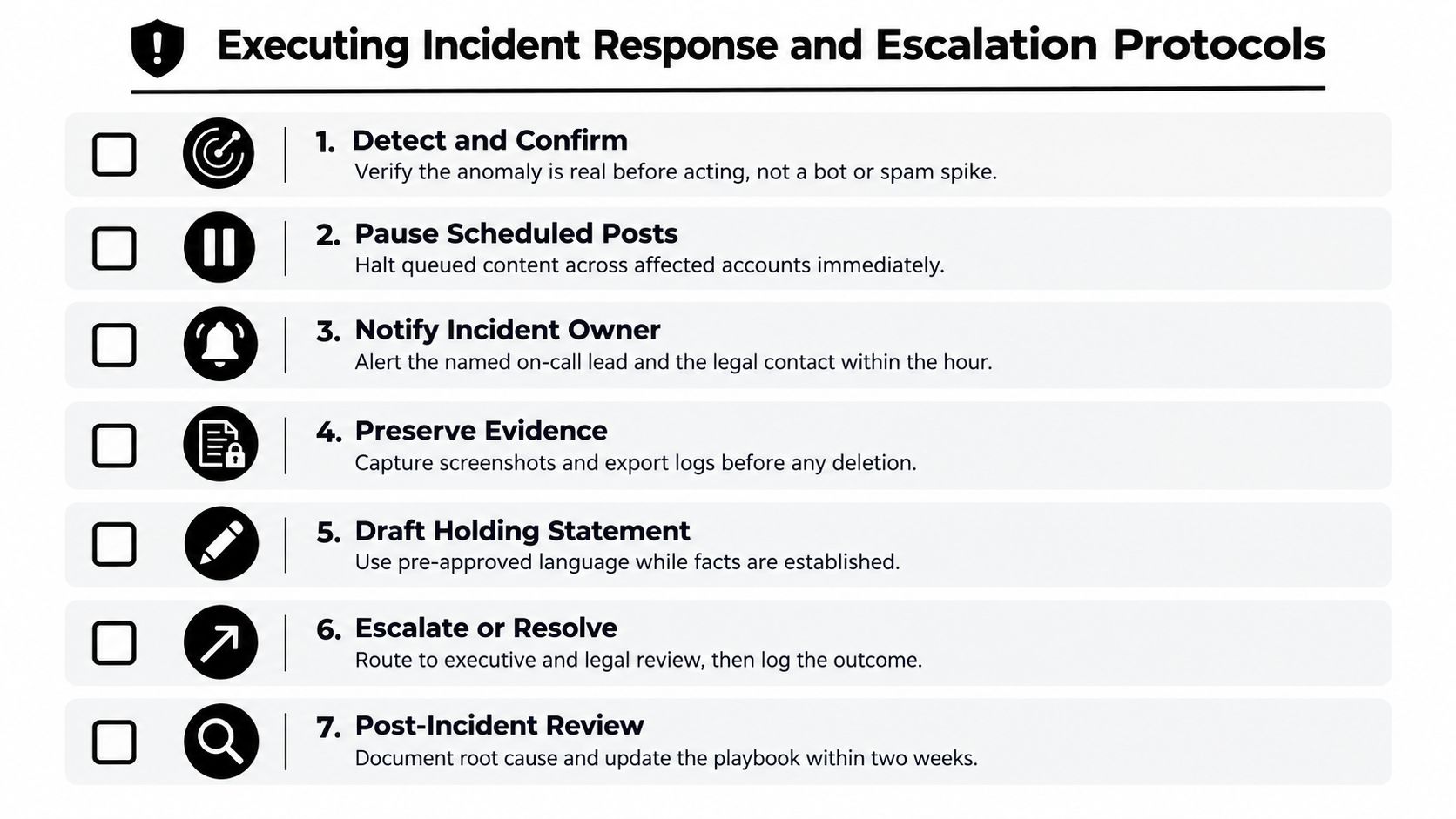
A practical response sequence is:
- Detect and confirm: Check whether the signal is a real anomaly, not a bot pattern or ordinary complaint cluster.
- Pause scheduled posts: Stop queued content on affected accounts when publishing could worsen confusion or reputational exposure.
- Notify the incident owner: Alert the named on-call lead and the relevant legal, security, communications, or trust and safety contact.
- Preserve evidence: Capture screenshots, message context, account-access events, API logs, and current policy versions before deletion.
- Draft a holding statement: Use approved language while facts are established. Don't let agents improvise an explanation during uncertainty.
- Escalate or resolve: Route material disclosure issues to legal or investor relations, safety matters to the responsible operational team, and coordinated abuse to trust and safety.
- Review the outcome: Document root cause, false positives, missed signals, and required playbook changes.
Separate containment from communication
Containment may mean locking down administrator access, revoking a compromised session, pausing automation, or restricting a malicious integration. Communication requires a different owner. The person who can secure the account shouldn't automatically publish a public explanation without review.
Preserve evidence before deleting spam or editing a post. If a customer complaint may become litigation, apply the relevant hold and suspend routine deletion for linked records. The DSA's requirement for statements of reasons also means a moderation action needs a connection between the item, the rule, the notice, and any appeal outcome.
Measuring Compliance Through Operational KPIs
Executives don't need a larger archive report. They need evidence that the social operation identifies risk, applies policy consistently, and responds at the right speed. Compliance KPIs should therefore sit beside service metrics, not in a disconnected legal dashboard.
Start with coverage and decision quality:
- Capture coverage: Which approved channels, accounts, message types, and private support pathways are connected?
- Routing accuracy: How often do billing cases reach finance, product defects reach engineering, and reputation risks reach communications without manual reassignment?
- High-risk detection: How many potential safety, legal, privacy, endorsement, or material-disclosure signals were flagged before publication or closure?
- Human-review adherence: How often did cases requiring approval receive a named decision before the response went live?
- Auto-closure quality: How many automated closures pass sampled review, and which error patterns trigger reopening?
- SLA performance by risk: Are urgent cases receiving faster treatment without allowing low-risk noise to overwhelm reviewers?
- Appeal and correction outcomes: Can the team show what changed after a user or internal reviewer challenged an automated decision?
Report evidence, not vanity
A useful executive report pairs each KPI with an artifact. Capture coverage should link to a channel inventory and integration-health record. Routing accuracy should connect to sampled cases. High-risk detection should show the trigger, model or rule version, reviewer action, and final outcome. Auto-closure should include false-positive and false-negative review rather than a single attractive rate.
Don't hide uncertainty. If encrypted channels provide incomplete capture, report the limitation and the approved alternative path. If multilingual slang produces inconsistent intent tags, show the review pattern and the corrective action. A candid exception register is more credible than a dashboard that implies perfect control.
The Ciphar guidance on coordinating crisis response securely provides useful context for connecting communications planning with secure incident coordination. Social ops leaders should apply the same discipline to everyday operations: name the owner, preserve the evidence, record the decision, and test whether the control worked.
The strongest program makes compliance visible in the daily workflow. Agents see the escalation rule before they publish, managers see reviewer workload and exception patterns, and executives see whether the operation is reducing risk while maintaining response quality.
Sift AI brings social and community conversations into a unified inbox, filters noise, tags intent, routes billing, engineering, communications, and trust and safety cases, and preserves the context behind AI-assisted decisions. Visit Sift AI to see how your team can connect real-time triage, human approval, audit trails, and operational reporting across its social channels.