Social Media Auditing: An Enterprise Playbook
"Social Media Auditing. Run a defensible social media audit for enterprise teams. Capture goals, channels, metrics, tooling, tag taxonomy, routing, reporting"
Monday morning starts with a billing complaint that sat unanswered in Instagram DMs over the weekend. The customer followed up, waited three hours for a reply, then moved their business elsewhere. Now the support lead has to explain the missed handoff while a manager asks for last quarter's reach and engagement metrics. Those numbers won't show whether the issue was seen, routed, or resolved.
A useful social media audit has to connect what happened in public and private channels to what the organization did next. That means looking beyond profile health and follower counts to the operating controls behind triage, response time, escalation, and resolution. The social media audit importance becomes clearer when the audit is treated as a way to spot exposure and assign accountability, not review posts.
Table of Contents
- Why an Enterprise Social Media Audit Cannot Stay a Quarterly Project
- Scoping Audit Goals and Inventorying Every Channel That Speaks for the Brand
- Capturing the Four Metric Families That Actually Move Decisions
- Sampling Methods and Tooling for a Repeatable Measurement Pipeline
- Tag Taxonomy and Routing Checks Across Care, Comms, Product, and Trust
- Reporting Templates and the Action Register That Closes the Loop
- Remediating Gaps and Running the Audit as a Living Control System
Why an Enterprise Social Media Audit Cannot Stay a Quarterly Project
A quarterly report can tell you what happened during a completed period. It can't, by itself, tell you whether the team intervened while an issue was still spreading. That distinction matters because inaccurate information can travel farther and faster than truthful claims. A Congressional Research Service review of research on Twitter data from 2006–2017 described inaccurate claims as diffusing “significantly farther, faster, deeper, and more broadly” than truthful ones. The review also reported that Facebook removed 7 million posts containing COVID-19 misinformation between April and June 2020 (Congressional Research Service review).
Those are historical examples, not a forecast for your own channels. They do make one operational point difficult to ignore: visible complaints and periodic manual checks aren't a reliable substitute for systematic monitoring. An audit needs to capture the volume and type of signals, how quickly they move, where they appear, and whether an intervention changed the outcome.
Treat timing as evidence
A report that records a scam post but not when the team detected, reviewed, escalated, and reported it leaves out the part leaders need to assess. Congressional research citing Twitter data found that about 90% of a tweet's retweets occurred within its first 51 hours, with a median of 28 hours (PNAS study on decisions to remove misinformation). For audit purposes, that makes timing a control measure: a review conducted weeks later may document a response without showing whether it was timely enough to limit spread.
Build the audit around the full incident path:
- Capture: Preserve the post, DM, comment, or report, along with its channel and timestamp.
- Classify: Apply a consistent issue category and severity assessment.
- Route: Record the receiving team and each escalation.
- Resolve: Document the action taken and whether the customer or operational issue was closed.
- Compare: Review patterns and outcomes over time, not just the number of visible interactions.
The playbook follows that logic across seven areas: scope, metrics, sampling, taxonomy and routing, reporting, remediation, and ongoing control. Each should feed one defensible output: an action register with evidence, an accountable owner, a deadline, and a measurable threshold.
Scoping Audit Goals and Inventorying Every Channel That Speaks for the Brand
Start with a narrow question: what business outcome must this audit help the team control? Choose one to three objectives before pulling data. If every platform, metric, and team is included without a decision in mind, the audit becomes a large export rather than a useful operating review.
A brand-awareness audit might examine reach and video completion across official brand channels. A customer-care audit should include the places customers ask for help, including DMs, comments, mentions, and communities. A trust-and-safety audit needs visibility into impersonation, scams, spam, and reports that could create reputational or customer harm.
Build the account inventory before measuring performance
List every account that speaks for the brand, not just the accounts the social team remembers. Include official, dormant, regional, employee-created, and potentially fraudulent profiles. For each entry, record the platform, handle, business purpose, accountable owner, access status, intended audience, brand-link consistency, and whether the account is actively monitored.
This inventory is a control, not housekeeping. A dormant regional account can still receive a billing complaint. An employee-created community may attract feature requests that product never sees. A fraudulent profile may confuse customers unless someone has responsibility for reporting it and warning affected users.
Use the table to choose a starting scope, then adapt it to the channels where the organization operates.
| Audit Objective | Primary KPI Family | Channels to Prioritize |
|---|---|---|
| Brand awareness | Unique reach, impressions, video completion, share of voice | Official brand profiles, campaign accounts, relevant public mentions |
| Customer care | First-response time, resolution rate, repeat contacts, escalation outcomes | DMs, comments, mentions, WhatsApp, forums, community spaces |
| Trust and safety | Scam and spam reports, detection-to-escalation time, repeat-pattern handling | Public replies, groups, forums, impersonation accounts, reporting workflows |
Keep ownership and access visible
An account inventory should show not only who owns each channel but whether the team can access it and who can change permissions. Review whether the profile links to the correct brand destination and whether its stated purpose still matches current operations. If an account has no business owner, decide whether to assign one, consolidate it, or close it through the platform's proper process.
Don't mistake a complete list for a complete audit. The list tells you where the work happens. The objective tells you what evidence to collect and what action the results should drive.
Capturing the Four Metric Families That Actually Move Decisions
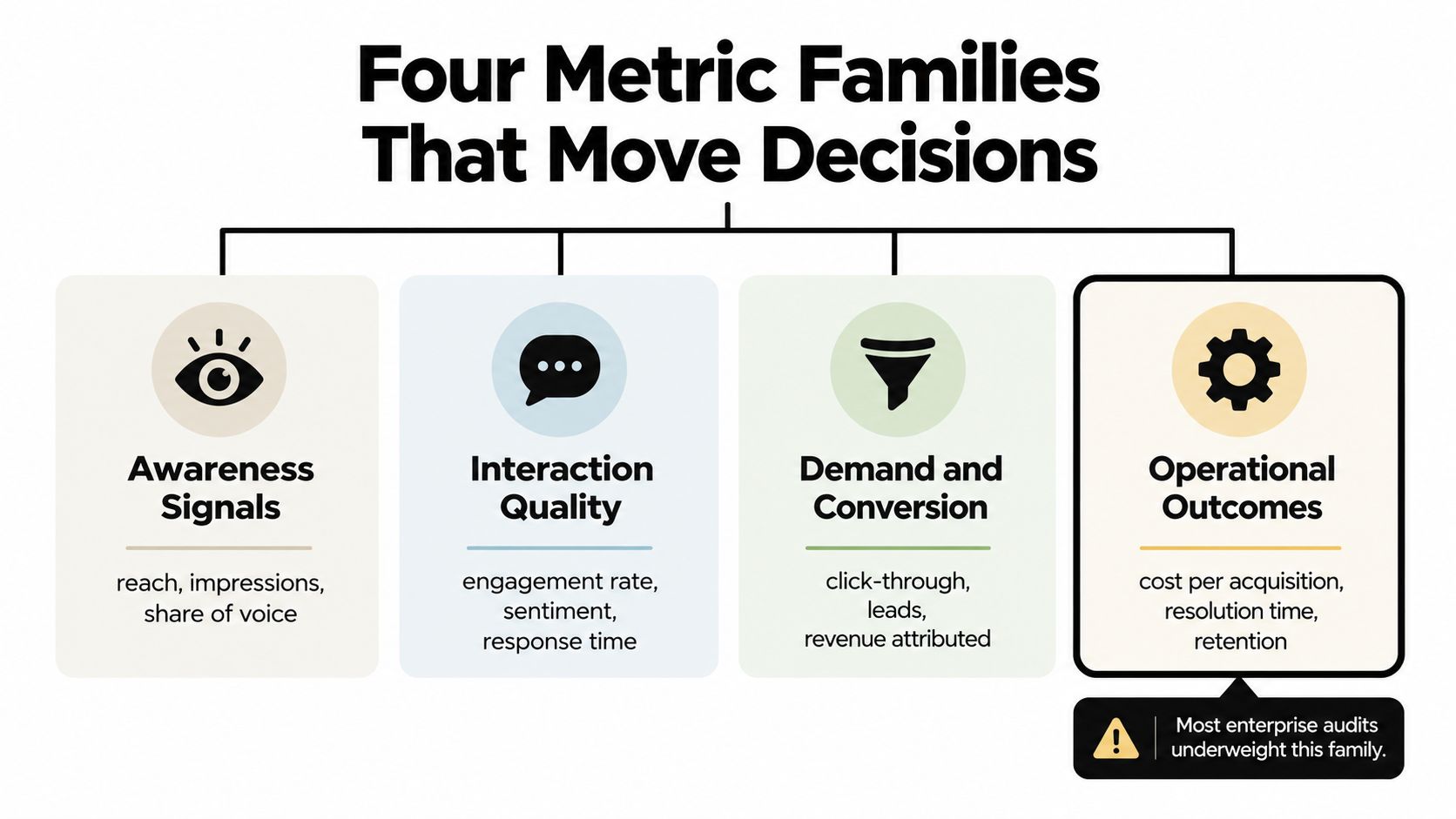
A social report can look healthy while customers are still waiting. Reach and engagement matter, but they measure different things from whether a billing issue reached finance or an outage report reached engineering. A useful audit separates four metric families so the team can see where visibility ends and service performance begins.
Separate attention from resolution
Awareness signals include reach, impressions, and video completion. Interaction quality covers comments, saves, shares, meaningful replies, and sentiment change. Demand and conversion looks at qualified clicks, assisted conversions, and attributed revenue. Operational outcomes track response and resolution: first-response time, escalation rate, resolution rate, repeat-contact rate, and the movement of sentiment after the interaction.
The fourth family is the one enterprise teams often underweight because it requires data from the unified inbox and support systems, not only the platform analytics screen. A reply can count as activity while the customer remains stuck. A high reply rate can even conceal poor service if agents redirect people without confirming that another team resolved the issue.
Practical rule: Count a response as an operational success only when the workflow records what happened after the reply.
Give every measure a source of truth
Define each metric before comparing channels. First-response time should use a stated start event, such as the first eligible customer message, and a stated stop event, such as the first human or approved automated reply. Resolution rate needs a clear definition of “resolved,” including how reopened issues and false closures are handled. Repeat-contact rate should identify whether it tracks the same person, issue, or case within the chosen measurement window.
Then reconcile the records:
- Native platform exports: Check post and conversation counts against channel-level data, noting deleted content or missing records.
- Unified inbox: Validate timestamps, tags, ownership changes, routing, and closure status.
- CRM and support records: Match social interactions to tickets or customer outcomes where the data can be reliably connected.
- Web analytics and campaign tags: Confirm that clicks and attributed conversions use consistent campaign definitions.
Don't report an engagement rate without its numerator, denominator, scope, and treatment of missing data. The same discipline applies to operational metrics: a dashboard is only useful when the team can explain how each number was produced and what decision it supports.
Sampling Methods and Tooling for a Repeatable Measurement Pipeline
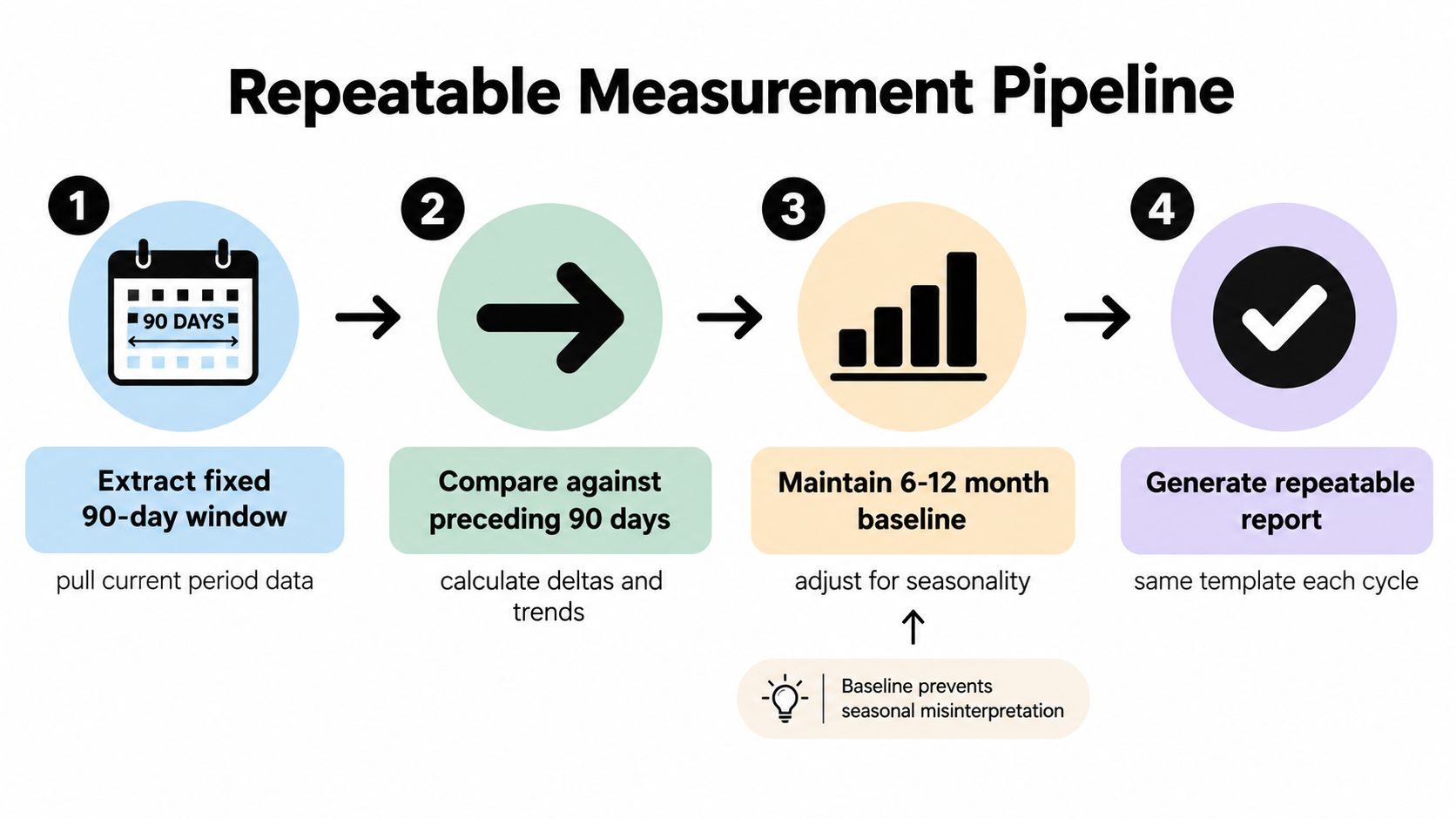
A repeatable audit needs a stable period and a documented method. Start by extracting a fixed 90-day window, compare it with the preceding 90 days, and retain a 6–12-month baseline to help interpret seasonality. The comparison shows what changed; the longer baseline helps distinguish a genuine shift from a recurring pattern.
Recompute from exports, not assumptions
Native platform metrics can be useful, but an audit should preserve the underlying fields and the formulas used to summarize them. Export raw data, document the calculation, and make the inclusion rules visible. If you report an engagement rate, state whether the denominator is reach, impressions, or followers. Those choices aren't interchangeable, and published benchmarks can differ by several multiples when they use different denominators.
Include paid-versus-organic scope and missing-data treatment beside the metric. Record whether API sampling, deleted posts, attribution windows, or duplicated cross-posts affect the dataset. If an Instagram post also appears on Facebook, don't count the same interaction twice unless the report explicitly measures cross-platform distribution.
Keep the comparison fair
A practical audit compares like with like: segment by platform, format, audience, theme, cadence, and business objective. Recompute the same measures in each period with the same formulas. For a benchmark, maintain a stable peer group of roughly three to five comparable accounts, and label the results as directional because public competitor data is incomplete.
Follower count alone won't establish commercial value. Your first comparison should be the brand's own normalized trend, followed by carefully qualified peer and industry context. Teams reviewing their broader campaign process may also find AdCrunch's PPC audit tool roundup useful when they need to think through how audit workflows and measurement tools fit together.
A spreadsheet can carry the method if it preserves the raw export, formula, denominator, time window, data exclusions, and owner for every reported figure. Use a dashboard for monitoring; use the documented dataset to defend the audit's conclusions.
Tag Taxonomy and Routing Checks Across Care, Comms, Product, and Trust
A tag is useful only if it helps the right person act. “Negative sentiment” doesn't tell finance what to do with a billing complaint, and “urgent” doesn't explain whether engineering, communications, or trust and safety owns the next move. Audit the route as well as the label.
Test the path from intent to owner
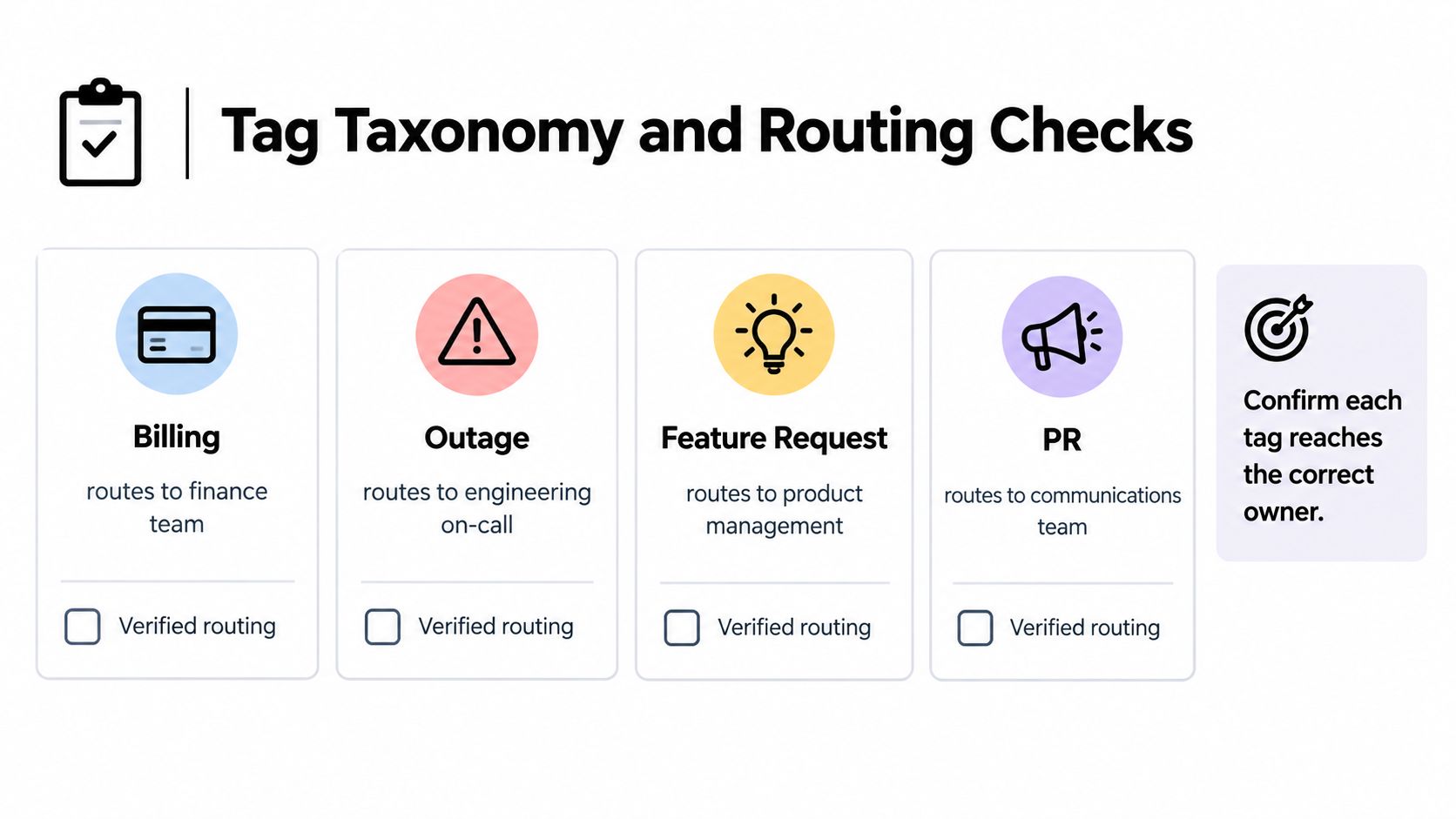
A working taxonomy should distinguish issues that require different responses. Billing routes to support or finance, depending on the organization's ownership model. Outage goes to engineering on-call. Feature request reaches product. PR risk goes to communications. Scam and spam need defined trust-and-safety handling, including evidence capture and platform reporting where appropriate.
A misrouted billing complaint can sit in a product queue while the support team assumes someone else owns it. A scam report tagged as generic spam may miss the communications escalation needed to warn customers. In both cases, delay and confusion spread across teams.
Audit the fields that reveal those failures:
- Tag coverage: What share of conversations remains untagged?
- Tag duplication: Are different labels being used for the same intent?
- Routing accuracy: Did the assigned queue match the issue and approved ownership rules?
- Handoff history: How many times did a case change teams before reaching its owner?
- Language coverage: Can reviewers interpret slang, sarcasm, and multilingual reports well enough to assign the right intent?
Check automation against platform rules
On X, automated DMs are allowed only when the recipient requested contact or clearly indicated they want to be contacted. The rules also prohibit bulk unsolicited DMs and require an easy opt-out that the sender promptly honors; duplicative or spammy replies can lead to enforcement (X automation rules). The audit should therefore preserve consent status, message frequency, opt-out state, and duplicate-send checks. AI can classify a likely support request and draft a response, but automated sending needs a documented basis for contact.
WhatsApp describes a hybrid enforcement model: automated systems can identify likely guideline violations and help prioritize cases for human reviewers with relevant subject-matter and language expertise (WhatsApp Messaging Guidelines). Apply that logic to operations as well. Review automated triage volume, human escalation, language coverage, and cases returned for human review. Automation should filter noise and route work, while people retain responsibility for context-heavy decisions.
Reporting Templates and the Action Register That Closes the Loop
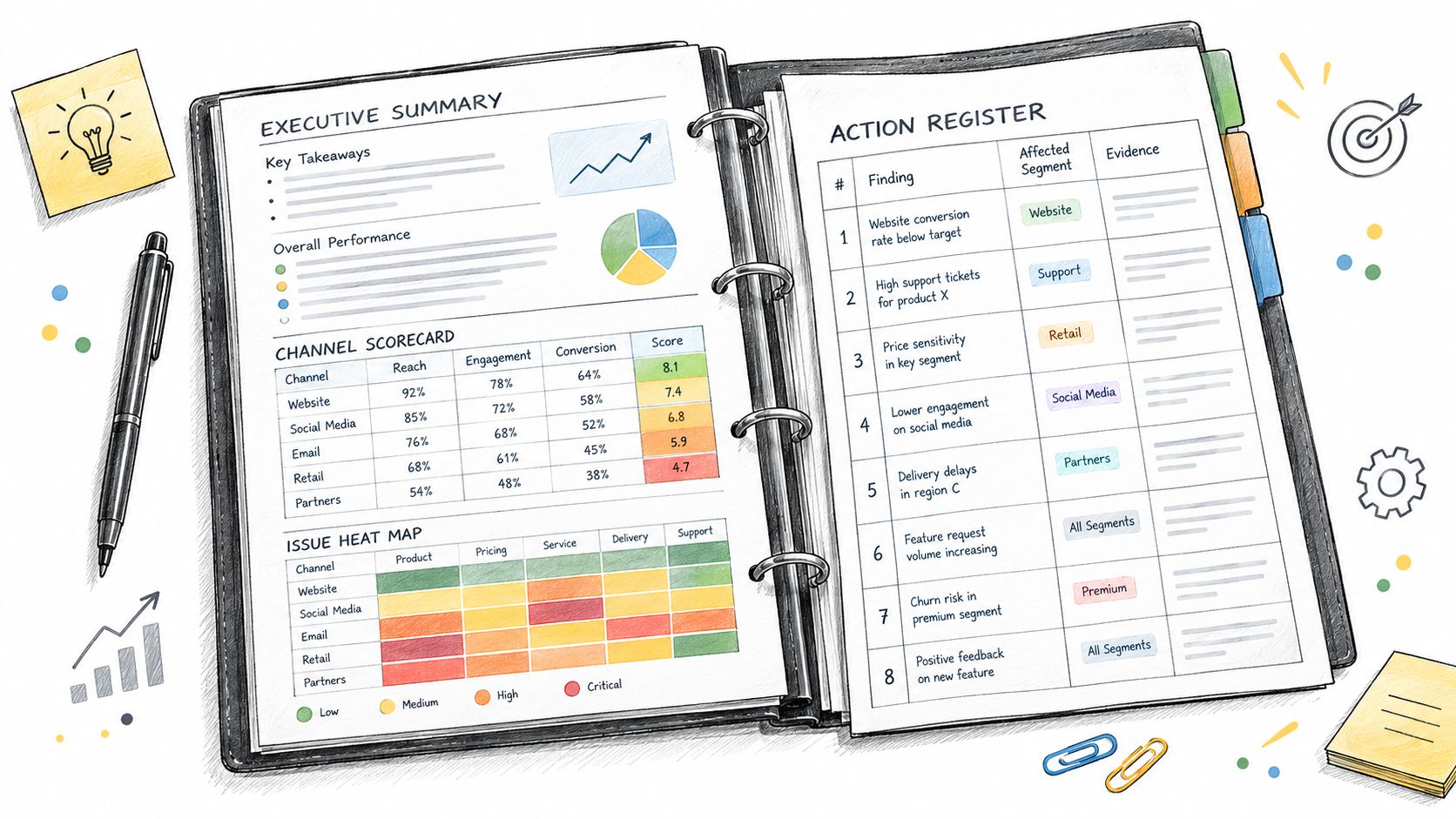
A dashboard shows patterns. The report has to tell a leader what needs to change and who will make that change. Keep the output practical: an executive summary for decisions, a channel scorecard for performance, an issue heat map for risk, and an action register that ties each finding to evidence and ownership.
Record evidence, decision, and accountability
Each action-register row should name the affected channel or audience segment, link to the source conversation or ticket ID, state the evidence, define the intervention, and assign an owner, deadline, and target metric. Severity tiers help teams distinguish a routine feature request from an outage surge or a scam pattern that warrants rapid escalation. Don't write “improve response time” as an action. Name the queue, routing change, owner, and measure that will show whether the fix worked.
Sample action-register entry
| Field | Example |
|---|---|
| Finding | Outage reports in public replies and DMs aren't reaching engineering promptly |
| Evidence | Link affected posts and inbox case IDs; record detection and escalation timestamps |
| Intervention | Add an outage tag, route it to engineering on-call, and use an approved customer update |
| Owner | Social operations lead with an engineering escalation partner |
| Deadline | Set a date agreed by both owners |
| Target metric | Reduce time from detection to engineering escalation and track resolution status |
Sample scam-wave runbook entry: Preserve the original posts and account details, group duplicate reports, assign a trust-and-safety owner, and notify communications if customers need a public warning. Record each platform report's category, submission time, acknowledgment, case identifier, and final disposition. Keep unresolved cases open internally while the platform reviews them.
That distinction matters on X: properly submitted violation reports are acknowledged within 24 hours, typical resolution takes a few days, and some cases can take up to 30 days (X report-violation process). Filing a report isn't closure. Track internal response obligations separately from platform enforcement, and escalate cases that remain unresolved beyond the expected window.
Remediating Gaps and Running the Audit as a Living Control System
A completed report doesn't improve operations unless someone changes the workflow and checks whether the change held. Prioritize fixes by expected impact, effort, risk, owner, deadline, and success threshold. Rerun the relevant part of the pipeline after a major outage, scam wave, or routing failure rather than waiting for the next scheduled review.
AI quality belongs in that control loop. A fast draft isn't a good outcome if it creates a false closure, mishandles personal information, or sends a sensitive issue to the wrong queue. Consumer research reports that 83% want disclosure when AI is used and 60% worry AI-generated responses may be inaccurate; 93% say mishandling personal data would cause a brand to lose their trust (Emplifi social customer care report). Audit disclosure compliance, correction frequency, sensitive-topic routing, human handoff, and language or cultural errors alongside response time.
A simple maturity ladder can help teams choose the next control:
- Inventory: Every account has an owner and access status.
- Measure: Metrics have documented definitions and reconciled sources.
- Route: Intent tags reach accountable teams, with exceptions reviewed.
- Learn: AI and human decisions are checked against resolution quality and customer trust.
Teams that need a creator-focused checklist can also consult this social media review for creators, then adapt the account-review elements to enterprise ownership and support workflows. The test for an enterprise audit is practical: when the next outage surge or scam wave arrives, can the team detect it, route it, and resolve it faster and more consistently than before?
Sift AI brings social and community conversations into a unified inbox, where AI can filter noise, tag intent, route issues to teams such as support, finance, engineering, and communications, and draft replies for human review. If you're rebuilding your audit around routing quality, resolution outcomes, and accountable controls, visit Sift AI to see how its workflows and analytics can support that operating model.