Social Media Analytics Platform for Ops Leaders
"Learn what a social media analytics platform must track: SLAs, noise filtered, auto-closure, and routing for social care teams."
It's Monday, an outage is unfolding, and your executive dashboard still looks healthy. Meanwhile, billing complaints are waiting in X replies, scam DMs are multiplying, and someone has posted a meme that might describe a safety issue. You own the SLAs and the executive rollup, so a reassuring average response time isn't much comfort when you can't tell which cases never reached the right person.
Table of Contents
- Why Mention Counts Hide the Real Queue
- The Scorecard for Human Versus Auto
- From Ingest to a Routed Reply
- Controls That Keep Automation Accountable
- A Buying Checklist for Social Ops
- Care and Comms Outcomes Worth Reporting
- Pilot One Queue Before You Scale
Why Mention Counts Hide the Real Queue
Say your team opens the unified inbox during that outage. Instagram comments ask whether payments went through. A Discord thread contains a useful feature request. Telegram messages repeat an unverified claim, while a customer on X says they've lost access to their account.
Those items don't belong in one undifferentiated backlog.
A social media analytics platform, for an ops leader, is the layer that turns cross-channel conversations into a governed queue, showing what needs action, who owns it, and what happened next.
That definition changes what you buy and report. Across X, Instagram, TikTok, Discord, Telegram, WhatsApp, and forums, you need to distinguish noise, auto-closed items, human-reviewed cases, and unresolved work. You also need to know whether the applicable SLA held, not whether someone sent a reply.

Treat the inbox as a service operation
In 2024, 80% of surveyed U.S. and UK consumers said they used social media more for customer service than the previous year, according to Sprout Social's Q1 2024 Consumer Pulse Survey, reported by O'Dwyer's. Your operating model should treat that queue as a service channel, not a side feed attached to publishing.
Mention volume, follower growth, and sentiment don't tell you whether finance received a payment dispute. Nor does a positive sentiment average prove that a safety complaint reached trust and safety.
AI clears repetitive noise and drafts the rest; humans approve, decide, and own billing, safety, trust, and reputation calls.
Staffing still matters. If you need a named owner for brand-channel coverage, Virtustant's resource to hire a remote social media manager can support that staffing decision. Define the person's escalation authority and handoff responsibilities before adding them to the inbox.
For the ops owner, the buying standard is practical: a human-versus-auto scorecard, a traceable ingest-to-route path, enforceable controls, demonstrable buying checks, and business outcomes that don't depend on a last click.
The Scorecard for Human Versus Auto
Social care scorecard and queue rules
| Signal | Benchmark | Queue rule |
|---|---|---|
| Social inquiry speed | Metrigy found just over half of consumers accept a response within 5 minutes, while only 15.6% of social-service users receive one within that window. | Prioritize outages, billing, and public risk. |
| Acceptable time bands | The same Metrigy report found that 29.5% accept 1.1–5 minutes, 16.3% accept 5.1–10 minutes, and 12.0% accept 10.1–20 minutes. | Set separate targets by severity rather than relying on one blended SLA. |
| Facebook window | ICMI's 2018 summary reported that 85% of respondents expected an answer within 6 hours, including 60% who expected one within 4 hours. | Give routine questions a defined service window; route urgent cases sooner. |
| X or Twitter window | ICMI's 2018 summary reported that 64% expected a Twitter reply within 1 hour, while 50% expected one within 30 minutes. | Triage public complaints promptly and route them by risk. |
| Tags and DMs | Emplifi's 2025 consumer survey found one-third of respondents expected replies within 1 hour, 67% preferred a human response, and 37% cited slow responses as a cause of negative experiences. | Use AI for drafts; have a human send high-risk replies. |
| Spam and scam DMs | Repetitive unsolicited messages can be filtered under an approved rule, while messages alleging fraud or scams should remain reviewable. | Auto-close clear repetitions; route credible fraud reports to a human. |
The speed rows describe different parts of the queue. A team may meet a fast average by answering easy questions first while urgent cases wait. Report response-time bands and SLA attainment by severity so the executive rollup shows where delays sit, not just the blended average.
Channel expectations also differ. The historical Facebook and Twitter figures are context, not contractual targets. Use them to inform channel-specific service windows, then measure whether each queue meets its own target.
Define the denominator before celebrating the rate
- Noise-filtered percentage is the share of inbound items removed as spam, bot waves, or empty engagement. Sample filtered items and record legitimate messages caught by mistake.
- Auto-resolution is the share of items closed without a human touch. Report false-positive closures alongside it, and separate spam closures from customer issues marked resolved.
- Time-to-first-meaningful-action measures the wait until a useful action, such as an accepted finance escalation or an account-recovery step. An automated acknowledgment does not count.
- Override rate counts human changes to routes, tags, or drafts among reviewed items. Break it down by language, channel, and content type to see where automation misroutes work.
- Repeat contact tracks whether the same customer returns about the same issue within a defined follow-up window.
Keep inbound-message counts separate from case counts. A customer who reports the same billing problem in a DM and a public reply has created two messages, not two successful resolutions.
Make the auto-close boundary explicit
Auto-close repetitive unsolicited messages only under an approved rule, and keep the decision auditable. A credible fraud report involving an existing customer needs investigation, not a closure that improves the dashboard rate.
Require human decisions for billing, account access, safety, and viral misinformation. If those cases wait while low-risk acknowledgments improve the average, the queue is rewarding speed on the easiest work rather than getting the right signal to the right person.
From Ingest to a Routed Reply
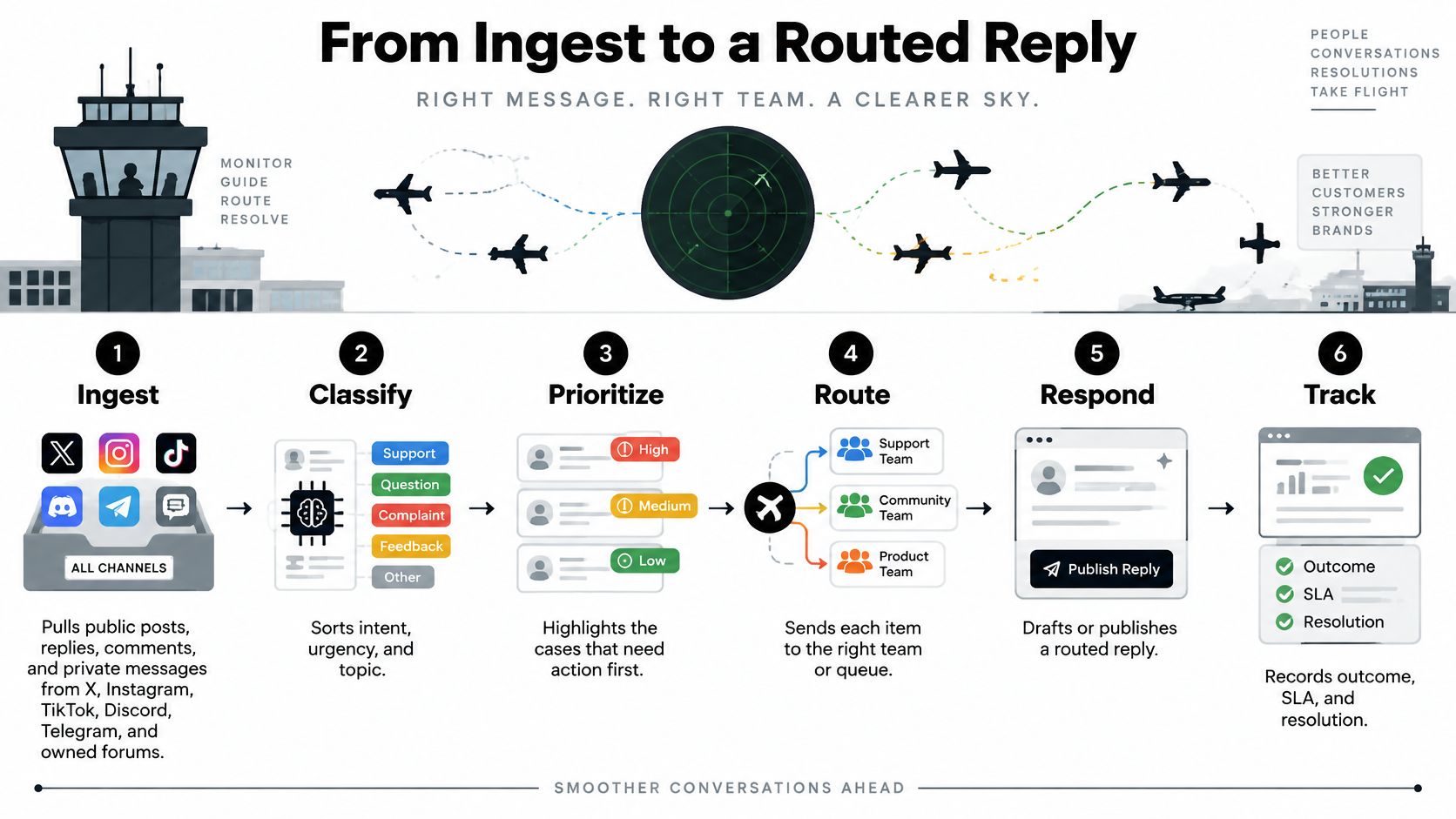
Think of the workflow as air traffic control, not a louder mention counter. Every item needs a destination, priority, and recorded disposition, including the items you decide not to work.
Build the operational path
Ingest the conversation and its context. Bring authorized public posts, replies, comments, and private messages from X, Instagram, TikTok, Discord, Telegram, WhatsApp, Facebook, and forums into one unified inbox. During an outage surge, preserve the parent post and thread so a short reply such as “still broken” remains interpretable.
Filter repetitive noise. Separate duplicate scam pitches, bot waves, and empty engagement from actionable work. For example, quarantine a repeated unsolicited promotion without discarding the customer message explaining that someone impersonated your support account. Keep filtered items inspectable to limit reviewer fatigue without hiding mistakes.
Detect intent and urgency separately. A negative message might be a payment dispute, a safety issue, or casual criticism. Treat multilingual slang and sarcasm as interpretation problems, not sentiment shortcuts. A joking caption attached to a dangerous-product image should remain eligible for safety escalation.
Auto-tag for later analysis. Apply channel, language, product, issue type, and severity labels. A WhatsApp complaint about a duplicate subscription charge should retain its billing and product tags after finance takes ownership, so analysts can reconstruct the workload without rereading every message.
Route to an accountable team. Send the payment dispute to finance, a reproducible defect to engineering, a viral claim to comms, and credible scam activity to trust and safety. Assign a fallback reviewer when confidence is low or no destination accepts the handoff. A routed item isn't owned until someone accepts it.
Draft a useful reply. Propose language in the configured brand voice using approved information. For a billing complaint, draft an invitation to move account details into an authorized private channel rather than asking for them publicly. Keep public, regulated, and ambiguous replies subject to human approval.
Preserve what a keyword misses
Multimodal evaluation belongs inside this path. A screenshot of an error, a meme describing harm, and an image of a suspicious payment request can change the meaning of otherwise ordinary text. Test whether the system uses that context before allowing it to recommend closure.
Private and community access also needs clear boundaries. Label WhatsApp and Telegram direct-message volume and Discord thread volume according to the accounts, permissions, and consent scope your team operates. Don't present those conversations as public reach, and keep their routing rules distinct from public replies.
After a cycle, you should be able to inspect filtered volume, tags, destination team, draft status, and human route overrides. For adjacent reporting workflows, HiveHQ's guidance to save time on social media reporting is a useful planning resource. Build the export around those operational records, not screenshots assembled after the incident.
Controls That Keep Automation Accountable
Provenance is the essential record. For each decision, preserve the original post, translation, extracted entities, classifier version, confidence score, route, and final disposition. If a reviewer can't reconstruct why a customer's message disappeared from the active queue, that closure isn't auditable.
The NIST AI Risk Management Framework organizes AI risk management around Govern, Map, Measure, and Manage, including human oversight and ongoing monitoring. Apply that as decision support: document who can approve automation, which situations require review, and how an operator reverses a bad decision.
Connect each control to evidence
Enterprise controls for a social analytics platform
| Control | What it prevents | Metric to report |
|---|---|---|
| Provenance log | Untraceable model decisions | Percent of events with post, translation, entities, model version, confidence, route, and final disposition |
| Human override log | Hidden drift on sarcasm, memes, and crisis language | Override rate by language, channel, and content type |
| Confidence thresholds | Unsafe auto-closure | Auto-closure rate versus false-positive closure rate on high-risk queues |
| Role-based access | Over-broad agent access to customer conversations | Mean time to revoke access |
| Least-privilege CRM sync | Excess customer data leaving the inbox | Unapproved export and connector alerts |
| Approved model inventory | Shadow AI exposure | Shadow-AI exceptions per quarter |
Log every override, including the reason. A rise in corrections on sarcastic posts or crisis language warrants investigation even when aggregate accuracy appears stable. Measure precision and recall separately for high-risk queues, and review low-confidence or reputationally sensitive items rather than treating a model score as permission to close.
Control test: Ask an operator to reconstruct a mistaken closure, identify the rule that allowed it, and show the corrective action without leaving the audit record.
Treat security as operating work
IBM's 2025 breach research found 20% of surveyed organizations experienced a breach involving shadow AI, adding an average USD 200,321 to breach costs; organizations using AI and automation extensively had identification and containment timelines 80 days shorter and average breach costs USD 1.9 million lower than organizations not using those capabilities. That contrast supports governed automation, not unrestricted model access, and it isn't a forecast of savings from a social inbox.
Require encryption, retention limits, immutable audit logs, and alerts for unapproved exports or model use. Scope CRM access to the fields and actions each workflow needs.
When escalations spike, investigate whether operators are seeing a genuine campaign, a compromised account, prompt injection, or unauthorized access. Include mean time to detect, access-revocation timing, provenance completeness, and shadow-AI exceptions in operational reviews. A security policy that nobody can test from the inbox isn't enough.
A Buying Checklist for Social Ops
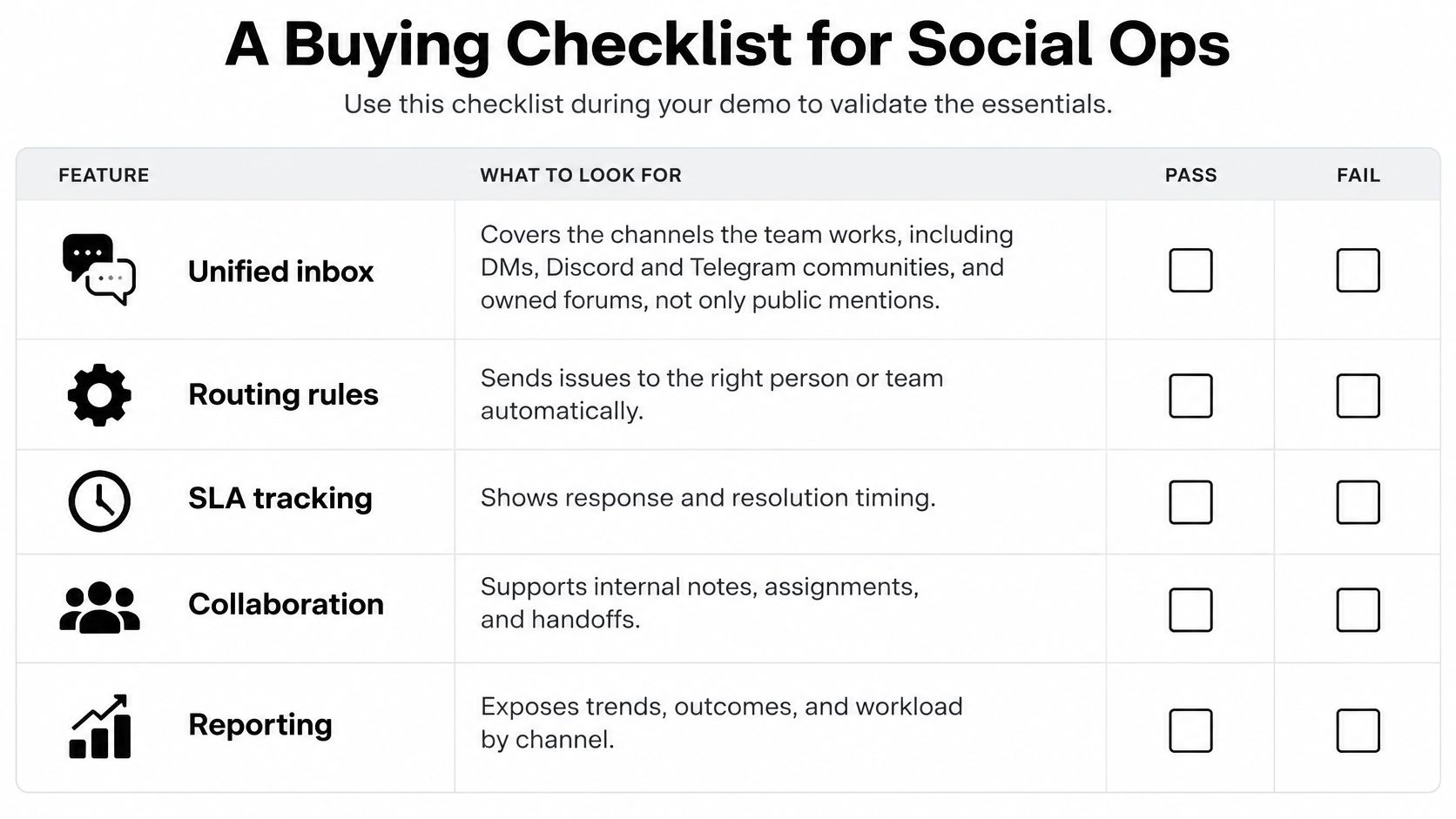
Score each check yes or no during the demo. Ask the vendor to use representative, appropriately redacted cases from your own queues rather than a polished collection of easy mentions.
Require a working demonstration
Does the unified inbox cover your actual channels? Verify DMs, Discord and Telegram communities, and owned forums, not just public brand mentions. Ask which message types, account permissions, and historical context each connector supports.
Can you inspect what filtering removed? Open the filtered queue and review a false-positive sample. A filtered percentage without recoverable examples doesn't let an ops owner assess whether legitimate customers disappeared.
Are intent and urgency separate from sentiment? Test distinct billing, outage, safety, and PR-risk labels. A polite account-access complaint should still receive urgent handling; an angry joke shouldn't automatically trigger crisis escalation.
Does routing reach a real owner? Send examples to finance, engineering, comms, and trust and safety. Test low-confidence escalation, rejected assignments, internal notes, and handoffs rather than stopping at a routing animation.
Can reviewers control reply drafts? Configure brand voice and approved information. Verify that sensitive cases remain unsent until a human approves them, including after a tag or assignment changes.
Do multilingual and multimodal tests survive your history? Use slang, sarcasm, screenshots, and memes from actual past cases. Ask reviewers to explain disagreements rather than accepting a single overall accuracy claim.
Can analytics export the operational scorecard? Request noise-filtered percentage, auto-resolution, time-to-first-meaningful-action by channel, override rate, and repeat contact. Confirm that you can inspect the underlying cases and distinguish response timing from resolution timing.
Can security verify the controls table? Require a provenance export, role-permission demonstration, model inventory, and CRM permission scope. Test retention and access revocation with the people who will approve production access.
Will the vendor support a bounded pilot? Propose one live queue for two weeks, compared with a holdout or a before-and-after baseline on that queue only. Agree on false-closure review before enabling automation.
Reject presentation-only analytics
A sentiment pie and follower chart don't answer these questions. Neither does a high auto-closure rate without case-level inspection.
Look for an operating-inbox pattern: unified intake, noise and intent tagging, accountable routing, controlled drafts, and analytics tied to human decisions. Other publishing or listening tools may remain useful, but they shouldn't substitute for proof that sensitive work reaches its owner.
Care and Comms Outcomes Worth Reporting
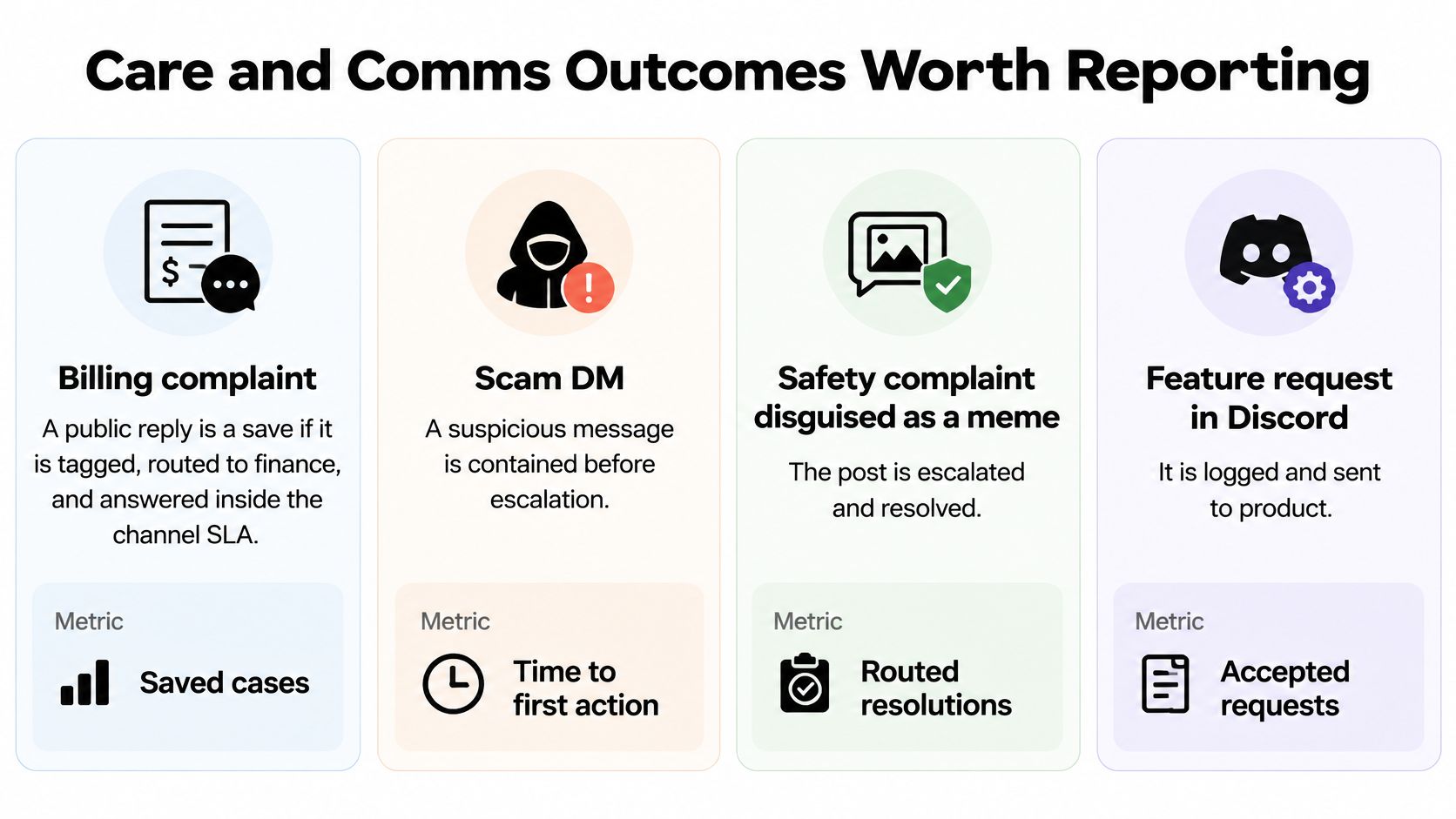
An executive rollup should distinguish work completed, risk handled, and business impact supported by evidence. Use case outcomes rather than treating every closed message as equivalent.
Follow the cases through the operation
A public billing complaint. A customer says a renewal charged them twice. The reviewer confirms the billing tag, finance accepts ownership, and the customer receives an actionable answer inside the channel SLA. Record time-to-first-meaningful-action, then evaluate the outcome through repeat contact on that issue.
An outage surge. Operators filter repetitive noise, use an approved status-response draft, and send engineering a defect cluster with original examples attached. Record prevented duplicate escalations only where a duplicate was identified and linked, not as a hypothetical saving. The primary metric is incident detection lead time.
A PR-risk meme. A sarcastic image appears dismissible until a reviewer recognizes a credible allegation. Comms owns the public response rather than letting the item close as casual engagement. Audit similar discarded items to measure false-negative exposure in the reputation queue.
A scam wave. Repetitive unsolicited DMs close under an approved rule, while reports of actual customer losses move to trust and safety. Compare the closed sample with escalated fraud cases before declaring containment. The metric is credible-fraud capture rate, assessed through reviewed cases.
A feature request in a DM deserves a separate product record, with the customer's original wording attached and the engineering or product destination recorded. Count an accepted request, not merely another positive mention.
Separate operational proof from revenue attribution
A 2025 survey of 1,200 global marketing leaders, summarized by Net Influencer, found 56% believed social media drives revenue, while 44% considered their teams expert at measuring business impact and fewer than half embedded social data into CRM systems. Don't fill that measurement gap by assigning sales value to every resolved complaint.
Report direct counts, such as resolved cases and defects surfaced, separately from indirect signals, such as fewer repeat contacts or improved retention among consented, reliably matched customer records. Keep unmatched identities visible as a limitation. Avoid claiming that every customer who stayed would otherwise have churned.
For content decisions arising from those conversations, planning with TheContentMap's performance insights can support a separate assessment of what published material achieves. Keep that assessment distinct from the value of resolving an account problem.
Faster handling is operational evidence. Avoided churn is a causal claim that needs stronger support.
Compare the same queue before and after filtering, routing, and drafting are enabled. Track first-route accuracy, reviewer touches per case, and repeat contact, while accounting for issue severity and seasonality. Use a matched cohort or holdout where feasible, and report uncertainty when samples are limited. That lets executives see an observed operational gain without mistaking it for proven revenue causation.
Pilot One Queue Before You Scale
Run a two-week pilot, not a platform tour. Choose a noisy live queue with a recognizable issue type, such as public billing replies plus related DMs, and agree on its boundaries before changing the workflow.
Record the baseline before enabling automation:
- Median time-to-first-meaningful-action. Measure when someone takes a useful step, using the same action definition throughout the pilot.
- Spam-or-duplicate share. Have reviewers distinguish repetitive unsolicited messages from separate customers describing the same incident.
- Human reopenings after closure. Record which cases operators reopen and why, including mistaken closures and new information.
Week one establishes the boundaries
Enable noise filtering and auto-tagging first. Limit auto-closure to repetitive unsolicited messages, inspect a daily sample, and preserve a straightforward recovery path for mistakes.
Keep payment, access, safety, and potentially public-risk decisions with people. Route actionable cases to finance, engineering, comms, or trust and safety, with a named fallback owner for unaccepted assignments.
At the end of the week, review override reasons with the receiving teams. Correct confusing labels, missing destinations, and unsafe closure rules before expanding what the system can do.
Week two tests assisted response
Add brand-voice drafts using approved answers, while retaining send approval for sensitive tags. Compare results with the baseline on that queue, noting changes in issue mix or incident intensity rather than attributing every improvement to automation.
Keep the executive rollup narrow: noise-filtered percentage, auto-resolution, response time by channel, override rate, and an outcome such as repeat contact or defects surfaced. Put false closures beside the automation results as a release condition, not an appendix.
Expand to another channel only if the operational measures improve without an increase in mistaken closures. If they don't, revise the taxonomy, routing, or review boundary and test again. The decision to scale should rest on traceable cases, not the appearance of a quieter inbox.
Sift AI offers a unified operating inbox for social and community channels, with noise filtering, intent tagging, routing, reply drafts, and analytics that keep humans responsible for hard calls. Visit Sift AI to discuss a bounded queue pilot and evaluate whether each meaningful signal reaches the right owner with an auditable decision trail.