Social Customer Service Operations Guide
"Master social customer service operations. Learn how to unify inboxes, route intents, balance AI with human support, and hit strict response SLAs."
An outage starts with one angry reply on X. Minutes later, Instagram fills with screenshots of failed payments, Discord members tag moderators, and someone asks whether the company is hiding a security incident. The team opens several native inboxes, copies links into a spreadsheet, and tries to decide which message deserves attention first.
That workflow breaks under pressure. Social customer service is public, time-sensitive, and operationally different from email or ticketing. A reliable operation needs a unified inbox, intent-aware triage, channel-specific SLAs, controlled public-to-private handoffs, and human ownership of sensitive decisions. AI should remove noise and prepare the next action, not make accountability disappear.
Table of Contents
- The Operational Reality of Modern Social Care
- Designing Public to Private Support Handoffs
- Setting Channel and Intent Specific Response Targets
- Balancing AI Automation With Human Authenticity
- Routing Social Signals Across Internal Departments
- Measuring Social Care Performance and Auto Closure
- Upgrading to an AI Orchestrated Command Center
The Operational Reality of Modern Social Care
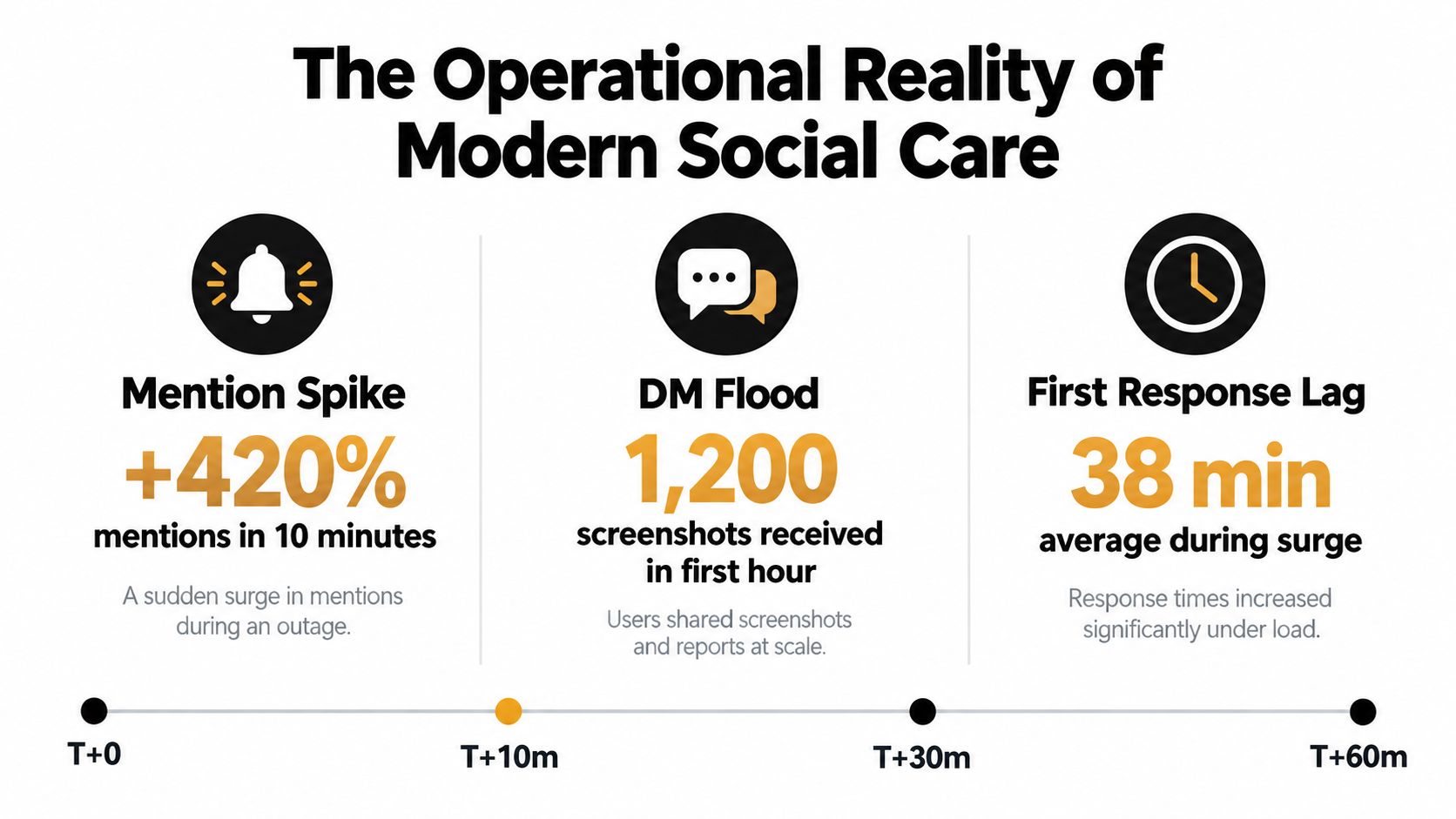
During an outage, social care rarely receives one clean queue. X mentions may contain duplicate reports, speculation, refund requests, and posts from journalists. Instagram DMs may include screenshots without context. Discord may surface a technically precise bug report inside a fast-moving conversation. TikTok comments can mix genuine questions with sarcasm, spam, and accusations.
A team monitoring each channel manually must repeatedly switch context, identify duplicates, assess urgency, and decide whether support, engineering, finance, communications, or trust and safety should act. That isn't a customer service process. It's emergency sorting performed in public.
Why manual monitoring misses the moment
Social media became a support channel because customers use it when other routes feel unavailable. A 2020 consumer survey of more than 1,000 people found that 26% chose social media for customer service when they couldn't reach a representative through another channel, while 42% expected resolution within one hour. The same research found that 33% of consumers who contacted a brand with a customer-service question never received a response.
Those figures describe more than poor etiquette. An unanswered public post remains visible to the original customer, their followers, and anyone looking for the same problem. A slow response can also force customers to repeat their story across a reply, a DM, a web form, and a phone call.
Operational rule: Treat every public support signal as both a customer case and a piece of visible brand communication.
The old broadcast model assumed that marketing published content and support handled private tickets. That boundary no longer matches the way people report problems. A billing complaint in an Instagram comment may need finance. A post about a broken login flow may need engineering. A viral allegation may need communications before a support agent sends a routine template.
The practical response is orchestration. AI can detect likely support intent, group duplicate posts, extract details from screenshots, identify language and sentiment, and surface the cases most likely to create customer or reputational harm. Humans still decide what the brand can promise, whether an allegation requires escalation, and how to respond when the facts aren't settled.
Designing Public to Private Support Handoffs
Moving a public complaint straight into a DM often feels efficient to the team and evasive to everyone watching. Customers want privacy for account, billing, and identity details, but they also want evidence that the brand has seen the issue.
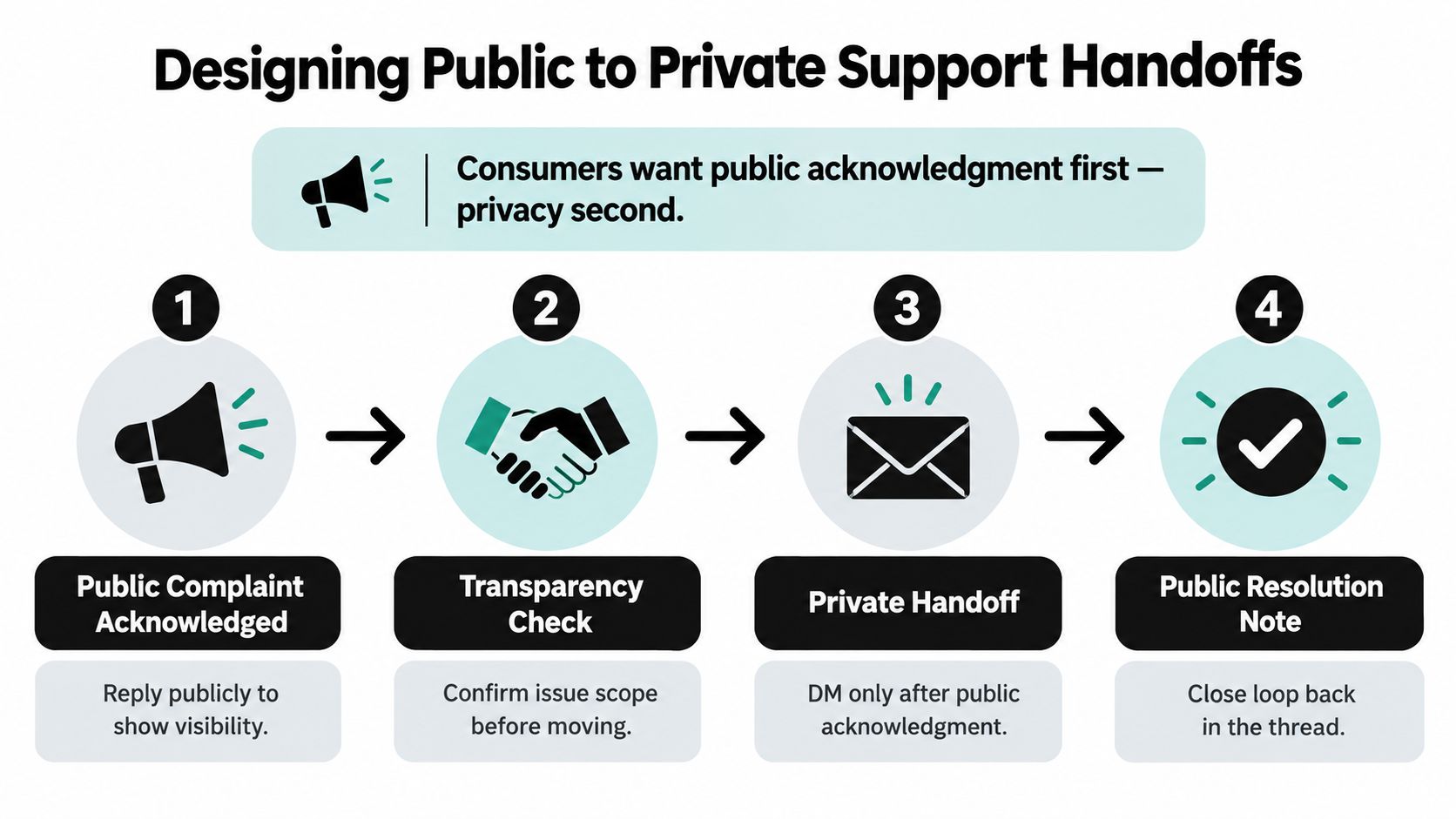
Research from Sprout Social on social customer service expectations found that 51% of consumers who contact a brand publicly expect a public acknowledgment before moving into a private direct message. That expectation should become a workflow rule, not a suggestion buried in a playbook.
Use a visible four-step handoff
1. Acknowledge the issue publicly. Confirm that the team has seen the problem without repeating personal information. For a failed payment, the reply might recognize the charge concern and state that the team is checking it. For an outage, acknowledge the disruption and avoid promising a restoration time that engineering hasn't confirmed.
2. Run a transparency check. Decide whether the conversation should move private, remain public, or use both channels. Account numbers, payment details, identity documents, and access credentials belong in a secure channel. A general outage update, product explanation, or confirmed resolution often belongs in the original thread as well.
3. Make the private handoff specific. Tell the customer why the DM is needed and what information the agent will request. Don't send a generic “please DM us” response that forces the customer to guess what happens next. Link the original post to the case in the unified inbox and preserve the reply chain, screenshots, timestamps, language, and prior tags.
4. Close the loop publicly when appropriate. Once the private case is resolved, return to the public thread with a concise progress or resolution note. Never expose account details. If the issue affects other customers, share the general fix or status so observers don't see only a disappearance into DMs.
Preserve context across teams
The handoff fails when the customer has to retell the story. A support agent may send the case to finance, finance may ask for a transaction reference, and communications may separately request the original wording. Each repetition increases effort and creates inconsistent replies.
The case record should carry the original post, conversation context, intent tag, risk level, channel, language, attachments, owner, and promised next action. For a billing complaint on X, finance should receive the payment context and public wording, while support owns the customer-facing update. For an account-access report on Instagram, trust and safety may need to review the risk before an agent requests sensitive details.
AI can draft the public acknowledgment and identify whether a private handoff is likely required. A human should approve language when the post involves legal exposure, safety, fraud, a public allegation, or an emotionally charged complaint. The customer should experience one connected case, not a sequence of disconnected departmental queues.
Setting Channel and Intent Specific Response Targets
A single social SLA creates false precision. It treats an urgent fraud report on X, a product question in a forum, and a feature request in a Telegram discussion as if they carry the same risk and audience.
Channel and intent should work together. Channel tells you how visible and time-sensitive the interaction may be. Intent tells you what could happen if the team waits.
| Queue | Typical signal | Operating response |
|---|---|---|
| X public complaints | Outage, billing failure, accusation, safety concern | Immediate detection and rapid human ownership |
| Instagram DMs and comments | Screenshots, account questions, purchase issues | Intent classification, privacy-aware handoff, case continuity |
| Discord and forums | Bugs, feature requests, community disputes | Route to engineering, product, or moderators with thread context |
| WhatsApp and Telegram | Direct support requests and account-related conversations | Secure handling, identity-aware escalation, clear ownership |
| TikTok comments | Product questions, viral criticism, spam waves | Filter noise, identify reputation risk, respond where visibility matters |
Research cited by Marketing Mag on world-class social customer service reports that 53% of customers who ask a brand a question on Twitter expect a response within one hour, regardless of when they post. The same source says 57% expect that response speed at night and on weekends.
That doesn't mean every message needs a human reply within the same window. It means your operation needs detection, coverage, and escalation outside office hours. A spam wave can be safely filtered. An outage report, payment failure, or safety signal can't wait behind routine mentions because it arrived after the daytime shift.
Route by risk, not arrival order
First-in-first-out triage is easy to explain and wrong for mixed social queues. Edison Research findings summarized in a Hootsuite social customer service whitepaper found that 32% of consumers seeking customer service through social media expected a reply within 30 minutes, while 42% expected one within 60 minutes.
Configure intent tags and urgency scores before assigning a case. Fraud indicators, account access failures, safety concerns, active outages, and credible reputational threats should bypass low-risk feature suggestions and duplicate mentions. The SLA should measure time to detection, time to owner assignment, time to first meaningful response, and time to resolution, not just the timestamp of an automated acknowledgment.
A product question can wait in a clearly owned queue. A payment complaint needs finance visibility. A public crisis signal needs communications involvement. The target isn't one impressive average. It's dependable handling of the cases whose consequences are greatest.
Balancing AI Automation With Human Authenticity
Faster replies aren't automatically better replies. A bot that responds instantly with the wrong tone can turn a frustrated customer into a public critic, especially when the message contains sarcasm, a screenshot, or a serious allegation that keyword rules misread.
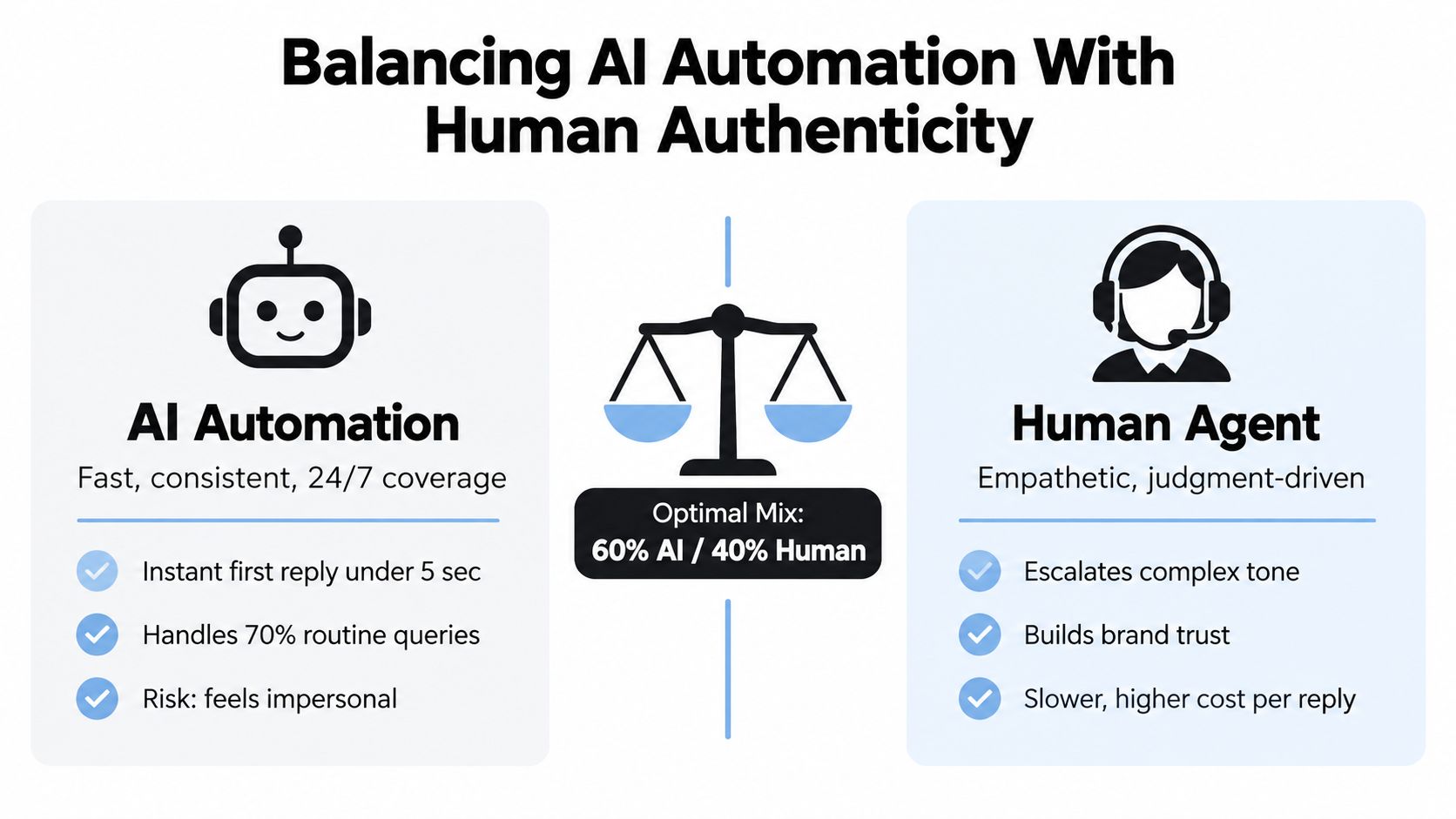
An Emplifi survey of nearly 1,000 frequent social-media users found that 67% preferred a human response, more than half considered AI responses inauthentic, and 83% wanted brands to disclose when AI was being used. Social care leaders therefore need to optimize for trust and resolution, not automation volume.
Give AI the repetitive work
AI is well suited to tasks that are repetitive, low risk, and easy to verify:
- Noise filtering: Remove obvious spam, scams, duplicate mentions, and irrelevant conversation from the active queue.
- Intent tagging: Distinguish billing complaints, outage reports, feature requests, bugs, account access, and general questions.
- Draft preparation: Create an on-brand response using approved knowledge and the conversation history.
- Context assembly: Attach the relevant thread, screenshot, prior case, language, and routing recommendation.
- Safe closure support: Suggest closure for a resolved, low-risk interaction when the customer has received a complete answer.
The system should stop drafting or auto-closing when confidence falls below the team's threshold. Sarcasm, ambiguous screenshots, multilingual slang, emotionally charged language, public allegations, safety concerns, fraud, payments, and account access deserve human review.
Human ownership matters most where the cost of being wrong is visible, irreversible, or personal.
Disclosure needs a policy as well. If AI drafts a reply and a human reviews it, the team can describe the interaction accurately without pretending a person wrote every word from scratch. If an automated agent handles the conversation, the customer should know that AI is involved and have a clear route to a human. The disclosure shouldn't be hidden behind vague language that makes escalation difficult.
A practical oversight model should define confidence thresholds, prohibited intents, mandatory reviewer roles, and audit samples. Teams building that process can use Pin Generator's AI oversight guide as a useful reference for keeping human review connected to automated decisions.
Measure successful resolution, customer effort, escalation quality, and reviewer fatigue alongside response time. A high auto-closure rate means little if customers reopen cases, repeat complaints on another platform, or publicly challenge an inaccurate answer. The right mix lets AI orchestrate the queue while humans approve, decide, and own the hard calls.
Routing Social Signals Across Internal Departments
A social message is often the earliest visible symptom of an internal problem. Treating every signal as a support ticket hides the department that can actually fix it.
A reply saying “my card was charged twice” should reach finance with the original transaction context. A Discord member posting a reproducible bug should reach engineering with the platform, version, steps, and media attached. A feature request repeated across Instagram DMs should reach product as structured feedback, not remain trapped in an agent's personal notes. A fast-moving accusation may require communications and trust and safety before support sends any response.
Build routing around ownership
The routing model should combine intent, urgency, channel, customer context, language, and risk. A keyword such as “charge” isn't enough. The system needs to distinguish a billing dispute from a product feature that mentions charging, and a legitimate payment concern from a scam message impersonating the brand.
A unified inbox can ingest mentions, comments, DMs, replies, reviews, and community posts from X, Instagram, TikTok, Discord, Telegram, WhatsApp, and forums. AI then groups related conversations, identifies likely intent, and recommends the internal owner. Sift AI is one example of this operating model. Its platform provides a unified command center, AI tagging and prioritization, drafted replies, and escalation to teams such as finance, engineering, communications, and trust and safety.
The routing record must remain richer than a department name. Preserve the exact social wording, thread location, attachments, language, sentiment, linked customer case, and any public commitment already made. Engineering needs the original bug report and environment details. Communications needs the public audience and spread context. Finance needs the account or transaction workflow, handled through the appropriate secure process.
Keep one owner accountable
Cross-functional routing creates a familiar failure mode: everyone is notified and nobody owns the next customer update. Assign a primary case owner, a supporting department, a response deadline, and an escalation path. The support owner can coordinate with finance while communications reviews a public statement, but the customer shouldn't have to manage that internal collaboration.
A shared case timeline prevents contradictory replies. It also gives leaders a usable view of recurring issues, from payment failures to feature requests buried in private messages. Social care becomes a signal engine for the business, while human teams retain responsibility for decisions that affect customers and reputation.
Measuring Social Care Performance and Auto Closure
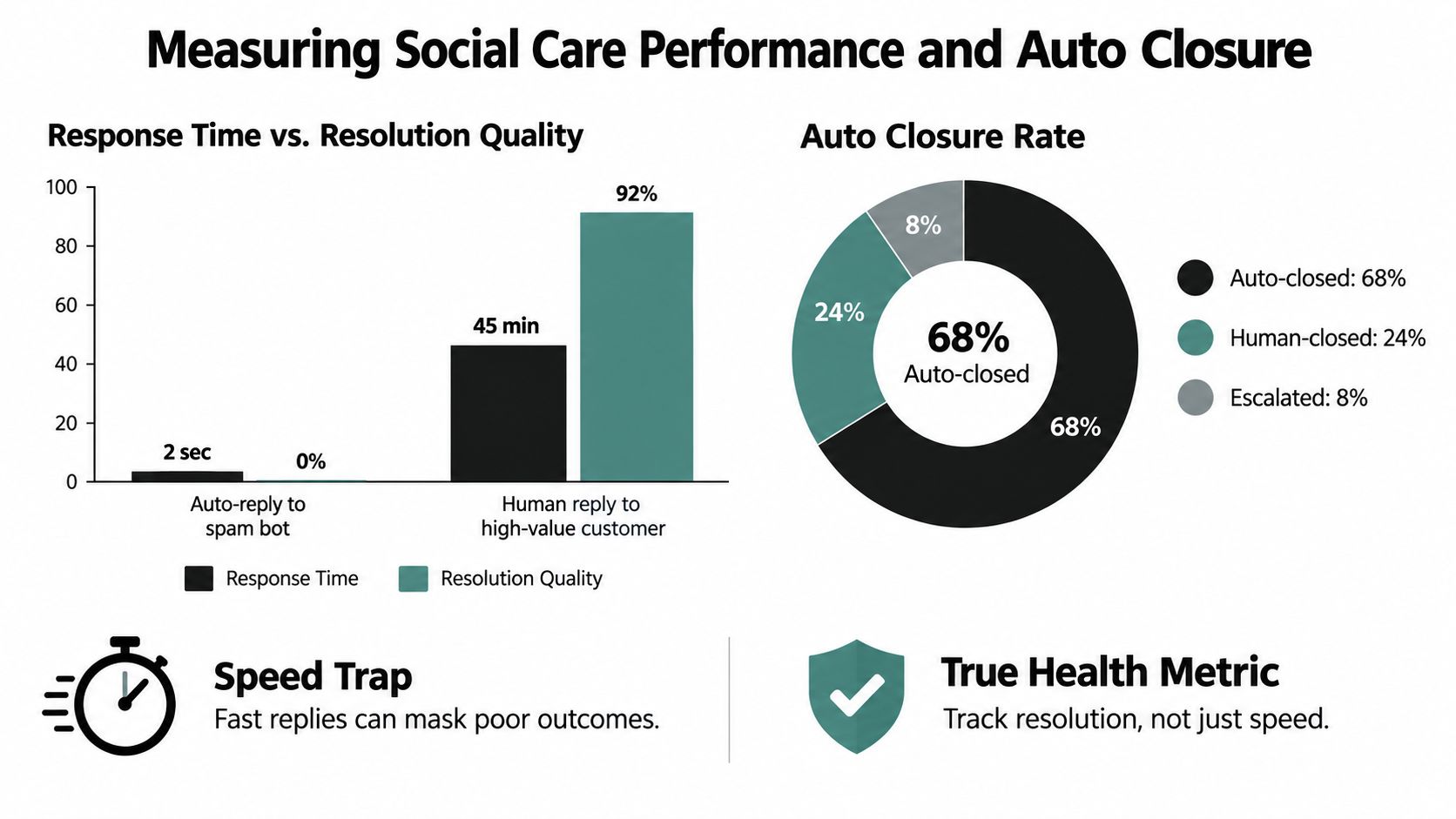
Average response time is easy to present and easy to manipulate. An immediate reply to spam can improve the metric while a high-value customer waits for a person to review a payment failure.
A 2024 benchmark cited in the Sprout Social Index found that incoming Instagram messages rose from 13 to 18 per day between 2023 and 2024, while the overall daily response rate to social messages and comments declined from 8% to 7%. The combination of higher inbound demand and lower response coverage shows why manual, channel-by-channel monitoring doesn't scale reliably.
Use a measurement stack
Track the operation in layers so one attractive number can't hide a broken workflow:
- Coverage: Measure the share of relevant messages detected, classified, assigned, and answered by channel.
- Noise filtering: Separate spam, scams, duplicates, and irrelevant mentions from genuine customer interactions.
- Speed: Report time to detection, owner assignment, first human-quality response, and resolution.
- Outcome: Track successful resolution, reopen rate, repeat contact, escalation quality, and customer effort.
- Automation quality: Monitor auto-closure rate by intent, confidence, channel, and risk. Review cases that customers reopen or challenge.
- Human load: Watch reviewer fatigue, override frequency, escalation volume, and cases requiring manual correction.
Segment every measure by intent and severity. A single average can hide a long tail of unresolved fraud reports or public outage complaints. Compare auto-closed cases with human-reviewed cases, then inspect the language and context rather than assuming automation worked because the queue became smaller.
A closed case isn't necessarily a resolved case.
Use the dashboard to improve rules and ownership. If feature requests are being routed to support, refine intent classification. If agents repeatedly edit drafts about billing, update the approved knowledge and require finance review. If customers receive private resolutions but continue posting publicly, inspect the public acknowledgment and closure workflow.
The executive view should connect operational health to customer outcomes. Report how much noise the system removed, how quickly high-risk cases reached owners, how often automation required intervention, and whether customers received complete resolutions. Speed matters, but it must serve resolution rather than replace it.
Upgrading to an AI Orchestrated Command Center
The move from separate native inboxes to an AI-orchestrated command center should happen as an operational rollout, not a rushed platform switch. Start with the failure that costs the team the most. For one organization, that might be outage surges across X and Discord. For another, it might be billing complaints scattered through Instagram, WhatsApp, and email.
Establish the control layer first
Connect the channels where customers already raise issues, then map the internal systems that hold customer, order, account, and incident context. Define role-based permissions before inviting every department into the queue. Finance shouldn't see information it doesn't need, and a community moderator shouldn't be able to approve a sensitive public statement.
Create the initial taxonomy around real work:
- Intent: Billing, outage, bug, account access, feature request, abuse, product question, or reputation risk.
- Urgency: Routine, time-sensitive, critical, or escalation required.
- Owner: Support, finance, engineering, product, communications, or trust and safety.
- Action: Draft, assign, request secure details, acknowledge publicly, escalate, or close.
- Voice: Approved terminology, prohibited promises, escalation language, and platform-specific style.
Train for the language customers actually use
Keyword matching fails when customers use slang, sarcasm, abbreviations, images, memes, or mixed languages. Give the system examples from real X replies, Instagram screenshots, TikTok comments, Discord threads, Telegram conversations, and forum posts. Include examples where the same word has different meanings, and mark cases that require a human because the context is uncertain.
Start with AI recommendations and human approval. Let reviewers correct tags, routing, draft language, and closure decisions. Feed those corrections back into the operating rules, but retain auditability so the team can explain why a case was classified or closed.
External specialists can help with adjacent campaign and channel work. For example, teams evaluating Social Cloud campaign services can separate campaign execution from the support command center, then define how campaign responses, inbound complaints, and escalation signals enter the same ownership model.
Roll out by risk, not ambition
Begin with low-risk classification, duplicate detection, and draft assistance. Add automated handling only after the team understands error patterns. Keep mandatory human approval for payments, account access, safety, legal threats, public allegations, crisis communication, and emotionally charged conversations.
The finished command center should make the human team calmer and more informed, not less accountable. Agents see the full context, leaders see SLA and resolution health, and internal departments receive signals they can act on. AI handles the noise and prepares the work. People approve the response, decide the exception, and own the outcome.
Sift AI brings social and community channels into one command center, filters noise, tags intent and urgency, routes cases to teams such as finance, engineering, and communications, and drafts replies for human approval. Visit Sift AI to see how an AI-orchestrated workflow can help your team manage public handoffs, channel-specific SLAs, and high-stakes social care with clearer ownership.