Risk Assessment Automation: Social Operations Playbook
"Learn how risk assessment automation transforms social care. From unified inboxes to AI scoring, get the playbook for enterprise social operations."
Manual review is breaking teams: GRC teams spend an average of 14 hours per week on manual processes, and 93% of organizations want to automate more of their GRC functions. Risk assessment automation works when AI handles repetitive triage and evidence work while people approve, decide, and own the consequential calls.
At 3 AM, an outage turns a manageable support queue into a wall of notifications. Billing complaints appear beneath outage reports, scam accounts copy the brand, customers post screenshots in multiple languages, and a journalist asks for comment in a public mention. One agent watches X, another checks Instagram, someone searches Discord, and nobody has a reliable view of what has already been answered.
That isn't a motivation problem. It's an operating model problem. Social teams can't protect SLAs or make sound risk decisions when they manually inspect every message, copy context between tools, and rely on whoever happens to be online to spot the serious issue.
Table of Contents
- Why Manual Triage Is Breaking Social Teams
- The Unified Inbox Architecture
- How AI Models Score and Tag Risk
- Triaging, Routing, and Escalation Rules
- Proven Metrics and Compliance Wins
- Governance, Limits, and the Human Loop
Why Manual Triage Is Breaking Social Teams
During an outage, the queue becomes the first operational failure. An agent opens a billing complaint in an Instagram reply, switches to a Discord thread about the same incident, then spots a threatening post beneath a flood of duplicate outage reports. Each channel contains part of the story, while no shared view shows which conversation carries the greatest risk or who owns the next response.
Manual triage forces agents to treat every message as urgent until someone reads it. Duplicate complaints, spam, scam waves, and routine feature requests consume the same attention as threats, account takeovers, or public allegations. Reviewers spend time discovering what matters instead of acting on it.

The queue creates the risk
The GRC burden figures cited earlier reflect the same operational pattern, but social teams experience it as reviewer fatigue and missed service targets. A noisy inbox hides the signals that require a decision. Agents lose time opening near-identical threads, checking whether another team already replied, and reconstructing context across channels.
That delay creates inconsistent response times and makes escalation depend on whoever happens to notice the issue first. A clear triage system should identify related messages, surface the strongest risk signals, and show why an item has priority before a reviewer opens it.
Practical rule: If an agent must read every item to discover which items matter, the system hasn't automated triage.
Automation is an operating model
Risk assessment automation should remove repeatable work first. It can identify likely billing intent, group duplicate outage reports, filter obvious spam, detect a scam wave, and flag language for trust and safety or communications review. Those actions reduce queue volume without transferring accountability to a model.
Human judgment still belongs on decisions with material consequences. A reviewer should decide whether a reputational incident is closed, whether a legally sensitive allegation receives a public reply, and whether the available evidence supports escalation.
The risk assessment and management tool market is valued at USD 4.5 billion in 2025 and is forecast to reach USD 12.2 billion by 2034, implying a 12.0% CAGR from 2026 to 2034, according to the market figures cited by MetricStream. For social operations, the useful shift is from periodic review to continuous prioritization. The system watches the full stream, groups recurring patterns, and sends exceptions to people with the context needed to act.
That operating model protects both speed and judgment. Agents handle the conversations that need a human response, while automation keeps routine noise from setting the agenda.
The Unified Inbox Architecture
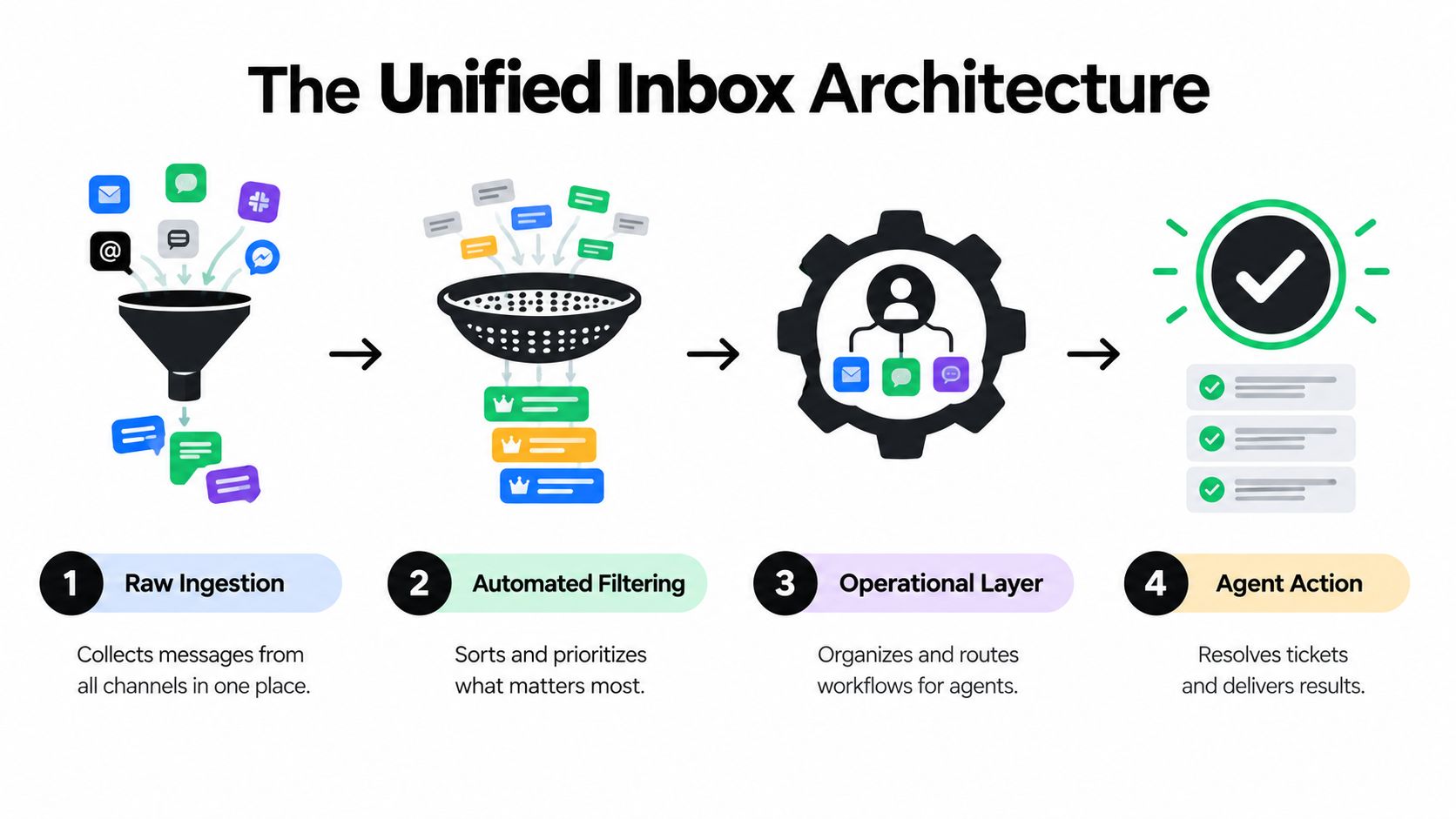
A unified inbox isn't a shared feed with every channel poured into one screen. It's an operational layer that preserves conversation history, assigns ownership, tracks response time, and gives each message a path to resolution.
Start with raw ingestion from X, Instagram, TikTok, Discord, Telegram, WhatsApp, and forums. The system needs to retain the post, reply, DM, thread context, account information, language cues, and relevant history. Without that context, a risk model sees isolated text and can't distinguish a genuine billing complaint from a copied scam message.
Filter before review
The next layer removes obvious spam, duplicate messages, irrelevant noise, and coordinated scam activity before an agent has to inspect the queue. The unified inbox workflow described by Sift treats filtering as a prerequisite for human review, not an optional convenience.
That ordering matters. If agents see raw ingestion first and filtering later, reviewer fatigue has already begun. A good pipeline places likely priority items at the top, groups related conversations, and makes the reason for prioritization visible.
Turn signals into work
The operational layer converts filtered messages into work that a team can own. Triage decides what needs attention first. Tagging records intent or risk. Routing sends the item to support, finance, engineering, communications, or trust and safety. Escalation moves ambiguous or high-impact cases to a specialist.
A billing complaint in a public reply shouldn't sit with a general community queue if the customer needs account verification. An outage surge shouldn't produce hundreds of independent tickets if the system can group reports and route the incident signal to engineering and communications. A product request buried in DMs should reach product rather than disappear into a closed inbox.
Agent action is the final layer, not the first. The agent sees the history, the label, the risk rationale, the owner, the SLA, and any approved response pattern. That lets the human resolve the issue instead of reconstructing it.
How AI Models Score and Tag Risk
Keyword matching asks whether a message contains a known word. Risk-aware classification asks what the person is trying to do, how urgent the situation is, which business function owns it, and what could happen if the team mishandles it.
“Your app stole my money” might be a billing complaint, a fraud allegation, or an angry response to a duplicate charge. “Everything is fine,” posted beneath a screenshot of a failed payment, may be sarcasm. A slang phrase in a multilingual Discord thread may express a serious threat even though it contains none of the words in an English escalation list.
Keyword rules versus contextual models
Simple tagging still has a place. A rule can reliably identify a known campaign phrase, a product name, or a direct request for a refund. Rules are easy to inspect and useful for deterministic routing.
They fail when the signal depends on context. Keyword matching can label every message containing “scam” as a fraud case, even when a customer is asking whether an unrelated account is legitimate. It can also miss an outage when customers use screenshots, slang, abbreviations, or indirect descriptions instead of the incident language used internally.
Context-aware models compare the message with its thread, surrounding conversation, language, account history, and operational signals. They can classify intent, urgency, topic, and likely business function across posts, comments, and DMs. The risk assessment guidance from Sift recommends labels such as billing, outage, scam, threat, creator complaint, feature request, and policy issue.
Score for action, not decoration
A risk score is useful only when it changes the queue. Low-risk, repetitive items can be grouped or handled through an approved workflow. Mid-range items should receive a human review. High-impact issues should go directly to a named specialist with the relevant evidence attached.
A semi-automated socio-technical risk assessment evaluation found that tools can automate execution steps such as computing risk levels and formatting reporting artifacts, while human oversight remains necessary for method validation and higher-value judgment. The empirical evaluation of semi-automated risk assessment supports a useful division of labor: machines extract, structure, score, and summarize; people interpret context and accept or reject the decision.
For social operations, that means the model shouldn't merely say “high risk.” It should show why the item was raised, identify related messages, suggest the owner, preserve the evidence, and present the response pattern. A human can then approve a reply, change the route, merge the issue into an incident, or escalate it to communications.
The strongest systems also learn from reviewer corrections. If agents repeatedly reclassify multilingual slang, sarcasm, or creator complaints, those corrections should improve the tagging logic without weakening the audit trail.
Triaging, Routing, and Escalation Rules
A risk label without an operational rule is just decoration. Every high-priority social risk needs a defined path from detection to closure.
Build the path around five controls. The first four are essential: trigger, responder, SLA, and closure rule. Add a fifth, response pattern, so agents know what they can say, when approval is required, and which phrasing is prohibited.
Define the trigger
A trigger might be a sudden cluster of outage language, a public billing complaint, a threat, a scam pattern, an executive mention, or a post alleging a product failure. Don't define it only with keywords. Combine intent, urgency, channel, account context, repetition, and likely impact.
For example, one refund request in a private DM may route to support. Several public complaints about unauthorized charges may route to finance and customer care. A post from a journalist during an outage may require communications review even if the text contains no support keyword.
Assign the responder
Routing should follow skill, language, account tier, and risk level, not whoever is online. The social inbox management playbook from Sift recommends named owners, explicit hand-off formats, and response expectations.
Use a practical routing map:
- Billing complaints: Send account-specific issues to support or finance, with privacy-safe handling for public replies.
- Outage surges: Group duplicate reports, route the incident signal to engineering, and send approved status language to communications and care.
- PR risk: Escalate allegations, executive mentions, and journalist inquiries to communications or a named PR owner.
- Trust and safety: Send threats, scam waves, and policy-sensitive content to specialists with the right review authority.
- Feature requests: Tag the request and route useful context to product instead of leaving it in a general community queue.
Make the SLA and closure rule explicit
An SLA should state when the first response is due, who owns the clock, and what happens before breach. A closure rule should define the evidence required to close the item. “Agent replied” isn't enough if finance still needs to investigate the charge or engineering hasn't confirmed the outage is resolved.
Auto-closure works best for low-risk, repetitive cases with a known resolution pattern. It shouldn't close a threat, legal-sensitive allegation, unresolved billing dispute, or crisis escalation merely because the customer stopped replying.
Escalate ambiguity, not just severity. A message can look harmless in isolation and become high risk when its thread, account, or incident context is considered.
The response pattern completes the control. It can specify approved brand voice, required disclaimers, approval steps, and no-go phrasing. AI can draft the response, but the accountable human decides whether the draft is appropriate for the audience and situation.
Proven Metrics and Compliance Wins
Automation needs an outcome ledger, not a vanity dashboard. Counting tags created or messages processed tells leaders that the system is active. It doesn't show whether customers receive better service, whether reviewers can focus, or whether high-risk items reach the right owner.
An industrial GRC study reported a 63% reduction in operational expenses and a 78% improvement in accuracy among organizations automating routine compliance tasks. The same source reported 85% better visibility into the risk environment and 71% faster response times to emerging threats, while stating that successful organizations typically automate about 70% of standard GRC processes and preserve human oversight for strategic decisions and complex assessments. These figures come from the industrial GRC study published by IRJMETS.
Read the numbers correctly
The cost reduction is not a promise that every social team will achieve the same result. It illustrates where value can emerge when teams stop spending human time on repetitive classification, evidence assembly, duplicate handling, and manual routing.
The accuracy improvement matters just as much. In a noisy inbox, an incorrect route creates extra work for at least two teams. A billing issue sent to engineering gets re-read. A product request sent to care receives a generic answer. A PR-sensitive mention left in a general queue can become a public escalation before the right person sees it.
Track operational metrics that expose those failures:
- Noise-filtered percentage: Measure how much irrelevant or duplicate volume agents no longer need to inspect.
- Auto-closure rate: Separate safe, approved closure from silent dismissal, and audit the reasons for closure.
- Routing accuracy: Review whether finance, engineering, communications, and trust and safety receive the right work.
- SLA breach rate: Look for breaches by intent, channel, language, and owner, rather than relying only on an overall average.
- Reviewer corrections: Use re-tags and reassignment patterns to find model weaknesses.
Connect compliance to evidence
Compliance value appears when the system preserves the trigger, classification, response, approval, owner, and closure evidence. That record helps a team explain what happened during an outage or escalation without reconstructing events from scattered screenshots and chat messages.
The strongest business case combines efficiency with control. Automation reduces repetitive work, while structured evidence gives leaders a clearer view of risk and makes exceptions easier to investigate.
Governance, Limits, and the Human Loop
Risk assessment automation can't compensate for disconnected data. A 2026 risk technology survey found that well over half of respondents lacked meaningful system integration, with many organizations relying on disconnected systems and spreadsheet-heavy processes, according to the Airmic Risk Technology Survey Report 2026.
That problem appears in social operations when the inbox, CRM, incident tool, analytics platform, and escalation channel hold different versions of the same conversation. The model may identify an outage, but if it can't see the incident status, customer history, ownership, or prior response, its recommendation won't be decision-grade.
Set boundaries before deployment
Start by deciding what the system may do without approval. Filtering obvious spam and grouping duplicate outage reports usually carries less decision risk than closing a fraud allegation or publishing a response to a journalist.
A practical governance model separates machine execution from human judgment:
- Automate extraction: Collect messages, thread context, language, attachments, and related records.
- Automate prioritization: Score intent, urgency, likely impact, and routing destination.
- Require review for ambiguity: Escalate unclear, high-impact, legally sensitive, or reputationally exposed cases.
- Record every decision: Preserve the model output, reviewer action, response, owner, and closure reason.
AI-specific risks make this boundary more important. Current risk assessment methods often lack threats and assets specific to AI systems, including training datasets, machine learning models, and automated decision pipelines. Recent research also identifies limitations in explainability, uncertainty representation, and black-box validation in AI risk assessment research published by Springer.
Keep people accountable
The human loop isn't a failure of automation. It's the control that makes automation usable in consequential work. Agents and specialists should be able to override a label, change an owner, pause auto-closure, edit a draft, and record why the decision changed.
Review those overrides as operational data. A spike in reassignment from support to finance may indicate a routing gap. Repeated rejection of drafts may point to a brand voice problem. A cluster of manual escalations in one language may show that the model needs better multilingual context.
The right target isn't a queue with no humans. It's a queue where humans spend their time on judgment, accountability, and customer outcomes instead of searching for the signal.
Sift AI gives social and community teams a unified inbox across channels, AI filtering and tagging, routing to owners such as finance, engineering, communications, and trust and safety, plus drafted responses and escalation workflows. Visit Sift AI to see how your team can apply risk assessment automation without removing human control from the conversations that matter.