Real Time Data Ingestion: The Social Ops Playbook
"Master real time data ingestion for social and community operations. Learn streaming architectures, connectors, reliability patterns, and how Sift AI uses them."
A billing complaint starts climbing through replies on X while an outage drives customers into Instagram DMs. At the same time, a scam wave reaches WhatsApp and a community argument accelerates in Discord. Your team is still working from email tickets, manually refreshing platform tabs, and trying to decide whether the next message belongs with finance, engineering, comms, or trust and safety.
That failure rarely begins with a bad triage rule. It begins earlier, when the signal arrives late, arrives twice, loses its context, or never reaches the queue where anyone can act on it. Real time data ingestion is therefore not just backend plumbing for social care. It determines whether your unified inbox gives people a usable operating picture or a delayed, noisy approximation of one.
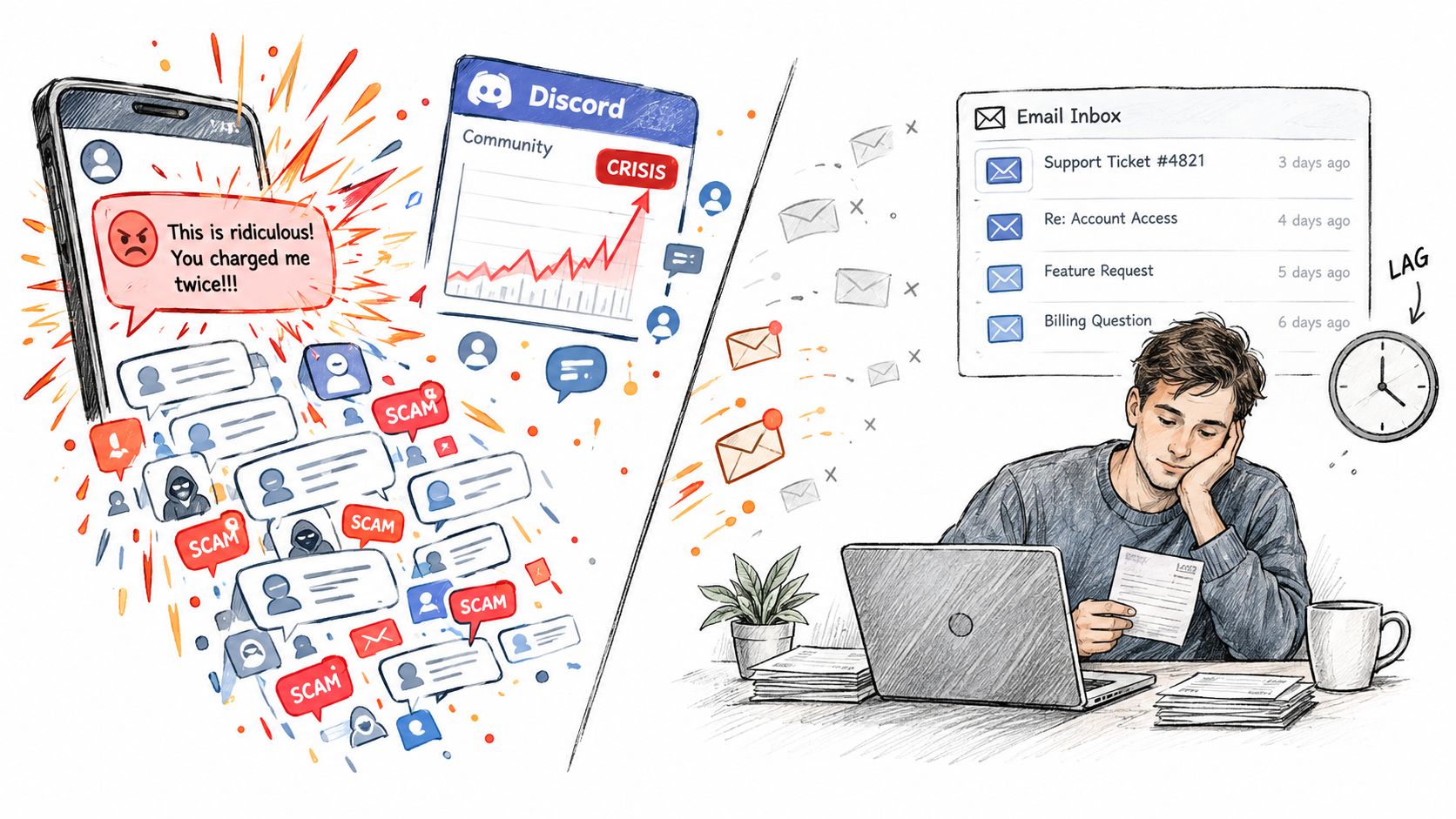
Table of Contents
- Why Social Teams Still Miss Critical Messages
- What Real Time Data Ingestion Actually Means
- Streaming Platforms That Scale Under Crisis
- How Connectors and Messaging Shape Triage
- Reliability, Latency, and Security Trade-offs
- Monitoring and Metrics That Matter
- Real-World Use Cases in Social Care Operations
- Moving from Ingestion to Intelligent Routing
Why Social Teams Still Miss Critical Messages
During a live outage, the first customer signal often appears in a reply, not a ticket. A customer posts a screenshot of a failed payment, another tags the brand in a video, and a third sends a direct message containing an account detail that shouldn't be public. If the ingestion layer treats those as unrelated fragments, the team sees volume without seeing the incident.
The practical difference is decision time. A message that reaches the right reviewer with its thread, media, language, customer history, and source intact can trigger an appropriate escalation. The same message, stripped of context or delayed behind a polling cycle, becomes another item in a crowded queue. Faster collection helps, but speed alone won't improve response time, SLA performance, or auto-closure rate if the pipeline can't preserve meaning.
The inbox is only as good as its event stream
Polling disconnected systems creates predictable weaknesses. A connector may fetch a page of posts, another may fetch replies, and a third may update a CRM record later. Between those operations, edits can be missed, duplicates can appear, and a high-risk mention can sit behind low-value chatter.
An event stream changes the operating model. Producers publish activity as it happens, a durable log retains the event, and independent consumers can process it for tagging, routing, search, analytics, or escalation. The support team doesn't need to coordinate every downstream use with the source system.
Operational rule: Treat every social signal as an event that may need to be replayed, reconciled, and reviewed, not as a disposable notification.
The architecture behind Apache Kafka established this pattern at LinkedIn around 2010–2011, when Jay Kreps, Neha Narkhede, and Jun Rao built it to handle clicks, messages, profile interactions, and feed events through a unified durable stream. Kafka was open-sourced in January 2011, entered the Apache Incubator later that year, and became an Apache top-level project in October 2012. The history and architectural principles are documented in this Apache Kafka background.
For a social care leader, the lesson isn't that every team needs Kafka. It's that durability, replayability, and decoupled consumers matter when brand reputation moves faster than a shared inbox. When assessing adjacent tools, you can also compare brand monitoring tools to understand how different products collect, organize, and surface external signals.
What Real Time Data Ingestion Actually Means
Real time data ingestion captures an event close to the moment it occurs, records it in a durable stream, and makes it available to downstream consumers with low propagation delay. In a social-care system, the event could be a post on X, a reply on Instagram, a TikTok comment, a Discord message, a Telegram forward, a WhatsApp DM, a forum edit, or an image attached to any of them.
That definition has four parts, and removing any one of them creates operational gaps.
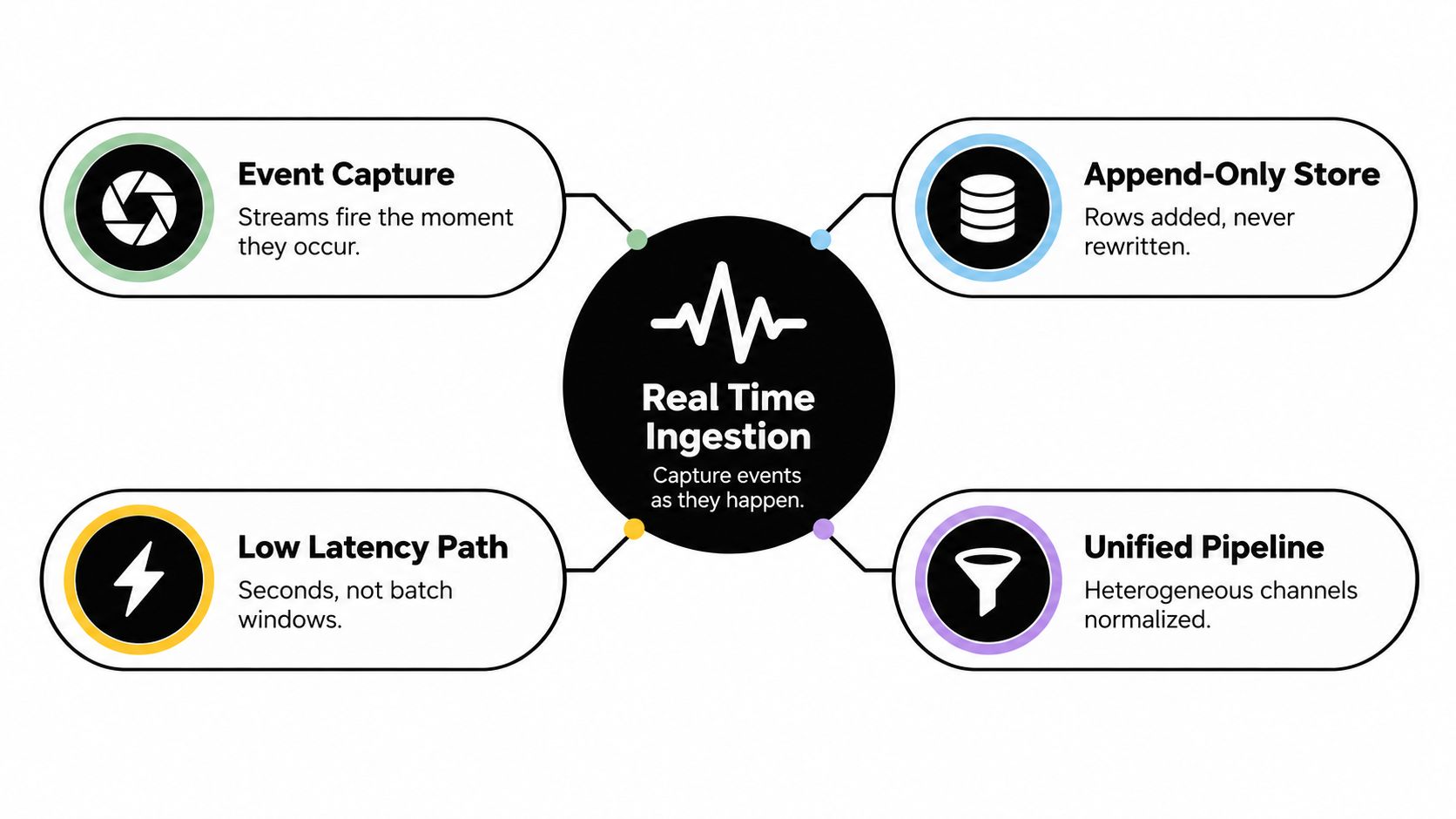
Capture the event, not just the latest state
A batch export gives you a snapshot. An event stream gives you the sequence that produced the snapshot. That distinction matters when a customer edits a message, deletes an attachment, adds a reply, or moves from a public complaint to a private conversation.
The producer might be a platform webhook, an API connector, a change-data-capture process from a CRM, or an application service that emits events directly. The ingestion layer should preserve the original event identity and source rather than collapsing everything into a final row immediately.
Append before interpreting
An append-only log adds records without rewriting the history of what arrived. That makes replay possible when a classifier changes, a routing rule is corrected, or an enrichment service was unavailable during a surge.
The stream should retain enough metadata to answer practical questions:
- What arrived: Preserve the raw payload or a safely stored representation of it.
- Where it came from: Record the platform, account, conversation, author context, and connector.
- What changed: Track edits, deletions, transformations, and enrichment results.
- Who consumed it: Keep lineage for triage, analytics, audit, and downstream automation.
This structure lets independent consumers handle different jobs. One consumer can detect billing intent, another can search media, another can route a crisis mention to comms, and another can update executive reporting. They don't need separate point-to-point integrations with every source.
Real time doesn't mean every action must happen instantly or synchronously. It means fresh events become available while they still influence a decision, rather than waiting for a reporting window or a later extraction job. Teams evaluating enrichment, normalization, and context layers may find it useful to review guidance on finding the right enrichment stack.
Streaming Platforms That Scale Under Crisis
A social-care surge can overwhelm a system that performs well on ordinary days. Architecture must model peak records per second and peak bytes per second separately, because crisis traffic changes event shape. A flood of short replies may exhaust record capacity first. A smaller stream of image-heavy posts may consume bandwidth first.
Amazon Kinesis Data Streams makes those limits explicit. Each shard supports up to 1 MB/s or 1,000 records/s for writes, and up to 2 MB/s for reads, according to the Kinesis Data Streams FAQ. Total stream capacity equals the capacity of its shards, so sizing should use whichever limit requires more shards. That calculation affects decision quality directly. Dropped or delayed posts can leave a social-care team routing from an incomplete view of the incident.
| Platform | Write Capacity | Read Capacity | Scaling Model |
|---|---|---|---|
| Amazon Kinesis Data Streams | Per shard, up to 1 MB/s or 1,000 records/s | Per shard, up to 2 MB/s | Provisioned mode adds shards. On-demand mode manages shard capacity automatically |
| Apache Kafka | Cluster capacity depends on brokers, partitions, replication, and storage design | Consumer capacity depends on partitions, consumers, and broker resources | Add brokers and partitions, then manage replication and consumer-group balance |
| Managed streaming service | Service-specific limits and quotas | Service-specific limits and quotas | Provider-managed infrastructure with configuration and quota controls |
Kafka and Kinesis solve different operating problems
Kafka gives engineering teams a distributed log with partitions, replication, retention, and independent consumer groups. It provides control over event distribution and replay across downstream services. That control brings operational work: broker capacity, partition placement, replication health, upgrades, and consumer rebalancing.
Kinesis removes much of the cluster management. Provisioned streams expose shard capacity, while on-demand mode adjusts capacity automatically. Its default on-demand capacity is 4 MB/s write and 8 MB/s read, with scaling up to 10 GB/s write and 20 GB/s read in selected regions, including US East (N. Virginia), US West (Oregon), and Europe (Ireland). Teams should verify regional availability and quotas before treating those figures as an incident plan.
Neither service removes design decisions. Partition keys can create hot shards or hot Kafka partitions. A popular account, campaign hashtag, or outage identifier may concentrate traffic when the key strategy is too narrow. Ask how the system distributes a viral thread, rather than relying only on a healthy broker status.
Capacity needs headroom and replay
Average volume is a weak planning input. LinkedIn's Kafka history reports throughput rising from approximately 1 billion messages per day in 2011 to about 20 billion in 2012, 200 billion in 2013, and 1 trillion by 2015. It also reports a peak of roughly 4.5 million messages per second in 2015, around 1.4 trillion messages per day in 2016, and more than 7 trillion messages per day by 2019 across over 100 clusters, approximately 4,000 brokers, and 7 million partitions. These figures appear in this LinkedIn Kafka architecture history.
Social-care teams need a practical rule: design for bursts, preserve replay, and let triage, analytics, search, and escalation consume independently. A replayable stream also supports channel-neutral routing, so posts, DMs, memes, and multilingual slang can reach the right human without forcing every decision through one consumer.
Platform guidance can help teams compare transformation and scaling choices, including these Databricks ETL best practices. The connector that survives a crisis is the one that preserves enough capacity and history for routing decisions to remain trustworthy.
How Connectors and Messaging Shape Triage
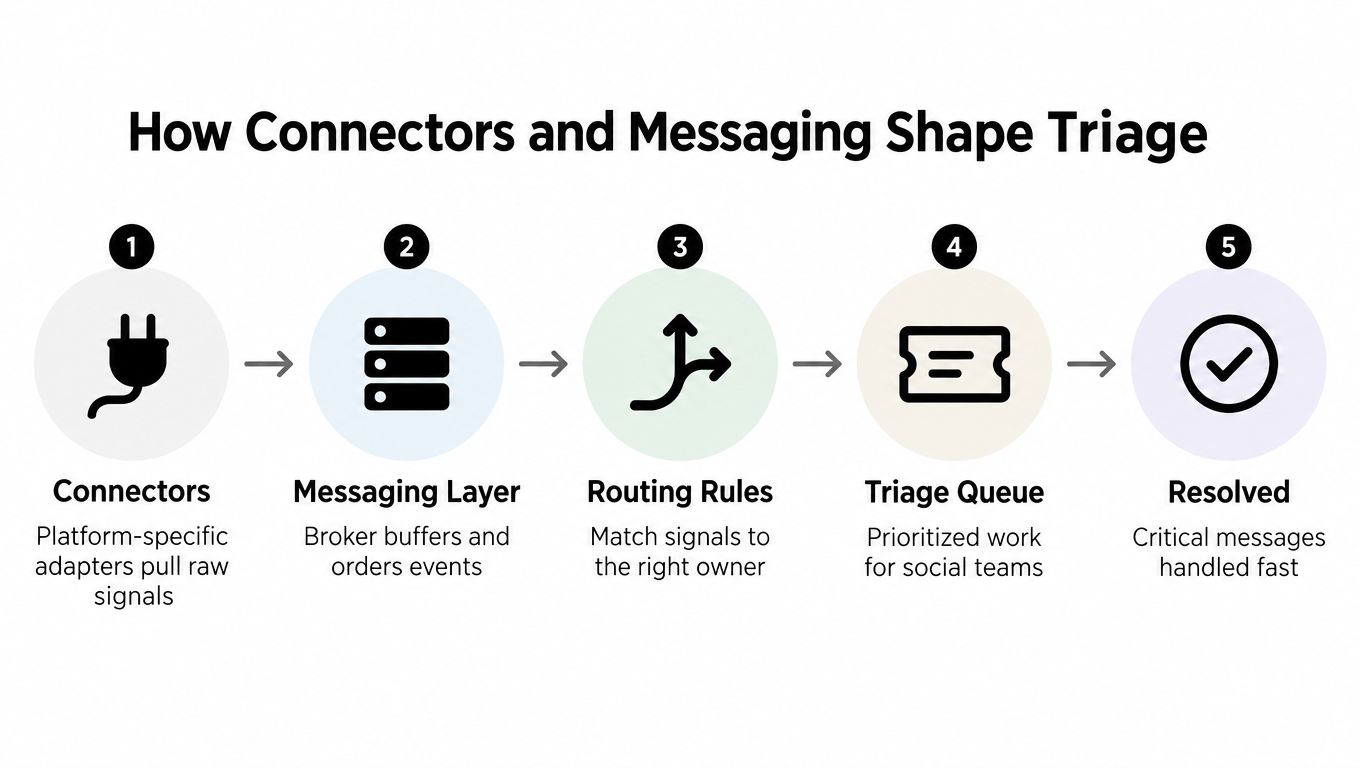
A connector decides what enters the system. A messaging layer decides how it waits, moves, and gets consumed. Routing decides who acts. If those layers disagree about identity or schema, the unified inbox becomes a fast way to distribute confusion.
For X, Instagram, TikTok, Discord, Telegram, WhatsApp, and forums, connectors need platform-specific handling for posts, replies, DMs, media, forwards, edits, and deletions. A webhook may provide immediate delivery where the platform supports it. Polling may be necessary as a fallback. Neither approach is sufficient if the connector drops provenance or treats a forwarded meme as equivalent to a plain text reply.
Compare the layers by failure mode
Webhooks reduce collection delay and can carry event-specific context, but they depend on delivery retries, endpoint availability, and platform coverage. A missing retry or weak acknowledgment path can turn a temporary outage into a permanent gap.
Polling is easier to introduce for platforms without usable event delivery, but its freshness depends on the interval and API limits. It also complicates edit reconciliation because the connector must compare states rather than receive a clean change event.
Change-data capture works well for CRM or support-system updates that must flow back into triage. It isn't a substitute for native social connectors, because the source database may already have lost media context, platform metadata, or conversation order.
Fan-in normalization brings varied formats into a common event model. That model should support multilingual slang, sarcasm, images, memes, and forwarded content without forcing every channel into a lowest-common-denominator text field.
Duplicate detection needs a stable event identity, not a fuzzy guess based only on message text. The same complaint may appear as a public post, a reply, and a DM, while a connector retry may deliver the exact same event again. Those cases require different handling. One is related conversation context, the other is duplicate delivery.
A reliable connector doesn't merely deliver more messages. It preserves enough context for a reviewer to know what happened and why the system routed it.
Schema compatibility also affects routing. If a platform adds a media type or changes a field's meaning, an event that still passes transport checks can reach the wrong queue. Quarantine incompatible records, retain the original payload, and replay them after the parser or mapping is corrected.
Reliability, Latency, and Security Trade-offs
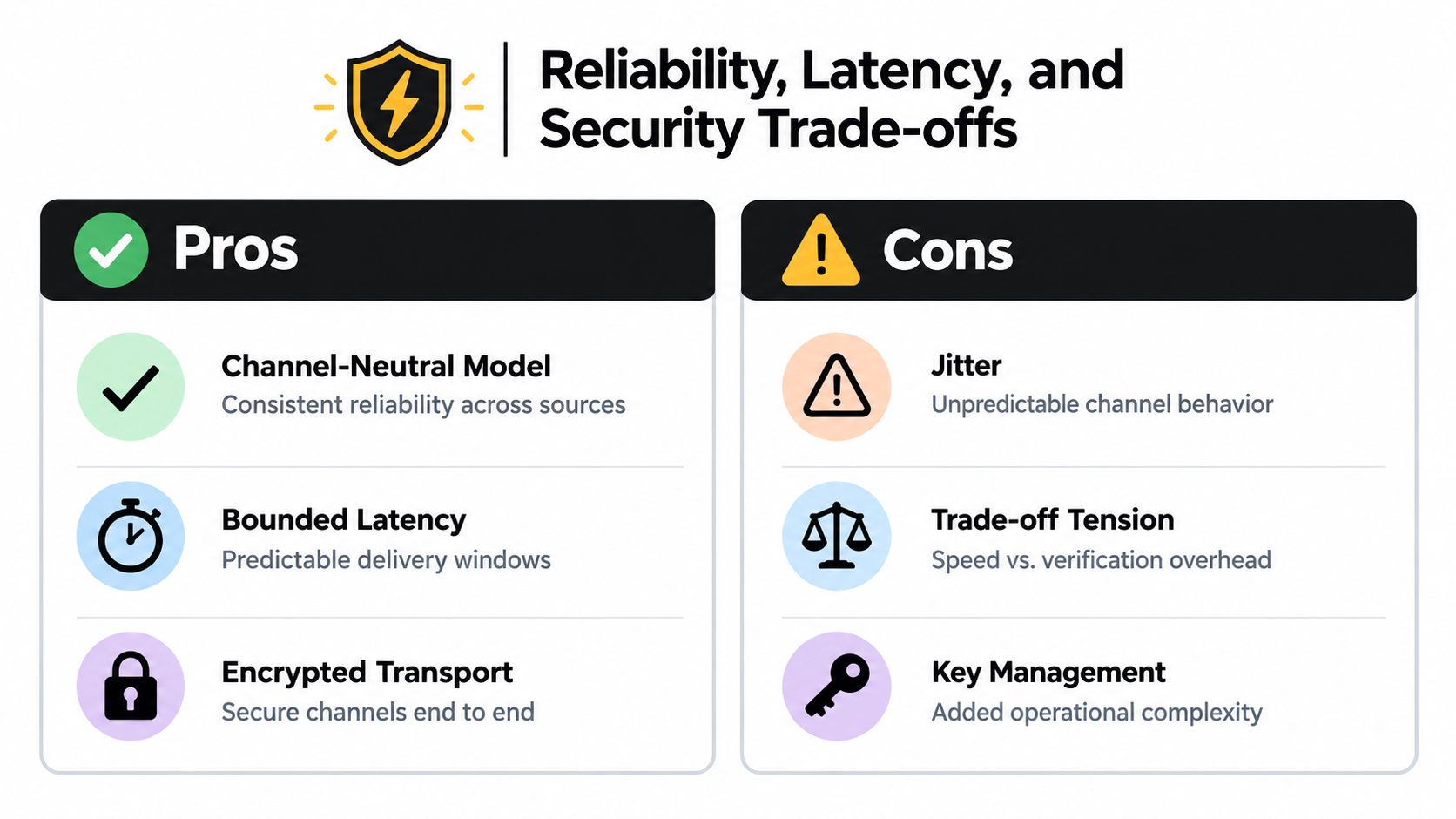
Social-care teams often ask for the fastest possible stream. The better question is whether the stream is fresh, complete, deduplicated, attributable, schema-compatible, and interpretable enough to support the next action.
A channel-neutral reliability model measures those properties together. Freshness tells you how old the event is when a consumer reads it. Completeness asks whether expected signals arrived. Deduplication prevents one complaint from inflating volume or triggering repeated responses. Provenance shows the source and transformations. Schema compatibility protects downstream consumers. Interpretation confidence tells the human reviewer how much trust to place in an intent tag or escalation.
Latency is a system behavior, not a producer promise
AWS defines Kinesis propagation delay as the time between writing a record and a consumer reading it. Records are available immediately after writing, but consumer polling largely determines observed delay. AWS recommends polling each shard approximately once per second per application, which typically produces average propagation delay below one second. Each shard is limited to five GetRecords calls per second, and polling below roughly 200 milliseconds can trigger ProvisionedThroughputExceededException, as explained in the Kinesis low-latency guidance.
Aggressive polling doesn't automatically produce a fresher inbox. Throttling can invoke exponential backoff, creating less predictable processing latency. Coordinate consumers, monitor throttling and iterator age, and define the latency objective at the point where triage can act, not at producer acknowledgment.
Security follows the event through every consumer
Encryption in transit and at rest is necessary, but it isn't the whole control surface. A social-care stream can contain account details, private messages, internal notes, and sensitive media. Role-based permissions should limit who can view raw content, who can export it, and who can approve a reply or escalation.
Audit lineage matters when an agent tags a complaint, an analyst reports a trend, or a reviewer closes a case. Keep records of source, transformation, model or rule version, reviewer action, and downstream destination. Retention and deletion policies also need to account for edits and platform removals rather than treating the durable log as permission to retain everything indefinitely.
When an event is malformed, duplicated, or uncertain, route it to quarantine or human review. Don't let a fast pipeline turn bad interpretation into an automated closure, a public response, or an incorrect finance escalation.
Monitoring and Metrics That Matter
A green infrastructure dashboard can hide a failing social-care operation. CPU, throughput, and transport latency might look normal while the classifier misreads new slang, a parser drops image metadata, or a model continues using an obsolete schema.
Research on schemaless streams notes that continuously running queries can become obsolete as record structures change. A recent study on agentic cloud data pipelines evaluates temporal skew, bursty ingestion, and backward-compatible versus backward-incompatible schema changes, reinforcing the need for observability beyond infrastructure health. The study and its broader discussion are available in this research on agentic cloud data pipelines.
Monitor the path and the meaning
At the transport layer, track propagation latency, consumer lag, iterator age, throttling frequency, retry volume, error rates, partition or shard hot spots, and dead-letter or quarantine growth. These signals tell you whether events are arriving and whether consumers can keep up.
At the decision layer, track:
- Source completeness: Compare expected platform activity with received events, accounting for platform-specific limitations.
- Duplicate rate: Separate connector retries from related conversations and repeated customer behavior.
- Schema compatibility: Detect new fields, missing fields, incompatible types, and semantic changes.
- Lineage coverage: Confirm that source, transformation, model version, and routing action remain visible.
- Interpretation quality: Review drift scores, embedding-quality indicators, uncertain classifications, and human overrides.
- Recovery time: Measure how long corrected events take to replay and how long re-indexing takes.
A pipeline can remain technically healthy while its interpretation degrades. A campaign may introduce unfamiliar language. A platform may change how it represents media. A meme may carry more intent than its caption. Multilingual slang can make keyword rules appear stable while routing accuracy slips.
Degrade safely instead of pretending certainty
Graceful degradation gives the team an explicit response when the stream changes. Quarantine incompatible events, route low-confidence items to a reviewer, preserve the raw event, and replay corrected data after the consumer is fixed. Maintain historical comparability by recording model and schema versions, so an executive dashboard doesn't mix decisions produced under incompatible interpretations.
Monitoring principle: Ask not only whether the event arrived, but whether the agent still understands it well enough to act.
That approach protects SLA reporting, auto-resolution analysis, and proactive-save measurement from silent changes in data quality. It also gives reviewers a safer queue, because uncertainty becomes visible instead of appearing as a confident but incorrect tag.
Real-World Use Cases in Social Care Operations
Ingestion quality becomes obvious when the queue contains competing priorities. A billing complaint in an X reply should reach finance or a specialized support workflow, not disappear into a general comms queue. An outage surge should connect related replies and DMs so reviewers don't handle the same incident as isolated cases.
The routing decision depends on more than text. The connector must preserve the conversation, source, account context, language, media, and event history. The consumer must recognize intent and urgency. The queue must show enough evidence for a human to approve an escalation or draft a response without reopening every platform tab.
Five cases that expose weak ingestion
- Billing complaints: A customer posts a failed charge publicly, then sends account details through a DM. Deduplication and conversation linking prevent duplicate work, while access controls keep private data away from broad comms queues.
- PR-risk mentions: A sudden cluster of screenshots or allegations needs a fast path to comms and leadership review. If the connector drops images or thread context, a text-only classifier may underestimate the risk.
- Spam and scam waves: Repeated messages across Telegram, WhatsApp, and community forums can overwhelm reviewers. Shared event identity and cross-channel signals help trust and safety separate a coordinated wave from normal customer activity.
- Buried feature requests: A request may arrive in multilingual slang inside an Instagram DM or Discord discussion. Semantic interpretation and language-aware enrichment surface product signal that keyword tagging would miss.
- Crisis escalation: A community incident may begin with support complaints, acquire trust and safety implications, and become a communications issue. Routing should support controlled handoffs, not force one team to own every decision.
The business measures are operational. Response time depends on delivery and prioritization. SLA compliance depends on timestamps that reflect the event's actual arrival and queue entry. Auto-closure rate depends on confidence and duplicate control, not just automation volume. Reviewer fatigue rises when the same incident appears repeatedly or when low-confidence items are presented as routine work.
A reliable stream lets analytics roll up noise-filtered volume, escalation accuracy, and unresolved themes without drowning executives in raw mentions. Humans still approve sensitive actions and own the hard calls. The system's role is to make the right work visible sooner.
Moving from Ingestion to Intelligent Routing
Start with a connector audit, not a model review. List every source your social-care team depends on, including X, Instagram, TikTok, Discord, Telegram, WhatsApp, forums, CRM updates, and email. For each source, document whether delivery uses webhooks, polling, or change-data capture, what metadata survives normalization, and how edits, deletions, media, and retries are reconciled.
Then test the stream under the conditions that break triage. Measure peak records per second independently from bytes per second. Force a consumer slowdown and inspect backpressure. Replay a corrected event. Introduce a schema change and confirm that incompatible records quarantine instead of reaching auto-closure.
The final design should connect four controls:
- Durable capture: Retain replayable events with identity and provenance.
- Decision observability: Track freshness, completeness, duplication, drift, confidence, and lineage.
- Human control: Require approval for high-impact routing, crisis escalation, public replies, and uncertain closures.
- Operational feedback: Use reviewer overrides, SLA outcomes, response time, and auto-closure results to improve rules and models.
Sift AI can fit into this operating model by unifying social and community conversations in a command center, applying AI-powered tagging and routing, drafting responses, and keeping humans in the loop for consequential decisions. The important architecture question remains unchanged: does each event arrive with enough reliable context for the right person to act?
Sift AI brings posts, replies, DMs, reviews, and community messages into a unified inbox, then helps teams filter noise, identify intent, route work to finance, engineering, comms, or trust and safety, and draft responses with human approval. Visit Sift AI to connect real time data ingestion with accountable triage, clearer SLAs, and safer social-care operations.