Enterprise Social Platform Guide for Social Ops Leaders
"Enterprise social platform guide for ops leaders covering routing, SLAs, compliance, and human approval across social care channels."
Last week the queue lied in the only way executives notice. The slide said social was covered. A billing complaint sat in a public reply for most of a workday, mentions spiked on a checkout failure, and reviewers burned the morning on scam DMs. If you own SLAs, auto-closure, and the numbers that reach the exec meeting, an enterprise social platform is not your content calendar. It is the control system for who owns a public issue, which clock is running, and whether the escalation can be audited.
Table of Contents
- When a Brand Channel Becomes an Unowned Queue
- What an Enterprise Social Platform Actually Controls
- Capabilities That Turn Mentions Into Owned Work
- How Social Ops Leaders Should Read the Queue
- Enterprise Use Cases for Care Comms and Trust
- How to Choose an Enterprise Social Platform
- Run a One-Week Ownership Audit Next
When a Brand Channel Becomes an Unowned Queue
It is 8:40 a.m. and the brand channel is already a service desk nobody staffed. A customer pasted a failed charge in a public reply and tagged the brand. Mentions are climbing because checkout is timing out. The same view is packed with fake "support" accounts offering refunds. In a DM, a power user described the feature product has argued about for a month. Product will never see it.
That is not a missed calendar post. Support thinks finance owns the chargeback language. Finance thinks support owns anything that starts on X. Engineering has the outage in a status channel that does not read social. Comms hears about the spike after a screenshot reaches a journalist. Trust and safety is still scrolling the scam wave by hand. Reviewer fatigue is what you pay when noise hits a person who should have received a tagged case.
Presence is not handling
Being on the network and answering the question are different jobs. A study of major UK companies found that 76% were present on Twitter, but only 39% answered customer-service questions posted there. Among companies that did respond, the average successful response took 8 hours and 37 minutes. The same source cites research showing that 32% of people who had sought social customer service expected a reply within 30 minutes, while 42% expected one within 60 minutes (social customer service response gaps). A collector inbox can leave an outage, a payment failure, or a fraud complaint untouched for most of a workday.
Operating rule: Automation clears noise and drafts the routine reply. A person still approves exceptions, sensitive accounts, and anything that can move money, create legal exposure, or damage the brand.
Hold the platform to triage, tagging, routing, escalation, response time, and a named approver on the hard send. Publishing features do not close an unowned queue. Extra channels and extra drafts will not either, if decision rights stay fuzzy.
What an Enterprise Social Platform Actually Controls
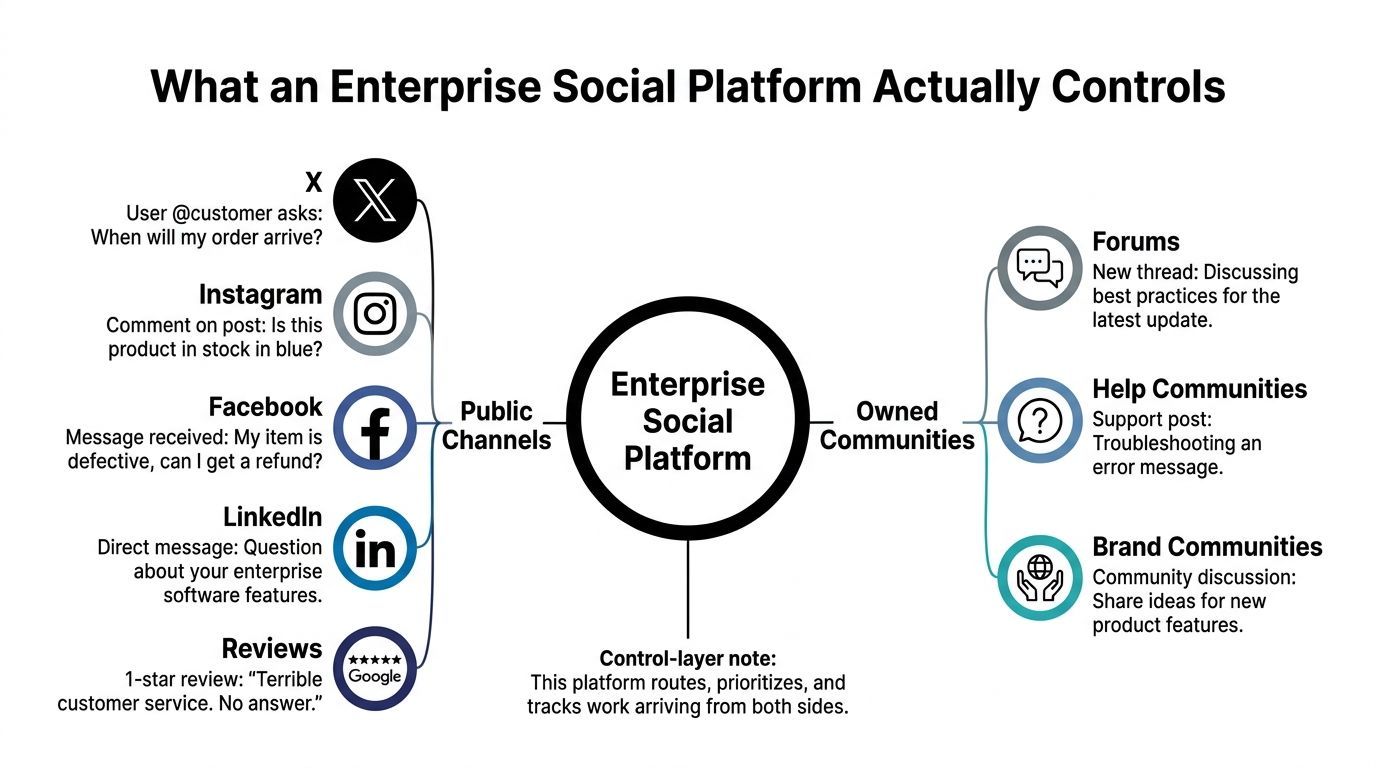
An enterprise social platform is the control layer for work that lands on public channels and in owned communities. It is not a louder feed, and it is not an internal social network from an earlier software cycle.
Use an air-traffic desk, not a billboard. A billboard can publish. It cannot hold an SLA, hand a case to finance, or show who opened an attachment.
Three rights, then the work counts
- One landing place. Posts, replies, DMs, and community threads hit the same queue, so a public billing complaint and a forum thread are the same class of work.
- A permission boundary. Seeing the brand account is not the same as opening a customer record, a private thread, or a file.
- A named path. The case goes to support, comms, product, finance, or trust and safety, and someone can audit the handoff.
Buying the software is the easy half. McKinsey's longitudinal look at the networked enterprise tracked social-technology adoption across about 1,500 companies. Usage was low in 2006. By 2008, roughly two-thirds had adopted at least one social technology, such as wikis, blogs, or internal social networks, yet only about 20% of employees in that database were using the tools. 35% of companies adopted partly because competitors had. McKinsey also estimated that by 2015 about one-fifth of the companies studied would account for half of all social-technology usage. Procurement arrived first. Daily participation lagged. A license does not count until routing, escalation, and review sit on the shift.
Customers already treat networks as service desks, which internal wikis never had to face. A Microsoft survey of 5,000 consumers in Brazil, Germany, Japan, the United Kingdom, and the United States found that 67% expected a social customer-service reply within 24 hours. Among ages 18–34, that figure was 78%. 52% of those younger consumers had asked a service question on social, versus 13% of people 55 and older (what consumers expect from social service).
The footprint is already mainstream, and it is largest where the org chart is messiest. Eurostat's enterprise social-media statistics put use of at least one social medium at 63.57% of EU enterprises in 2025, and at 89.09% of large enterprises. Social care coverage describes inquiries that mix buying questions, complaints, and escalation signals, often without an SLA or an owner, while Forrester's 2025 U.S. CX Index fell for a fourth straight year to its lowest level in nearly a decade. That is an operating risk.
Connect the queue to the systems that already own the customer through help desk integrations, or the routed case dies as a screenshot. The control system is routing accuracy, escalation quality, auditability, and response-time parity with ordinary support.
Capabilities That Turn Mentions Into Owned Work
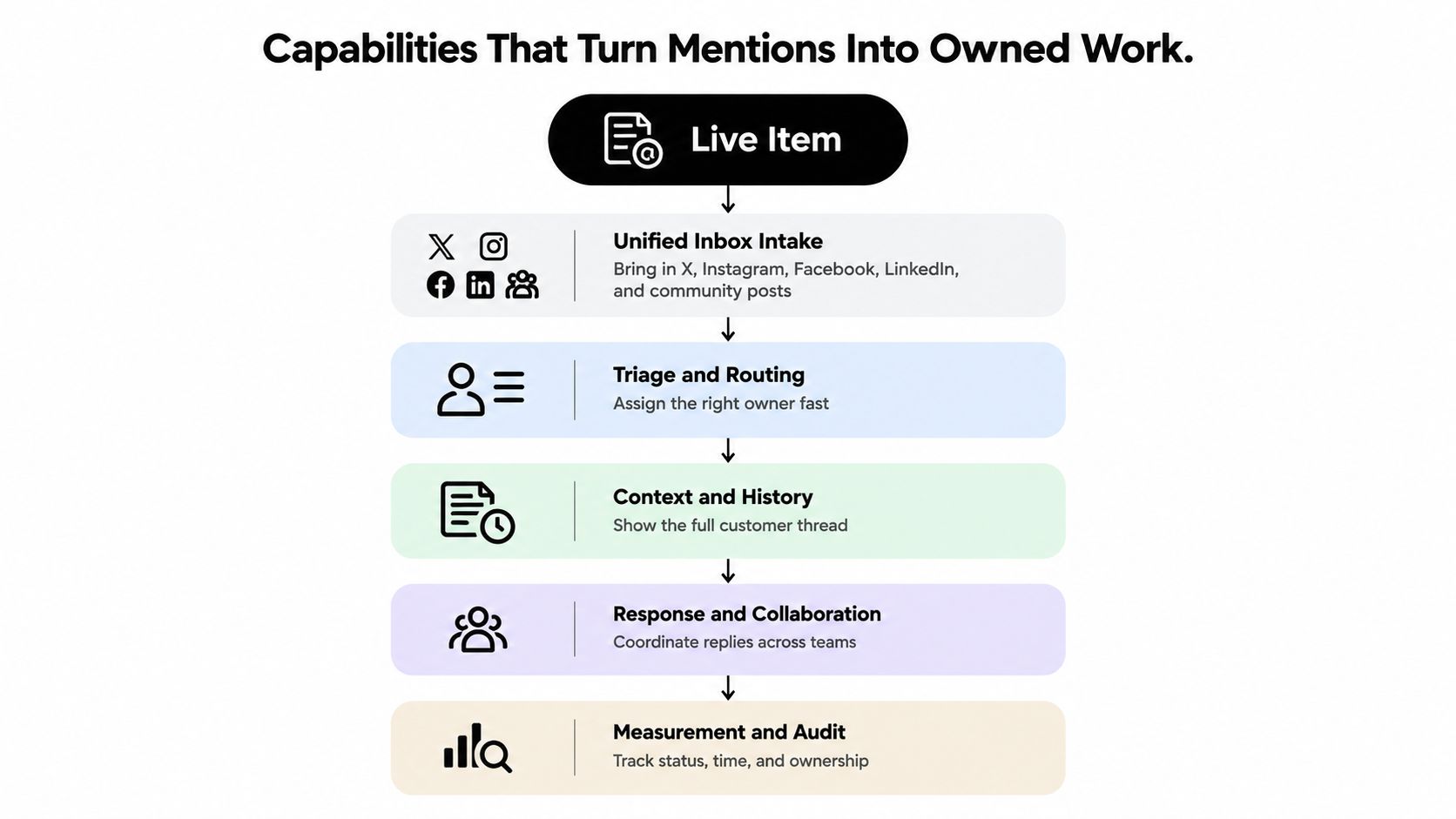
A public complaint arrives during a busy shift. The platform needs to show who owns it, which response clock applies, and whether an escalation reached the right team. Collection alone does not solve the queue.
Intake through audit
Unified inbox intake. Bring X, Instagram, TikTok, Discord, Telegram, WhatsApp, Facebook, and forums into one operational view. A charge dispute in a reply and the same issue in a community thread need a visible owner and a consistent clock, even if they started on different channels.
Noise filtering and intent tagging. Separate spam and scam waves from outage reports, purchase questions, and feature requests. Keyword rules alone miss slang, sarcasm, screenshots, and memes. Tags should identify what the customer needs and how urgently the issue should be handled, then support routing and an auditable record of the decision. Keep the focus on external mentions: employee-networking evidence does not establish how well a tool filters or classifies customer messages.
Routing and escalation. Send payment failures to finance, broken flows to engineering, reputational spikes to communications, and abuse or fraud to trust and safety. Set a named owner and an SLA for each route. If the responsible team misses its deadline, the platform should escalate the case rather than leave it waiting for someone to notice. A human approves sensitive public responses.
Drafts after the route, not instead of it. AI can propose a reply in brand voice, but the assigned reviewer remains accountable for tone, policy, and exceptions. Identify the owner before drafting; otherwise, finance language can end up in a communications response.
Analytics that ops can defend. Track noise-filtered volume, auto-closure rate, response time, and proactive saves. These measures should show whether a mention reached the team responsible for action, not merely whether a post drew engagement.
Permissions without a trail fail
Role labels do not control every risk when social data connects public channels, private communities, CRM records, and internal escalation. NIST's Zero Trust Architecture emphasizes continuous telemetry and auditable access. Relevant records include asset logs, network traffic, resource-access actions, and other security events collected in real or near-real time. Log configuration changes, too. If content cannot be decrypted, inspect the available metadata.
The platform should record who accessed a workspace, customer record, message, attachment, or integration, what action they took, which policy allowed or denied access, and when identity or configuration changed. Export those records to a SIEM and correlate them with identity, device, and API telemetry. Apply least privilege, protect logs against tampering, and test whether each policy decision works as intended.
More channels and more drafted replies do not fix undefined decision rights.
How Social Ops Leaders Should Read the Queue
An internal average can look healthy while customers still feel ignored. That is the number you will get challenged on.
Metrigy's wait-time findings put the tolerated wait next to the lived one. Slightly more than half of consumers treated a response of up to five minutes as acceptable for social customer service, yet only 15.6% said they received a reply in that window. Companies reported sub-minute response times for texting, while only 26.8% of consumers on that channel said they got a text in under a minute. Stated speed and experienced speed are different metrics. Stop equating a tool's brochure with the queue.
Stated Social Response Speed Versus What Customers Experience
| Signal | Claim or expectation | What customers reported |
|---|---|---|
| Social service wait | Slightly more than half treated up to five minutes as acceptable | Only 15.6% said they got a reply in that window |
| Texting speed | Companies reported sub-minute text response | Only 26.8% of consumers on that channel said they received a text in under a minute |
What rolls up on Monday
Split the read by channel and by audience. Do not blend a public billing fight with a low-risk how-to and call it one SLA.
- Median and percentile response time. The average hides the tail where angry threads live.
- SLA-breach rate. Count misses by queue, not as one company-wide comfort number.
- Auto-closure rate. A closure counts only when the case was routine.
- Escalation volume. Show which team received the work, not only that it left social.
- Reviewer fatigue. If humans are still reading spam, the filter failed before the SLA did.
A public billing complaint needs fast triage and a private handoff. A low-risk how-to can sit on a longer SLA. Humans stay on exceptions, account-sensitive issues, and replies with financial, legal, or brand risk. The weekly exec read is short. How much noise came out, how many cases closed without a reviewer, where the SLA broke, and which teams took the escalations.
Enterprise Use Cases for Care Comms and Trust
The same platform does different jobs. Each one needs an owner, an SLA class, and a decision automation must not swallow.
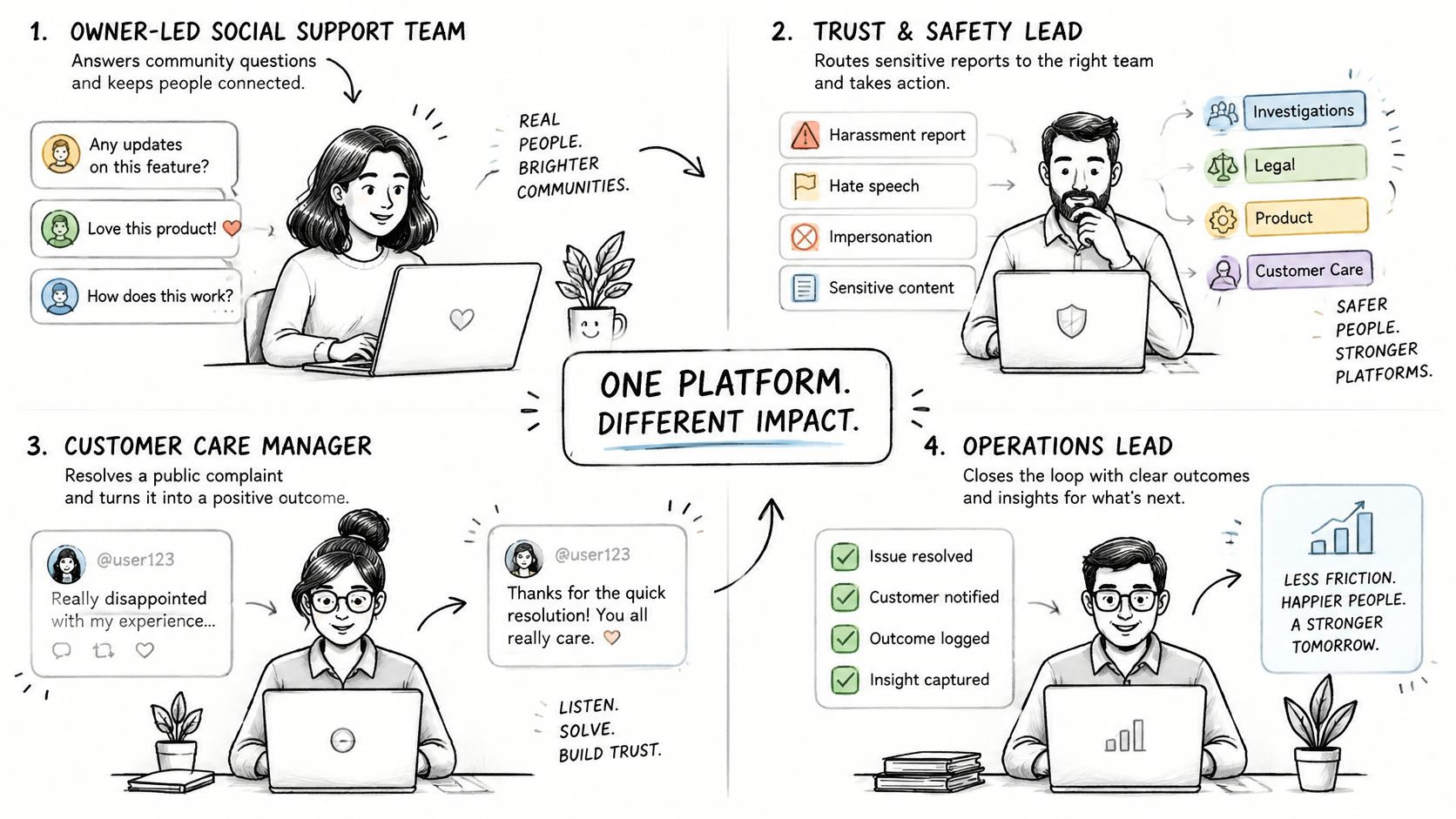
Social care. A customer posts a double charge under a product photo. The item is tagged as billing, pulled off the public thread, and routed to finance. Support keeps the customer posted in private with a holding reply a reviewer approved. The public thread does not become a negotiation about a card number. Outcome you want: one owner, a private handoff, and a clock that matches the risk, not the channel's vanity metrics.
Operations in an outage. Mentions jump, and half of them say the same thing. Duplicates collapse. Engineering gets the signal with a count, not fifty copies of one error. Routine status replies are drafted for approval so reviewers are not retyping the same update while the incident channel moves. The human call is whether the public line matches what engineering will stand behind.
Comms cannot wait for a press cycle
Negative mentions start climbing before any single post is "everywhere." A 2025 study of 3,135,675 social-media dissemination points from 94 corporate crisis incidents found that intervention during the ascending phase significantly reduced crisis propagation. Compared with not intervening, responding during the incubation period reduced the decay coefficient of crisis communication by 90.4% (timing of crisis response on social dissemination). Treat that as an escalation trigger. Detect the abnormal rise, flag influential or high-risk posts, and route them to comms or legal while the issue is still accelerating. AI can surface the surge and the context. A person decides whether this is a product outage, a reputational threat, or something that needs public disclosure.
Do not wait for the press office's usual timetable if the curve is still rising.
Trust and safety, then product signal. A scam wave should be filtered so real fraud reports still reach the right queue, instead of exhausting the same reviewers who owe customers an answer. Feature requests buried in DMs and forums get tagged as product signal, not left as unsolved tickets nobody in product opened. Point at one of these in your own org this week and name the owner, the SLA class, and the human decision.
How to Choose an Enterprise Social Platform
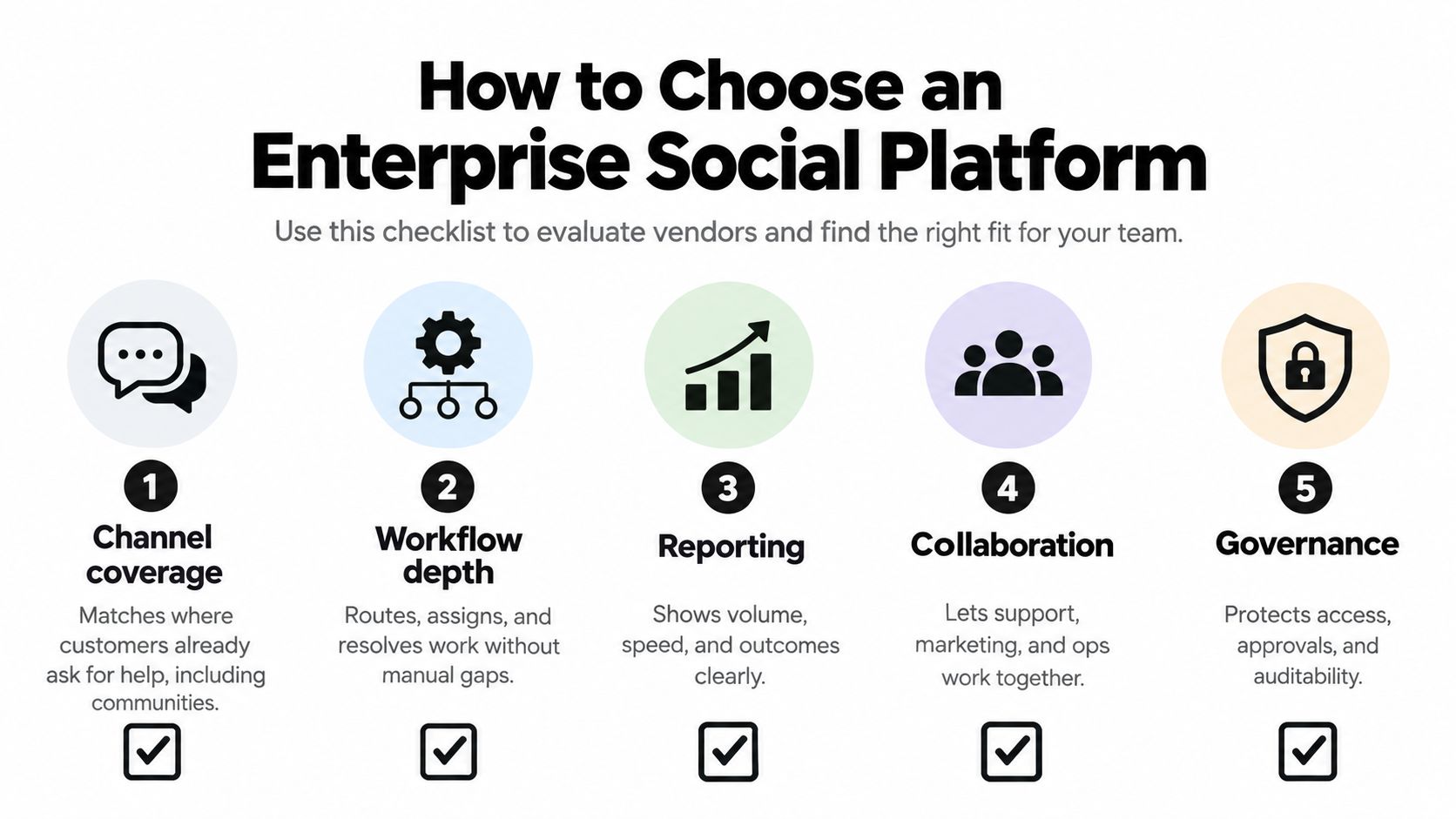
Take a scorecard into the vendor review. Score ownership clarity and auditability first, speed second. A tool that only publishes, or only moderates, will rebuild the unowned queue with a newer login.
What to demand before a demo
- Channel coverage. It has to match where customers already ask for help, including communities and messaging apps, not only the public networks marketing posts to.
- Intent and urgency that survive each post. Slang, sarcasm, images, and memes, not keyword match alone. The World Bank's 2025 Digital Progress and Trends Report warns that English dominates training data, that social-media data sits mainly with platforms headquartered in the United States, and that nondominant languages, especially non-Latin scripts, often lack enough data for reliable AI. Language limits and weak data governance constrain inclusive use. Validate by language, script, market, modality, and escalation class. Set fallback rules and human-review thresholds before anyone allows automated closure. Multilingual skill is risk management and service equity, not a translation checkbox.
- Routing with named teams. Finance, engineering, comms, product, and trust and safety, each with an explicit escalation rule.
- Drafts in a configurable brand voice. Human approval stays on risk. Auto-send is for the boring, reversible case.
- Analytics an ops lead can read aloud. Noise filtered, auto-resolution, response time, and proactive saves.
- Enterprise controls. Role-based permissions, audit trails, CRM or data sync, and SOC 2 and ISO readiness.
Sift AI is one operating model built for that scorecard, used by brands including Lyft, Coinbase, and Circle. It is an AI operating system for social and community operations. It pulls X, Instagram, WhatsApp, Telegram, Discord, Facebook, and forums into one command center, uses context-aware agents to filter noise and detect intent, routes and escalates to the right owners, and drafts responses while people stay on what matters. It reads slang, sarcasm, images, and memes, and it keeps role-based permissions, audits, and a configurable brand voice. It does not replace the reviewer on the hard call. Score it, and every alternative, on who owns the case and whether you can prove the handoff.
Run a One-Week Ownership Audit Next
Do not start with another vendor tour. Pull one week of public replies, DMs, and community posts. Mark each item with an owner, an SLA class, and whether a human should have approved the outcome.
Mark the misses
- Billing complaints that stayed public. They needed a private handoff to finance, not a longer thread.
- Outage mentions that never reached engineering. Volume without a route is not incident response.
- PR-risk posts that waited for a press cycle. If the curve was still rising, the wait was the failure.
- Scam noise that exhausted reviewers. That work should have been filtered before a person opened it.
- Feature requests that never left the inbox. Product signal that dies in social is a routing miss.
Count breaches, auto-closures that were safe, and escalations with no named team. That sheet is the baseline executives can read without a tour of the tool. If the gaps are ownership and noise rather than a missing content calendar, replay the same week through a governed inbox. See which items would have been filtered, tagged, routed to finance versus engineering versus comms, and held for a person.
Keep the operating rule tight. Automate the noise and the draft. Keep humans on the decision that can move money, safety, or the brand.
Sift AI is the operating layer for that week's queue, unifying social and community channels, filtering noise, tagging intent, and routing work to support, comms, product, or trust and safety while people approve the hard replies. If your audit shows unowned public issues and SLAs nobody can defend, compare that workflow with how the queue runs today at Sift AI.