Crisis Communication Management Playbook for Social Ops
"Master crisis communication management from detection to recovery. Playbooks, governance, and social ops tooling to respond in minutes not hours."
Your queue is fine until it isn't. Then an outage hits, billing complaints flood Instagram and X replies, your support DMs fill with “is this a scam?” screenshots, and one high-follower account posts a clipped version of the issue that makes your brand look deceptive. At the same time, your scheduled promo is still queued, your community team is answering the wrong questions in Discord, and engineering is posting updates in Slack that haven't reached the people holding the public inbox.
That's the moment when crisis communication management stops being a PR talking point and becomes a social ops problem.
For social ops and insights leaders, the work isn't just writing a statement. It's spotting the first credible signal, separating real customer pain from pile-on noise, pausing the wrong content fast, routing the right issues to finance, engineering, legal, or comms, and keeping a clean audit trail while executives ask for status every few minutes. If your team runs the unified inbox, owns SLA reporting, and gets blamed when response time slips, you're already part of crisis command whether anyone has formalized it or not.
The hard part is that social channels collapse functions that used to stay separate. Support, PR, trust and safety, product feedback, and fraud reports all land in the same stream. A billing complaint can become a press question. A meme can carry a legitimate accusation. A scam wave in WhatsApp or Telegram can look like isolated noise until customers start tagging your public handle asking why you're ignoring them.
Speed matters more than most org charts admit. A corporate-crisis analysis found that more than one-quarter of crises spread to international media within 1 hour, over two-thirds spread within 24 hours, and companies took an average of 21 hours to respond in the same dataset, leaving a long gap for public interpretation and escalation (cross-market crisis analysis).
That gap is what good operations close.
Table of Contents
- Introduction When Every Reply Becomes a Headline
- What Crisis Communication Management Really Means
- Governance Roles Escalation Paths and Decision Trees
- Monitoring Detection and Signal Routing at Social Speed
- Playbooks Response Templates and Timing That Limits Damage
- How to Measure Crisis Communication Effectiveness
- Tooling and Integration Patterns for a Unified Command Center
Introduction When Every Reply Becomes a Headline
On a normal day, social ops is a throughput game. Clear the inbox. Tag intent. Route edge cases. Protect SLA. Keep reviewer fatigue from wrecking quality by hour six.
In a crisis, the same queue turns into a command center. The issue isn't just volume. It's mixed-intent volume. Genuine customers need help. Bad actors inject scams. Screenshots spread without context. Reporters and creators ask public questions in the same feed where refund requests are piling up.
What the surge actually looks like
The early signs usually don't arrive as one obvious alert.
You see:
- Billing pain in public replies where customers say they were charged twice, can't access service, or can't get support.
- Outage signals in DMs and comments that sound repetitive at first, then suddenly span regions, devices, or account types.
- Scam and impersonation waves where fake support accounts tell customers to “verify” through external links or crypto wallets.
- PR risk mentions on X that reinterpret a product failure as negligence, discrimination, censorship, or fraud.
- Community spillover in Discord, Telegram, or forums where the most active users begin filling in the blanks themselves.
Once that starts, every delayed reply gives the crowd room to write the story for you.
Practical rule: The first operational mistake in a crisis is treating all inbound as one queue.
The teams that recover fastest don't rely on one heroic social manager typing faster. They run triage. They split noise from signal. They route by ownership. They preserve a single source of truth. AI helps by filtering repetitive posts, tagging intent, and drafting low-risk replies. Humans still own severity calls, public language, and exceptions.
What social ops leaders are actually accountable for
If you're accountable for SLA, auto-closure, escalation hygiene, and what rolls up to execs, crisis communication management sits squarely in your lane. Your leadership team may think about statements. You have to think about workflow.
That means:
- Detection before the issue trends.
- Routing to the people who can verify and act.
- Response timing that matches how fast social narratives move.
- Recovery tracking so the postmortem isn't just “we should communicate faster next time.”
The difference between chaos and control usually isn't better wording. It's better orchestration.
What Crisis Communication Management Really Means
A common mistake is defining crisis communication management too narrowly. Many think it means drafting a statement, getting legal approval, and posting it on brand channels. That's part of it, but only part.
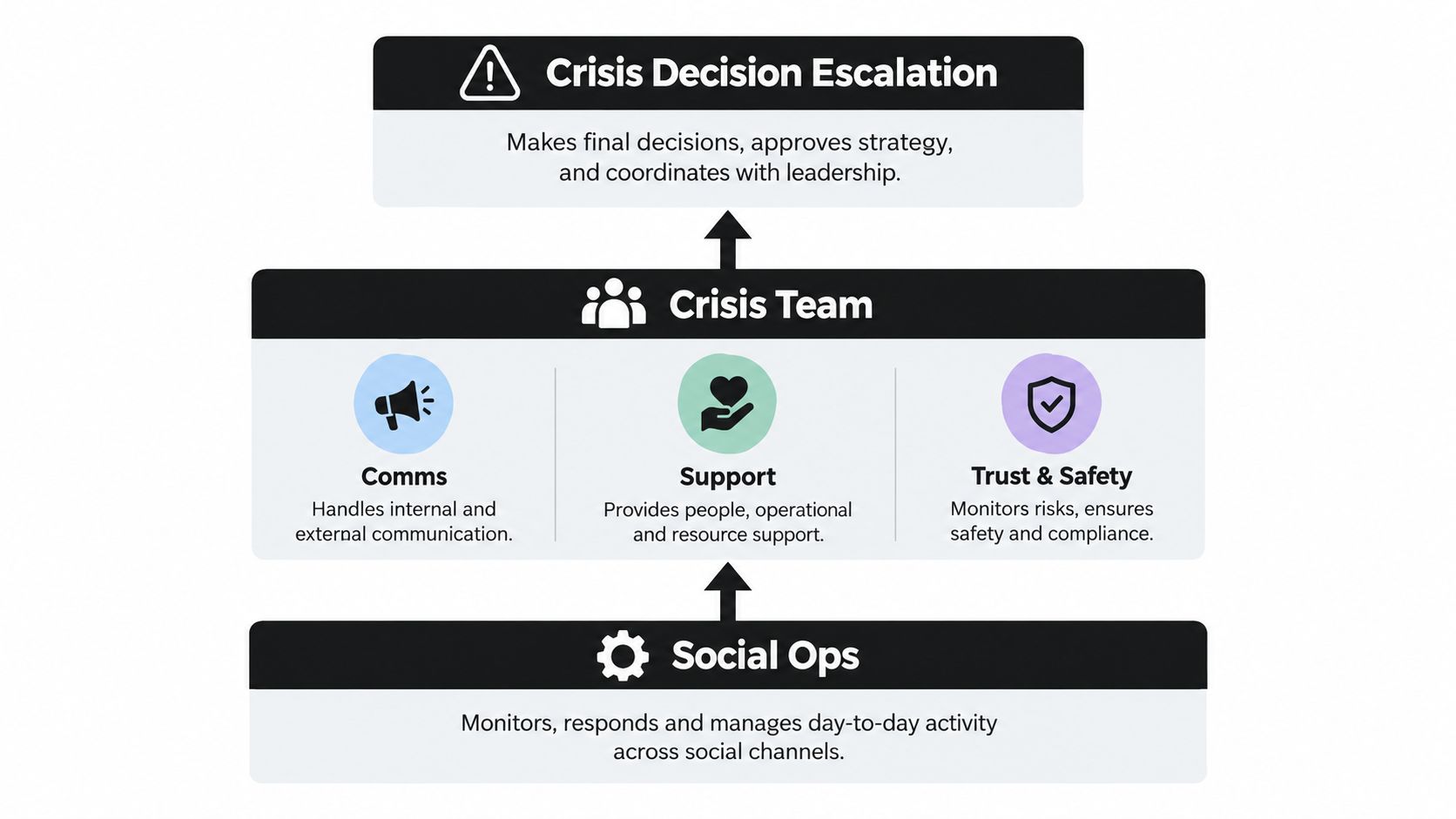
In practice, crisis communication management is the operating layer that decides what gets acknowledged, who approves it, where it gets published, how inbound is handled, and when the issue moves from customer support to enterprise risk.
It helps to think of it as a command center, not a content task.
The difference between daily care and crisis mode
Daily social care is built for known issues. Password resets. Shipping delays. Subscription confusion. Feature requests buried in DMs. Your team can solve most of that through macros, routing rules, and standard brand voice review.
Crisis mode starts when one or more of these are true:
- The issue crosses functions and support alone can't resolve it.
- The narrative outruns the facts and public interpretation becomes part of the incident.
- Private and public channels diverge so one team knows what's happening and another is still replying as if nothing changed.
- Leadership needs a defensible audit trail of what was known, when it was known, and who approved what.
A lot of published guidance still treats the discipline as message craft first. Recent industry synthesis for 2026 points in a more useful direction, framing crisis communication as a governance function across pre-, during-, and post-crisis operations while also noting a practical gap in how teams operationalize approvals, escalation paths, and real-time coordination (2026 crisis communication outlook).
The lifecycle is broader than the statement
The plain-language version is simple. Before a crisis, you prepare owners, workflows, templates, and thresholds. During a crisis, you detect, verify, route, respond, and update. After a crisis, you review what failed in routing, timing, and coordination, then harden the process.
That's why a useful command-center model includes:
- Pre-crisis readiness with severity criteria, channel coverage, and approval maps
- Live incident control with triage lanes, holding statements, and update cadence
- Post-crisis recovery with corrections, reporting, and process changes
If your team can publish a polished statement but can't stop scheduled posts, reroute high-risk messages, or see what happened across DMs and mentions in one place, you don't have crisis communication management. You have copy approval.
For a broader strategic checklist, these 2026 crisis communication tips are useful because they push teams to think past apology language and into readiness.
Governance Roles Escalation Paths and Decision Trees
When the volume spikes, weak governance shows up fast. People start asking the same questions in three Slack channels. Support waits on comms. Comms waits on legal. Legal asks engineering whether the issue is confirmed. Meanwhile the queue keeps moving.
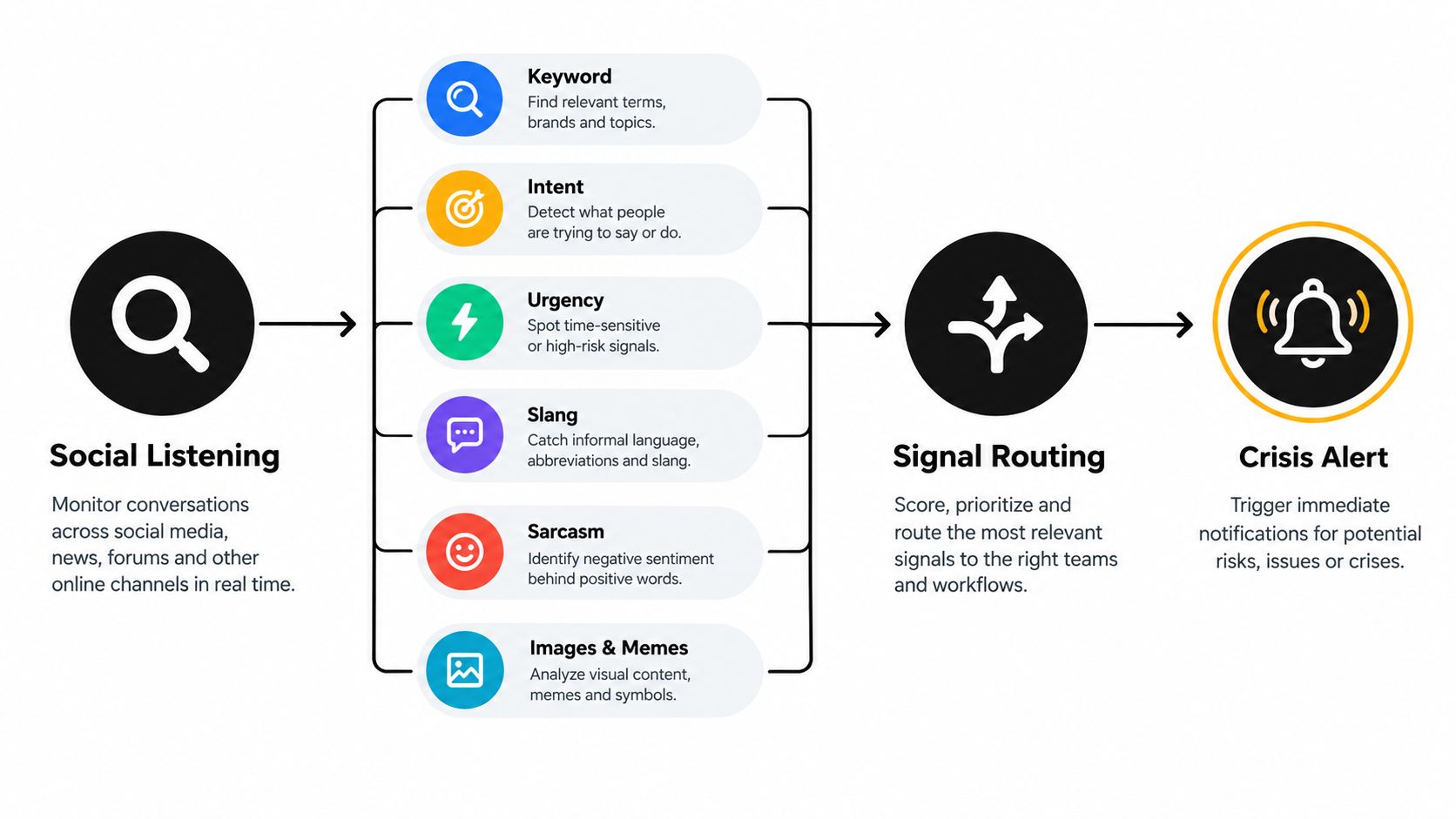
A usable crisis structure answers one question first: who decides what without waiting for everyone?
Who belongs in the crisis lane
Social ops should sit at the front, because your team sees the issue before most stakeholders do. But front-line visibility is not final authority.
A practical setup usually includes:
- Social ops for intake, triage, tagging, queue control, and escalation hygiene
- Comms or PR for public narrative, spokesperson alignment, and media sensitivity
- Support leadership for customer-impact patterns, macros, refunds, and case policy
- Trust and safety for scams, impersonation, abuse, and coordinated harmful behavior
- Product or engineering for incident verification and fix status
- Finance or billing ops for payments, reversals, and charge disputes
- Legal or compliance for regulated language, disclosure limits, and preservation requirements
Decision trees beat vague escalation rules
“Escalate urgent issues” isn't governance. It's a recipe for reviewer fatigue.
Use routing logic that maps signal to owner:
- A spike in “charged but locked out” complaints goes to finance plus support leadership
- Reports of failed login, degraded service, or broken integrations go to engineering
- Posts accusing the company of fraud, censorship, discrimination, or cover-up go to comms and legal
- Scam screenshots, fake handles, and phishing DMs go to trust and safety
The point isn't to create bureaucracy. It's to stop every issue from landing in the same approval pile.
Crisis Severity and Escalation Matrix
| Severity Level | Signal Example | Primary Owner | Escalation Path and SLA |
|---|---|---|---|
| Low | Isolated complaints, no clear pattern | Social ops or support | Handle in standard queue under normal SLA |
| Moderate | Repeating issue across multiple posts or channels | Support lead or product ops | Escalate to functional owner for verification and response approval |
| High | Confirmed outage, billing failure, scam wave, or public allegation gaining traction | Cross-functional crisis team | Immediate routing to comms, support, and relevant domain owner; hold statement path |
| Critical | Safety, legal, regulatory, or major reputational exposure across channels | Executive crisis lead with legal and comms | Executive escalation, locked approvals, centralized update cadence |
Approval rules need to protect speed
A widely cited U.S. survey found that only 49% of companies had a formal, documented crisis communications plan, while 28% had an informal plan and 23% had no plan or weren't sure they had one. Among leaders who had activated a plan, 98% said it was effective, including 77% who called it very effective. The same survey found that cyberattacks accounted for 28% of crisis events and technology failures for 22%, so digital disruption represented half of all reported crises (business leader survey on crisis planning).
That matches what operators see. Plans help, but only if they shorten approvals instead of multiplying them.
Operational note: Preapprove the language categories, not every sentence. Teams move faster when legal approves boundaries and disclaimers before the incident, then humans review the final wording in context.
Brand voice guardrails matter here too. During a live issue, “friendly” can sound glib and “transparent” can drift into speculation. Give reviewers examples of what not to publish, especially for humor, empathy language, and partially confirmed fixes.
Monitoring Detection and Signal Routing at Social Speed
Keyword alerts are not enough. They catch branded complaints, but they miss slang, screenshots, memes, and the private-channel spillover that usually appears before an issue becomes a trend.
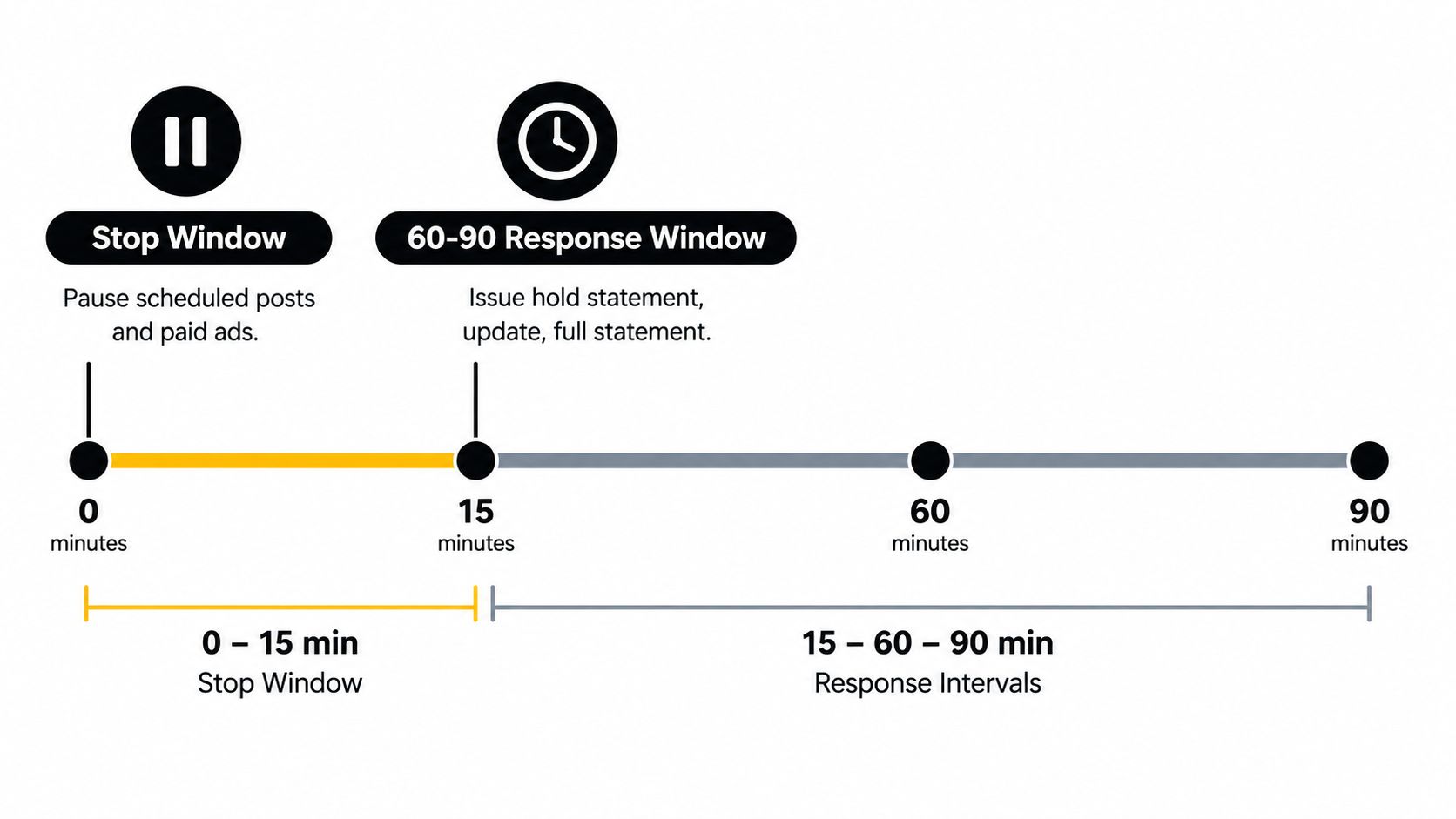
Good monitoring for crisis communication management works like signal routing, not passive listening.
What to watch beyond keywords
Real detection starts with context:
- Intent distinguishes “can't log in” from sarcasm or dunk-posting
- Urgency separates annoyance from service loss, fraud risk, or safety concern
- Language variation catches multilingual complaints, misspellings, and platform slang
- Format awareness matters because a cropped receipt, fake DM screenshot, or meme can carry more risk than a plain-text mention
- Channel behavior shows whether the story is public, private, or migrating between both
That's why social listening needs to ingest more than X mentions. DMs, Discord threads, Telegram groups, WhatsApp reports, Instagram comments, TikTok replies, and forum posts all contribute to the signal picture.
If you want a helpful primer on how monitoring stacks differ, Captapi breaks down social listening in a way that's useful for teams comparing mention tracking with deeper signal analysis.
Build a route, not just a dashboard
A dashboard tells you something happened. A route gets the issue to the right person while it still matters.
The flow should look like this:
- Ingest posts, comments, DMs, community threads, and owned-channel replies into one queue.
- Filter noise so spam, duplicates, and low-signal chatter don't drown reviewers.
- Auto-tag for issue type, urgency, language, product area, and potential risk.
- Route by ownership so billing goes one way, outages another, scams another.
- Require human verification on high-severity alerts before public action.
Organizations using specialist emergency-communication software show what process support can do operationally. 77.1% can activate crisis plans within 30 minutes, compared with 48.6% for organizations without that technology. Across the surveyed group, 92% can activate within 60 minutes and 73% within 30 minutes (crisis communication effectiveness benchmark).
Human review is where false positives get stopped
This is the part teams underinvest in. AI can cluster similar complaints, flag urgency, and surface likely scams. It can't own the final call on whether a creator-led thread is merely loud or changing public understanding of the incident.
A reviewer should confirm:
- whether the signal is real
- whether it's growing across channels
- whether customer harm is active
- whether the issue needs a public acknowledgment, not just support handling
Treat the first alert as a hypothesis. Treat cross-channel confirmation as the trigger.
That discipline matters even more now because platform engagement isn't always aligned with what agencies post. A 2026 CERC analysis on the Los Angeles wildfires found a mismatch between agency posting and public engagement, and related 2026 research highlighted how organizational anxiety can increase stakeholder anxiety while responsibility acknowledgment can reduce it (2026 CERC and emotional crisis communication research).
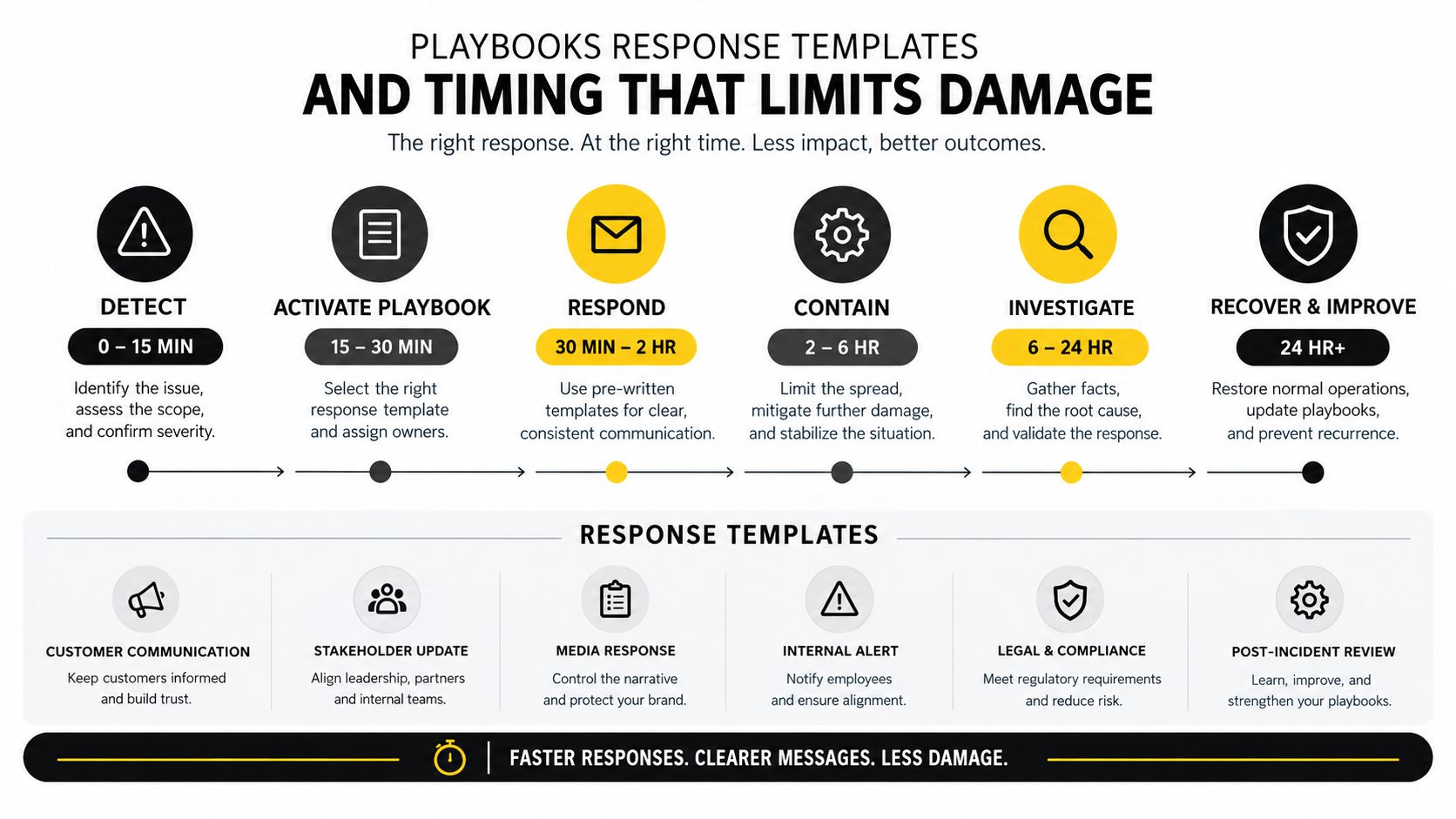
Playbooks Response Templates and Timing That Limits Damage
When teams miss the early window, it's rarely because they lack empathy. It's because they lack a live playbook. Someone is still asking whether to pause content. Someone else is rewriting the first line of the holding statement. Meanwhile the queue is filling with duplicate questions your team could already be answering consistently.
Timing discipline matters because delay compounds customer frustration and market fallout. One crisis-response study summarized by industry sources found that companies responding within hours saw an average 4% stock decline, while delays into days and weeks were associated with roughly 10% and 14% declines, respectively. The same source reports an average first public response time of 21 hours (crisis response timing study summary).
The first minutes decide the tone
One 2026 guide is blunt about the first move: pause all scheduled social posts and paid ads immediately, using a 0 to 15 minute “Stop” window to hold queued content before any public response (social media crisis management stop window).
That matters more than teams think. Nothing undermines credibility faster than a cheerful campaign post appearing while customers are posting outage receipts or scam warnings.
A practical first-action checklist:
- Freeze outbound on X, Instagram, TikTok, community announcements, and paid placements
- Lock reply macros that assume normal operations
- Open an incident lane in the unified inbox so reviewers aren't mixing routine and crisis work
- Pin internal facts that have been verified and mark everything else as unconfirmed
Use a response cadence your team can actually run
Crisis response timelines in 2026 are often framed as a 15-20-60-90 rule: acknowledge publicly within 15 minutes, share a preliminary statement with confirmed facts within 20 minutes, provide a detailed update within 60 minutes, and deliver a briefing with regular updates within 90 minutes (15-20-60-90 crisis response rule).
That doesn't mean every incident gets a polished thread in minutes. It means the organization commits to early acknowledgment and predictable updates instead of silence.
“We're aware, we're verifying, next update at [time]” is stronger than waiting for a perfect paragraph.
Run the incident in phases
One 2026 workflow breaks crisis operations into five phases: Detect (0 to 10 min), Triage (10 to 30 min), Respond (30 to 120 min), Stabilize (2 to 24 hrs), and Recover (1 to 14 days) (five-phase crisis workflow).
Translate that into owner actions:
Detect
Confirm whether the trigger is real. Save evidence. Capture URLs, screenshots, account examples, and affected channels.Triage
Assign severity. Decide whether this is a support issue, fraud event, product incident, or reputational event with legal sensitivity.Respond
Publish the holding statement, update pinned posts, and brief the reviewers handling replies and DMs.Stabilize
Answer the highest-signal questions first. Correct misinformation. Route exceptions like refunds, media requests, and creator escalations to named owners.Recover
Explain what changed. Share policy updates, remediation paths, or customer next steps where appropriate.
Templates that hold up under pressure
Use templates as structures, not scripts.
Holding statement
- We're aware of the issue affecting [service/account/process].
- Our team is investigating now.
- We'll share the next update at [time].
- If you're affected by [specific risk], contact us through [channel].
Detailed update
- What's confirmed
- Who is affected
- What customers should do now
- What not to do, especially around scams or fake accounts
- When the next update is coming
Correction post
- Name the inaccurate claim directly
- Replace it with the confirmed fact
- Link or point to the latest official update
- Avoid arguing with bad-faith posters unless trust and safety or legal directs otherwise
Tone should change by channel. X often needs fast public acknowledgment. Instagram replies usually need reassurance and direction. Discord and Telegram need moderator presence because communities fill silence with speculation. DMs need one-to-one clarity and safe escalation paths.
Consumer expectations won't give you much room. One 2026 article reports that 88% of consumers expect brands to respond to social media comments and complaints within 24 hours, while another reports 78% expect a response within an hour, including on weekends (consumer expectations for social response times).
How to Measure Crisis Communication Effectiveness
If the postmortem is just “we got through it,” you won't improve much. Social ops leaders need metrics that show whether the workflow held under pressure and whether the response reduced confusion instead of amplifying it.
Start with operational measures, not vanity reporting.
What belongs on the live dashboard
Track the metrics that expose friction:
- Time to first acknowledgment so you know how long the public saw silence
- Time to detailed update which shows whether the team could move from awareness to substance
- SLA adherence by severity because routine SLA and crisis SLA aren't the same thing
- Response time by route to compare billing, product, trust and safety, and comms lanes
- Auto-closure rate for low-risk repetitive messages that didn't need human review
- Noise-filtered percentage so leaders can see how much reviewer load was prevented
- High-signal backlog which tells you whether the dangerous queue is under control
What to review after the incident
The post-crisis review should answer a small set of blunt questions.
| Review Area | What to Check |
|---|---|
| Detection | Did the team identify the issue from signal quality, or only after it was already obvious publicly? |
| Routing | Did messages land with the correct owners the first time, or bounce between teams? |
| Approvals | Which review step created the longest delay? |
| Messaging | Did the public statement match what support and community teams were saying privately? |
| Recovery | Did the team close the loop with customers after the immediate surge ended? |
You also need an audit trail. For regulated brands and enterprise teams, that means preserving what was published, what was drafted, what was escalated, who approved it, and what changed over time.
The cleanest executive summary is not “sentiment improved.” It's “we acknowledged quickly, routed correctly, contained misinformation, and reduced unresolved high-risk volume over the life of the incident.”
The strongest measurement setups also sync crisis-tagged social data into CRM, product feedback, and incident review workflows. That's how recurring pain points stop showing up as “unexpected” every quarter.
Tooling and Integration Patterns for a Unified Command Center
Most crisis stacks fail because they're a patchwork. One tool for social listening. Another for community moderation. Separate inboxes for DMs. A spreadsheet for escalations. Slack for approvals. Status updates somewhere else. That setup can work during normal volume. It breaks when the same issue hits X, Instagram, Discord, Telegram, WhatsApp, and forums at once.
A better pattern is a unified command center with a few essential elements:
- One inbox across channels so public replies, DMs, and community posts can be triaged together
- AI tagging and intent routing for issue type, urgency, language, and risk
- Draft generation with brand voice controls so reviewers start from a usable response, not a blank box
- Role-based permissions and audit logs for legal, compliance, and executive review
- CRM and ticket sync so social incidents connect to customer history and case outcomes
That's where an AI operating system is more useful than a collection of point tools. Point tools can tell you that conversation volume changed. A command-center architecture helps your team decide what to do next and who should do it.
One option in this category is Sift AI, which unifies social channels and communities into a single queue, tags intent and urgency, routes issues to teams like support, engineering, comms, or trust and safety, and keeps humans in the loop for approvals and hard calls.
You should also think beyond social-only risk. Many crises spill into phishing, spoofed outreach, and employee-targeted attacks. If your incident model includes that threat surface, this email security tools list is a practical companion resource for teams tightening the broader communications stack.
The right architecture doesn't replace judgment. It removes manual triage, cuts routing delay, and gives decision-makers one place to see what's real.
If your team is already running crisis communication management through a patchwork of inboxes, spreadsheets, and Slack threads, Sift AI gives you a unified command center for social and community operations. It brings channels, intent tagging, routing, AI-assisted drafting, and auditability into one workflow so your team can move in minutes, not hours, while keeping human approval on the decisions that matter.